The short answer: yes, but with important conditions. Fire code compliance, roof condition, and installation technique all determine whether a cedar roof solar project succeeds or gets stopped at the permit stage. Skipping any one of these factors leads to permit denials, cracked shakes, leaks, or costly panel removal down the line.
This guide covers the complete process — from checking local codes through post-installation validation — so you can make an informed decision before committing to anything.
Key Takeaways
- Cedar roofs can support solar, but homes in California's fire hazard severity zones — which covers much of Southern California — often face local prohibitions, so verifying your jurisdiction's codes is the first step
- Where permitted, panels are secured with lag bolts driven into rafters and flashing slipped under the underlayment — shakes are never drilled through directly
- Cedar's brittleness means the installation requires contractors with hands-on wood shake experience — standard roofers often lack it
- If your roof is aging or codes prohibit rooftop solar, re-roofing and going solar simultaneously is often the smarter financial move
- In California, combining a new fire-rated roof with solar can qualify for additional incentives — making the upgrade more cost-effective than tackling each project separately
Can You Put Solar Panels on a Cedar Roof?
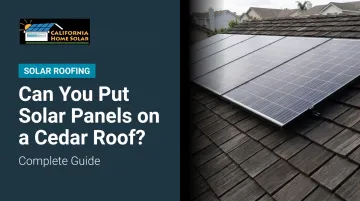
Yes — qualified contractors install solar on cedar roofs regularly where codes permit. In Southern California, though, fire code requirements are typically the deciding factor on whether a project can proceed.
The Fire Classification Problem
California's Building Code (CBC Section 1505.1) classifies roof assemblies as Class A, B, C, or unclassified based on fire-test exposure. Untreated cedar and wood shake falls into the unclassified or sub-Class C category — the lowest fire resistance rating. In wildfire-exposure areas, CBC Chapter 7A requires that wood shakes be fire-retardant-treated and listed by the State Fire Marshal under Title 19 CCR Section 208(c).
This directly affects solar permitting. Los Angeles County's Solar PV Plan Review requirements ask applicants to state the roof's fire classification, roofing material, number of layers, slope, and whether the home sits in a Very High Fire Hazard Severity Zone (VHFHSZ).
A cedar roof that doesn't meet fire-rating thresholds can stop a solar permit before installation even begins.
Specific Southern California examples:
- City of Los Angeles — Roofing Ordinance #165047 (effective August 25, 1989) restricted wood shake and shingle roofs for new construction and replacement over 10% of the roof surface. This directly affects whether a cedar roof qualifies for solar-related work.
- City of San Diego — Following the 2003 Cedar Fire, the city prohibited wood shake and shingles except as provided under the State Historical Building Code.
- Pasadena — The Fire Department identifies wood shake roofs as particularly vulnerable to fire spread in the local hazard context.
What Happens If Your Jurisdiction Prohibits It?
You're not out of options. Two paths remain:
- Re-roof with a fire-rated, solar-compatible material (asphalt composition or metal), then install solar — often the better long-term choice
- Install a ground-mounted system that doesn't touch the roof at all, provided the property has adequate open space with good sun exposure
The Lifespan Alignment Issue
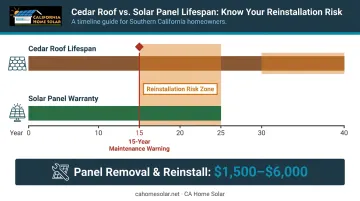
Even where codes allow rooftop cedar solar, age matters. According to the Cedar Shake & Shingle Bureau, cedar roofs have an average lifespan of approximately 30–40 years. Solar panels typically carry 25-year power warranties.
If your cedar roof is already 15+ years old, installing solar now means paying to remove and reinstall the entire system when the roof eventually fails. That removal and reinstallation typically costs $1,500–$6,000 depending on system size. Addressing the roof first avoids that cost entirely.
Prerequisites and Safety Considerations
Four prerequisites must be confirmed before installation planning begins — skipping any one of them can stop a project mid-permit or trigger unexpected costs.
1. Local Code Verification
Contact your local building department directly — or work with a licensed solar contractor — to confirm whether solar installation on a cedar or wood shake roof is permitted in your specific city or municipality. Rules vary significantly even within Los Angeles County.
2. The 25% Re-Roofing Trigger
LA County Building Code Manual 1512 A1 states that if more than 25% of the roof covering is removed or replaced within any one-year period, the entire roof must conform to new-construction requirements. In the City of Los Angeles, the threshold is even stricter — Ordinance #165047 sets it at 10%.
For cedar roofs in fire-restricted zones, triggering either threshold can mean mandatory re-roofing to a fire-rated material before solar can be approved. This is one of the most overlooked cost risks in cedar roof solar planning.
3. Roof Condition Assessment
An experienced contractor should evaluate:
- Age and remaining service life of the shakes
- Integrity of the underlayment beneath the cedar
- Presence of rot, soft spots, or water damage
- Soundness of the roof deck below
Installing solar on a failing roof guarantees a costly tear-down within a few years — evaluate condition before committing to any system design.
4. Structural Load Confirmation
LA County's prescriptive criteria allow solar installation without structural calculations when the system weighs no more than 4 pounds per square foot — the typical threshold for residential panel systems. If a gravity-load increase exceeds 5% or a lateral-force increase exceeds 10%, a structural compliance review is required. Older homes often need this assessment before permits are issued.
If any of the four prerequisites above reveals a problem, the project must pause. Do not proceed if:
- Local codes prohibit rooftop solar on cedar
- The roof shows rot, soft spots, or underlayment failure
- The roof has fewer than approximately 10 years of remaining life
- The structural load review fails
How Solar Panels Are Installed on a Cedar Roof
Cedar roof solar follows a defined sequence. The key difference from a standard asphalt installation is the extra care required to work around brittle wood shakes: pressure applied in the wrong place during any step can crack shakes and create leak points that cost far more to repair than to prevent.
Site Assessment and Mounting Point Identification
The installer locates rafter positions beneath the cedar shakes, maps panel placement for optimal sun exposure, and visually inspects every planned mounting location. Any shakes that are already cracked, soft, or lifting must be replaced before work continues — these are not cosmetic issues.
Installing Lag Bolts and Flashing
This step carries the most risk on a cedar installation — one wrong move cracks a shake. At each mounting point, the process works as follows:
- Lift the cedar shake above the target location carefully — no cracking, no forcing
- Slide metal flashing beneath the underlayment layer
- Drive a lag bolt through the flashing and roof deck into a structural rafter — LA County requires at least a 5/16-inch lag screw embedded a minimum of 2.5 inches into the rafter
- Apply roofing sealant around each penetration point for a watertight seal
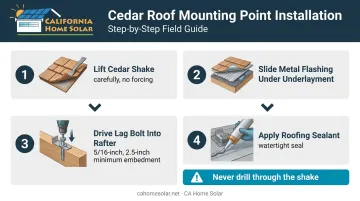
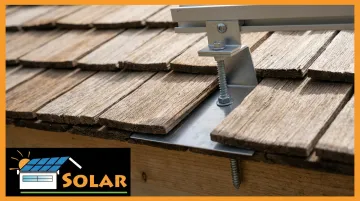
The shake is never drilled through directly. Installers use flashing hardware designed specifically for shake and slate roofs — such as IronRidge's QBase Shake & Slate Mount with EPDM rubber counter flashing — to create a weatherproof seal that places no structural reliance on the cedar shake itself.
Mounting the Racking System and Placing Panels
Once all lag bolts and flashing are secured, mounting rails attach to the bolt heads, and panels fasten to the rails. The panels connect to the structural framing of the house, not to the cedar surface. At approximately 4 psf, the panels don't place meaningful stress on the shakes themselves.
LA County's prescriptive criteria set maximum support spacing at 48 inches on center and maximum concentrated load per support at 40 pounds.
Post-Installation Validation
After panels are in place, a thorough check should confirm:
- Every mounting point is visually inspected — flashing seated correctly, sealant uniformly applied
- No shakes were cracked or displaced during installation
- Electrical output test confirms the system is generating correctly
- Attic space is inspected after the first rainfall (or via a controlled water test) for any moisture infiltration at penetration points
That final attic check is easy to skip — and when it is, minor sealing failures at penetration points can go undetected until moisture reaches structural framing and the repair bill grows considerably.
Common Cedar Roof Solar Problems and Fixes
Common Cedar Roof Solar Problems and Fixes
Two problems come up most often when solar goes onto cedar roofs — here's what causes them and how they're resolved.
Cracked or Broken Shakes During Installation
Problem: One or more shakes crack or splinter during the lifting process or while routing cables.
Likely cause: Cedar becomes increasingly brittle with age and UV exposure. Installers without wood shake experience apply too much pressure or use the wrong lifting technique.
Fix: Any cracked shake must be replaced immediately — a broken shake is an immediate leak risk, not a cosmetic issue. If widespread cracking is occurring across the installation zone, work should stop and the roof condition reassessed. The roof may require partial or full re-roofing before solar can proceed.
Water Infiltration at Mounting Points
Problem: Water appears in the attic or on interior ceilings at locations corresponding to mounting points after rain. The most common culprits are improperly seated flashing, inconsistent sealant application, or lag bolts that weren't fully driven into the rafter.
Fix: Affected mounting points must be accessed — which means temporarily removing the panels above them — to reseat the flashing and reapply sealant. A watertight inspection should follow before panels are remounted.
Pro Tips for Cedar Roof Solar
Consider re-roofing and solar as one project. If your cedar roof has 10 years or fewer of service life remaining, combining a roof replacement with solar installation is the most cost-effective path. The U.S. Department of Energy estimates that homeowners who replace their roof and add solar simultaneously can save an average of $4,000 compared to doing each project separately — because scaffolding, labor mobilization, and permitting overlap significantly.
CA Home Solar handles both roofing remodels and solar installation as a single coordinated project, which eliminates the coordination gaps that create problems when separate contractors handle each piece.
Vet your contractor specifically for wood shake experience. Ask directly whether they have completed solar installations on cedar or wood shake roofs, and request documentation or examples. A contractor who has only worked on asphalt shingles will not approach cedar lifting, flashing, and sealant application the same way.
For Southern California homeowners, CA Home Solar brings 36 years of combined solar and roofing experience across Los Angeles County — meaning both projects get assessed and executed without compatibility gaps.
Ground-mount and alternative structures are viable options. If your cedar roof is ineligible under local fire codes, other paths exist:
- Ground-mounted systems avoid the roof entirely — provided the property has open space with adequate sun exposure
- Detached garages, sheds, or carports with non-cedar roofing are also worth pricing out
- Cost note: Ground-mounted systems typically run around 51% more than rooftop solar, so budget accordingly before committing
Each option has trade-offs, but none requires compromising on your cedar roof.
Frequently Asked Questions
Can you put solar on a roof with cedar shingles?
Yes, it is technically possible where local building codes allow it. Many jurisdictions in fire-prone areas of California prohibit rooftop solar on cedar and wood shake roofs due to fire hazard classification. Verifying local code compliance is the mandatory first step before any other planning.
What happens when you have to replace your roof if you have solar panels?
Solar panels must be professionally removed before roof replacement work begins, then reinstalled once the new roof is complete. Panel removal and reinstallation typically costs $1,500–$6,000 depending on system size and location. This is one of the main financial arguments for combining a roof replacement and solar installation into a single project.
What is the 25% roofing rule for solar installations in California?
LA County's Building Code requires full compliance if more than 25% of the roof covering is removed or replaced within any one-year period; the City of Los Angeles applies a stricter 10% threshold under Ordinance #165047. On cedar roofs in fire-restricted areas, hitting either threshold can trigger a mandatory re-roof to a fire-rated material before solar is approved.
Is installing solar on a cedar roof more expensive than on asphalt shingles?
Yes, cedar installations typically cost more due to the additional labor required to carefully work around brittle shakes, the specialized flashing technique, and the extra time involved compared to a standard asphalt job. Expect to factor in extra labor costs; exact pricing depends on system size and roof condition.
Can solar panels damage a cedar shake roof?
When installed correctly — using proper flashing seated beneath the underlayment and lag bolts driven into rafters rather than shakes — solar panels should not damage a cedar roof. The primary damage risk comes from inexperienced installation, making contractor selection critical on this roof type.
What is the best alternative if my cedar roof cannot support solar panels?
Two practical options exist. Re-roofing with asphalt or metal and installing solar at the same time aligns both system lifespans and reduces total cost. Alternatively, a ground-mounted system works well if the property has open space with good sun exposure and local zoning permits it.