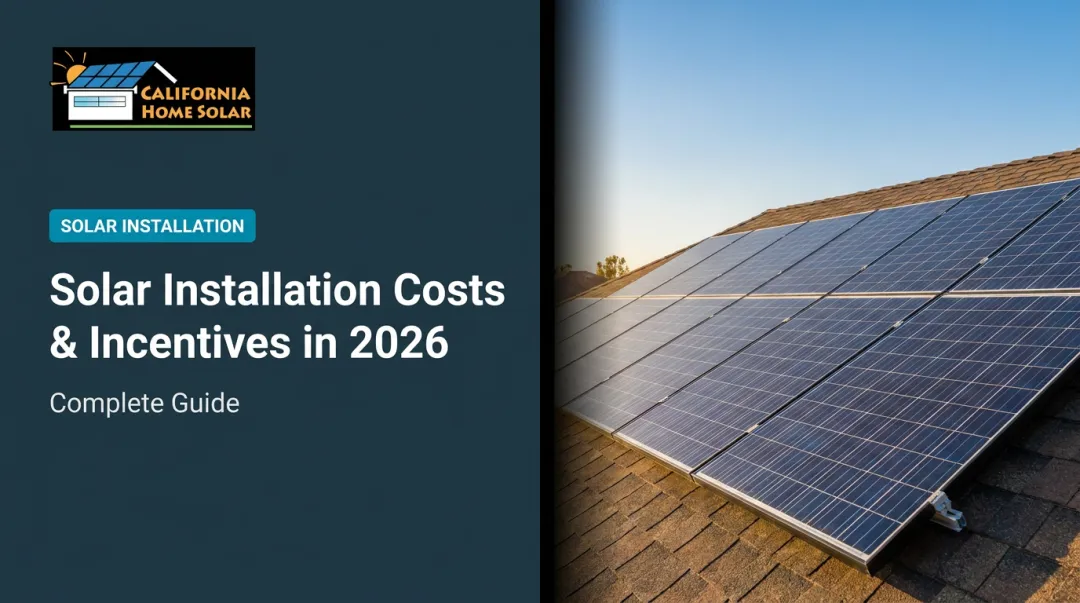
According to EnergySage's May 2026 California data, the average residential solar installation in California costs $2.53 per watt, with an average system size of 8.81 kW and a total pre-incentive cost of $22,284. That's a useful benchmark — but the final number on your quote will depend heavily on your home's energy usage, roof condition, equipment choices, and local permitting requirements.
One critical change affects 2026 buyers directly: the federal 30% Residential Clean Energy Credit expired for systems placed in service after December 31, 2025. That changes the incentive math significantly compared to prior years.
This guide walks through what you'll actually pay, what drives those costs, and how to budget without getting caught off guard.
Key Takeaways
- A typical Southern California solar installation ranges from roughly $10,000–$30,000+ before incentives, depending on system size
- System size, panel type, roof complexity, and permitting costs are the primary cost drivers
- The federal 30% solar tax credit expired after 2025; California's property tax exclusion and SGIP battery storage incentives still apply
- NEM 3.0 has lengthened payback periods; EnergySage currently estimates 7.64 years on average in California
- Low bids often mean weak warranties or poor system design — both cost more to fix over a 25-year lifespan
How Much Does Solar Panel Installation Cost in 2026?
No two homes get the same quote, even on the same street. Energy usage, roof layout, shading, equipment tier, and installer choice all create meaningful price differences.
Two budgeting mistakes trip up most California homeowners:
- Focusing only on panel price — which accounts for just ~12% of total system cost per NREL benchmark data
- Projecting savings without accounting for California's NEM 3.0 net metering changes
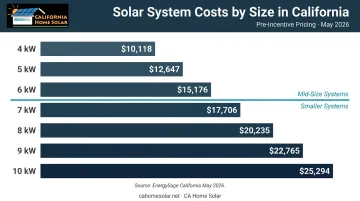
Here's how costs break down by system size, using EnergySage's verified California figures from May 2026:
Smaller Systems (4–7 kW)
California pre-incentive cost range: $10,118–$17,706
| System Size | Estimated Cost (Before Incentives) |
|---|---|
| 4 kW | $10,118 |
| 5 kW | $12,647 |
| 6 kW | $15,176 |
| 7 kW | $17,706 |
Best for:
- Smaller households with modest electricity bills
- Homes with limited usable roof space
- Homeowners targeting partial offset rather than full coverage
Mid-Size Systems (8–12 kW)
California pre-incentive cost range: $20,235–$25,294+ (verified for 8–10 kW)
| System Size | Estimated Cost (Before Incentives) |
|---|---|
| 8 kW | $20,235 |
| 9 kW | $22,765 |
| 10 kW | $25,294 |
Best for:
- Average Los Angeles-area households with central air conditioning
- Homes aiming to offset the majority of their electricity bill, including summer AC loads
- Most Southern California homeowners will land in this tier
Larger Systems (13 kW+)
National EnergySage data shows $2.50/W at 13 kW, putting pre-incentive costs around $32,500+. California pricing at this size varies — get installer quotes to confirm your local number.
Best for:
- High-consumption homes with elevated year-round usage
- Properties in hotter inland areas like the Antelope Valley or San Gabriel Valley
- Homeowners adding EV charging or pairing solar with battery storage
These ranges give you a baseline — but the right system size depends on your actual usage and roof conditions. The next step is understanding how incentives bring these numbers down.
Key Factors That Affect Your Solar Installation Cost
Solar quotes vary widely — and the gap between a $18,000 system and a $32,000 system usually comes down to five variables. Understanding each one helps you evaluate proposals accurately and spec a system that actually fits your home.
System Size and Your Energy Usage
More kilowatts = more cost — but larger systems benefit from economies of scale. National EnergySage data shows the cost-per-watt drops from $2.86/W at 4 kW to $2.44/W at 15 kW, so going slightly larger often makes financial sense if your roof allows it.
The right sizing method: pull 12 months of utility bills and calculate your average monthly kWh usage. Southern California homes with central AC typically run 800–1,500 kWh per month in summer — that consumption profile usually points toward a 9–12 kW system.
Panel Type and Equipment Quality
Three main panel types exist, but for most Southern California homeowners the choice is clear:
- Monocrystalline — 20–23% efficiency, the residential standard; dominates new installations
- Polycrystalline — 15–17% efficiency, largely phased out of new residential projects
- Thin-film — 11–16% efficiency, primarily used for commercial or portable applications
CA Home Solar primarily installs monocrystalline technology, including advanced mono PERC panels that deliver higher energy yields per square foot.
Inverter selection adds another layer to the cost equation:
- String inverters: most affordable upfront, but output drops if any single panel is shaded
- Microinverters: higher upfront cost with 25-year warranties on many models — the better fit for complex or partially shaded LA rooftops
- Power optimizers: mid-range cost, panel-level optimization without full microinverter expense
For homes with multiple roof planes or partial shading from trees or neighboring structures — common throughout Los Angeles — microinverters or power optimizers generally outperform string inverters over time.
Roof Characteristics
Roof condition and type directly affect both installation complexity and labor cost:
- Clay tile roofs (very common in Southern California) require specialized mounting hardware and more labor time
- Steep pitch or multiple roof planes increase installation complexity
- Roofs older than 10–15 years may need replacement before installation — doing it after panels are installed costs significantly more in removal and reinstallation fees
- Significant shading from trees or adjacent structures may require additional equipment or trimming
CA Home Solar handles roof assessment and replacement as part of bundled solar-roofing projects, which can avoid costly scheduling gaps between contractors.
Location and Local Permitting
Permit and interconnection costs vary across LA County cities and typically add 3–8% to total project cost — that's $600–$2,000+ on a mid-size system. Some municipalities process permits faster and cheaper than others.
Those permitting costs look different once you factor in what you're offsetting. LADWP's standard residential rates reach $0.389/kWh at higher tiers in summer 2026, while SCE's TOU plans show summer on-peak rates up to $0.74/kWh — among the highest in the country. Higher utility rates mean faster payback, which changes how you should think about every dollar of upfront cost.
Solar Installation Cost Breakdown: Where Your Money Goes
The panel price you see advertised is a fraction of what you'll actually pay. Here's how total installed cost breaks down using NREL's Q1 2024 residential benchmark for an 8 kW system at $3.25/W:
Equipment Costs (One-Time)
| Component | Cost per Watt | Share of Total |
|---|---|---|
| Solar panels | $0.40/W | ~12% |
| Inverter(s) | $0.37/W | ~11% |
| Racking, wiring, BOS | $0.62/W | ~19% |
| Equipment subtotal | $1.39/W | ~43% |
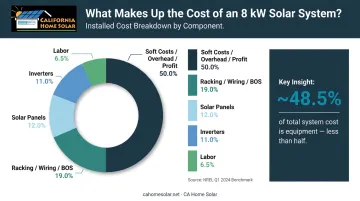
Equipment is less than half the bill. The rest goes to installation, permitting, and contractor overhead.
Installation, Labor, and Permitting (One-Time)
- Labor: approximately 6.5% of total cost
- Permitting and interconnection: included in soft costs; fees vary by city and utility
- Electrical panel upgrade: $1,363–$2,272 on average in Los Angeles (Angi 2026 data), with 400-amp upgrades running $2,360–$4,720 — common in older Southern California homes
Installer Overhead and Profit (One-Time)
Soft costs — including sales, customer acquisition, engineering, overhead, and profit — account for roughly 50% of total installed cost per NREL data. Installer selection matters here: a contractor with lower overhead can quote meaningfully less than a national sales-heavy operation without sacrificing installation quality.
CA Home Solar has operated across Southern California for 36 years and is recognized as a Top 500 Solar Contractor by Solar Power World — credentials that reflect operational depth, not just advertising reach.
Ongoing Maintenance Costs (Recurring)
Solar systems are low-maintenance, but not zero-maintenance:
- Panel cleaning: $150–$350 per service (EnergySage 2025 data); recommended twice yearly, more often near dusty inland areas
- String inverter replacement: typically every 10–15 years; microinverters often carry 25-year warranties
- Monitoring: most modern systems include free monitoring apps
Professional cleaning services typically include a performance inspection — useful for catching degradation issues before they affect your annual output.
Solar Incentives and Financing Options in 2026
Federal Tax Credit: What Changed
The 30% federal Residential Clean Energy Credit (Section 25D) is not available for systems placed in service after December 31, 2025, per IRS guidance and Public Law 119-21. If you purchased and installed a system in 2025 or earlier, unused credit may carry forward — but new 2026 installations do not qualify for this credit. Consult a tax professional to confirm your specific situation.
California-Specific Incentives
Despite the federal credit expiration, several state-level programs remain active:
- Active Solar Energy System Exclusion keeps solar additions off your assessed property value, preventing a property tax increase; set to sunset January 1, 2027
- SGIP (Self-Generation Incentive Program) covers battery storage at eligible properties; residential rates vary by step and utility, so check current availability with CPUC or your utility directly, as steps open and close frequently
- LADWP and SCE cash rebates for homeowner-owned PV were not verified as currently active — SGIP remains the primary storage incentive pathway
NEM 3.0 and Payback Periods
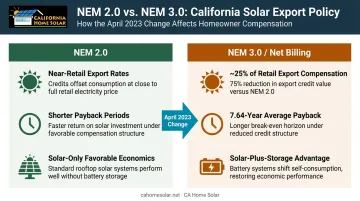
California's Net Billing Tariff (NEM 3.0) changed the economics for anyone who applied for interconnection after April 14, 2023. Export compensation dropped to roughly 25% of retail rates on average, compared to near-retail compensation under NEM 2.0. EnergySage estimates this reduced net metering credit value by about 75%.
That drop translates directly to longer payback periods. EnergySage currently shows California's average payback at 7.64 years, though solar-plus-storage systems often outperform solar-only under NEM 3.0 by capturing more energy value on-site.
Financing Options
| Option | Upfront Cost | Long-Term Savings | Ownership |
|---|---|---|---|
| Cash purchase | High | Highest | Yes |
| Solar loan | Low/none | High | Yes |
| Solar lease / PPA | None | Lower | No |
| HERO / PACE financing | None | Moderate | Yes |
For homeowners who want full system ownership without a large upfront payment, HERO/PACE financing is worth a close look. California Home Solar is a HERO Registered Contractor, so Southern California homeowners can finance solar and other energy improvements through their property taxes. Approval is based primarily on home equity rather than credit score, with repayment spread over 5–25 years.
How to Budget Smart — and What Most Homeowners Get Wrong
Most homeowners focus on the installation quote — but the real budget mistakes happen before and after that number.
Saving $2,000 upfront on a cheaper system with lower-efficiency panels or a weaker warranty can easily cost $5,000+ in lost production over 20 years. Factor in the full 25-year cost of ownership, not just the installation invoice.
Hidden Adjacent Costs
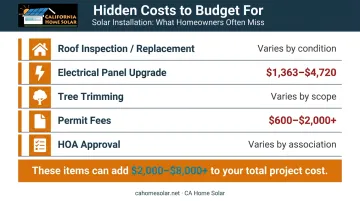
Ask every installer for a full scope-of-work estimate that explicitly covers:
- Roof inspection and any repairs or replacement needed
- Electrical panel upgrade (especially relevant for homes built before 1990)
- Tree trimming for shading mitigation
- Permit fees by jurisdiction
- Any HOA approval requirements
These items regularly add $2,000–$8,000+ to a project's real budget and are frequently omitted from initial quotes.
Get a Proper Site Assessment
Online calculators give ballpark estimates. A licensed installer doing an in-home assessment gives you accurate numbers — accounting for your specific roof orientation, shading patterns, utility rate structure, and energy usage profile.
CA Home Solar provides free in-home consultations for Southern California homeowners, covering system sizing, roof condition, and equipment recommendations. With 36 years of experience across Los Angeles and Orange County, the team handles the full project scope from permitting through interconnection.
Frequently Asked Questions
How much does it cost to install a solar system for a 2,000 sq ft house?
A 2,000 sq ft home typically needs a 7–9 kW system, though actual sizing depends on your energy usage and location — not square footage. Based on California EnergySage data, expect a pre-incentive range of roughly $17,706–$22,765. Your electricity bills are a far more reliable sizing guide than floor area.
Is the 30% solar tax credit going away in 2026?
It already has. The federal Residential Clean Energy Credit expired for systems placed in service after December 31, 2025, per IRS guidance. Unused credits from prior eligible years may carry forward. Consult a tax professional before making assumptions about your tax liability.
Can solar panels run my air conditioning?
Yes, and in Southern California that's often the primary driver for going solar. A correctly sized system can offset or eliminate the bulk of summer AC costs. Homes with central AC typically need larger systems (9–12 kW+) to account for peak summer consumption.
How long does it take for solar panels to pay for themselves in Southern California?
EnergySage currently estimates 7.64 years average payback in California as of May 2026, though NEM 3.0 has pushed some solar-only estimates toward 8–10 years. Battery storage adds upfront cost but can improve overall financial returns under NEM 3.0's lower export compensation rates.
Do I need to replace my roof before installing solar panels?
If your roof is within 5–10 years of needing replacement, replace it first. Removing and reinstalling panels for a later roof replacement adds $1,500–$4,000+ in labor costs. CA Home Solar can bundle both into a single project, reducing permitting steps and overall labor.
How do I know what size solar system I need?
Review 12 months of electricity bills and calculate your average monthly kWh. Factor in any planned additions (EV, pool equipment, battery storage), then have a licensed installer conduct a site assessment covering roof orientation, shading, and your utility rate plan.