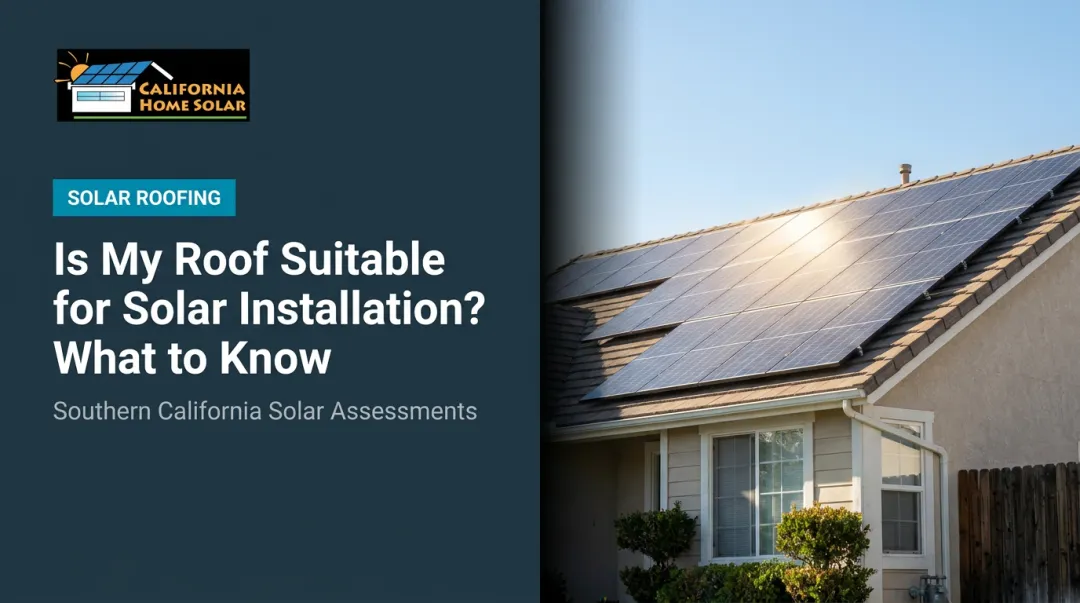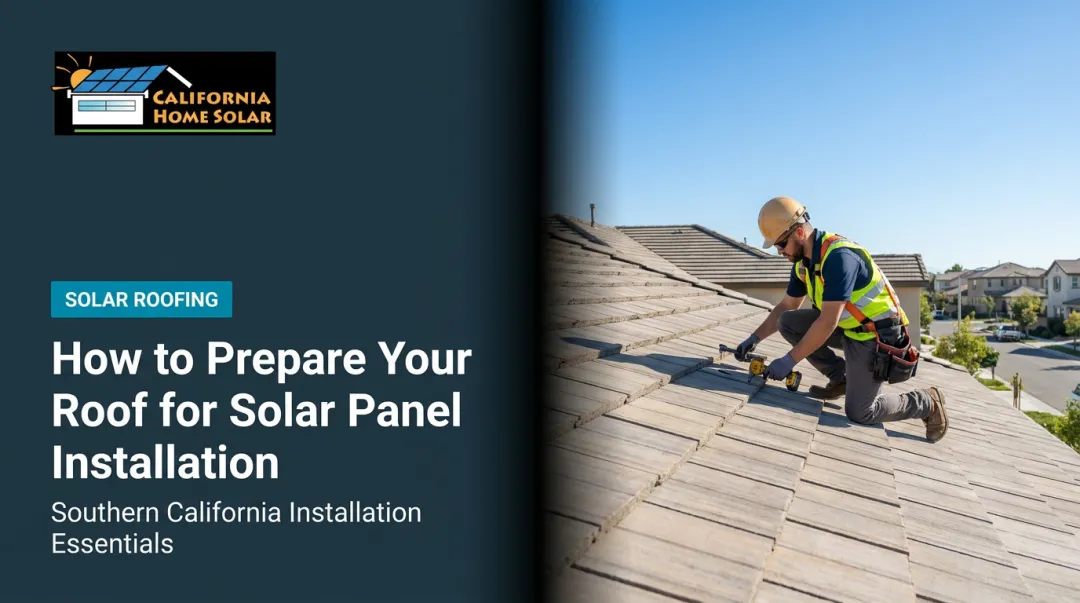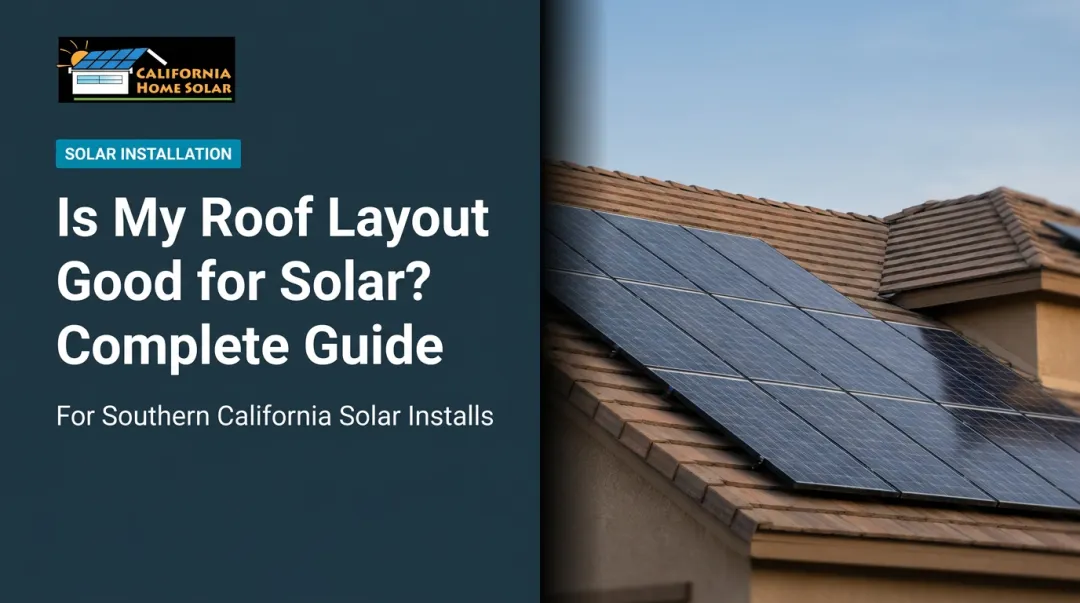
Roof condition affects far more than just the installation itself. It shapes total project cost, system longevity, and your ability to avoid expensive do-overs when the roof eventually needs replacement. Before any panel gets mounted, a thorough roof evaluation is the non-negotiable first step.
This guide covers what solar installers look for during a roof assessment, how roof age and material type affect your options, what structural requirements California jurisdictions enforce, and when replacing your roof first is actually the financially smarter move.
Key Takeaways
- Roofs with fewer than 10 years of remaining useful life should typically be replaced before solar installation
- Roof type directly affects mounting hardware, installation complexity, and cost (tile roofs, for example, require specialized brackets)
- Most Southern California jurisdictions require permits and structural review for most solar installations
- South-facing roofs at roughly 34 degrees pitch capture the most sunlight at Los Angeles's latitude
- Combining roof replacement with solar installation avoids redundant labor costs and future panel removal fees
Why Roof Condition Is the First Thing Solar Installers Evaluate
The roof is the foundation of your solar investment. Any weakness there becomes a weakness in the system above it — structurally, financially, and legally.
What a Pre-Installation Assessment Covers
A proper roof evaluation before solar installation checks for:
- Soft spots, cracked or cupped shingles, and excessive granule loss
- Compromised flashing and evidence of internal leaks
- Underlayment condition (especially on tile roofs)
- Estimated remaining roof lifespan relative to the solar system's 25+ year expected life
- Whether the structure meets load requirements under local code
The SEIA 251 draft standard explicitly states that a rooftop solar system should not be installed unless the underlying roof covering has at least 10 years of remaining useful life — and requires a site-specific estimate for future removal and reinstallation costs when reroofing is anticipated within that window.
The Cost of Skipping This Step
Installing panels on a deteriorating roof creates a predictable and expensive problem. When the roof eventually fails, the solar panels must be carefully removed, the roof replaced, and the panels reinstalled — all at the homeowner's expense unless covered under warranty. Depending on system size, remove-and-reinstall alone can run $1,500–$6,000, wiping out a year or more of energy savings before the new roof even pays off.
In Southern California, roofs also face compounding stress: prolonged UV exposure, temperature cycling between hot days and cooler nights, and periodic seismic activity. These factors can accelerate deterioration in ways that aren't visible from street level, which is why a hands-on roof assessment matters more than a visual scan.
Contractors who handle both roofing and solar under one roof are better positioned to catch these issues early, before they surface mid-installation or post-permit. CA Home Solar has managed both scopes for 36 years across the LA area, which means roof problems get flagged and addressed before they become the homeowner's problem.
Roof Age and Solar Panels: The Timeline That Matters
Solar panels are designed to operate for 25 years or more, degrading at roughly 0.5% per year in output according to NREL's PVWatts modeling. The math becomes a problem when you're installing on a roof that only has a fraction of that lifespan left.
The 10-Year Rule
The industry's most widely cited threshold: if your roof has 10 or fewer years of remaining useful life, most experienced installers will flag it for replacement before proceeding with solar. The concern is practical: a roof that fails mid-system forces panel removal, re-roofing, and reinstallation — costs that can easily exceed the original installation price.
Roof material lifespans vary, but general ranges give context:
| Roof Material | Typical Lifespan |
|---|---|
| Asphalt/Composition Shingles | 20–30 years |
| Clay or Concrete Tile | 40–50+ years |
| Metal | 40–70 years |
| Flat/Low-Slope Membrane | 15–25 years |
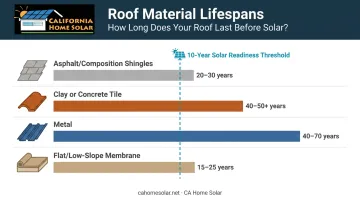
A 22-year-old asphalt roof and a 22-year-old tile roof represent very different solar readiness situations — even if they were installed the same year.
That age context also shapes what comes next: when replacement is already necessary, the timing becomes an opportunity.
The Timing Opportunity
When a roof replacement is already on the table, coordinating it with solar under a single contractor avoids redundant mobilization costs, keeps scheduling straightforward, and ensures the new roof is properly flashed and sealed around all mounting hardware from day one.
CA Home Solar handles both scopes as a single coordinated project. With 36 years of combined roofing and solar experience in Southern California, the company eliminates the handoff problems that come with managing two separate contractors.
Roof Type Compatibility: Which Roofs Work Best for Solar
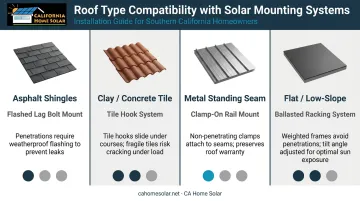
Not all roofing materials accept solar mounting systems the same way. The type of roof directly affects hardware selection, installation method, and total project cost.
| Roof Type | Mounting Method | Key Consideration |
|---|---|---|
| Asphalt Shingles | Lag-bolt and flashing | Simplest install; most common baseline |
| Clay / Concrete Tile | Tile hook brackets | Requires tile-specific installer experience |
| Metal (Standing Seam) | Clamp-based, no penetrations | Most solar-friendly; long-lasting |
| Flat / Low-Slope | Ballasted or mechanically attached | Drainage planning is critical |
Asphalt Shingles
The most common residential roof type in California — accounting for roughly 58.7% of statewide residential roofs according to California Energy Commission survey data — and the easiest roof type to work with for solar. Standard lag-bolt and flashing systems are designed with asphalt shingles as the baseline.
Clay and Concrete Tile
Very common across Southern California. Tile roofs require specialized mounting brackets that hook under tiles without drilling through them — hardware like adjustable tile hooks that accommodate both curved and flat tile profiles. Improper installation can crack tiles and cause leaks. Installer experience with tile specifically is non-negotiable — an inexperienced crew risks cracked tiles and water intrusion that show up months later.
Metal Roofs
Among the most solar-friendly options. Clamp-based mounting systems attach directly to standing seams without any roof penetrations at all — the clamps dimple the seam material slightly but don't pierce it. Metal roofs also tend to outlast the solar system itself.
Flat and Low-Slope Roofs
Flat roofs typically use ballasted racking systems — weighted mounts that don't penetrate the membrane — or mechanically attached systems where code requires it. Plan drainage around the array carefully; poorly designed flat-roof installations can trap water and accelerate membrane wear.
Structural Load: Can Your Roof Support Solar Panel Weight?
California jurisdictions have specific structural thresholds that determine whether a solar installation requires a full structural review or qualifies for expedited permitting.
What Los Angeles Jurisdictions Require
Both the City of Los Angeles (LADBS) and LA County use a 4 psf (pounds per square foot) threshold as a key screening criterion:
- City of LA (LADBS): A building permit is required for all solar structural support. A streamlined exemption applies only if the roof is structurally sound with one roofing layer, the array covers no more than half the total roof area, and PV modules plus supports are ≤ 4 psf with concentrated loads ≤ 60 lbs
- LA County: Similar simplified criteria apply, but the concentrated load limit is ≤ 40 lbs, and structural calculations are required if the design increases gravity load by more than 5% or lateral force by more than 10%
Systems that exceed these thresholds — or roofs with aging or non-standard framing — require stamped structural engineering calculations before a permit is issued.
How This Fits Into the Installation Process
CA Home Solar includes permitting as a standard part of every project, with a dedicated project manager coordinating each phase:
CA Home Solar includes permitting as a standard part of every project, with a dedicated project manager coordinating each phase:
- Site survey and structural assessment
- Structural and electrical design
- Permit submission and approval
- Installation and final inspection
- Permission to operate
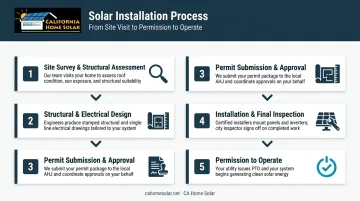
When structural calculations are needed, they're addressed during the design phase — before installation begins, not after.
Roof Orientation, Pitch, and Shading: Factors That Impact Solar Performance
Optimal Orientation and Tilt for LA
NREL's PVWatts tool sets the default fixed-array tilt equal to site latitude and default azimuth to 180 degrees (true south). For Los Angeles at approximately 34 degrees north latitude, that means a south-facing roof at roughly a 34-degree pitch captures the most direct sunlight year-round.
East- and west-facing roofs can still support productive solar systems. East- and west-facing roofs can still support productive solar systems. The design simply needs to account for reduced peak-hour exposure — typically through additional panels or adjusted string configurations. Actual output differences vary based on your specific roof plane, local horizon obstructions, and seasonal shading patterns, which is why site-specific modeling matters before finalizing any system design.
Managing Shading
Once orientation is dialed in, shading becomes the next critical variable — and one of the most underestimated. Even partial shade on a single panel can reduce output across an entire string. Sources of shading to evaluate:
- Nearby trees or vegetation (which grow over time)
- Chimneys, roof vents, and HVAC equipment
- Neighboring structures and fencing
- Seasonal sun angle changes — winter sun sits lower in the sky, causing shadows to fall differently than in summer
A shading analysis should cover all seasons, not just summer peak hours. The CEC requires solar assessment tools to verify shading conditions under Joint Appendix JA11.4.
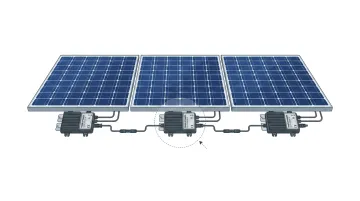
Where shading is unavoidable, microinverters (which allow each panel to operate independently) or power optimizers (which mitigate mismatch losses at the panel level) can meaningfully reduce the performance impact.
When (and Why) to Replace Your Roof Before Installing Solar
The Decision Framework
If your roof has fewer than 5–10 years of remaining life, replacing it before installing solar is almost always the better financial decision. Mid-system reroofing requires pulling panels off, doing the roof work, and reinstalling everything — and those costs compound quickly:
- Panel and hardware removal (and potential damage)
- Any recertification required after reinstallation
- Lost power production during the work
- A second contractor mobilization on top of the first
The SEIA 251 draft standard backs this up by requiring installers to provide homeowners with a site-specific estimate for future removal and reinstallation when reroofing is anticipated. That mandatory disclosure is worth taking seriously before you commit to an installation on a roof that's already aging.
The Bundling Advantage
When roof replacement and solar installation are planned together:
- The new roof is flashed and sealed around mounting hardware from day one
- Labor mobilization happens once, not twice
- There's no risk of warranty conflicts between separate roofing and solar contractors
- Financing can cover both scopes under a single arrangement
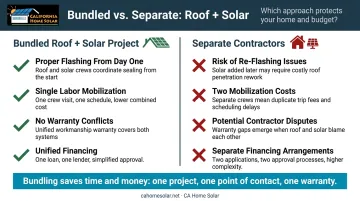
For Southern California homeowners, CA Home Solar manages both the roofing and solar installation under one contract, so there's no handoff between separate crews and no scheduling gap between the two jobs. The combined project also qualifies for financing through HERO, which covers solar PV and qualifying roofing upgrades with terms of 5–25 years, zero upfront costs, and repayment billed through property taxes.
Frequently Asked Questions
What are the percentage rules (25%, 50%) that affect roofing before solar in LA?
In LA County, replacing more than 25% of an existing roof triggers full new-installation requirements for that area. Replacing more than 50% triggers broader energy code compliance. These are reroof/repair thresholds — not solar-specific eligibility rules — but they can affect the scope and cost of any roof work done before or alongside solar installation.
How old is too old for a roof to get solar panels?
Most installers flag roofs with fewer than 10 years of remaining useful life as candidates for replacement first. The specific threshold depends on roof material and current condition — a tile roof at 30 years may have decades left, while a 20-year-old asphalt roof Most installers flag roofs with fewer than 10 years of remaining useful life as candidates for replacement first. The specific threshold depends on roof material and current condition — a tile roof at 30 years may have decades left, while a 20-year-old asphalt roof may not.
Does installing solar panels void my roof warranty?
A properly permitted and professionally installed solar system typically does not void a roof warranty. Manufacturers like GAF and Owens Corning have specific programs for solar installations on warranted roofs, which require pre-installation inspections, approved flashing details, and post-installation reviews.
Can solar panels be installed on a tile roof?
Yes — tile roofs are common across Southern California and can support solar panels. They require specialized mounting hardware, such as adjustable tile hooks designed for curved or flat tile profiles, and experienced installers who know how to work around tile without cracking it.
Should I replace my roof before installing solar panels?
Replace the roof first if it has less than roughly 5–10 years of remaining life. Removing and reinstalling panels for a future roof replacement is expensive and avoidable with proper timing. If replacement is needed, bundling it with solar installation is the most cost-efficient approach.
How do I know if my roof can handle the weight of solar panels?
A pre-installation structural assessment — conducted as part of California's permitting process — evaluates whether the existing framing can support the added load. In LA and LA County, installations that stay within the 4 psf and concentrated-load thresholds qualify for streamlined review. A reputable installer will flag any structural concerns during the design phase, before permitting begins.