Solar roof loading determines whether your system is safe, code-compliant, and built to last the full 25–30 year lifespan of the equipment. For Southern California homeowners specifically, this question carries more weight than in most U.S. regions. Tile roofs are everywhere from Pasadena to Malibu. Santa Ana wind corridors create uplift conditions that bare shingles never face. And a significant portion of LA County's housing stock predates modern building codes.
This guide breaks down what solar roof loading actually means, how dead and live loads interact, what structural capacity looks like for SoCal homes, and what happens during a proper pre-installation assessment.
Key Takeaways
- Solar installations typically add 2–4 PSF of permanent (dead) load to a roof structure
- Dead load and live load must both be calculated — they don't work independently
- California's Solar Permitting Guidebook sets baseline dead load at 20 PSF for tile roofs and 10 PSF for non-tile assemblies
- Structural screening is built into the California permitting process — non-qualifying systems require stamped engineering drawings
- Get a pre-installation assessment from a local installer to confirm your roof's actual load capacity
What Is Solar Roof Loading?
Solar roof loading is the cumulative structural demand (expressed in pounds per square foot, or PSF) that a photovoltaic system places on a roof's load-bearing structure, including rafters, trusses, and decking.
The load isn't just the panels themselves. It's the entire permanent system:
- Solar panels (approximately 42–51 lbs each, depending on module size)
- Aluminum mounting rails
- L-feet, lag bolts, and racking hardware
- Associated electrical conduit
Once installed, this becomes a fixed, constant addition to your roof's structural demand. Engineers and installers calculate it before any hardware is ordered, treating it as a design parameter from the start.
How Solar Load Transfers Through the Roof
The path works like this: panel → rail → mounting bracket → rafter. Stainless steel or aluminum L-feet bolt directly into structural rafters, rails attach to those feet, and panels clamp to the rails.
The load bypasses roof sheathing and shingles entirely — those aren't the structural elements bearing the weight.
This creates two distinct load types at the roof level:
- Distributed load — weight spread across the roof surface, typically 2–4 PSF for a complete PV system
- Point load — concentrated force at each individual mounting bracket
Point loads matter as much as distributed loads. Fewer mounting points can mean higher force concentration at each remaining bracket, increasing stress on individual rafters. Per IronRidge's design documentation, staggering attachment points across rafters can reduce the point load on any single member — which is why racking layout is an engineering decision, not just an aesthetic one.
Dead Load vs. Live Load: The Core Distinction
Two fundamental categories govern roof capacity calculations, and solar installation changes the balance between them.
What Is Dead Load in a Solar Context?
Dead load is the permanent, constant weight on a roof structure. Before solar, this includes the roofing material itself, structural decking, and framing. After solar, the entire PV array joins that permanent category.
Roofing material weights vary significantly, which matters because they set the baseline before any solar is added:
| Roofing Material | PSF (Approximate) |
|---|---|
| Asphalt shingles | 2 PSF |
| Wood shingles | 3 PSF |
| Lightweight clay tile | 6 PSF |
| Concrete roof tile | 12 PSF |
| Spanish clay tile | 19 PSF |
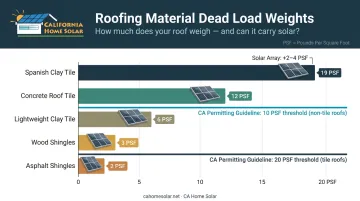
Source: Building material weight reference table
The California Solar Permitting Guidebook uses 10 PSF as the assumed assembly weight for non-tile roofs (asphalt or wood shingle) and 20 PSF for clay or cement tile assemblies. Those are the structural screening benchmarks — the starting point before the solar system's 2–4 PSF is added on top.
What Is Live Load and Why Does It Matter in Southern California?
Live load is any temporary, variable force on the roof. In most of the U.S., snow accumulation is the primary live load concern. In Southern California, the relevant forces are different: wind uplift in coastal areas, inland wind corridors, and communities subject to Santa Ana conditions (Malibu, Palos Verdes, Antelope Valley), plus the occasional load from maintenance personnel accessing the roof.
Wind uplift is a dual-direction concern. A mounted solar array can act as a sail, creating upward lift forces at attachment points that the racking and roof connection must resist. IronRidge's engineering documentation identifies three distinct force vectors at each attachment:
- Downforce — compression pushing into the roof
- Uplift — tension pulling away from the roof
- Lateral force — load running parallel to the roof slope
All three require design consideration, particularly in SoCal's wind-exposed communities.
California's permitting framework evaluates post-installation live load capacity as part of the structural screening criteria. Adding solar's dead load directly reduces the remaining capacity available for live loads — which is why a structural assessment before installation isn't optional.
Weight Limits and Structural Capacity for Southern California Homes
Two factors — roofing material type and home age — drive most structural capacity assessments for Southern California solar installations. Both vary significantly across the region's housing stock, from 1920s Craftsmans to 1990s tract homes.
Roofing Material Type and Baseline Capacity
The tile-vs-non-tile distinction is the most consequential split for Southern California solar assessments — more so than home age alone.
Clay and concrete tile are common throughout Los Angeles County, Pasadena, and San Gabriel Valley neighborhoods. These materials are heavy — the California Permitting Guidebook's 20 PSF assembly assumption reflects that. Tile roofs typically include additional structural framing to carry that weight, which means they often have meaningful reserve capacity for solar.
That reserve capacity must be verified through inspection, not assumed. Framing quality, age, and condition vary enough that no two tile roofs carry the same actual margin.
Asphalt shingle roofs, common in the San Fernando Valley and older Hollywood-area homes, start from a lower 10 PSF baseline. The structural over-engineering present with tile framing may not exist, making rafter condition and span the variables that determine capacity.
Home Age and Structural Integrity
Homes built after California unified its building standards (post-1978, with meaningful improvements through the 1980s and 1990s) are designed to exceed minimum load requirements. Most can support solar's additional 2–4 PSF without reinforcement.
Older homes — common in Sherman Oaks, Glendale, Burbank, and Pasadena — require closer inspection for several reasons:
- Lumber dimensions: A nominal 2×4 has actual dimensions of 1.5 × 3.5 inches after drying and finishing. Older framing practices varied, and actual member capacity depends on species, grade, and condition — not just era.
- Water damage and dry rot: Marine layer moisture in coastal SoCal communities can compromise framing integrity over decades. A roof that appears structurally sound from the exterior may have compromised members underneath.
- Prior overlay layers: California's permitting guidebook specifically requires that attachment fasteners account for multiple roofing layers to achieve required embedment into solid wood. Multiple overlays can reduce effective fastener depth and structural connection.
This is why attic access and visual framing inspection are non-negotiable parts of any reputable pre-installation assessment.
How Solar Roof Loading Is Assessed Before Installation
Pre-installation structural assessment is both a code requirement and a practical safeguard. Permits require load calculations — and those calculations protect you.
What the Assessment Actually Evaluates
A qualified solar contractor or structural engineer examines several specific elements:
- Deck thickness and condition — sheathing must be intact and of adequate thickness for fastener embedment
- Rafter span and spacing — typically 16 or 24 inches on center; span tables in the California guidebook determine the allowable loads for each configuration
- Prior roof overlay layers — multiple layers affect fastener depth and available embedment
- Framing integrity — visual attic inspection to identify water damage, dry rot, or prior structural modifications
- Current dead load calculation — existing roofing material weight plus structural assembly
- Projected dead load after solar — adding the 2–4 PSF system weight to the existing baseline
- Resulting live load headroom — confirming adequate capacity remains for wind and maintenance loads
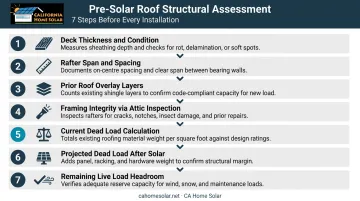
If all structural screening criteria are met, California's guidebook allows qualifying systems to proceed without additional calculations. Systems that don't meet the checklist criteria require stamped drawings from a California-licensed civil or structural engineer. This isn't universal for every permit — it's conditional on what the screening reveals.
When structural design is required, CA Home Solar handles it as part of the installation scope — from site survey and permitting through final inspection and permission to operate, with a project manager coordinating each stage. For Southern California homeowners from Long Beach to Santa Clarita, that means load assessments tied to each property's actual construction, not generic estimates.
What Happens When a Roof Exceeds Safe Load Limits
When load calculations show inadequate structural capacity, the solar permit won't be issued until deficiencies are addressed. This isn't a bureaucratic hurdle — it's the system working as intended.
Remediation Options
Homeowners facing structural concerns have several paths forward:
- Sister the rafters — attach new lumber alongside existing rafters to increase load capacity at specific spans
- Replace the roof deck — necessary when sheathing is deteriorated or insufficiently thick
- Reduce panel count — fewer panels means less added dead load; the system produces less power but can meet structural limits
- Ground-mounted solar — for properties where the roof is genuinely unsuitable, a ground-mount eliminates roof loading concerns entirely
Structural remediation is the exception, not a common outcome. Most Southern California homes built after California standardized its building codes can support a typical residential PV system without additional structural work.
For homeowners who do need roof repairs before installation can proceed, CA Home Solar handles roofing remodeling alongside solar installation. Financing through the HERO program can bundle both the roofing work and the solar system into a single project — keeping everything under one contractor instead of coordinating two separate jobs.
Common Misconceptions About Solar Roof Loading
A few persistent beliefs about solar weight and structural risk tend to surface in homeowner conversations. Each one contains a grain of logic — which is exactly what makes them worth addressing directly.
"Solar panels are too heavy for my older LA home"
Modern residential installations add 2–4 PSF — a modest load by structural standards. The real concern with older homes isn't panel weight; it's the condition of the framing. An older home with intact, dry framing often supports solar without issue. A structural inspection clarifies whether reinforcement is needed before any equipment goes on the roof.
"If my roof survived the last windstorm, it can handle solar"
Wind on a bare roof and wind on a mounted array are not the same problem. IronRidge's engineering documentation identifies uplift, lateral, and downforce reactions at each attachment point — force vectors that simply didn't exist before installation. Past storm survival tells you nothing about how those new loads will behave.
"Fewer mounting brackets means less roof damage — use as few as possible"
This logic backfires structurally. Reducing attachment points does lower the number of roof penetrations, but it concentrates load at each remaining bracket. Per Unirac's engineering guidance, point load at each attachment equals tributary area multiplied by calculated roof pressure — so fewer points means higher individual forces, not lower risk.
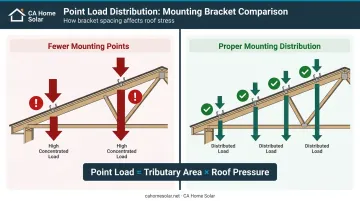
Proper installation finds the right balance: enough attachment points to distribute load safely, each one properly flashed and sealed to protect the roof below.
Frequently Asked Questions
Can most Southern California homes support the weight of solar panels without reinforcement?
Most homes built after California standardized its building codes can support the 2–4 PSF addition from a solar installation without structural reinforcement. The structural screening built into California's permitting process confirms this for each specific property — tile roofs and older construction require closer evaluation.
What is the difference between dead load and live load for solar?
Dead load is the permanent, constant weight of the solar system once installed. Live load covers temporary forces — primarily wind uplift and maintenance personnel in Southern California. California's permitting framework requires that adequate live load capacity remain after the solar dead load is added.
How much does a full solar panel system weigh per square foot?
Modern residential solar installations typically add 2–4 PSF in distributed load. Individual panels weigh approximately 42–51 lbs each (roughly 19–23 kg) but are spread across 17–21 square feet of roof area through the racking system, keeping the per-square-foot load modest.
Do clay or concrete tile roofs in California require special consideration for solar?
Yes. Tile roofs carry a higher baseline dead load (California's guidebook assumes 20 PSF for tile assemblies vs. 10 PSF for non-tile). Installers must confirm rafter integrity and use tile-compatible mounting hardware to avoid cracking tiles during the installation process.
Will adding solar panels void my roof warranty?
A properly permitted installation using industry-standard flashing and mounting techniques typically does not void a roof warranty. CertainTeed confirms penetrations don't void their asphalt shingle warranty; GAF allows solar on guaranteed systems subject to specific installation requirements — confirm details with your roofing manufacturer and installer.
Do I need a structural engineer, or will my solar installer handle the load assessment?
Reputable solar installers include structural load calculations as part of their permitting process. Systems that pass California's structural screening checklist require no additional calculations. For non-qualifying systems, stamped drawings from a California-licensed civil or structural engineer are required — that review is built into any code-compliant installation.