The stakes are higher than most homeowners realize. Roof work with panels in place isn't an option — they have to come off first. That means paying for professional removal, storage, and reinstallation on top of whatever the roof replacement costs.
This guide covers three things: when to replace your roof before going solar, the warning signs that indicate your roof needs attention, and what the removal and reinstall process actually looks like — including what it costs.
Key Takeaways
- If your roof is more than 10 years old, get it inspected before signing any solar contract
- Solar panels actually protect the shingles beneath them by reducing heat and UV exposure
- Any roof work under your panels requires full panel removal by a qualified solar technician, not a general roofer or handyman
- Expect to pay $200–$300 per panel for removal and reinstallation — total costs typically range from $1,500 to $7,000+
Should You Replace Your Roof Before Installing Solar Panels?
Timing is everything here. Solar panels carry 25-year warranties and can produce power for 30+ years. If your roof is already 12 years old when you install panels, you'll need a roof replacement before those panels reach the end of their useful life.
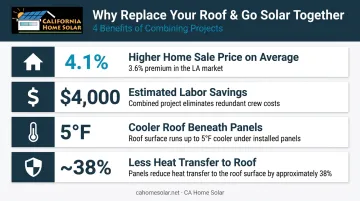
According to EnergySage, if your asphalt roof is over 10 years old, replacement before solar installation is the smarter move. The U.S. DOE puts it simply: doing both at the same time can save homeowners an estimated $4,000 by consolidating labor, scaffolding, and project coordination.
When Replacement Before Solar Makes Sense
Two scenarios make the case clearly:
- Damage or aging is visible — curling shingles, granule loss, water stains, or cracked flashing signal the roof won't last another 15–20 years
- You're within 10 years of end-of-life — even without obvious damage, replacing now avoids a far costlier future project that requires removing the panels first
The "Free Roof" Myth
Some solar deals market themselves as including a "free roof replacement." In practice, these are bundled discounts — not free roofs. Solar shingles like the Tesla Solar Roof do replace the roof entirely, but EnergySage's comparison data shows the Tesla Solar Roof costs around $6.40/W versus $2.86/W for traditional panels — up to 75% more expensive — with lower efficiency per square foot.
Why Doing Both at Once Pays Off
Beyond avoiding future costs, the combination delivers real upside:
- Zillow data shows solar homes sell for 4.1% more on average, with Los Angeles seeing a 3.6% premium
- A new roof amplifies that resale value — paired together, it's one of the higher-ROI upgrades available to Southern California homeowners
- UCSD research found roof surfaces beneath solar panels run up to 5°F cooler, with panels cutting heat transfer to the roof by roughly 38%
- That thermal buffer helps new shingles hold up longer, extending the useful life of the roof itself
CA Home Solar handles both solar installation and roofing remodeling for Southern California homeowners, which means a single team can assess and execute both projects — no juggling two separate contractors or timelines.
Signs Your Roof Needs Attention Before Going Solar
Don't wait for a solar installer to flag roof problems mid-project. Catching issues before installation avoids delays, change orders, and potential structural concerns that could affect how panels are mounted.
Visible Warning Signs to Look For
These are the most reliable indicators that a roof needs repair or replacement:
- Curling or cupping shingles: lifted edges or buckled tabs are a reliable sign of advanced aging
- Missing or cracked shingles — gaps in coverage allow moisture infiltration
- Check gutters for granule buildup; bald patches on shingles mean the protective layer is breaking down
- Water stains on interior ceilings point to active or past leakage that needs to be resolved before any roof penetrations
- Cracked or lifted flashing around chimneys, vents, or skylights is one of the most common water entry points
Why Southern California Roofs Age Faster
InterNACHI's inspection guidance is direct: hot climates drastically reduce asphalt shingle life. Southern California's combination of intense UV exposure, sustained heat, and wildfire debris puts local roofs under more stress than national averages suggest.
A roof that might last 25–28 years in a temperate climate can reach the end of its useful life several years earlier in the LA basin. That makes a pre-solar inspection genuinely necessary here, not a box-checking exercise.
If a solar crew discovers structural problems after work has started, you're looking at project delays, unplanned costs, and a roof that still needs fixing before panels can be safely mounted.
What Happens If You Need Roof Work After Installing Solar?
Panels must come off before any roofing work begins — no exceptions. A roofing crew needs unobstructed access to the entire surface, and working around installed panels leads to incomplete repairs, equipment damage, and potential warranty violations.
The Removal and Reinstall Process
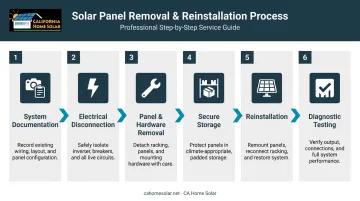
A professional solar panel removal and reinstallation involves several distinct steps:
- System documentation — photos and records of panel placement, wiring, and mounting configuration
- Electrical disconnection — panels remain live even when the inverter is off; safe disconnection requires trained personnel
- Panel and hardware removal — careful disassembly of panels and racking components
- Secure storage — panels are stored safely while roofing work proceeds
- Reinstallation — panels remounted and reconnected once the new roof is certified complete
- Diagnostic testing — system performance verified before going back online
The Warranty Risk of Using the Wrong Contractor
Most solar manufacturers require that PV system work — installation, maintenance, and removal — be handled by qualified personnel. REC's installation manual states explicitly that only qualified personnel must perform work on PV systems, and that failure to follow instructions can invalidate the product warranty. Disassembling panels, opening junction boxes without authorization, or using incompatible hardware are all cited as warranty-voiding actions.
Using a general roofer or handyman to pull panels might seem like a cost-saving move, but a voided 25-year equipment warranty exposes the homeowner to the full replacement cost of any panel that fails down the line.
One Contractor vs. Two
For homeowners in Southern California, coordinating a solar removal contractor with a separate roofing crew creates real scheduling risk — both parties need to align on timing, and delays in one phase push back the other. CA Home Solar's ability to manage both roofing and solar work internally eliminates that coordination problem. One team handles the full sequence: removal, roofing, reinstallation.
The Cost of Removing and Reinstalling Solar Panels
This is the number that surprises most homeowners — especially those who installed solar years ago and are now facing roof issues for the first time.
What to Expect
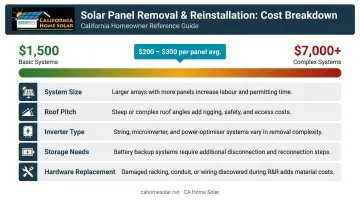
EnergySage reports that full removal and reinstallation typically costs $1,500–$6,000, and can exceed $7,000 for larger or more complex systems. The per-panel average runs $200–$300. Palmetto notes their residential R&R service starts at $5,000.
Cost drivers that push jobs toward the higher end:
- Larger system (more panels = more labor)
- Steep roof pitch
- String inverter systems vs. microinverters (different disconnection processes)
- Off-site storage requirements
- Panel inspection or cleaning during the process
- Hardware that needs replacement rather than reuse
What Many Homeowners Miss
These figures sit on top of — not inside — the roofing replacement cost. A homeowner who budgets carefully for shingles and labor can still get caught off guard by a separate panel-handling bill they never saw coming.
One practical safeguard is to ask your solar installer — before signing the original contract — whether removal and reinstall provisions are included in the warranty or service agreement. Some installers do build in protections or discounted R&R services, so knowing this early can make a real difference down the road.
Cutting corners on who handles removal rarely saves money. Voided warranties, damaged panels, and denied insurance claims cost far more than a qualified technician's fee.
Tips for a Smooth Roof-Solar Project in Southern California
A few practical steps that prevent the most common problems:
Start early. Both solar companies and roofing contractors in Southern California run backlogs, particularly late summer through fall. If you're seeing roof wear and considering solar, begin conversations now — not after the problem gets worse.
Request a combined inspection. Before committing to any work, ask for a roof and solar assessment in the same visit. CA Home Solar offers both solar and roofing services, making this kind of combined review straightforward. It gives you an honest picture of whether repair, replacement, or simple maintenance is the right call — without paying for work you don't need.
Ask the right questions before signing any solar contract:
- Does the installer offer a roof warranty on the mounted area, and what voids it?
- What is the estimated cost if panels need to come off for roof work in the future?
- Does the company handle both solar and roofing, or will you need to coordinate two separate contractors?
Contractors who can't answer these questions clearly are worth walking away from — especially before panels go on a roof that isn't ready for them.
Frequently Asked Questions
Should I replace my roof before or after installing solar panels?
If your roof is more than 10 years old or showing visible wear, replace it first. Doing both together saves an estimated $4,000 in combined labor costs and avoids a far more expensive future removal and reinstall project. If the roof is newer and in good condition, installation can proceed without replacement.
How do you repair a roof that has solar panels installed?
Solar panels must be professionally removed before any roofing work begins. A qualified solar technician handles the removal and reinstallation, while the roofing contractor completes the work in between.
How much does it cost to remove solar panels for roof repair?
Expect to pay $1,500–$7,000+ depending on system size, roof complexity, inverter type, and whether off-site storage is needed. The per-panel average is $200–$300.
Can solar panels damage my roof?
Properly installed panels rarely cause damage — in fact, they reduce heat and UV stress on the shingles beneath them. Problems typically stem from poor original installation or from removal and reinstallation by unqualified contractors who damage the roof surface or mounting points.
Will removing my solar panels for roof work void my warranty?
Solar manufacturers require qualified personnel for any work on PV systems and make clear that unauthorized disassembly or improper handling can void product warranties. Having an unqualified roofer or handyman pull your panels carries real warranty risk.
How long does it take to remove and reinstall solar panels for roof work?
Panel removal typically takes one day. Reinstallation happens after the new roof is complete and inspected. The full project timeline — from removal to a fully reinstalled, tested system — commonly ranges from a few days to a couple of weeks depending on the scope of the roofing job.