The roof is the largest surface exposed to direct sun, yet it's rarely the first thing homeowners consider when cutting energy costs. That's a costly oversight.
This guide covers everything Southern California homeowners need to know: how energy efficient roof tiles actually work, which types perform best in warm climates, what California's Title 24 compliance requires, and how to calculate realistic savings before committing to a project.
Key Takeaways
- Conventional roofs hit 150°F+; a properly rated cool roof stays 50°F+ cooler under the same conditions
- Clay, concrete, metal, and composite tiles all outperform standard asphalt shingles in Southern California's climate
- To meet California's Title 24 in most Southern California climate zones, your roof needs an aged solar reflectance of at least 0.20 and thermal emittance of 0.75 — minimums worth exceeding if you want real cooling savings
- Cool roofs can cut annual air-conditioning energy use by up to 15% for single-story homes in warm climates
- Add rooftop solar to a cool tile roof and you reduce both your cooling load and your grid dependence at the same time
What Makes Roof Tiles Energy Efficient?
Three physical properties determine whether a roof tile will help or hurt your energy bills.
The Three Core Properties
Solar Reflectance (SR) is the most impactful property — it measures how much incoming sunlight a tile bounces back rather than absorbs. A value of 1.0 reflects everything; 0.0 absorbs everything. White products typically reflect 60–90% of sunlight, while cool-colored products reflect roughly 30–60%.
Thermal Emittance (TE) measures how quickly a surface releases absorbed heat back into the atmosphere rather than conducting it downward into your home. Most roofing materials have high emittance (0.85–0.95), so this property tends to matter less than reflectance for distinguishing products.
Thermal Mass describes a material's density and its ability to slow heat transfer. High-density tiles absorb heat slowly during the day and release it gradually — preventing the sharp temperature spikes that low-mass materials cause.
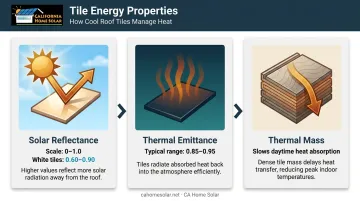
Together, these three properties explain exactly where standard asphalt falls short.
Why Standard Asphalt Shingles Fall Short
Asphalt shingles are cheap and common, but they're poorly suited to Southern California's climate. Dark shingles absorb solar energy aggressively, pushing roof surface temperatures to 150°F or higher — and that heat radiates straight into the attic, running up your cooling costs all day.
Properly rated tile roofs break this pattern two ways: their material properties reflect or slow heat transfer, and their raised profile creates a natural air gap beneath the tile.
Research by the Oak Ridge National Laboratory and the Florida Solar Energy Center found that a vented tile roof reduced ceiling heat flux by 48% versus a black-shingle reference roof — and even a direct-nailed tile installation reduced it by 39%.
The "Cool Roof" Defined
The U.S. Department of Energy defines a cool roof as one designed to reflect more sunlight and absorb less heat than a standard roof. Certain tile types qualify by default — not just because of color or coating, but because of two compounding factors:
- Material composition that reflects or slowly releases heat
- Installation geometry that creates a natural ventilating air gap beneath each tile
Types of Energy Efficient Roof Tiles for Residential Homes
Three primary tile categories suit Southern California homes. Each has distinct performance characteristics, cost ranges, and structural requirements.
Clay and Concrete Tiles
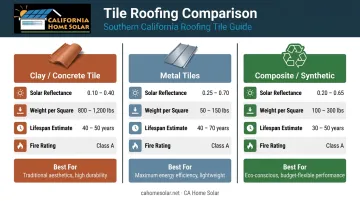
Clay and concrete tiles have dominated roofing in hot, sunny climates across Mediterranean Europe, Florida, and California for a straightforward reason: thermal mass. Dense material absorbs daytime heat slowly and releases it gradually, preventing the sharp indoor temperature swings that lightweight materials produce.
The tile profile matters as much as the material. Individual tiles installed over battens create a ventilated air space beneath the roof deck. ORNL/FSEC research attributed roughly 30% of total deck thermal resistance to that above-sheathing ventilation alone in a high-profile clay tile assembly.
Performance highlights:
- Ceiling heat flux reduced 39–48% vs. black-shingle reference (ORNL/FSEC)
- Class A fire rating — naturally fireproof without added treatment
- Wind resistance up to 200 mph with proper installation design
- Available with cool-pigment coatings that meet Title 24 reflectance requirements
Key considerations:
- Concrete tiles typically weigh 550–970 lbs per square; clay runs 598–676 lbs per square — a structural evaluation is often required before installation
- Higher upfront cost than asphalt, but a 50+ year lifespan means fewer replacement cycles — often two or three fewer over the life of the home
- Homes replacing lighter roofing materials face the greatest structural review risk
Metal Roof Tiles
Metal is naturally reflective and accepts Energy Star-rated coatings that push solar reflectance higher than almost any other roofing category. For solar reflectance performance in a sunny climate, it leads most competing categories.
The Metal Roofing Alliance reports that metal roofing may save 10–40% in energy costs, though real-world results depend on the specific product, color, and local conditions. The DOE's cool-roof benchmark confirms reflective roofs can stay more than 50°F cooler than conventional surfaces under the same conditions.
Performance highlights:
- Class A fire rating under UL 790/ASTM E108 (relevant for Southern California wildfire zones)
- Wind resistance exceeding 140 mph
- Available in profiles that mimic clay tile, slate, or cedar shake
- Low thermal mass means quick temperature response in both directions
Key considerations:
- Metal can be noisy during rain and may benefit from added underlayment for sound dampening
- Style options have expanded well beyond the utilitarian look most homeowners picture; modern profiles closely replicate clay, slate, and shake
- Lifespan varies by product and coating quality; verify manufacturer warranties before specifying
Composite (Synthetic) Roof Tiles
Composite tiles are made from recycled plastics and rubber, engineered to replicate the look of clay, slate, or cedar shake at a lighter weight and more accessible price point. Their energy efficiency comes from built-in UV protection and cool-roof color formulations designed to meet California's Title 24 reflectance requirements.
For homes that cannot support the structural load of clay or concrete (a common situation when re-roofing older Southern California homes) composite tiles offer a genuine performance alternative rather than a compromise.
Performance highlights:
- Class 4 impact rating (the highest available) — relevant for areas with hail risk
- Class A fire rating
- High wind resistance — some products rated to 188–211 mph depending on fastener type
- Lighter weight (approximately 270–297 lbs per square for some products) eliminates most structural concerns
- Cool-color options verified by manufacturers for Title 24 compliance
Key considerations:
- CRRC and Title 24 compliance must be verified at the specific SKU and color level — not all colorways qualify
- Performance varies across manufacturers; confirm product-specific ratings before specifying
California Title 24 Compliance: What Southern California Homeowners Need to Know
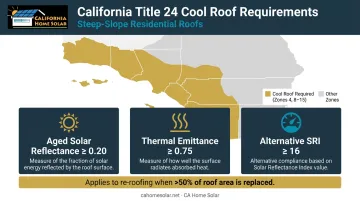
Title 24 is California's mandatory Building Energy Efficiency Standards — not a voluntary green building program. Any new roof installation or re-roofing project covering more than 50% of the roof area must meet its requirements, including minimum cool roof thresholds.
Current 2022 Title 24 Requirements for Steep-Slope Roofs
For residential steep-slope roofs (defined as 2:12 pitch or greater), California's 2022 Title 24 standards require:
| Requirement | Value |
|---|---|
| Minimum aged solar reflectance | 0.20 |
| Minimum thermal emittance | 0.75 |
| Alternative SRI (if using composite score) | 16 |
These thresholds apply to new single-family construction in climate zones 10–15, and to re-roofing alterations in climate zones 4 and 8–15. Most Southern California residential roofing projects fall within these zones and trigger the cool roof requirement.
Failing to use a compliant product can result in a failed inspection, correction orders, or the cost of replacing non-compliant materials after installation.
Which Tile Types Meet Title 24
- Clay tiles with cool-pigment coatings meet or exceed requirements when properly specified
- Concrete tiles with appropriate reflective pigments — verify against the CRRC Rated Products Directory
- Energy Star-rated metal tiles — note that the Energy Star Roof Products program was sunset in June 2022; use CRRC ratings for current product verification
- Composite tiles in cool-color options — compliance is color and SKU-specific
Material selection needs to happen during the planning phase, not as a last-minute choice. Picking a tile for aesthetics and then trying to find a compliant version afterward often limits options.
Verifying compliance before purchase — not after — is where working with a contractor familiar with local climate zones pays off. California Home Solar handles roofing projects across Southern California, from coastal Orange County to the San Fernando Valley, and can confirm whether a specific product and SKU meets current Title 24 standards for your climate zone before the project starts.
Cost vs. Long-Term Savings: Is It Worth the Investment?
Upfront Cost Ranges (Installed, 2025 National Data)
| Tile Type | Installed Cost Range (per sq ft) |
|---|---|
| Composite/Synthetic | ~$10–$15 |
| Metal tiles/shingles | ~$7–$22 |
| Concrete tile | ~$9–$18 |
| Clay tile | ~$8–$25 |
Note: These are national cost-guide figures. California labor rates and permitting costs typically push installed prices toward the higher end of these ranges. Homes requiring structural reinforcement for clay or concrete tile may add $1,000–$10,000 in preliminary costs.
Energy Savings and Payback Period
Those upfront costs look more manageable once you factor in what a cool roof saves you over time.
Cool roofs in warm or hot climates can reduce annual air-conditioning energy use by up to 15% for single-story buildings, according to Lawrence Berkeley National Laboratory. Separate Florida research measured an average 19% cooling-energy reduction across 11 homes after roof color changes.
Southern California's high sun exposure and above-average electricity rates push the ROI higher than most U.S. regions. Most homeowners here see payback within 5–10 years, though results vary based on home size, existing insulation, and current energy use.
Available Financial Incentives
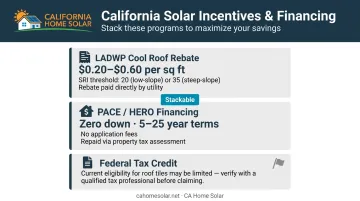
- Federal tax credit (IRS Form 5695): Covers certain building envelope improvements through December 31, 2025 — but traditional roof tiles are not currently a listed eligible category. Verify with a tax professional before assuming a credit applies.
- LADWP cool roof rebates: Qualifying cool roofs earn $0.20–$0.60 per sq ft, with steep-slope SRI thresholds of 20 (lower tier) and 35 (higher tier). SCE and SoCalGas customers should check their respective utility programs separately.
- HERO/PACE financing: As a registered HERO contractor, California Home Solar offers PACE-based financing with zero down, terms of 5–25 years, and no application fees — paid through property taxes and stackable with utility rebates. California First and YGrene are additional PACE options available.
Home Value Impact
Energy-efficient upgrades have measurable resale value in Southern California's competitive real estate market. The 2024 JLC Cost vs. Value report for the Pacific region found that a metal roof replacement recouped approximately 62.3% of project cost at resale — and that's before accounting for energy savings during ownership. Buyers in energy-conscious California markets increasingly factor utility costs into purchase decisions.
How to Maximize Your Roof's Energy Performance
The tile material is just one variable — the full roof system determines actual energy outcomes.
Attic Ventilation
Proper attic ventilation significantly reduces heat buildup beneath the roof deck. ORNL/FSEC research found that a well-vented attic with balanced ridge and soffit ventilation reduced ceiling heat flux by 66% versus a sealed attic — a larger impact than the tile choice alone in some configurations.
A balanced ventilation system relies on:
- Soffit vents — intake air at the eaves
- Ridge vents — exhaust hot air at the peak
- Adequate net free ventilation area relative to attic floor area
CA Home Solar also installs solar attic fans, which can reduce attic temperatures by up to 40°F during summer months — a complement to passive ventilation rather than a replacement.
Radiant Barriers and Underlayment
A radiant barrier installed beneath the roof deck reflects radiant heat before it enters the attic space. The DOE confirms radiant barriers are most effective in hot climates and require an air space to function. They work by radiation rather than conduction, so they carry no inherent R-value, but reduce heat gain significantly when installed with the required air gap.
Tile Color and Cool-Pigment Technology
Lighter colors reflect more sunlight, but the relationship between color and performance is no longer as restrictive as it once was. Modern cool-pigment technology allows medium and darker tile colors to meet Energy Star reflectance thresholds using infrared-reflective pigments that bounce back the heat-carrying portion of the solar spectrum, even when a tile appears dark to the eye.
Homeowners don't have to choose between aesthetics and energy performance. A terracotta or charcoal tile can meet Title 24 requirements with the right product specification.
Pairing a Cool Roof with Solar Panels
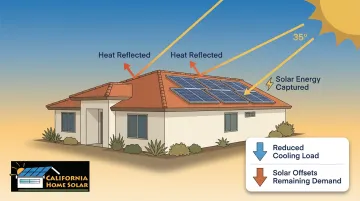
A cooler roof creates a secondary benefit for rooftop solar. PV panels lose efficiency as operating temperatures rise — standard modules carry a temperature coefficient of roughly -0.47% per degree Celsius above their rated 25°C operating point. A reflective surface beneath the panels keeps module temperatures lower and preserves output.
The combination works both ways:
- The cool roof reduces the cooling load the home draws from the grid
- The solar system offsets what cooling demand remains
CA Home Solar handles both services under one project scope — roofing remodeling and solar installation — simplifying permitting, coordination, and the overall project timeline.
Frequently Asked Questions
Which roofing material is most energy efficient?
Metal roofing with reflective coatings and clay or concrete tile both rank among the top performers. The best choice depends on your budget, structural capacity, and aesthetic goals. For Southern California's sunny climate, all three major tile types significantly outperform standard asphalt shingles.
Are energy efficient roof tiles worth the cost for Southern California homes?
For most Southern California homeowners, the ROI is stronger here than in most other U.S. regions. Annual cooling cost reductions and available PACE financing (with no upfront costs) make the investment accessible, and the payback timeline is generally shorter than the national average.
Do energy efficient roof tiles qualify for tax credits or rebates?
Traditional roof tiles don't currently qualify for federal tax credits under IRS guidelines. However, LADWP and other California utilities offer cool roof rebates of $0.20–$0.60 per sq ft for qualifying products. Verify current eligibility with a licensed contractor or through your utility provider.
What is California's Title 24 and how does it affect my roofing choice?
Title 24 is California's mandatory building energy code. New and re-roofed residential properties in most Southern California climate zones must use cool roof materials meeting minimum aged solar reflectance (0.20) and thermal emittance (0.75) thresholds — non-compliant products will fail inspection.
How does roof tile color affect energy efficiency?
Lighter colors reflect more sunlight by default. Modern cool-pigment technology allows darker-colored tiles to also meet Energy Star and Title 24 reflectance standards, giving homeowners aesthetic flexibility without sacrificing performance. Always verify the specific color SKU against CRRC ratings.
Can I install solar panels on an energy efficient tile roof?
Yes — solar panels install on tile roofs using profile-specific mounting systems designed for clay, concrete, and composite profiles. The combination is especially effective: a reflective cool roof keeps panel temperatures lower, improving solar output over the life of the system.