This happens to homeowners across Southern California every day. California's Title 24 energy code makes cool roof compliance mandatory for most full reroofs, and missing the requirements can stall your permit or force costly corrections after installation.
This guide covers exactly when Title 24 kicks in, what the performance numbers mean, how steep-slope and low-slope rules differ, and which exceptions might apply to your home.
Key Takeaways
- 50% rule: Cool roof requirements activate when more than half your roof surface is being replaced or re-covered
- Steep-slope minimums (Climate Zones 4 and 8–15): aged solar reflectance ≥ 0.20 AND thermal emittance ≥ 0.75, OR SRI ≥ 16
- CRRC certification is required: ENERGY STAR alone does not satisfy Title 24 compliance
- Exceptions exist: R-38+ ceiling insulation, radiant barriers, and solar panels can reduce or eliminate the cool roof requirement
- 2022 Standards govern current permits through December 31, 2025
- The 2025 Standards take effect January 1, 2026
What Is Title 24 and When Does It Apply to Your Reroof?
Title 24, Part 6 is California's Building Energy Efficiency Standards, the statewide code governing energy performance for new and remodeled buildings. Compliance is enforced through the local building permit process — there's no working around it after the fact.
The 50% Trigger
Under Section 150.2(b)1I of the 2022 Energy Code, cool roof requirements apply when more than 50% of a roof's exterior surface is being replaced. This includes:
- Full tear-off and reroof
- Re-covering (adding a new layer over existing material)
- Any combination of repairs that collectively exceed half the roof area
A full reroof almost always crosses this threshold. Patching a section after storm damage typically does not — but the moment that patchwork adds up past 50%, compliance is required.
Which Code Edition Applies Right Now?
The 2022 Energy Standards govern permits submitted between January 1, 2023 and December 31, 2025. The 2025 Energy Standards take effect for permits filed on or after January 1, 2026. This guide is based on the 2022 Standards.
Climate Zones in Southern California
California uses 16 building climate zones, and your requirements depend on which zone your home sits in. Most Southern California homes fall into these zones:
| Location | Climate Zone |
|---|---|
| Fullerton, Orange County | CZ 8 |
| Burbank, Glendale | CZ 9 |
| Riverside | CZ 10 |
| Palmdale | CZ 14 |
| Palm Springs / Low Desert | CZ 15 |
| Torrance | CZ 6 |
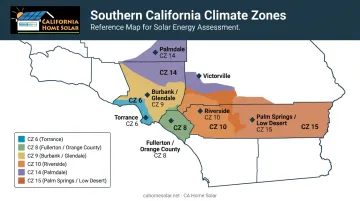
Zone boundaries don't follow city or county lines exactly. Use the CEC Climate Zone Tool to look up your specific address before assuming which zone applies.
Cool Roof Metrics: Solar Reflectance, Thermal Emittance, and SRI
Three numbers determine whether a roofing product meets Title 24: solar reflectance, thermal emittance, and SRI. Knowing what each one measures — and where the minimums sit — is what separates a compliant product selection from a failed inspection.
Aged Solar Reflectance (SR)
California requires the aged solar reflectance value — measured after three years of outdoor weathering — not the initial factory figure. This distinction matters because reflectance degrades over time; a product that starts at 0.30 can drop to 0.22 after a few years of exposure, and only the aged number counts for compliance.
The CRRC Rated Roof Products Directory lists initial and 3-year aged SR values for certified products. When aged data isn't available, the 2022 code applies this formula:
Aged SR = 0.2 + 0.70 × (Initial SR – 0.2)
For field-applied coatings, the multiplier is 0.65 instead of 0.70. Apply the formula before assuming an unlisted product will pass.
Thermal Emittance (TE)
Thermal emittance is where many otherwise reflective products fall short. It measures how efficiently a roof radiates absorbed heat back into the atmosphere rather than transferring it into the structure below. The standard minimum for steep-slope applications is 0.75 — products below that threshold fail even with strong solar reflectance numbers.
Solar Reflectance Index (SRI)
SRI combines both SR and TE into a single number, calculated per ASTM E1980. It's an alternative compliance path — instead of meeting separate SR and TE minimums, a product can qualify by hitting the SRI threshold alone. For steep-slope roofs, the minimum aged SRI is 16. Higher SRI = cooler roof performance overall.
All three values for compliant products appear in the CRRC Rated Roof Products Directory. The CRRC label on product packaging is the accepted proof-of-compliance document for permit purposes.
Steep-Slope vs. Low-Slope: Which Requirements Apply?
The 2022 code draws the line at 2:12 pitch:
- Steep-slope: pitch of 2:12 or greater (most single-family homes — standard gable, hip, and tile roofs)
- Low-slope: pitch of less than 2:12 (flat roofs, very shallow commercial-style roofs)
Steep-Slope Requirements
For steep-slope reroofs in Climate Zones 4 and 8–15, homeowners must meet one of two compliance paths:
| Compliance Path | Aged SR | Thermal Emittance | SRI |
|---|---|---|---|
| Path A (both required) | ≥ 0.20 | ≥ 0.75 | — |
| Path B (alternative) | — | — | ≥ 16 |
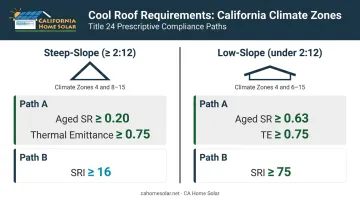
If your home sits in Climate Zones 1, 2, 3, 5, 6, 7, or 16, the steep-slope prescriptive cool roof requirement does not apply — though confirm with your local building department, since some jurisdictions add their own requirements.
Low-Slope Requirements
Low-slope reroofs face stricter standards because flat roofs absorb far more solar heat. In Climate Zones 4 and 6–15, the minimums are:
| Compliance Path | Aged SR | Thermal Emittance | SRI |
|---|---|---|---|
| Path A | ≥ 0.63 | ≥ 0.75 | — |
| Path B | — | — | ≥ 75 |
Low-slope projects in Climate Zones 1, 2, 4, and 8–16 also require R-14 continuous insulation or a roof assembly U-factor of ≤ 0.039 under Table 150.2-C. Both the reflectance and insulation requirements must be satisfied — one does not substitute for the other.
Exceptions That May Exempt Your Reroof from Cool Roof Requirements
Meeting the cool roof standard isn't the only path to compliance. Section 150.2(b)1Ii lists several exceptions for steep-slope reroofs that can exempt a home entirely.
The Main Prescriptive Exceptions
Three categories cover most homes that qualify without a cool roof product:
- Ceiling assemblies with a U-factor ≤ 0.025, or at least R-38 ceiling insulation
- A qualifying radiant barrier already installed in the attic (not directly above spaced sheathing) under Section 150.1(c)2
- In Climate Zones 2, 4, 9, 10, 12, and 14, buildings with no ducts in the attic
- R-2 or greater continuous insulation above or below the roof deck
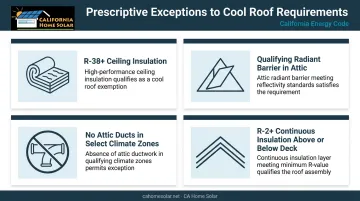
If your home already has R-38+ insulation in the attic, you may not need to change your roofing product at all. A pre-reroof assessment can confirm whether your existing conditions qualify — CA Home Solar's free consultation includes an energy evaluation that can help identify this before work begins.
The Solar Panel (BIPV) Exception
Roof area physically covered by building-integrated photovoltaic (BIPV) or solar thermal panels is exempt from cool roof requirements. If you're planning to add solar alongside your reroof, the panels covering a significant portion of the south- and west-facing slopes could reduce or eliminate the compliant-surface area required.
CA Home Solar handles both roofing and solar installation under one scope of work, so the panel coverage calculation gets factored into the project plan from the start.
The Heavyweight Roofing Exception
Roofing materials weighing 25 lb/ft² or more — certain concrete and clay tile products — are exempt from the cool roof reflectance and emittance requirements entirely. If you're planning to install heavy tile, confirm the product weight using the manufacturer's data sheet before relying on this exception. Not all tile products hit that threshold.
How to Choose a CRRC-Certified Roofing Product
Under Section 10-113 of the Energy Code, every roofing product used for Title 24 compliance must be rated and labeled by the Cool Roof Rating Council (CRRC). A product can carry an ENERGY STAR label and still not satisfy Title 24 — these are separate programs with different requirements.
Using the CRRC Directory
The CRRC Rated Roof Products Directory is publicly searchable. You can filter by:
- Product type (asphalt shingles, tile, metal, coatings, etc.)
- Aged solar reflectance
- Thermal emittance
- SRI
Check the aged SR and TE values against the thresholds for your climate zone before purchasing. The CRRC label on the product packaging is the document your contractor submits for permit compliance — keep it.
Product Types That Can Qualify
Many material categories can meet the standard when properly selected:
- Certain asphalt shingles (lighter-colored or specialty reflective products)
- Metal roofing with reflective coatings
- Clay and concrete tile (if not already exempt by weight)
- Coated or painted roofing products with CRRC-rated values
Selecting the right product across all these categories requires cross-referencing rated values against your specific climate zone thresholds — which is where contractor experience matters. California Home Solar handles product selection and permit documentation for Southern California homeowners, so the CRRC verification gets done before materials are ever ordered.
Frequently Asked Questions
What is the Title 24 Energy Code in California?
Title 24, Part 6 is California's statewide Building Energy Efficiency Standards, which sets mandatory energy performance requirements for new and remodeled buildings. It's enforced through the local building permit process and applies to both residential and nonresidential construction.
Is a new roof tax deductible in California?
A standard roof replacement is generally not directly tax-deductible. However, if you combine a reroof with qualifying improvements like solar panels, you may be eligible for the federal Residential Clean Energy Credit. Consult a tax professional for current IRS guidance on your project.
When exactly does Title 24 cool roof compliance become required for my reroof?
The threshold is more than 50% of the roof surface being replaced or re-covered, under Section 150.2(b)1I. Partial repairs below that threshold generally don't trigger compliance. Once cumulative work crosses that line, the full requirement kicks in.
What roofing materials can meet the cool roof standard?
Many product types qualify — including certain asphalt shingles, metal roofing, clay or concrete tile (if not exempt by weight), and coated products — as long as they are CRRC-rated and meet the minimum aged SR, TE, or SRI thresholds for your climate zone.
Do solar panels affect cool roof compliance?
Yes. Roof area physically covered by building-integrated photovoltaic or solar thermal panels is exempt from cool roof requirements. Adding solar alongside a reroof can noticeably reduce the compliant-surface area you need to address.
What happens if I reroof without meeting Title 24 requirements?
Non-compliant reroofs can fail the building permit inspection, requiring removal and replacement of non-conforming materials before a final permit is issued. Unpermitted or non-compliant work also creates disclosure problems when selling the home.