The core tension is this: solar roof tiles promise a sleek, integrated look that satisfies HOAs and design-conscious buyers. Traditional solar panels promise proven efficiency, faster ROI, and a competitive installer market. Choosing the wrong option can mean tens of thousands of dollars in unnecessary costs or a payback period that stretches a decade longer than it should.
This article breaks down both options across cost, efficiency, aesthetics, installation complexity, and Southern California-specific factors—including NEM 3.0, tile roof considerations, and resale value—so you can make a confident, well-informed choice.
Key Takeaways
- Solar roof tiles replace your roofing material and generate power—best for new builds or full roof replacements, but they cost 60%–190% more than traditional panels for equivalent output
- Traditional rack-mounted panels are more efficient, more affordable (~$2.53/W installed in California), and faster to install on existing roofs
- Under NEM 3.0, maximizing kWh per dollar invested matters more than ever — and traditional panels lead on that metric
- Both options qualify for the 30% federal Investment Tax Credit (ITC) through 2032
- For most LA-area homeowners with an existing roof, traditional panels deliver better value
Solar Roof Tiles vs. Solar Panels: At a Glance
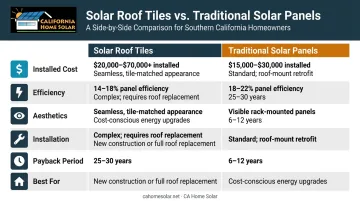
Here's how solar roof tiles and traditional solar panels compare across the factors that matter most to California homeowners.
| Attribute | Solar Roof Tiles | Traditional Solar Panels |
|---|---|---|
| Installed Cost | ~$3.90–$4.50/W; $40,000–$100,000+ for a typical system | ~$2.53/W avg. in California; $18,941–$25,627 for an 8.81 kW system |
| Efficiency | CertainTeed Apollo II: 15.4% | Leading monocrystalline panels: up to 22.6% (REC Alpha Pure-RX) |
| Aesthetics | Fully integrated into roofline; no visible hardware | Rack-mounted above roof surface; visible from the street |
| Installation | Requires full roof tear-off before installation | Installed on most sound existing roofs within days |
| Payback Period | Longer than panels given higher cost per watt; no CA-specific benchmark available | Average 7.64 years in California (EnergySage, 2025) |
| Best For | New construction or full roof replacement | Existing homes with a roof in good condition |
What Are Solar Roof Tiles?
Solar roof tiles—also called solar shingles or Building-Integrated Photovoltaics (BIPV)—serve a dual function: they're both the roofing material and the power generator. Unlike traditional panels, they don't sit on top of your roof. They are your roof.
The Products Available Today
Two products dominate the U.S. market:
- Tesla Solar Roof – 72W Solar Glass Tiles with a 25-year tile and power warranty, Class A fire rating, and Class 4 hail rating. The certified installer network is considerably smaller than what's available for traditional panels.
- CertainTeed Apollo II / Solstice Shingle – The Apollo II delivers 63W output at 15.4% module efficiency. Certified installers exist but are sparse in Southern California.
That limited installer network has real consequences: fewer competing bids, longer lead times, and less flexibility if service issues arise later.
Key Advantages
Installer access aside, solar tiles offer genuine benefits for the right homeowner.
- HOA compatibility – Many HOAs prefer minimal visual impact. California Civil Code Section 714 protects your right to install solar, and tiles satisfy aesthetic concerns that traditional panels often don't.
- Clean roofline with no rail systems or elevated modules above the roof surface.
- When your roof needs full replacement anyway, tiles consolidate two projects into one — and the cost premium over traditional panels shrinks accordingly.
Honest Limitations
- Lower efficiency – At 15.4%, the Apollo II trails leading monocrystalline panels by 6–7 percentage points, requiring more roof area to hit the same output.
- Solar shingles typically cost 60%–190% more than traditional panels for equivalent output.
- Fewer qualified local installers means less competition and less pricing leverage for you.
When Solar Roof Tiles Make Sense
Two scenarios genuinely favor solar tiles:
- Your roof needs full replacement anyway. The cost math shifts significantly when you subtract the roofing expense that tiles replace. The premium over traditional panels shrinks considerably.
- You're building new. Designers can maximize solar tile coverage from the start, avoiding retrofitting challenges entirely and creating an integrated energy system.
What Are Traditional Solar Panels?
Traditional rack-mounted solar panels are photovoltaic (PV) modules installed above your existing roof surface using a racking system anchored to the roof structure. They generate electricity but don't replace roofing material.
That means the roof stays intact, installation is faster, and the product has been refined across decades of real-world use.
Why They Dominate the Market
NREL data shows residential BIPV market share sat at just 0.4% in 2021, compared to the overwhelming majority of conventional rooftop PV. Traditional panels dominate for practical reasons:
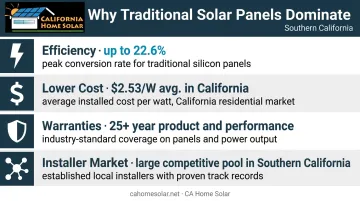
- Higher efficiency – Leading panels like the REC Alpha Pure-RX reach 22.6% efficiency, and the Qcells Q.TRON BLK M-G2+ hits 22.5%. Both outperform current solar tile products.
- Lower upfront cost – California's average installed cost runs $2.53/W, compared to $3.90–$4.50/W for solar tiles.
- 25+ year warranties – Manufacturers like REC, Qcells, and Panasonic back their panels with 25-year product and performance warranties.
- Large competitive installer market – Southern California has no shortage of qualified solar contractors, which keeps pricing competitive and service accessible.
Key Limitations
- Visible on the roofline – Rack-mounted panels are noticeable from the street, which matters to some HOAs and design-focused homeowners.
- Roof condition is a prerequisite – If your roof is more than 10–15 years old, it should be inspected before installation. Installing panels on a failing roof means expensive "detach and reset" work later when the roof finally needs replacement.
- Tile roof comp-outs add cost – Spanish clay and concrete tile roofs—common throughout the LA area—often require removing tiles beneath the array and replacing them with composite shingles before mounting. This adds project scope but is standard practice among experienced local installers.
When Traditional Solar Panels Make Sense
Traditional panels are the right call when:
- Your roof has at least 10–15 years of remaining life
- You want to start generating savings quickly without a full roof overhaul
- You're pairing solar with battery storage (more on this below)
- You want access to a wide, competitive pool of local installers
California Home Solar has been installing traditional panel systems in the Los Angeles area for 36 years, managing the full process from site assessment and permitting through utility interconnection with SCE and LADWP. For homeowners with an aging roof, the company's roofing services can be scheduled alongside solar work, which avoids costly detach-and-reset fees if the roof needs attention after panels are already installed.
Which Is Better for Southern California Homeowners?
There's no single answer. The right choice depends on four variables: budget, roof age and condition, aesthetic priorities, and whether you're retrofitting or building new.
The NEM 3.0 Factor
California's Net Billing Tariff (adopted December 2022, effective for new applications after April 15, 2023) changed the solar economics for SCE customers significantly. Under the previous NEM structure, exported power was credited at retail rates. Under NEM 3.0, export compensation is based on avoided cost values, considerably lower than retail.
The practical impact: self-consumption now matters far more than export. Every kWh you generate and use directly offsets a retail-rate bill. Every kWh you export earns much less. This makes high-efficiency panels paired with battery storage the stronger combination—you maximize the value of every watt your roof produces.
Solar tiles, with their lower efficiency per square foot, produce fewer kWh for the same roof area. Under NEM 3.0, that efficiency gap has real dollar consequences over the life of the system.
LADWP operates under its own Net Energy Metering guidelines (separate from CPUC), so the dynamics differ slightly for LADWP customers, though the principle of maximizing self-consumption still applies.
Decision Framework
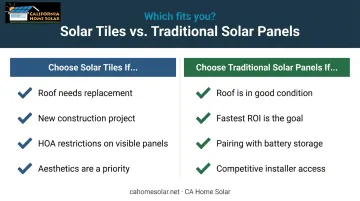
Choose solar tiles if:
- Your roof needs full replacement regardless
- You're building new construction
- Your HOA restricts visible panel installations
- Aesthetics are non-negotiable and you have the budget for a longer payback period
Choose traditional solar panels if:
- Your roof is in good condition with 10+ years of life remaining
- You want the fastest ROI and lowest upfront cost
- You're combining solar with battery storage
- You want access to a wide competitive installer market in Southern California
Impact on Home Resale Value
Both options add value. A 2019 Zillow study found homes with solar sold for 4.1% more nationally, with a 3.6% premium in Los Angeles specifically. Lawrence Berkeley National Laboratory's research found buyers paid roughly $4/W of installed PV capacity—about $15,000 for an average system.
No authoritative study has isolated a separate resale premium for solar tiles versus traditional panels. In high-design neighborhoods, tile aesthetics may influence buyer perception. For most buyers evaluating a solar home, though, a well-documented energy savings track record often matters more than design.
Either way, the decision starts with knowing what your roof can support. A professional site assessment clarifies that before you commit—something California Home Solar handles as the first step of every project.
Frequently Asked Questions
How difficult is it to replace a roof with solar panels already installed?
Removing and reinstalling panels for a roof replacement—called "detach and reset"—typically costs $1,500–$6,000 and can exceed $7,000 depending on system size, at roughly $200–$300 per panel. This is why assessing roof condition before installation matters; handling both projects together from the start avoids this cost entirely.
Are solar roof tiles as efficient as traditional solar panels?
No. The CertainTeed Apollo II runs at 15.4% efficiency, while leading monocrystalline panels like the REC Alpha Pure-RX reach 22.6%—a gap of roughly 6–7 percentage points. In practical terms, tiles require more roof area to generate the same output as a traditional panel system of equal capacity.
How much do solar roof tiles cost compared to traditional solar panels in California?
Solar tiles run approximately $3.90–$4.50/W installed, with total system costs ranging from $40,000 to over $100,000 before incentives. Traditional panels average $2.53/W in California, with a typical 8.81 kW system costing around $22,284 before incentives. Tiles cost significantly more, though the gap narrows when you're replacing an aging roof at the same time.
Do solar roof tiles qualify for the federal solar tax credit?
Yes. The IRS confirms that solar roof tiles and shingles qualify for the 30% Residential Clean Energy Credit because they serve both solar and structural functions—traditional panels qualify too. The credit applies through 2032, then steps down to 26% in 2033 and 22% in 2034. Consult a tax professional for your specific situation.
Which option adds more value to my Southern California home?
Both increase resale value. Zillow data shows a 3.6% premium for solar homes in Los Angeles, and LBNL research points to roughly $4/W in buyer value for installed PV. No study has definitively separated the two, though tile aesthetics tend to resonate in design-forward neighborhoods.
Can I install traditional solar panels on an existing tile roof in Los Angeles?
Yes, but tile roofs (clay and concrete) commonly require a "comp-out"—removing tiles beneath the array and replacing them with composite shingles before mounting the panels. This adds cost but is a well-established, standard practice among experienced LA-area installers. It protects the roof and ensures a properly waterproofed installation.