Most homeowners don't realize their roof is a significant part of the problem. A standard dark-colored roof can reach 150°F or higher on a sunny afternoon, turning your attic into an oven and forcing your air conditioner to work overtime. The right roofing upgrade can break that cycle—reducing your cooling load, lowering your utility bills, and improving comfort across every room.
This guide covers everything you need to make a smart decision: how energy efficiency in roofing is actually measured, which materials perform best in SoCal's climate, the supporting systems that amplify performance, available financial incentives, and how a new roof pairs with solar panels.
Key Takeaways
- An energy-efficient roof reflects sunlight, releases absorbed heat quickly, and resists heat transfer—cutting cooling loads and lowering electricity bills.
- For Southern California's sunny climate, metal roofing and cool-rated asphalt shingles lead on performance—clay or concrete tile are strong alternatives worth considering too.
- Lighter colors reflect more sunlight; modern reflective-pigment coatings let darker roofs hit energy performance thresholds.
- Attic insulation, ventilation, and radiant barrier underlayment amplify any roofing material's energy performance.
- Federal tax credits and HERO financing can make upgrades more accessible for California homeowners.
What Makes a Roof Energy-Efficient?
Energy efficiency in roofing comes down to three measurable properties. Each one tells you something specific about how a roof performs in the California heat.
Solar Reflectance
Solar reflectance measures the fraction of sunlight a roof surface reflects rather than absorbs. A higher value means less heat enters your home.
According to the U.S. Department of Energy, white roofing products typically reflect 60% to 90% of sunlight, while conventional dark roofs may reflect as little as 5%. The real-world impact is dramatic: reflective roofs can stay more than 50°F cooler than conventional roofs under identical sunny conditions.
The Solar Reflectance Index (SRI) combines solar reflectance and thermal emittance into a single number for easy product comparison. The Cool Roof Rating Council (CRRC) calculates SRI values using standardized reference surfaces—a standard white at SR 0.80 and a standard black at SR 0.05. This gives you a standardized way to compare products directly.
Thermal Emittance
Thermal emittance measures how quickly a roof sheds absorbed heat back into the atmosphere. Think of the difference between a metal pan and an asphalt parking lot: metal cools within minutes of leaving the sun, while blacktop radiates heat for hours after dark.
For Southern California, where evenings can cool quickly, high emittance helps your home recover faster overnight—reducing the load on your AC the following morning.
Thermal Resistance (R-Value)
R-value measures how well the entire roofing system resists heat transfer from outside into your living space. Where solar reflectance and emittance work at the surface, R-value reflects the full stack — the underlayment, insulation, and installation method all contribute to the final number.
For most LA-area homes, California's Title 24 code sets minimum insulation requirements by climate zone, but exceeding those minimums is often worth it: higher R-value reduces heat gain in summer and heat loss on cooler winter nights. A contractor can assess whether your current assembly meets code and where upgrades would have the most impact.
What This Means for LA-Area Homeowners
In Southern California's prolonged sunny seasons, solar reflectance is typically the most critical factor. California's Title 24 energy code sets minimum cool-roof requirements for new construction and re-roofing projects. Under the 2025 Energy Code (applying to permit applications on or after January 1, 2026):
| Roof Type | Climate Zones | Minimum Requirement |
|---|---|---|
| Low-slope (<2:12) | CZ 6, 8, 9, 10 | Aged SR 0.63 / TE 0.75 or SRI 75 |
| Steep-slope (≥2:12) | CZ 8, 9, 10 | Aged SR 0.20 / TE 0.75 or SRI 16 |
| Steep-slope (≥2:12) | CZ 6 | No prescriptive cool-roof requirement |
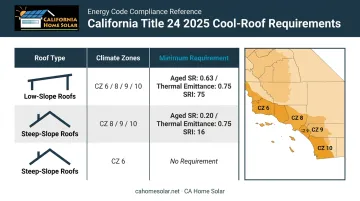
Your permit address determines your climate zone—a contractor familiar with LA-area building departments can confirm which requirements apply to your specific project.
Best Energy-Efficient Roofing Materials for Southern California Homes
No single material is right for every home. The best choice depends on budget, architectural style, HOA rules, and how long you plan to stay. That said, certain materials consistently outperform others when the sun is intense and cooling costs are high.
Metal Roofing
Metal is one of the strongest performers available. It combines high solar reflectance with high thermal emittance (the ability to release absorbed heat)—so it sheds heat rapidly rather than radiating warmth long after dark.
According to the Metal Roofing Alliance, metal roofing may save 10% to 40% in energy costs, though actual results depend on color, installation method, and existing insulation.
One often-overlooked advantage: metal roofs installed on battens (raised off the roof deck) create an air channel above the sheathing. Oak Ridge National Laboratory research found that this above-sheathing ventilation allows roofs to perform as well as—or better than—high-reflectance materials fastened directly to the deck. That air channel removes heat before it ever reaches your attic.
Key specs at a glance:
- Lifespan: 40–70 years, making it a strong base for solar panel installation
- Energy savings: 10%–40% reduction in cooling costs (Metal Roofing Alliance)
- Best for: Steep-slope roofs in sun-intensive climates
Cool-Rated Asphalt Shingles
Traditional asphalt shingles absorb heat readily, but modern cool-roof versions embed solar-reflective granules that change the performance picture considerably. Florida Solar Energy Center (FSEC) research found white asphalt shingles produced 10.2% raw cooling-energy savings and a 17% reduction in coincident peak demand compared to standard dark shingles.
When shopping, look specifically for shingles that are ENERGY STAR certified or rated by the CRRC. ENERGY STAR requires steep-slope products to meet a minimum initial solar reflectance of 0.25—a meaningful threshold above standard shingles. CRRC ratings also matter for California Title 24 compliance, where aged reflectance values control code approval.
Cool asphalt shingles offer the most accessible entry point for homeowners on a tighter budget who still want meaningful energy performance.
Clay and Concrete Tile
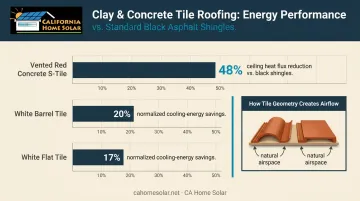
Clay and concrete tile are a natural fit for Southern California, both aesthetically and thermally. The geometry of tile (each piece slightly elevated off the roof deck) creates natural airspace beneath the surface, reducing heat transfer into the attic.
Performance data from FSEC research tells the story clearly:
- Vented red concrete S-tile reduced ceiling heat flux by 48% vs. black shingles
- White barrel and flat tile delivered 17%–20% normalized cooling-energy savings
- Lighter, glazed, or coated options improve solar reflectance further
Tile's higher thermal mass means it stores heat longer than metal. In much of Southern California, though, where evenings cool noticeably, this moderates indoor temperatures overnight rather than working against you. Concrete tile can last a lifetime with proper maintenance; clay tile routinely reaches 50–100 years, making both solid platforms for future solar panel installation.
Spray Polyurethane Foam (SPF)
Not every Southern California home has a pitched roof. For flat and low-slope roofs, common on LA commercial buildings and many residential properties, SPF is worth a close look.
SPF creates a seamless, fully adhered roofing layer with a reflective topcoat, delivering both high R-value and solar reflectance in one system. The foam fills existing surface irregularities and adds meaningful insulation value that other flat-roof systems typically don't provide.
How Roof Color Impacts Energy Efficiency
The basic principle is straightforward: lighter colors reflect more sunlight, darker colors absorb more heat. The DOE confirms white roofing products typically reflect 60% to 90% of sunlight, while cool-colored darker products using special infrared-reflective pigments typically reflect 30% to 60%.
That gap narrows considerably with modern technology. Homeowners who prefer charcoal, brown, or slate aesthetics no longer have to accept poor thermal performance. Manufacturers now embed near-infrared-reflective pigments into darker granules, allowing those shingles to meet ENERGY STAR and CRRC thresholds even at lower visible reflectance.
Those pigment ratings only matter if you're comparing the right number, though. When shopping, skip the color names and request the product's CRRC-rated aged solar reflectance value—that figure tells you exactly how the shingle performs after three years of weathering, which is what California's Title 24 code uses for compliance.
Local factors also influence how much color choice matters for your specific property:
- Marine layer along the coast reduces direct sun exposure, softening the performance gap between light and dark shingles
- Significant tree canopy can make color less critical than attic ventilation
- Steeper roof pitches receive less direct solar radiation per square foot than shallow ones
In Southern California's inland valleys—where summer temperatures regularly push past 100°F—color choice carries real weight. Coastal properties in Hermosa Beach or Malibu face a different calculus than homes in the San Gabriel Valley or Antelope Valley, where peak cooling loads are higher and the gains from high-reflectance shingles are most pronounced.
The Supporting Systems That Maximize Energy Performance
The roofing surface is only part of what determines your home's thermal performance. Attic insulation, ventilation, and underlayment form the invisible layer beneath every roof—and neglecting them can undercut even the most reflective material above.
Attic Insulation
Attic insulation acts as a thermal buffer between your roof and living space. In summer, it resists heat pushing down into your home; in winter, it keeps conditioned air from escaping upward.
CA Home Solar highlights that roughly 25% of a home's energy can be lost through the attic—which makes attic insulation one of the most impactful upgrades a Southern California homeowner can make. CA Home Solar offers attic insulation as a standalone service or as part of a broader energy-efficiency assessment, useful for homeowners who want to address the whole system rather than just the surface.
Roof Ventilation
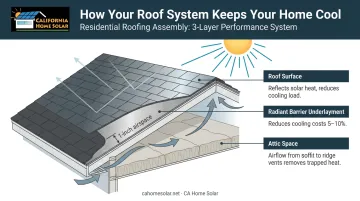
Even a highly reflective roof will underperform if heat builds up in a sealed attic. Proper ventilation—soffit intake vents combined with ridge vents at the peak—creates continuous airflow that flushes hot air out before it transfers into your living space.
CA Home Solar includes ventilation assessment as part of its roofing remodeling process. For homes that need more than passive airflow, solar attic fans are also available—these can reduce attic temperatures by up to 40°F during peak summer months.
Advanced Underlayment
Standard asphalt felt underlayment handles waterproofing but does little for thermal performance. Radiant barrier underlayments—synthetic materials with a reflective foil surface—add a measurable thermal layer to any roofing system.
The Department of Energy reports that radiant barriers in warm, sunny climates can reduce cooling costs by approximately 5% to 10%. One critical requirement: they need at least a 1-inch airspace above or below them to function effectively. Batten-installed roofing profiles deliver this naturally: the raised installation creates the airspace a radiant barrier requires, which direct-nailed systems simply can't match.
Financial Benefits, Savings, and Available Incentives
FSEC field research across 11 occupied residences found that increasing roof solar reflectance reduced cooling energy use by an average of 19%, with individual results ranging from 2% to 43% depending on existing insulation levels, home size, and climate. The same research found a 22% reduction in coincident peak demand—relevant for California homeowners subject to time-of-use electricity rates.
Federal Tax Credits
The federal Inflation Reduction Act includes the Section 25C Energy Efficient Home Improvement Credit. Key details:
- Covers 30% of qualified expenses for eligible improvements placed in service from 2023 through 2025
- Qualifying items include insulation, air-sealing materials, and certain building-envelope improvements
- Roof coverings are not confirmed as directly eligible under current IRS guidance
- Insulation and ventilation upgrades completed as part of a roofing project may qualify
Verify your specific situation with a tax professional and review current IRS guidance before filing.
Financing Options for California Homeowners
CA Home Solar is a HERO Registered Contractor and works with multiple California financing programs—including California First and YGrene—to help homeowners fund energy-efficient improvements. Note that LA County's residential PACE program stopped accepting new originations on May 13, 2020, after administrator contracts expired.
Contact CA Home Solar directly to discuss what financing paths are currently available for your property and situation.
Pairing Your Energy-Efficient Roof with Solar Panels
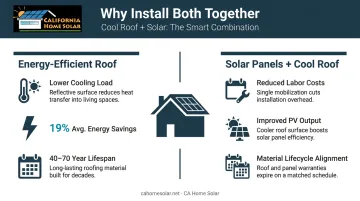
A cool roof and solar panels are genuinely complementary—not just a convenient upsell. The CRRC confirms that higher roof solar reflectance can reduce roof and panel temperatures, improving PV output. For monofacial panels, every 0.1 increase in solar reflectance yields an average 0.7% increase in annual energy production. That's a modest but real gain on top of the cooling-load reduction the roof provides independently.
The practical case for doing both together:
- Reduced labor costs: One mobilization, one permit process, one project manager
- No panel removal: Installing a new roof before panels go up avoids the future cost of removing and reinstalling an array for an early roof replacement
- Material alignment: Long-lived materials—metal (40–70 years) or tile (50+ years)—are far better matches for a 25-year solar system than asphalt shingles, which may need replacement mid-panel-lifecycle
Both upgrades handled by a single contractor makes that material alignment easier to get right. California Home Solar installs energy-efficient roofing and solar systems throughout Southern California—serving Los Angeles County, Orange County, and communities across the region. For homeowners who want both upgrades handled without juggling multiple contractors, call 877-903-1012 or email info@cahomesolar.com for a free consultation.
Frequently Asked Questions
What type of roof is most energy-efficient?
Metal roofing consistently ranks highest due to its combination of high solar reflectance and rapid thermal emittance. Cool-rated asphalt shingles and clay or concrete tile are strong alternatives: shingles work well for budget-conscious projects, while tile suits homeowners wanting longevity and a traditional SoCal aesthetic.
Does a new roof qualify for an energy tax credit?
The federal Section 25C credit covers 30% of qualified energy-efficient home improvements, but roof coverings themselves weren't confirmed as directly eligible in current IRS guidance. Insulation and air-sealing upgrades done as part of a roofing project may qualify—verify your specific situation with a tax professional or at IRS.gov.
How much can an energy-efficient roof save on energy bills?
FSEC research on occupied residences found an average 19% reduction in cooling energy use from increased roof solar reflectance, with a range of 2%–43%. Actual savings depend on your climate zone, home size, current insulation levels, and the material you choose.
What is a cool roof and how does it work?
A cool roof combines high solar reflectance with high thermal emittance, keeping the surface more than 50°F cooler than a conventional dark roof under identical sunny conditions. It reflects sunlight back into the atmosphere and sheds any absorbed heat quickly, transferring far less into your home.
Does roof color really affect energy efficiency?
Yes, but modern reflective-pigment technology has closed much of the gap. Lighter colors still outperform darker ones, but CRRC-rated cool-colored shingles can meet Title 24 and ENERGY STAR thresholds even in darker shades—so you don't have to choose a white roof to see real energy benefits.
Can I install solar panels on an energy-efficient roof?
Solar panels and energy-efficient roofing are highly compatible, and a cooler roof can actually improve panel output slightly. Pair your panels with a long-lasting material like metal or tile, and consider installing both at the same time to save on labor and avoid pulling the array off for an early roof replacement. In Southern California's sunny climate, that combination pays dividends fast.