Introduction
HVAC systems are the single largest energy expense in most commercial buildings, yet property managers often ignore them until something fails. At that point, months of inflated utility costs have already accumulated.
According to EIA's 2018 Commercial Buildings Energy Consumption Survey, HVAC-related end uses — space heating, cooling, and ventilation — account for roughly 52% of commercial building energy consumption. That's more than half your utility bill tied to one controllable system.
For LA-area property owners, the pressure compounds quickly:
- Utility rates continue to climb year over year
- California's Title 24 energy code keeps tightening its requirements
- LA's EBEWE program now holds large commercial buildings accountable through mandatory benchmarking and audits
- Tenants increasingly expect comfortable, sustainable spaces that aging equipment can't reliably provide
This guide covers what you need to know: the main system types, how to read efficiency ratings, upgrade economics and payback timelines, available incentives, and the operational factors that determine whether a new system actually delivers on its potential.
TL;DR: Key Takeaways
- HVAC-related end uses make up roughly 52% of commercial energy consumption — the highest-impact area for cost reduction
- VRF systems can save 34–45% versus older equipment; next-generation RTUs up to 50% versus conventional units
- Efficiency is measured by SEER2 and EER2; the federal minimum for three-phase commercial units under 65,000 Btu/h is now 13.4 SEER2
- The IRS Section 179D deduction starts at $0.58/sf and can reach $5.81/sf with prevailing wage compliance
- Proper sizing, regular maintenance, and envelope improvements determine whether a new system actually delivers its rated efficiency
Why HVAC Efficiency Matters More in Commercial Buildings
Space heating accounts for about 32%, cooling for roughly 10%, and ventilation for another 10% of commercial energy use — 52% combined, per EIA data. No other building system comes close as a cost-reduction target.
Commercial buildings face a fundamentally different challenge than residential properties. Larger floor plates, variable occupancy throughout the day, mixed-use zones with competing temperature needs, and strict code compliance requirements all amplify the cost of running an inefficient system.
A leaky, oversized, or poorly controlled system wastes energy continuously — at scale, hour after hour, across tens of thousands of square feet.
The Southern California Factor
In the LA Basin and Orange County, cooling loads dominate most of the calendar year. That asymmetry matters. Buildings in climates with balanced heating and cooling seasons spread inefficiency across both modes; SoCal commercial buildings concentrate it almost entirely on the cooling side, where compressor runtime and electricity costs run highest.
Title 24 and LA's EBEWE Program
California's 2025 Energy Code applies to permit applications filed on or after January 1, 2026. Any HVAC replacement requiring a permit now triggers Title 24 Part 6 compliance, including:
- Economizer requirements above 33,000 Btu/h
- Demand-controlled ventilation for applicable spaces
- DDC sequences and acceptance testing
For larger properties, Los Angeles's EBEWE program covers privately owned buildings of 20,000 sf or more. Annual benchmarking is due June 1 each year, and an audit/retro-commissioning review is required every five years. Non-compliance carries a $202 fee, a 250% late charge after 30 days, and 12% annual interest after 60 days.
In short, regulators have made the cost of an underperforming system explicit — and enforceable.
Types of Energy-Efficient HVAC Systems for Commercial Buildings
No single system fits every building. The right choice depends on square footage, layout, occupancy patterns, zone complexity, and budget. Here's how the main options compare.
Variable Refrigerant Flow (VRF) Systems
VRF systems use refrigerant — rather than ducted air — as the medium flowing between a single outdoor unit and multiple indoor air handlers. Each zone gets precise, independent temperature control, and the system modulates capacity based on actual demand rather than running at full output continuously.
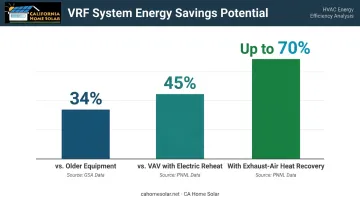
The efficiency evidence is strong. A GSA evaluation found VRF systems achieving 34% energy savings versus older equipment, while PNNL modeling showed 45% cost savings compared to VAV systems with electric reheat, with potential HVAC energy savings up to 70% when exhaust-air heat recovery is added.
VRF systems work best in buildings between 5,000 and 100,000 sf with distinct zones, including:
- Office complexes and mixed-use properties
- Retail centers and healthcare facilities
- Retrofit projects where duct space is limited
Typical system lifespan runs around 15 years. The tradeoff is higher upfront cost (roughly $2–$6/sf incremental) and proprietary components that can complicate long-term serviceability.
Heat Pump Systems
Heat pumps move heat rather than generate it, which is why they're far more efficient than resistance-based heating. According to DOE, heat pumps can deliver 3 to 5 times the energy they consume in electricity — a performance ratio no combustion system can match.
For Southern California commercial properties, this is especially practical. Heating demand is minimal most of the year, so a heat pump handles year-round conditioning without the need for a separate furnace. California's 2025 Energy Code also now requires single-zone systems of 240,000 Btu/h or less to be heat pumps for certain retail, school, and office occupancies in most climate zones — making this less a choice and more a near-term compliance requirement for many buildings.
CA Home Solar's HVAC team installs heat pump systems designed for Southern California's commercial properties, where the mild climate lets heat pumps operate at peak efficiency through most of the year.
Smart and Building Automation HVAC Systems
Even the most efficient equipment underperforms when it's operated poorly. Controls and automation are what close the gap between rated efficiency and real-world performance.
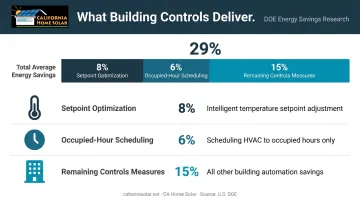
DOE research found that building controls deliver an average of 29% total energy savings across commercial buildings, including 8% from setpoint optimization alone and 6% from occupied-hour scheduling. Smart HVAC platforms add remote monitoring, real-time energy tracking, fault detection, and occupancy-based adjustments — layering operational savings on top of hardware efficiency. For multi-zone commercial buildings, controls typically offer the shortest payback period of any HVAC upgrade — often under three years when combined with occupancy scheduling.
Geothermal HVAC Systems
Geothermal systems tap stable underground temperatures to heat and cool buildings, reaching 300–600% efficiency and cutting energy use 25–50% versus conventional air-source systems, per DOE data. Once the ground loop is in place, operating costs are minimal.
The main barrier is upfront installation. Ground-loop infrastructure is site-dependent — feasibility varies based on available land, soil conditions, and structural access. DOE cites a typical payback of 5–10 years for commercial applications, which means geothermal makes the most sense for large properties with long holding periods where that timeline pays off.
Understanding HVAC Efficiency Ratings: SEER2, EER2, and What They Mean
Two ratings appear most often when evaluating commercial HVAC equipment:
- SEER2 (Seasonal Energy Efficiency Ratio): Measures cooling output over an entire cooling season divided by total energy input. Higher SEER2 = lower seasonal operating costs.
- EER2 (Energy Efficiency Ratio): Measures efficiency at a specific operating condition — typically peak load. Better for evaluating performance during the hottest days.
Both metrics were updated to the SEER2/EER2 standard in 2023 to reflect more realistic static pressure testing conditions. Ratings under the new standard are slightly lower numerically than their predecessors but represent comparable real-world performance.
Current Federal Minimums
| Equipment Type | Federal Minimum (Effective Jan. 1, 2025) |
|---|---|
| Three-phase single-package AC under 65,000 Btu/h | 13.4 SEER2 |
| Three-phase split AC under 65,000 Btu/h | 13.4 SEER2 |
| Three-phase single-package heat pump under 65,000 Btu/h | 13.4 SEER2 / 6.7 HSPF2 |
| Three-phase split heat pump under 65,000 Btu/h | 14.3 SEER2 / 7.5 HSPF2 |
ENERGY STAR's light commercial criteria set a higher voluntary benchmark — 15.2 SEER2 and 12.0 EER2 for qualifying split systems — and are worth targeting for buildings where operating costs matter long-term.
What This Means for Purchasing Decisions
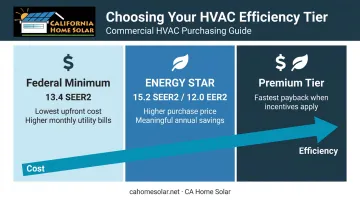
Meeting the federal minimum satisfies code — nothing more. Here's how the tiers compare in practice:
- Federal minimum (e.g., 13.4 SEER2): Lowest upfront cost; higher monthly utility bills over time
- ENERGY STAR threshold (15.2 SEER2 / 12.0 EER2): Higher purchase price, but meaningful reductions in operating costs each year
- Payback timeline: The efficiency premium typically pays for itself within a few years through utility savings, often faster when federal tax credits or utility rebates apply
The Financial Case: ROI, Cost Savings, and Available Incentives
Energy Savings Potential
Savings vary by measure, building, and existing conditions — so ranges matter more than single figures. Some benchmarks from independent sources:
- VRF vs. older systems: 34–45% energy savings (GSA/PNNL)
- Next-generation RTUs vs. conventional: Up to 50% energy cost reduction (DOE)
- Building controls alone: Average 29% total energy savings (DOE)
- ENERGY STAR Energy Treasure Hunts: 15%+ facility energy reduction
The higher end of any range requires proper sizing, good controls, and consistent maintenance. Buildings that check all three boxes consistently outperform those that just swap equipment.
Section 179D Tax Deduction
The IRS Section 179D provision applies to commercial property owners who make qualifying energy-efficient improvements — including HVAC, ventilation, hot water, lighting, and envelope upgrades. Key details:
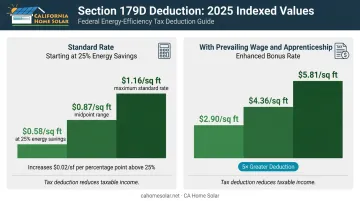
- Deduction starts at $0.58/sf for 25% energy savings
- Increases by $0.02/sf per percentage point above 25%
- 2025 indexed values: $0.58–$1.16/sf standard, or $2.90–$5.81/sf with prevailing wage and apprenticeship requirements
- This is a tax deduction, not a credit — it reduces taxable income, not the tax bill directly
Beyond federal tax benefits, California property owners can stack additional savings through utility rebate programs.
California Utility Rebate Programs
- Southern California Edison offers business energy efficiency programs, On-Bill Financing, GoGreen Business Energy Financing, and Building Improvement Consulting for commercial customers
- SoCalGas runs an Equipment Rebate program open to commercial customers, with space-heating boiler rebates at $0.50–$3 per MBtuh and commercial hot-water boiler rebates at $5–$9 per kBtuh (program cap of $500,000/site)
- The CPUC regulates investor-owned utility efficiency programs through 2031 — current eligibility and amounts should be confirmed directly with your utility
PACE / C-PACE Financing
Unlike rebates, C-PACE is a financing mechanism — one that lets you fund upgrades now and repay costs over time rather than out of pocket.
C-PACE (Commercial Property Assessed Clean Energy) financing lets California commercial property owners fund HVAC upgrades with no large upfront payment. Costs are repaid as a line item on property taxes over terms typically ranging from 5 to 25 years. California Home Solar works with HERO, California First, and Ygrene — all registered PACE programs available to eligible commercial properties.
The $5,000 Rule and the 30–50% Threshold
These are contractor rule-of-thumb guidelines, not formal ASHRAE or ACCA standards — but they're useful starting points:
- $5,000 rule: Multiply the system's age (in years) by the estimated repair cost. If the result exceeds $5,000, replacement typically makes more financial sense than repair.
- 30–50% threshold: If a repair costs 30–50% of the system's replacement value, replacement is generally the better long-term decision.
Use these as screening tools, not final answers. A lifecycle cost analysis from a qualified contractor will show whether repair or replacement pencils out for your specific building.
Key Factors That Maximize Energy Savings
Choosing efficient equipment is only part of the equation. Installation quality, maintenance practices, and the building envelope determine whether those efficiency ratings translate to actual utility bill reductions.
Proper System Sizing
An oversized system short-cycles — turning on and off too frequently — which reduces efficiency, increases mechanical wear, and causes humidity control problems. An undersized system runs continuously without reaching setpoint. Both conditions waste energy and accelerate component failure.
ACCA Manual N is the standard commercial load calculation methodology. Any qualified HVAC contractor should run a full load calculation before recommending system capacity. Skipping this step is one of the most common reasons commercial HVAC projects underperform.
Preventive Maintenance
ENERGY STAR notes that blocked vents and poorly maintained equipment can require as much as 25% more energy to achieve the same output. ASHRAE Standard 180 establishes minimum commercial HVAC inspection and maintenance requirements, covering filter replacement, coil cleaning, refrigerant charge checks, controls calibration, and system performance verification.
Deferred maintenance creates a gap between a system's rated SEER2 and what it actually delivers. A 16 SEER2 unit running with a dirty coil and low refrigerant charge performs well below that rating — regardless of what the spec sheet says.
Building Envelope and Duct Integrity
HVAC systems don't operate in isolation. Duct leakage, poor insulation, and single-pane windows all add load the system must overcome — and that load compounds over thousands of operating hours. LBNL research on large commercial duct systems found many measured installations leakier than ASHRAE's unsealed-duct reference case.
Key envelope and distribution improvements worth addressing alongside any HVAC upgrade:
- Duct sealing — reduces conduction and leakage losses before they reach the equipment
- Attic and wall insulation — cuts solar heat gain and thermal transfer through the building shell
- Low-E window installation — limits radiant heat load without sacrificing natural light
- Cool roof technology — reflects solar energy before it enters the building
CA Home Solar provides all of these envelope upgrades alongside HVAC work, so the improvements are coordinated rather than piecemeal. A smaller load means less runtime, lower energy consumption, and longer equipment life. Each improvement builds on the others: a better envelope compounds the savings from a more efficient system.
Frequently Asked Questions
What is the most energy-efficient HVAC system for commercial buildings?
VRF systems and heat pumps consistently rank among the most efficient options. In Southern California's warm climate, both deliver strong results: VRF excels in multi-zone buildings, while heat pumps are increasingly required under California's 2025 code for single-zone commercial systems.
What are common rules of thumb for deciding between repair and replacement?
The $5,000 rule: multiply system age by repair cost. If it exceeds $5,000, replacement is often more cost-effective. The 30–50% threshold: if repair costs approach 30–50% of replacement cost, replacement typically wins financially. Both are starting points, not formal standards.
How much can an energy-efficient HVAC system save a commercial building annually?
Savings commonly range from 20–50% depending on how old the existing system is, what replacement technology is chosen, and how well the new system is maintained. Controls improvements alone average 29% total energy savings in commercial buildings, per DOE data.
What SEER2 rating should a commercial HVAC system have?
The federal minimum is 13.4 SEER2 for most three-phase commercial units under 65,000 Btu/h. ENERGY STAR light commercial criteria set a higher benchmark at 15.2 SEER2. For buildings in warm climates like Southern California, targeting ENERGY STAR thresholds or above typically delivers the fastest payback on the efficiency premium.
How long does it take for an energy-efficient commercial HVAC upgrade to pay for itself?
Most commercial upgrades pay back within 3–7 years when Section 179D deductions, SCE/SoCalGas rebates, and annual energy savings are combined. Controls-based improvements tend to land at the shorter end of that range, while full equipment replacements typically fall toward the middle.
Are there tax incentives or rebates for commercial HVAC upgrades in California?
Yes. Commercial property owners can access the IRS Section 179D deduction (up to $5.81/sf with prevailing wage compliance), SCE and SoCalGas equipment rebate programs, and C-PACE financing options like HERO, California First, and Ygrene. CA Home Solar is a registered contractor for all three C-PACE programs and can help coordinate the full incentive stack.