For LA-area property owners, that number hits harder. Southern California's hot summers mean cooling systems run hard, and California's 2025 Energy Code (Title 24) takes effect for permit applications starting January 1, 2026 — introducing updated ventilation standards, new heat-recovery acceptance testing requirements, and expanded electric-readiness mandates for commercial buildings.
Add rising utility rates, updated federal efficiency standards, and expanded tax deductions under the Inflation Reduction Act, and the case for upgrading now becomes hard to argue with.
This guide covers the five highest-impact HVAC upgrades for commercial buildings in 2026, how to evaluate which upgrade fits your property, and what to look for in a contractor.
Key Takeaways
- Commercial HVAC accounts for over half of a building's energy use — targeted upgrades typically cut energy costs 20–40%, with payback periods under five years
- Top 2026 upgrades include VRF systems, smart building automation, energy recovery ventilators, and solar-integrated heat pumps
- California's 2025 Title 24 code applies to all permit applications from January 1, 2026 — scope projects against the new requirements before pulling permits
- Section 179D tax deductions offer $0.58–$5.81/sq ft depending on prevailing wage compliance
- No single upgrade fits every building — this guide matches each option to your building type, occupancy pattern, and budget
Why 2026 Is the Right Time to Upgrade Your Commercial HVAC
Efficiency Standards Have Changed
HVAC equipment manufactured after January 1, 2023 must meet new federal minimum efficiency standards. Current minimums for commercial packaged air-cooled units are:
- 65,000–135,000 Btu/h range: 14.8 IEER minimum
- 135,000–240,000 Btu/h range: 14.2 IEER minimum
Systems built before these thresholds are increasingly out of step with current benchmarks. When you factor in maintenance costs and downtime, running aging equipment is rarely the economical choice it appears to be.
Note: commercial packaged units are rated by IEER/EER/COP, not SEER2. SEER2 applies to light commercial split systems under 65,000 Btu/h and residential equipment.
California-Specific Drivers
California's 2025 Energy Code applies to permit applications from January 1, 2026. Key nonresidential HVAC changes include:
- Updated minimum ventilation and exhaust rates
- New acceptance testing requirements for DOAS, HRV, and ERV systems
- Prescriptive requirements for mechanical heat recovery
- Electric readiness mandates for commercial kitchens
- 2025 CALGreen (Title 24 Part 11) also takes effect January 1, 2026
Property owners who delay upgrades risk designing projects against an outdated code version, which can mean costly permit revisions or missed incentive windows tied to qualifying systems.
Acting before those windows close also positions you to capture current utility rebates. Available programs include:
- SoCalGas: $3,000/unit for Heat Recovery Rooftop Units (minimum 10-ton cooling capacity); 2025 installation applications due January 31, 2026
- SCE Business Programs: Express Solutions, Customized Solutions, and On-Bill Financing — verify current HVAC rebate amounts directly with SCE, as incentive schedules change
The Section 179D Deduction
Beyond state programs, a federal incentive applies directly to qualifying HVAC projects. The Inflation Reduction Act expanded the Section 179D commercial building energy efficiency tax deduction. HVAC systems can qualify if a certified analysis confirms at least a 25% reduction in total annual energy and power costs against the applicable ASHRAE 90.1 reference building.
Current official deduction amounts:
- Base rate: $0.58–$1.16/sq ft
- With prevailing wage and apprenticeship: $2.90–$5.81/sq ft
Verify current 2026 inflation-adjusted rates with a tax professional and your HVAC contractor before finalizing project financials.
Top HVAC Upgrades for Commercial Buildings in 2026
These five upgrades were selected based on energy savings potential, compatibility with California's climate and regulatory environment, and demonstrated ROI for commercial properties.
Variable Refrigerant Flow (VRF) Systems
VRF systems precisely modulate refrigerant flow to match real-time demand across different building zones, eliminating the constant on/off cycling that makes traditional rooftop units so wasteful. Instead of conditioning an entire floor to satisfy one thermostat, VRF delivers exactly what each zone needs, when it needs it.
For multi-zone commercial buildings (offices, retail centers, medical facilities, mixed-use developments), that precision translates directly to cost control. Southern California's commercial real estate landscape is particularly well-suited: a building that houses a warm server room on one side and a cold-storage area on another can simultaneously heat and cool different zones using the same refrigerant circuit, with waste heat from one area repurposed to condition another.
GSA Proving Ground findings show commercial VRF systems commonly achieve 16–20+ IEER, with preliminary data indicating 34% or higher HVAC energy cost savings in targeted buildings. ORNL measured one VRF installation using 17% to 73% less energy than a rooftop VAV baseline in a light-commercial test facility.
| Factor | Detail |
|---|---|
| Best Fit | Multi-zone commercial buildings: offices, retail, mixed-use, medical |
| Efficiency Metric | 16–20+ IEER (GSA findings) |
| Energy Savings vs. Traditional Systems | 17–73% less energy vs. rooftop VAV baseline (ORNL); 34%+ HVAC cost savings (GSA) |
| Cost Screening Benchmark | GSA recommends targeting buildings where VRF cost premium is under $4.00/sq ft |
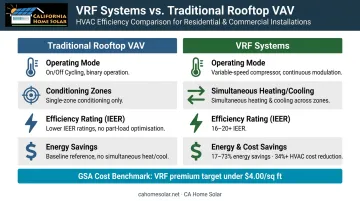
VRF retrofits work best in buildings where refrigerant piping runs are manageable, zoning complexity is high, and part-load operation is the norm — which describes most LA-area commercial properties.
Smart Thermostats and Building Automation Systems (BAS)
Modern commercial building controls go well beyond scheduling. Today's BAS platforms deliver measurable returns across several fronts:
- Use occupancy sensors and real-time weather feeds to continuously right-size heating and cooling output, reducing energy use in unoccupied zones
- Cut commercial HVAC energy use by up to 30%, per DOE data, with fault detection and diagnostics specifically showing median savings of 9% and payback of 1–2 years
- Allow facility managers across multi-location LA metro properties to monitor temperature, airflow, and energy consumption remotely from a single dashboard
| Factor | Detail |
|---|---|
| Key Features | Occupancy-based setback, remote monitoring, fault detection, energy reporting |
| Compatibility | Works with most modern HVAC systems; often retrofittable onto existing infrastructure |
| Payback Period | 1–2 years for EIS/FDD; under 5 years for full automated optimization (GSA/DOE data) |
| Software Cost Benchmark | ~$0.02/sq ft basic EMIS; ~$0.10/sq ft full automated optimization |
Controls are typically the right first upgrade — they generate near-term savings, reveal where larger equipment investments will deliver the highest return, and require minimal installation disruption.
Advanced Indoor Air Quality (IAQ) and Filtration Systems
California's wildfire seasons have made indoor air quality a direct operational concern for Southern California commercial properties. During smoke events, buildings without upgraded filtration see measurable spikes in particulate matter indoors, creating liability exposure and productivity losses that cost far more to remediate than to prevent.
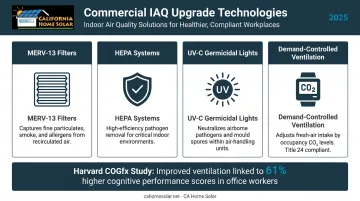
Upgrading to MERV-13 or higher filters, HEPA systems, or UV-C germicidal lights provides measurable protection against smoke particles, allergens, and airborne pathogens. Harvard's COGfx research found that cognitive function test scores doubled in green building conditions with enhanced ventilation versus conventional settings — with the productivity value exceeding the energy cost of enhanced ventilation by more than 150 times.
Demand-controlled ventilation (DCV) is a complementary upgrade: CO₂ sensors adjust fresh air intake based on actual occupancy, preventing energy waste from over-ventilating empty conference rooms while maintaining air quality standards. This directly supports California's Title 24 ventilation compliance requirements, which set minimum ventilation rates that updated in the 2025 code cycle.
| Factor | Detail |
|---|---|
| Technology Options | MERV-13 filters, HEPA systems, UV-C germicidal lights, activated carbon filtration, DCV |
| California Relevance | Title 24 ventilation standards; 2025 code updates minimum ventilation/exhaust rates |
| Productivity Impact | Cognitive performance doubled under enhanced ventilation conditions (Harvard COGfx) |
Energy Recovery Ventilators (ERVs)
ERVs transfer heat and moisture between outgoing stale air and incoming fresh air, pre-conditioning the incoming air before it reaches the HVAC system. In Southern California's hot, dry summers, that means the cooling load is reduced before it ever reaches the compressor — directly cutting energy consumption without sacrificing air quality or ventilation rates.
ERVs also address humidity imbalances common in tightly sealed commercial buildings. Unchecked humidity swings create the conditions for mold growth and tenant complaints, both of which are far more costly to remediate than to prevent. Integration with existing ductwork keeps ERV installation costs well below a full system replacement.
Two code requirements make ERVs a compliance consideration on most LA-area commercial projects:
- California 2025 Title 24 now requires acceptance testing for HRV and ERV systems on all permitted projects
- 2018 IECC commercial mechanical requirements mandate energy recovery ventilation for fan systems above specified airflow thresholds, with at least 50% exhaust-air total recovery efficiency
| Factor | Detail |
|---|---|
| Primary Benefit | Reduces HVAC load by pre-conditioning incoming air; improves humidity balance |
| Best Application | Hot/dry climates like Southern California; mixed-use and tightly sealed commercial buildings |
| Installation Complexity | Moderate; typically integrates with existing ductwork — timeline varies by airflow, duct access, and economizer configuration |
| California Code Relevance | 2025 Title 24 adds ERV/HRV acceptance testing requirements |
Solar-Integrated Heat Pump Systems
Pairing a commercial heat pump with rooftop solar creates a system where daytime solar output directly powers HVAC operation. Heat pumps move heat rather than generate it, making them inherently more efficient than combustion-based systems — federal minimums set heating COP at 3.3–3.4 for commercial packaged units, meaning they deliver 3.3+ units of heat for every unit of electricity consumed. Solar generation offsets that electricity cost, compounding the savings.
California's Net Billing Tariff (NEM 3.0), which applies to interconnection applications from April 15, 2023 onward, compensates solar exports at avoided-cost rates rather than retail rates. That shifts the financial priority toward maximizing on-site consumption, and daytime HVAC loads from a heat pump are an ideal match for daytime solar generation. This combination also supports California's building electrification direction and positions commercial properties for long-term compliance.
CA Home Solar has 36 years of experience serving Southern California commercial and residential properties, offering both solar installation and HVAC upgrade services. The company works with financing programs including HERO to help property owners coordinate and fund these projects.
| Factor | Detail |
|---|---|
| Efficiency Advantage | Heat pump COP 3.3–3.4 (federal minimum); solar offsets electrical operating costs |
| Incentive Eligibility | Section 48E Clean Electricity Investment Credit (base 6%, up to 30% with PWA); Section 179D for efficiency; SCE/SoCalGas commercial rebates |
| Ideal For | Buildings with existing or planned rooftop solar; properties targeting net-zero or electrification goals |
How to Choose the Right HVAC Upgrade for Your Building
The most common mistake commercial property owners make is selecting an upgrade based on upfront price without first conducting a proper load calculation and energy audit. An undersized or oversized system wastes money regardless of its efficiency rating.
Key Evaluation Factors
Before committing to any upgrade, assess:
- Current system age — Commercial rooftop units typically last 15–20 years; air-cooled chillers around 20 years; water-cooled chillers up to 23 years. Systems approaching these thresholds — especially those using outdated refrigerants — are strong candidates for replacement rather than repair
- Building square footage and occupancy patterns — High-variability occupancy favors VRF and BAS; stable, single-zone occupancy may be well-served by a high-efficiency packaged unit
- Existing ductwork condition — Leaking or undersized ducts undermine any new system's performance; duct assessment should precede equipment selection
- Utility incentive availability — SoCalGas and SCE rebate programs change; a qualified local contractor can confirm current eligibility before you finalize your budget
- Title 24 compliance requirements — Projects permitted from January 1, 2026 fall under the 2025 code; scope HVAC upgrades against the new standards early
Sequencing Your Investment
Not every upgrade requires the same capital outlay. Here's a sequencing approach that matches payback speed to project complexity:
- Controls and IAQ first — Fault detection systems typically pay back in 1–2 years with minimal installation disruption and immediate energy feedback
- Add ERVs next — Reduces ventilation loads cost-effectively by working with existing ductwork rather than replacing it
- Replace aging equipment with VRF or high-efficiency packaged units — Best timed around system age thresholds, code compliance deadlines, or refrigerant phase-outs
- Integrate solar last — Size the array to match heat pump and HVAC daytime loads for optimal NEM 3.0 economics
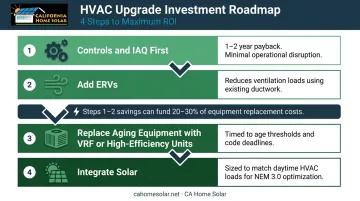
In practice, the energy savings from Steps 1 and 2 often cover 20–30% of the capital required for equipment replacement — making the sequencing financially self-reinforcing, not just logical.
Conclusion
No single upgrade applies to every building. The right combination of VRF systems, smart automation, advanced IAQ, ERVs, and solar-integrated heat pumps depends on building type, occupancy patterns, energy goals, and budget.
The financial context, however, is consistent: IRA incentives, California's 2025 Title 24 code taking effect in 2026, and rising commercial utility rates across Southern California have created a genuinely favorable window to act.
That window rewards a phased approach. Treat HVAC upgrades as a capital investment rather than a single expense — start with a professional energy audit to identify quick wins, then build a multi-year plan that layers in larger equipment as near-term savings accumulate.
CA Home Solar has spent 36 years helping commercial and residential property owners across the Los Angeles area with HVAC installations, solar integration, and energy-efficiency upgrades. Financing options include the HERO program. Contact CA Home Solar for a consultation at 877-903-1012 or info@cahomesolar.com.
Frequently Asked Questions
Which HVAC system is best for a commercial building?
The best system depends on building size and zone complexity. VRF systems are widely regarded as top performers for multi-zone commercial buildings due to their precision and heat-recovery capability, while high-efficiency packaged rooftop units remain practical for simpler, single-zone spaces. A proper load calculation should drive the decision.
What is the 2-foot rule in HVAC?
The 2-foot rule refers to the minimum clearance distance required around HVAC equipment — particularly condenser units — to ensure adequate airflow, safe operation, and compliance with manufacturer specifications and local building codes. Insufficient clearance degrades efficiency and can void equipment warranties.
How much does a commercial HVAC upgrade cost?
Costs vary widely by system type, building size, and installation complexity. VRF retrofits are most cost-effective in buildings where the installation cost premium stays under $4.00/sq ft (GSA benchmark). BAS/EMIS software runs roughly $0.02–$0.10/sq ft.
Are there tax incentives for commercial HVAC upgrades in 2026?
Yes. Section 179D allows commercial building owners to claim $0.58–$5.81/sq ft for HVAC systems that achieve at least 25% certified energy cost savings versus the ASHRAE 90.1 reference standard. The higher rates require prevailing wage and apprenticeship compliance. Verify current 2026 inflation-adjusted amounts with a tax professional.
How long does a commercial HVAC system last before replacement?
Commercial rooftop units typically last 15–20 years; air-cooled chillers around 20 years; water-cooled chillers up to 23 years (ASHRAE data). Systems nearing these thresholds — especially those running phased-out refrigerants or lacking smart controls — are strong candidates for proactive replacement over continued repair.
What is the ROI on a commercial HVAC upgrade?
Payback periods vary by upgrade type. BAS and fault detection systems typically pay back in 1–2 years. Full automated EMIS optimization runs under 5 years in GSA modeling. VRF systems show 34%+ HVAC energy cost savings in targeted applications.