Introduction
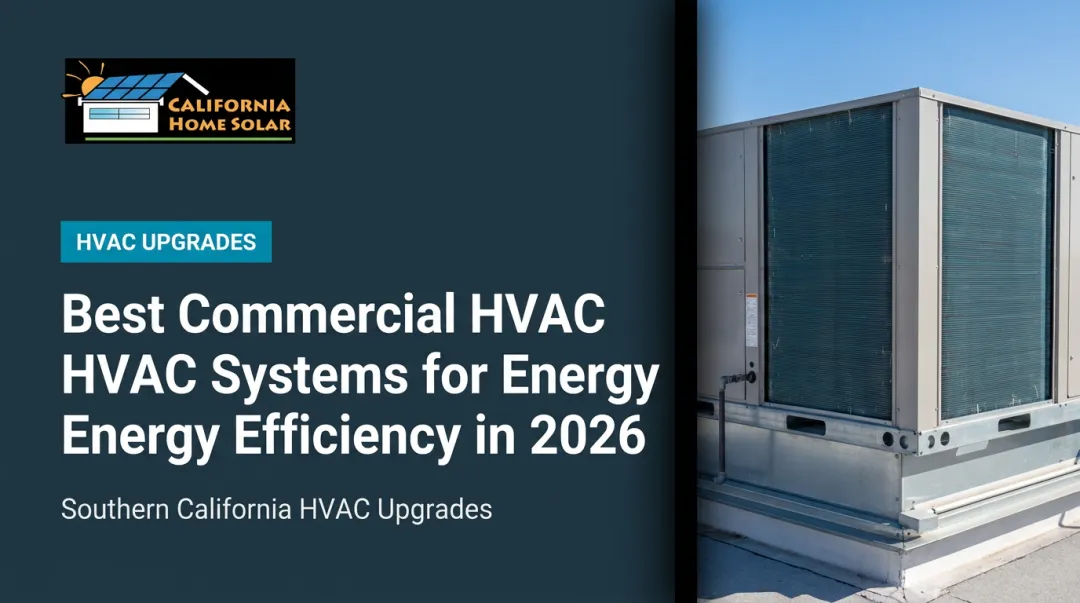
Southern California commercial property owners face a compounding problem. Year-round cooling demand, energy costs that keep climbing, and building stock where HVAC systems are often well past their prime — it's a combination that turns an aging rooftop unit into a serious liability.
The symptoms show up fast: utility bills that spike without explanation, hot spots on one side of the building while the other stays frigid, repair techs on speed dial, systems still running refrigerants the EPA phased out years ago. Add California's Title 24 energy code requirements, and the pressure to act becomes hard to ignore.
This guide covers:
- Warning signs your commercial HVAC system is nearing the end
- Which upgrades deliver the best return on investment
- The real financial benefits of modernizing your system
- Funding options including federal tax deductions, utility rebates, and PACE financing
Key Takeaways
- HVAC systems over 15 years old cost more to run and repair — and the gap widens every year.
- The highest-impact upgrades: VRF systems, building automation, energy recovery ventilators, advanced filtration, and zoned climate control.
- HVAC accounts for roughly 30% of commercial building energy consumption — modern systems can cut that share substantially.
- Upfront costs are offset by the federal 179D deduction, SoCalGas rebates, SCE financing, and PACE programs.
- Title 24 compliance and year-round cooling demand make efficiency upgrades especially high-priority for LA-area commercial buildings.
Signs Your Commercial HVAC System Is Due for an Upgrade
Age and Compounding Inefficiency
Most commercial HVAC equipment has a practical service life of 15–20 years, though performance typically degrades well before the system fully fails. According to the DOE Better Buildings program, rooftop units older than 15 years can waste substantial energy compared to modern high-efficiency models — and rooftop units currently provide cooling for nearly 50% of U.S. commercial building floor area.
Age alone isn't the whole story. LBNL research covering more than 60,000 pieces of HVAC equipment across 90 million square feet found that on any given day, roughly 40% of air handling units and 30% of air terminal units had at least one reported fault. Many of those faults go undetected until the utility bill arrives.
Performance Red Flags to Watch For
Don't wait for a breakdown to evaluate your system. These are clear signals it's time for a serious assessment:
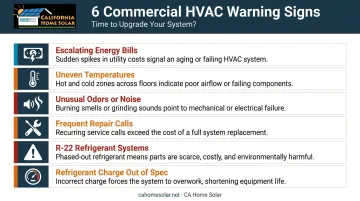
- Escalating energy bills with no change in usage or occupancy
- Uneven temperatures across zones — common offices running hot while conference rooms stay cold
- Unusual odors or noise from ducts or equipment
- Frequent repair calls that cost more each time
- R-22 refrigerant systems : the EPA completed its R-22 phase-out on January 1, 2020, and virgin R-22 is no longer produced, making servicing more expensive and hard to source
- Refrigerant charge out of spec — an ACEEE study found refrigerant charge was incorrect in more than 40% of tested commercial systems; correcting it alone can recover about 5% of cooling energy
Compliance Pressure
California's 2022 Title 24 nonresidential energy code introduced updated minimum efficiency requirements across equipment categories, including new heat pump mandates for certain single-zone DX cooling systems and demand-responsive thermostat requirements when air handlers or condensing units are replaced.
The DOE's 2023 efficiency standard updates introduced SEER2, EER2, and HSPF2 metrics. Systems rated under the old SEER/EER methodology may no longer meet current minimums, and operating a non-compliant system exposes building owners to regulatory risk during any permitted renovation or change of occupancy.
Top Commercial HVAC Upgrades to Maximize Efficiency
Upgrade to a Variable Refrigerant Flow (VRF) System
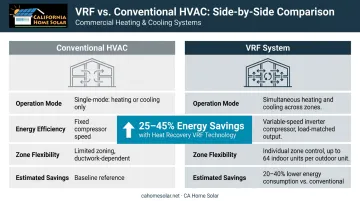
VRF systems operate differently from conventional commercial units. Rather than cycling fully on or off, they modulate refrigerant flow in real time to match actual demand. Heat recovery VRF configurations go further — simultaneously cooling one zone while heating another by transferring heat between spaces instead of exhausting it outside.
DOE research found VRF and ductless heat pumps offer approximately 25% energy savings over conventional systems. GSA preliminary findings modeled savings of 34–45% depending on the baseline system replaced. For large or mixed-use commercial buildings in the LA area — where cooling loads shift throughout the day — that load-matching flexibility translates directly to lower bills.
Install Smart Thermostats and Building Automation Systems (BAS)
A building automation system connects thermostats, sensors, and HVAC equipment into a single platform that responds automatically to real-time occupancy, temperature, and humidity data. Empty conference rooms stop getting cooled. Overnight setbacks happen without manual intervention. Energy waste shrinks.
DOE data shows high-performance building controls can reduce commercial HVAC energy use by 30%. BAS platforms also generate energy trend reports that help facility managers spot recurring inefficiencies — useful for multi-location operations where on-site monitoring isn't always practical.
Add Zoned Climate Control and Ductless Mini-Splits
HVAC zoning divides a building into independently controlled climate areas. This matters most for buildings with varied occupancy patterns — server rooms that need continuous cooling, warehouses that rarely need conditioning, and open-plan offices where heat loads shift throughout the day.
Ductless mini-splits are a common retrofit solution for zoning in existing commercial buildings. No ductwork required, minimal structural disruption, and independent control per zone. For Southern California properties where adding new duct runs would be prohibitively expensive, mini-splits often make the economics of a zoning upgrade work.
Switch to Energy Recovery Ventilators (ERVs)
ERVs transfer heat and moisture between outgoing exhaust air and incoming fresh air, reducing the load on your primary HVAC system. The DOE notes that ERV cores cut HVAC energy consumption by pre-conditioning ventilation air before it enters the occupied space.
In Southern California's climate — where outside air temperatures stay elevated for much of the year and managing heat gain from fresh air is an ongoing challenge — ERVs are a practical addition to any ventilation upgrade. They reduce cooling load in summer and can recover heat in cooler months.
Upgrade to Advanced Air Filtration
Filtration upgrades span a wide range of options depending on your building's needs:
- Higher MERV-rated filters for improved particulate capture in standard commercial spaces
- HEPA systems for environments with elevated contaminant levels
- Activated carbon filters for odor control in food service, medical, or industrial settings
- UV-C light systems installed in ductwork to neutralize airborne pathogens
For commercial properties where indoor air quality directly affects occupant health and productivity, these upgrades pair well with demand-controlled ventilation (DCV) — which calibrates airflow to actual occupancy levels rather than running at full capacity around the clock.
Key Benefits of Upgrading Your Commercial HVAC System
Lower Energy Bills and Reduced Operating Costs
HVAC is one of the largest energy expenses in any commercial building. According to the DOE's commercial HVAC research, HVAC systems account for approximately 30% of total U.S. commercial building energy consumption. ENERGY STAR-certified light commercial equipment uses roughly 17% less energy than standard equipment straight out of the box — and that gap widens when older, degraded systems are the baseline.
Beyond utility bills, newer systems reduce maintenance costs. Replacement parts are widely available, service intervals are longer, and the compounding repair bills that plague aging equipment simply stop.
Improved Indoor Air Quality and Workforce Productivity
The business case for indoor air quality goes beyond comfort. Harvard's COGfx Study found that cognitive function scores doubled in green building environments with enhanced ventilation compared to conventional buildings — and that productivity gains from improved ventilation can be worth more than 150 times the energy cost of providing it.
The EPA also estimates that poor indoor air quality costs the nation tens of billions of dollars annually in lost productivity and medical expenses. For Southern California commercial properties, the right upgrades address this directly:
- Advanced filtration removes particulates that degrade cognitive performance
- Humidity control prevents mold growth and reduces airborne irritants
- Fresh air ventilation meets ASHRAE minimums and keeps occupants alert
These aren't comfort extras. They're measurable investments in workforce output.
Compliance, Lifespan, and Property Value
Modern commercial HVAC systems outlast older equipment when properly maintained — and upgrading eliminates the compliance exposure that can surface during renovations or tenant changes. Upgraded systems deliver several additional advantages:
- Meet DOE's SEER2/EER2 standards and California's Title 24 nonresidential requirements
- Reduce regulatory risk during future occupancy or permit activity
- Support stronger rental rates in competitive markets like Los Angeles
- Give prospective tenants a concrete reason to choose your building over alternatives
Tenants increasingly factor operating costs into occupancy decisions. A modern, efficient HVAC system is a real, measurable advantage — not just a line item on a capital plan.
Financial Incentives and Financing Options
Federal 179D Tax Deduction
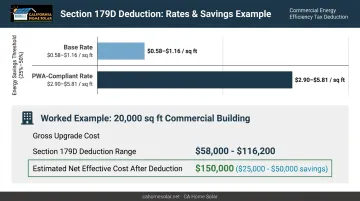
The Section 179D Commercial Buildings Energy Efficiency Tax Deduction applies to HVAC systems placed in service from January 1, 2023 onward. To qualify, the system must be certified to reduce total annual energy costs by at least 25% compared to a reference building.
Current IRS inflation-adjusted rates (2025):
- Base deduction: $0.58–$1.16 per square foot (at 25–50% energy savings)
- With prevailing wage and apprenticeship (PWA) compliance: $2.90–$5.81 per square foot
Example: A 20,000 sq. ft. commercial building meeting the 179D threshold with PWA-compliant installation could qualify for a deduction of $58,000–$116,200. Stack that against utility rebates and financing, and the net out-of-pocket cost drops substantially before construction even begins.
Utility Rebates: SoCalGas and SCE
California utility programs actively incentivize commercial HVAC upgrades:
- SoCalGas offers commercial equipment rebates for qualifying businesses through its 2026 Energy Efficiency Rebate program, with program limits up to $500,000 per site. Eligible customers must have active, non-delinquent SoCalGas accounts.
- Southern California Edison (SCE) offers GoGreen Business Energy Financing and On-Bill Financing for qualifying upgrades including HVAC, controls, and related equipment. On-Bill Financing provides no-interest, no-fee loans repaid through monthly utility bills.
Rebate amounts and eligibility requirements are updated regularly and can shift mid-program year — visit the SoCalGas business rebates page and SCE's business energy efficiency programs page for current figures before budgeting.
PACE Financing
Property Assessed Clean Energy (PACE) financing lets commercial property owners fund HVAC upgrades with repayments structured as a property tax assessment. According to PACENation, PACE assessments can extend up to 30 years and stay with the property at sale depending on program structure — meaning no large upfront capital outlay and no impact on business credit lines.
California Home Solar is a HERO Registered Contractor, so Southern California commercial clients can navigate PACE financing directly as part of the upgrade process.
Calculating Your Payback Period
With financing and incentives mapped out, the next step is confirming the numbers work for your specific project.
Payback period = Total upgrade cost ÷ Annual energy savings
Example: A $60,000 HVAC upgrade that reduces annual energy costs by $18,000 pays back in approximately 3.3 years. Factor in a $30,000 179D deduction and the effective cost drops to $30,000 — cutting payback to roughly 1.7 years.
Commercial HVAC upgrades commonly pay back within 3–7 years depending on system age, building size, and the efficiency gap between old and new equipment.
How to Plan and Execute Your Commercial HVAC Upgrade
Start with an Energy Audit
Before selecting equipment, establish a baseline. ASHRAE's Standard 211 defines three levels of commercial energy audit — from a basic walkthrough (Level 1) to detailed engineering analysis (Level 3) — designed to identify where energy is being lost and which upgrades will deliver the highest ROI for your specific building.
Key factors an audit should cover:
- Current equipment age, condition, and efficiency ratings
- Occupancy patterns and zone-by-zone usage
- Baseline energy consumption by system type
- Duct condition and leakage
- Ventilation adequacy relative to occupancy
DOE Better Buildings data shows that following operations and maintenance best practices alone can save 5–20% on annual energy bills. A proper audit identifies where to focus investment for maximum return.
Retrofit vs. Full Replacement
The decision comes down to system age, condition, and the scope of deficiencies:
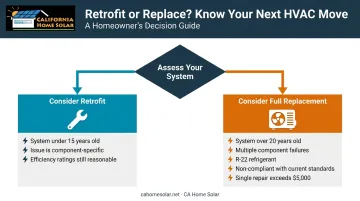
- Retrofit makes sense when the core system is under 15 years old, the issue is component-specific, and efficiency ratings are still reasonable
- Full replacement typically delivers better long-term ROI when the system is aging, inefficient across multiple components, running on phased-out refrigerant, or no longer compliant with current standards
Two practical rules of thumb to guide the call:
- The $5,000 rule: If a single repair exceeds $5,000 on an aging system, replacement is worth serious consideration
- The 20-year rule: If the system is over 20 years old, replacement is usually the clearer financial decision
Choose a Qualified Commercial HVAC Contractor
Once you've determined the scope of your upgrade, finding the right contractor is what separates a smooth project from a costly one. Not every HVAC contractor has commercial experience. When evaluating contractors, look for:
- Verified commercial (not just residential) project history
- Valid California contractor licensing and bonding
- Itemized quotes — not lump-sum estimates
- Clear post-installation support and warranty terms
- Familiarity with 179D documentation requirements and utility rebate processes
CA Home Solar has served Southern California commercial and residential clients for 36 years as a licensed and bonded contractor. The company is also a HERO Registered Contractor, which means clients can explore PACE financing as part of their upgrade project — a useful option for managing upfront costs.
Frequently Asked Questions
How do the $5,000 rule, the 20 rule, and the 2-foot rule apply to commercial HVAC decisions?
The $5,000 rule suggests replacing rather than repairing when a single repair exceeds $5,000 on an older system. The 20 rule points toward replacement for systems over 20 years old. The 2-foot rule is an installation clearance guideline requiring adequate space around equipment for service access. These are practical guidelines, not legal mandates.
Which HVAC system is best for a commercial building upgrade?
It depends on building size and layout. VRF systems suit large, multi-zone buildings well. Ductless mini-splits are strong retrofit options for smaller or compartmentalized spaces. Rooftop packaged units remain cost-effective for single-story commercial buildings. A professional energy assessment is the best way to determine the right fit.
How long does a commercial HVAC system last before needing replacement?
With proper maintenance, most commercial HVAC systems last 15–20 years. In practice, rising repair costs, declining efficiency, and shifting regulatory standards often make upgrading worthwhile before the end of that window.
Are there tax credits or rebates available for commercial HVAC upgrades in California?
Yes. California commercial property owners can access the federal 179D deduction, equipment rebates and financing through SoCalGas and Southern California Edison, and PACE financing options. Yes. California commercial property owners can access the federal 179D deduction, equipment rebates and financing through SoCalGas and Southern California Edison, and PACE financing options. Together, these programs can substantially reduce the net cost of qualifying HVAC upgrades.
Should I retrofit or fully replace my commercial HVAC system?
If the system is under 15 years old and the issue is limited to specific components, a retrofit may be more cost-effective. If it's aging, inefficient across multiple systems, running on R-22, or out of compliance with current standards, full replacement typically delivers better long-term ROI.
How much can a commercial HVAC upgrade save on energy bills?
Savings vary by equipment type, building size, and existing system condition. ENERGY STAR-certified equipment typically cuts energy use by about 17% versus standard models, while VRF systems and advanced controls can reach 25–30%. Older, poorly maintained systems tend to see savings at the higher end of that range.