The stakes are high. According to the U.S. Department of Energy, HVAC systems account for 39% of total energy used in commercial buildings. That's the single largest energy expense in most facilities, which means the system you choose in 2026 has a direct, measurable impact on operating costs for the next 15–20 years.
This article covers the top five commercial HVAC systems ranked for energy efficiency in 2026, the key metrics you need to evaluate them, and what Southern California commercial property owners should prioritize when making this decision.
Key Takeaways
- Commercial HVAC efficiency is measured by IEER (Integrated Energy Efficiency Ratio) for rooftop units and COP/IPLV for chillers — not residential SEER2
- Top 2026 systems use variable-speed/inverter compressors, low-GWP refrigerants (R-454B, R-32, R-1234ze), and smart building integration
- California's 2025 Energy Code, effective Jan. 1, 2026, raises minimum efficiency thresholds for commercial HVAC equipment
- Federal Section 179D deductions and utility rebates from LADWP and SCE can offset a significant share of upgrade costs
- Top 2026 picks: Daikin Rebel, Trane Intellipak, Carrier AquaForce PUREtec, Mitsubishi City Multi, Lennox LGH/LCH
Why Energy Efficiency Is the New Standard for Commercial HVAC in 2026
IEER vs. SEER2: Using the Right Metric
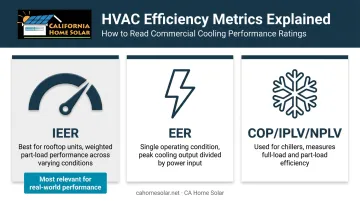
The most common mistake commercial buyers make is applying residential metrics to commercial equipment. SEER2 (Seasonal Energy Efficiency Ratio 2) applies to residential and light-commercial products — for true commercial HVAC, the relevant benchmarks are:
- IEER (Integrated Energy Efficiency Ratio) — a weighted part-load efficiency metric that reflects how systems perform across varying load conditions, not just at peak
- EER — cooling output divided by power input at a single operating condition
- COP/IPLV/NPLV — used for chillers to measure full-load and part-load efficiency
IEER matters more than peak ratings because most commercial facilities spend the majority of operating hours at partial load — not running at maximum capacity. A system with an outstanding full-load rating but poor part-load performance will underdeliver in the real world.
Those metrics don't exist in a vacuum — two major forces in 2026 are actively raising the bar on what those numbers need to be.
Two Forces Reshaping Commercial HVAC in 2026
1. The AIM Act refrigerant phasedown The EPA's Technology Transitions program is phasing out high-GWP refrigerants under the American Innovation and Manufacturing Act. The dominant commercial refrigerant, R-410A (GWP ~2,088), is being phased out in favor of lower-GWP alternatives:
- R-454B (GWP 465) — now used in newer commercial rooftop units including Trane's Intellipak line
- R-32 — adopted by Daikin for its commercial rooftop systems
- R-1234ze(E) (GWP 0.97) — used in Carrier's AquaForce PUREtec chillers
Systems still running R-410A face a practical problem: as EPA restrictions tighten, refrigerant availability shrinks and service costs rise. Locking into a phased-out refrigerant now means paying more to maintain it later.
2. California's 2025 Energy Code Effective January 1, 2026, California's updated building energy efficiency standards set higher minimum efficiency thresholds for commercial HVAC equipment. For VRF systems, the 2025 Code mandates minimums including 20.0 IEER for air-cooled VRF cooling (under 65,000 Btu/h). Verify current minimums by equipment type in CEC Table 110.2 before specifying any system.
California's commercial electricity rates average around $0.22–$0.26/kWh — well above the national average of roughly $0.12/kWh — which means the payback period on a high-efficiency upgrade is significantly shorter here than in most other states.
Best Commercial HVAC Systems for Energy Efficiency in 2026
These systems were evaluated on published efficiency ratings, refrigerant compliance, smart controls capability, suitability for Southern California's climate, and manufacturer support. Here's how the top five compare.
Trane Intellipak™ Commercial Rooftop Unit
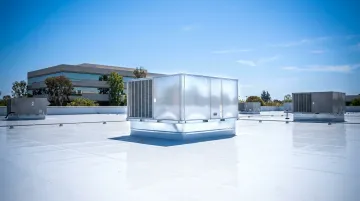
Trane's Intellipak is one of the most widely deployed commercial rooftop platforms in the U.S., common across office buildings, schools, and retail centers. The family spans three configurations covering 20–150 tons, giving facility managers flexibility to match system capacity precisely to building load.
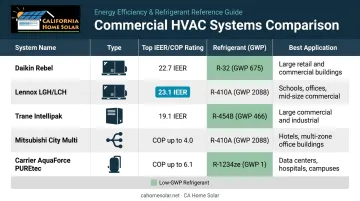
The efficiency advantage comes from variable-speed fan and compressor technology, which reduces energy draw during partial-load operation. Intellipak 1 and 2 models achieve up to 19–19.1 IEER, with BACnet and LonTalk integration for building automation system (BAS) connectivity via the Symbio 800 controller.
| Spec | Detail |
|---|---|
| Efficiency | Up to 19.1 IEER (Intellipak 2) |
| System Type | Packaged rooftop unit (RTU) |
| Capacity Range | 20–150 tons |
| Refrigerant | R-454B (GWP 465) |
| Best Application | Large open-plan commercial spaces: offices, schools, big-box retail |
Carrier AquaForce® PUREtec™ Chiller
For large commercial facilities — hospitals, hotels, mixed-use developments — that operate central chilled water plants, Carrier's AquaForce PUREtec line uses R-1234ze(E) (GWP of 0.97), which effectively removes refrigerant-related regulatory exposure for the system's service life — a meaningful advantage as California tightens HFC restrictions through 2026 and beyond.
The air-cooled configuration (30KAVZE) covers 370–1,350 kW nominal cooling capacity. The water-cooled heat pump version (30XWHPZE) covers 265–1,110 kW cooling and 320–1,300 kW heating. Note: specific IPLV/NPLV figures for PUREtec models should be verified through AHRI or Carrier technical submittals before specifying.
| Spec | Detail |
|---|---|
| Efficiency | Verify COP/IPLV via AHRI directory |
| System Type | Air-cooled or water-cooled chiller |
| Capacity Range | 265–1,350 kW (approx. 75–385 tons) |
| Refrigerant | R-1234ze(E), GWP = 0.97 |
| Best Application | Large facilities with central chilled water systems |
Daikin Rebel® Commercial Rooftop Unit
The Daikin Rebel Model DPS achieves up to 22.7 IEER, with the Rebel Applied reaching up to 20.3 IEER — both well above California's minimum thresholds for most commercial applications.
The inverter-driven scroll compressor modulates cooling output precisely, which is particularly valuable in Southern California's climate where cooling loads vary significantly across seasons. The Rebel also uses R-32 refrigerant (low-GWP), consistent with Daikin's broader portfolio transition away from R-410A announced in late 2024. The MicroTech 4 controller handles unit-level automation; verify Intelligent Equipment platform compatibility with Daikin directly for BAS integration projects.
| Spec | Detail |
|---|---|
| Efficiency | Up to 22.7 IEER (Model DPS) |
| System Type | Packaged rooftop unit (RTU) |
| Capacity Range | 3–31 tons (Model DPS) |
| Refrigerant | R-32 (low-GWP) |
| Best Application | Commercial retail, offices, light industrial, multi-tenant buildings |
Mitsubishi Electric City Multi® VRF System
Variable Refrigerant Flow (VRF) technology serves a different use case than packaged rooftop units. Mitsubishi's City Multi system is the right choice when a commercial building requires simultaneous heating and cooling across multiple zones — a common requirement in mixed-use buildings, hotels, and multi-tenant office spaces throughout the LA area.
A single outdoor unit can serve multiple indoor units independently, allowing different zones to heat or cool as needed at the same time. This reduces waste compared to systems that operate all zones uniformly. City Multi is compatible with BACnet and BMS integration; confirm exact controls compatibility using Mitsubishi's City Multi Controls Compatibility Chart. Note: Current City Multi R2/Y-Series documentation lists R-410A; verify refrigerant transition timeline with Mitsubishi for new installations.
| Spec | Detail |
|---|---|
| Efficiency | Verify EER/COP/IEER via AHRI or Mitsubishi submittals |
| System Type | VRF multi-zone heat pump |
| Capacity Range | Verify via Mitsubishi MyLinkDrive submittals |
| Refrigerant | R-410A (current); confirm transition roadmap |
| Best Application | Multi-tenant buildings, hotels, mixed-use spaces requiring zone control |
Lennox Commercial Rooftop (LGH/LCH Series)
For mid-sized commercial properties — retail strip centers, restaurants, smaller office buildings — the Lennox LGH/LCH series covers 35, 40, 45, and 50-ton configurations. Lennox's commercial Model L reaches up to 21.2 SEER2 / 23.1 IEER, though model-specific LGH/LCH ratings should be confirmed via the AHRI directory.
The LCH series includes demand-controlled ventilation (DCV) via 0–10 VDC and economizer damper control — both meaningful in California, where mild shoulder-season temperatures allow significant free-cooling hours. Energy Star certification applies to qualifying Lennox commercial models; verify specific model certification on the Energy Star directory. Current LGH/LCH units use R-410A, so factor refrigerant transition costs into long-term ownership calculations.
| Spec | Detail |
|---|---|
| Efficiency | Up to 21.2 SEER2 / 23.1 IEER (Model L); confirm LGH/LCH via AHRI |
| System Type | Packaged rooftop unit (RTU) |
| Capacity Range | 35–50 tons |
| Refrigerant | R-410A (confirm low-GWP transition timeline) |
| Best Application | Mid-size commercial: retail, restaurants, small offices |
How to Choose the Right Energy-Efficient Commercial HVAC System
The Five Evaluation Criteria That Actually Matter
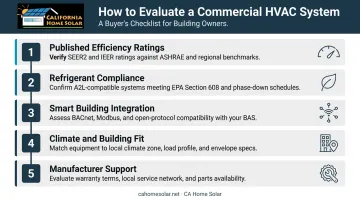
System selection mistakes tend to be expensive and long-lasting — so evaluate any commercial HVAC system against these five factors before committing:
- Published efficiency ratings: IEER for rooftop units, COP/IPLV for chillers. Verify figures through the AHRI directory, not just marketing materials
- Refrigerant compliance: Systems using R-454B, R-32, or R-1234ze are positioned for 15+ years without regulatory disruption; R-410A units carry transition risk
- Smart building integration: BACnet compatibility, demand-response capability, and remote monitoring are increasingly required for California code compliance and utility incentive programs
- Climate and building fit: Southern California's long cooling season favors high IEER systems; mixed-use or multi-tenant buildings often benefit more from VRF than packaged RTUs
- Manufacturer support and parts availability: A 20-year system is only as good as the service network behind it
Three Mistakes That Drive Up Long-Term Costs
- Prioritizing upfront price over lifecycle cost — a lower-efficiency unit that saves $15,000 at purchase can cost far more over 15 years at California's commercial utility rates
- Skipping a load calculation — oversized systems short-cycle (hurting both efficiency and comfort); undersized ones run continuously at peak load. Neither scenario delivers the efficiency ratings on the spec sheet
- Underestimating R-410A transition costs — EPA regulatory changes have already tightened supply, and ACCA reported in May 2026 that refrigerant prices could keep climbing even after the EPA lifted a prior installation deadline
CA Home Solar's HVAC installation team serves commercial properties across the Los Angeles region and can perform a professional load assessment to match system selection to your building's actual profile, which is especially useful when integrating HVAC with a commercial solar system.
Conclusion
Choosing the best commercial HVAC system in 2026 comes down to fit, not brand loyalty. Building size, occupancy patterns, zone requirements, refrigerant compliance posture, and long-term operational goals all shape which system delivers the best return.
Two things should be non-negotiable regardless of building type: refrigerant compliance (R-410A units carry real regulatory and cost risk) and smart integration capability (California's energy codes and utility programs increasingly reward controllable, demand-responsive systems).
Look beyond first-year savings. Over a 15–20 year system life, available Section 179D federal deductions for commercial building energy improvements (up to $5.00/sq ft with prevailing wage requirements met) and utility rebate programs from LADWP and SoCal Edison can shift the numbers dramatically. A high-efficiency system that looks expensive at purchase often costs less over its full life than a cheaper unit with higher operating costs and compliance exposure.
Navigating that full picture — system selection, load assessment, incentive stacking, and integrated HVAC-plus-solar planning — is where the right contractor makes a real difference. CA Home Solar has 36 years of experience serving commercial and residential properties across Southern California. As a HERO Registered Contractor with multiple financing options available, the team helps commercial property owners in the LA area identify the right system and maximize available incentives.
Call 877-903-1012 or email info@cahomesolar.com to schedule a commercial HVAC consultation tailored to your property.
Frequently Asked Questions
What is the most energy-efficient commercial HVAC system in 2026?
VRF systems like the Mitsubishi City Multi and inverter-driven rooftop units like the Daikin Rebel (up to 22.7 IEER) and Trane Intellipak consistently rank at the top for commercial energy performance. The best fit for your building depends on zone requirements, size, and load profile.
What is the $5,000 rule for HVAC?
Multiply the system's age (in years) by the estimated repair cost. If the result exceeds $5,000, replacement typically makes more financial sense than repair. For aging commercial systems with increasing repair frequency, this rule offers a practical starting point.
What is the energy-efficient HVAC tax incentive for commercial buildings?
Commercial building owners may qualify for the Section 179D energy-efficient commercial buildings deduction. Buildings that improve HVAC efficiency by at least 25% can claim $0.50–$1.00/sq ft, or $2.50–$5.00/sq ft when prevailing wage and apprenticeship requirements are met. Consult a tax professional for current eligibility details — figures update annually.
What IEER rating should a commercial HVAC system have in 2026?
California's 2025 Energy Code sets minimums that exceed federal baselines. For VRF systems, the code requires at least 20.0 IEER for air-cooled units under 65,000 Btu/h. For rooftop units and chillers, verify current minimums against CEC Table 110.2 by equipment category. Targeting ratings meaningfully above the minimum delivers real payback at California's commercial electricity rates.
How long do commercial HVAC systems typically last?
Well-maintained commercial systems generally last 15–20 years, with rooftop units on the lower end and chiller systems potentially longer. Preventive maintenance is the primary factor — systems that miss routine service rarely reach their rated lifespan and lose efficiency well before failure.
Can commercial HVAC systems be paired with solar panels to reduce energy costs?
Yes — pairing a high-efficiency commercial HVAC system with a commercial solar installation is one of the most effective strategies for reducing operating costs in California. High utility rates and CPUC net metering/net billing policies make solar ROI particularly strong here. Coordinating HVAC load calculations with solar array sizing ensures the system adequately offsets your largest energy draw.