The consequences of poor planning are real. An undersized solar array cannot offset peak HVAC demand during LA's summer cooling months. Incomplete permit packages get rejected by LADBS, adding weeks or months to project timelines. And HVAC equipment installed without solar integration planning often requires costly rework before the system operates as intended.
This guide walks Los Angeles commercial property owners through every phase of a correct, compliant installation — from site assessment through commissioning — so you can make informed decisions and hold your contractors accountable.
Key Takeaways
- Commercial solar and HVAC projects require contractors licensed under CSLB C-46 or C-10 (solar) and C-20 (HVAC)
- LADBS issues two separate permits: electrical (PV/inverter) and mechanical (HVAC); structural review may apply depending on roof load and system size
- The 2025 California Energy Code takes effect January 1, 2026, mandating solar PV on most new nonresidential buildings
- The federal Investment Tax Credit is 30% of qualified system costs when prevailing wage and apprenticeship requirements are met
- LADWP operates its own NEM program — separate from the CPUC's Net Billing Tariff that applies to PG&E, SCE, and SDG&E customers
Pre-Installation: Site Assessment and Readiness Requirements
No commercial solar or HVAC installation should proceed without a formal site assessment. Before design work begins, evaluate these areas:
- Roof structure and loading capacity — panel placement and weight tolerance
- Existing electrical infrastructure — service panel capacity and utility interconnection feasibility
- Current HVAC load profile — energy usage data, peak demand windows, equipment condition
Structural Prerequisites
Commercial rooftops must be evaluated by a licensed structural engineer for dead-load and live-load tolerances before solar panels are mounted. This is especially important on older or wood-frame buildings common across many LA commercial districts.
LADBS requires that plans for solar energy system structural support include attachment methods, supporting structure layout, and design calculations. A building permit exception is only available when PV modules plus supports weigh 4 psf or less and concentrated loads stay at 60 lb or less — thresholds that many commercial arrays exceed. Roof-mounted systems must also comply with LAFD Requirement No. 96 for fire access — one of several code layers that need to be cleared before the project can advance to electrical design.
Electrical and HVAC Prerequisites
On the electrical side, the existing service panel and utility interconnection point need capacity assessment. LADWP classifies interconnection into three types: Type 1 (up to 30 kW, no panel upgrade required), Type 2 (up to 30 kW with panel upgrade or certain three-phase service), and Type 3 (above 30 kW up to 1 MW). A panel upgrade moves a project into Type 2 territory, adding complexity and cost.
The HVAC side of the assessment covers different ground. Specifically, it needs to establish:
- Whether existing equipment can accept solar-generated AC power via inverter
- Whether it's approaching end-of-life, making replacement more cost-effective than integration
- Whether a heat pump upgrade makes sense under updated Title 24 standards
Pre-Installation Checklist
Certain conditions must be resolved before installation begins:
- Active roof leaks or structural deficiencies must be repaired first — working with a contractor who covers both roofing and solar under a single project, as CA Home Solar does, avoids the scheduling delays that split-contractor arrangements typically create
- LADWP interconnection approval must be initiated at the design stage, not after installation — lead times vary and can delay project completion
- A formal energy audit must be completed so the solar array is correctly sized to actual HVAC and operational loads
The Commercial Solar and HVAC Installation Process, Step by Step
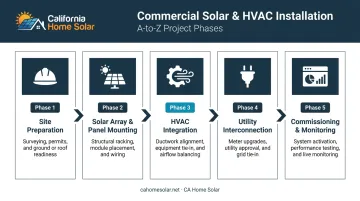
A commercial installation follows a defined sequence: site prep → solar array installation → HVAC integration → interconnection → commissioning. Compressing any phase typically causes performance deficiencies or permit failures that are expensive to fix after the fact.
Site Preparation and Panel Mounting
At the commercial scale, site preparation includes rooftop clearing, surface inspection, and installation of the mounting system. Flat commercial rooftops commonly use ballasted racking — weighted with concrete blocks — to avoid roof penetrations. Penetrating systems attached to the roof structure are the alternative when ballasted systems aren't feasible.
Conduit routing for DC wiring — from the array to the inverter location — is completed during this phase. Panel orientation is optimized for LA's approximately 34°N latitude, and the mounting system must meet LAMC wind load requirements.
Solar System Installation and Inverter Connection
During the electrical installation phase:
- PV panels are connected in strings to an inverter
- The inverter converts DC output to 240V AC
- The system is wired to the main service panel or a dedicated solar subpanel
String inverters and microinverters both have commercial applications. Microinverters handle shading and multiple roof orientations more effectively — relevant for many LA commercial rooftops with HVAC equipment creating partial shading. CA Home Solar works with Enphase IQ8 series microinverters, SolarEdge string inverters with module-level optimizers, and other CEC-listed equipment.
All wiring must meet the California Electrical Code (Title 24, Part 3). Inverters should be verified against the CEC Solar Equipment Lists, which some utilities and local governments reference during interconnection and permit review.
HVAC Integration and System Coordination
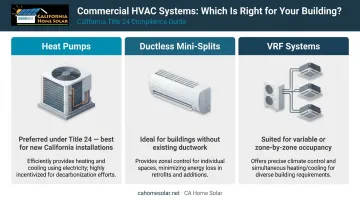
Once solar electrical output is confirmed, HVAC equipment connects to solar generation via smart load controls or energy management systems. If new equipment is going in at the same time, updated Title 24 standards favor heat pumps. System type depends on the building's needs:
- Heat pumps — preferred under current Title 24 standards for new installations
- Ductless mini-splits — practical for buildings with no existing ductwork
- VRF systems — best for commercial spaces with variable or zone-by-zone occupancy
A load analysis must confirm the solar array is properly sized to cover peak HVAC demand. NREL modeling for the LA area (approximately 34°N, 118°W) shows peak AC output in May through July, which aligns with LA's highest cooling demand — meaning the solar and HVAC loads naturally complement each other.
Post-Installation Validation and Commissioning
A proper commissioning process covers:
- LADBS final inspection sign-off on both electrical and mechanical permits
- LADWP interconnection approval and NEM enrollment
- Inverter performance testing against expected output benchmarks
- HVAC airflow and refrigerant charge verification
- Activation of the system monitoring dashboard for real-time solar production and HVAC consumption tracking
CA Home Solar provides 24/7 system monitoring as a standard feature of their commercial installations. Skipping commissioning often means systems run for months below rated output before anyone notices, making it one of the most expensive shortcuts a commercial owner can take.
LA Permits, Title 24 Compliance, and Contractor Licensing
Commercial solar and HVAC projects in Los Angeles require two separate permit categories from LADBS:
| Permit Type | Applies To | Plan Check Threshold |
|---|---|---|
| Electrical | PV system, inverter, service panel work | Required when total load exceeds 400 amperes |
| Mechanical HVAC | All HVAC equipment installation | Required when total heating/cooling input reaches 500,000 BTU/H or more |
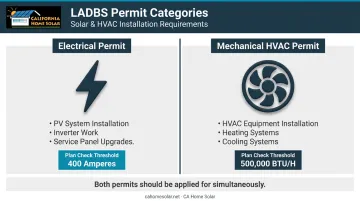
Applying for both simultaneously with complete documentation reduces delays. LADBS publishes a Supplemental Correction Sheet for Solar PV Systems that documents the most common plan check corrections — reviewing it before submission helps you avoid the corrections that stall most commercial applications.
Title 24 and the 2025 California Energy Code
The 2025 Building Energy Efficiency Standards take effect January 1, 2026. Key provisions for commercial properties:
- Section 140.10(a) requires solar PV on newly constructed nonresidential buildings where at least 80% of total floor area serves covered building types (offices, retail, grocery, warehouse, schools, restaurants)
- Section 110.10(b)-(d) applies solar-ready construction requirements to certain nonresidential buildings not otherwise required to install PV
- The code expands heat pump use, encourages electric-readiness, and strengthens ventilation standards
Properties undergoing major HVAC renovations should confirm whether "solar-ready" construction requirements apply. That determination affects conduit routing, electrical panel sizing, and roof structural preparation — even when full solar installation isn't required right away.
Contractor Licensing Requirements
- Solar PV installation: CSLB C-46 Solar Contractor or C-10 Electrical Contractor license
- HVAC work: CSLB C-20 Warm-Air Heating, Ventilating and Air-Conditioning license
- Combined commercial projects: Both license classifications required — either held by a single contractor or coordinated across licensed subcontractors
A contractor holding both license types handles permitting accountability, inspection coordination, and warranty coverage under one roof. When multiple specialty contractors are involved, documentation gaps and scheduling conflicts between inspections are the most common sources of delay.
Financing, Incentives, and ROI for Los Angeles Commercial Properties
Federal Investment Tax Credit
The clean electricity investment credit currently sits at 6% of qualified investment, rising to 30% if prevailing wage and apprenticeship requirements are met. The credit is scheduled to phase down after the later of 2032 or when US electricity-sector emissions meet the statutory target. Confirm current eligibility with a tax professional — the prevailing wage requirements have specific documentation obligations.
California and LADWP Programs
The incentive landscape has changed significantly — here's what actually applies to Los Angeles commercial properties today:
- The California Solar Initiative General Market Program closed December 31, 2016 — it no longer applies to new projects
- LADWP operates its own commercial solar programs including NEM, VNEM, and a Feed-in Tariff that allows property owners to sell eligible renewable output directly to LADWP — but no active upfront commercial PV rebate was found on LADWP's official pages
- The CPUC's Net Billing Tariff applies to PG&E, SCE, and SDG&E customers — not LADWP customers, who operate under LADWP's separate NEM guidelines
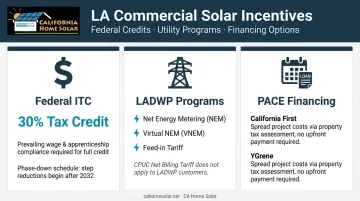
Since upfront rebates are limited, PACE financing is a practical option for many commercial owners. California Home Solar works with California First and YGrene programs in addition to their HERO registration, with a focus on purchase-based financing rather than leasing arrangements.
Battery Storage and Export Economics
Under LADWP's NEM structure, exported solar energy is compensated at lower rates than energy consumed on-site. Battery storage improves financial outcomes by shifting energy use to higher-value periods and maximizing on-site consumption — reducing dependence on those export rates. For commercial properties with heavy HVAC loads during peak hours, pairing storage with solar can meaningfully shorten payback timelines compared to solar-only installations.
Common Installation Pitfalls and Pro Tips for LA Commercial Property Owners
The Three Most Common Problems
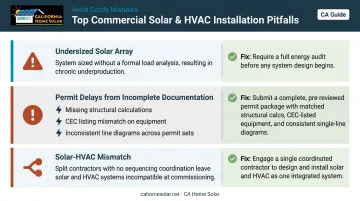
1. Undersized solar array Cause: No formal load analysis before design. The result is a system that cannot offset peak HVAC demand during LA's summer months. Fix: Require a completed energy audit and load calculation before approving the system design — not after.
2. Permit delays from incomplete documentation LADBS rejects packages for three recurring reasons:
- Missing structural calculations
- Equipment not matched to CEC listings
- Electrical line diagrams inconsistent with the proposed installation
Fix: Confirm the contractor submits complete permit packages upfront, using LADBS's published correction sheets to check for gaps before submission.
3. Solar-HVAC mismatch Installing new HVAC without solar integration planning — or mounting solar on a roof due for replacement within five years — are costly mistakes. Rework costs compound quickly when two separate contractors are involved. Fix: Sequence roof, HVAC, and solar work together under coordinated project management. A single contractor covering all three scopes eliminates the most common rework triggers.
Pro Tips for Managing the Project
- Insist on single-point accountability: One contractor managing solar, HVAC, and roofing scope eliminates the coordination failures that arise when multiple specialty contractors divide the work. CA Home Solar has handled integrated commercial projects across the LA market for 36 years.
- Document before final payment: Collect all permit approvals, LADBS inspection sign-offs, and LADWP interconnection confirmation before releasing final payment.
- Start interconnection paperwork early: LADWP interconnection applications should be initiated at the design stage. Systems 10 kW or larger require a LADWP Electric Service Representative inspection before they can be placed in service.
Frequently Asked Questions
How long does a commercial solar and HVAC installation take in Los Angeles?
Most commercial projects take three to six months from site assessment through LADWP interconnection sign-off, depending on system size and permit processing speed. Larger systems requiring Type 3 interconnection (above 30 kW) typically take longer due to additional LADWP review requirements.
Do I need separate permits for solar and HVAC installation in Los Angeles?
Yes. LADBS issues a separate electrical permit for the PV system and inverter work, and a separate mechanical permit for HVAC installation. Structural review may also be required if rooftop panel loading exceeds LADBS thresholds.
What does Title 24 require for commercial solar installations in Los Angeles?
The 2025 California Energy Code (effective January 1, 2026) mandates solar PV on newly constructed nonresidential buildings that meet covered building-type criteria under Section 140.10(a). It also updates ventilation standards and encourages heat pump HVAC systems. Exceptions apply for limited roof area or structural constraints.
How does solar power reduce commercial HVAC costs in Los Angeles?
Solar generation offsets the grid electricity used to run HVAC equipment. Peak solar output in LA occurs in May through July — exactly when cooling demand and utility rates are highest — so the offset targets the most expensive portion of the energy bill directly.
Can an existing commercial HVAC system be integrated with a new solar installation?
AC-powered HVAC equipment can typically accept solar-generated power through a grid-tied inverter without full replacement. A quick equipment assessment confirms compatibility and flags any modifications needed for integration.
What financing options are available for commercial solar and HVAC projects in Los Angeles?
Several options are available for commercial projects in LA:
- Federal ITC: 30% tax credit with prevailing wage compliance
- LADWP programs: Net Energy Metering (NEM) and Feed-in Tariff
- PACE financing: Programs like California First and YGrene spread costs over time
- Solar loans: Purchase-based financing that avoids lease trade-offs
CA Home Solar works with multiple PACE programs and focuses on purchase arrangements, which typically deliver stronger long-term returns than leases.