For Southern California homeowners, that number skews higher. LA County's licensing requirements, permit complexity, and cost of living all push labor rates above the national average.
Costs also vary dramatically based on system type, home size, efficiency rating, ductwork condition, and whether you need permits and inspections. This guide breaks down 2026 HVAC pricing by budget tier, explains what drives costs up or down, covers the hidden expenses most quotes leave out, and shows how to make a smart purchasing decision.
Key Takeaways
- Full system installed cost: Roughly $5,000–$28,000 depending on system type and home size
- Homes needing new ductwork can add $3,000–$12,000 to the total — the single biggest cost variable
- Higher SEER2 ratings cost more upfront but pay back through lower energy bills, especially across SoCal's long cooling season
- SCE, SoCalGas, and the federal Inflation Reduction Act offer rebates and tax credits that can cut your total cost by thousands
- A mismatched or undersized system costs more over its lifetime — cheapest upfront rarely means cheapest overall
How Much Does a New HVAC System Cost in 2026?
There's no single fixed price for HVAC replacement. The installed cost — equipment, labor, permits, and any ductwork — spans a wide range depending on system type, home size, and installation complexity.
Two budgeting mistakes trip up most homeowners:
- Underestimating total installed cost by focusing only on equipment price
- Choosing the lowest bid without accounting for operating efficiency or what the quote actually includes
Here's how costs break down by budget tier.
Budget Tier 1: Entry-Level Systems ($5,000–$10,000)
Entry-level installs cover a basic single-stage central AC or gas furnace swap in homes with existing, compatible ductwork. Standard SEER2-rated equipment, straightforward labor — no extras.
This tier works best for:
- Homes under 1,500 sq ft with ductwork in good condition
- Emergency replacements where speed matters more than efficiency
- Homeowners who need functional comfort on a tight budget
One trade-off to know: single-stage systems run at full blast or not at all. That means more noise, higher energy use, and less precise temperature control compared to variable-speed alternatives.
Budget Tier 2: Mid-Range Systems ($10,000–$18,000)
This range covers two-stage or variable-speed central AC/furnace combos and entry-level heat pumps — typically suited for homes in the 1,500–2,500 sq ft range. Quotes often include minor ductwork repairs, a smart thermostat, and higher SEER2 efficiency ratings.
Most Southern California homeowners replacing aging systems land here. The mid-range tier hits the sweet spot for improved comfort and lower energy bills without the premium price of a full system overhaul — which is why it accounts for the majority of LA-area replacements.
Good fit for:
- Homeowners balancing upfront cost against long-term savings
- Those upgrading from an aging single-stage system
- Anyone wanting noticeably quieter, more consistent comfort
Budget Tier 3: High-End / Premium Systems ($18,000–$28,000+)
Premium installs involve high-efficiency heat pumps, dual-fuel systems, or full ductwork replacement from scratch. Multi-zone setups and smart thermostat integration are standard at this level. Geothermal heat pumps — priced by HomeAdvisor at $4,541–$26,537 with an average around $15,206 — sit at the top of this range.
This tier makes sense for:
- Homes over 2,500 sq ft or those without existing ductwork
- Homeowners prioritizing maximum efficiency and long-term savings
- Those pairing HVAC with solar panels to significantly cut monthly utility bills — a combination that's increasingly common in Southern California
Key Factors That Affect HVAC System Cost
HVAC pricing is driven by equipment specifications, installation complexity, and regional variables. The factors below explain why two homes of similar size can receive quotes that differ by thousands of dollars.
System Type and Configuration
Different system types carry very different price tags:
| System Type | Typical Installed Cost Range |
|---|---|
| Central AC replacement (existing ducts) | $3,900–$8,000 |
| Gas furnace replacement | $3,800–$10,000 |
| Air-source heat pump (whole-home) | $8,000–$20,000 |
| Ductless mini-split (single to multi-zone) | $2,000–$21,000+ |
| Geothermal heat pump | $12,000–$30,000+ |
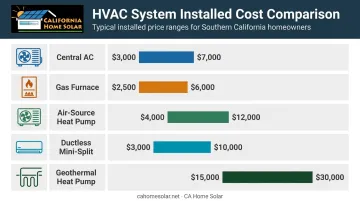
Heat pumps handle both heating and cooling in one system — higher upfront cost, but you're replacing two systems. Mini-splits are ideal for homes without existing ductwork or for room additions.
Home Size and System Capacity
HVAC systems are sized in "tons" of cooling capacity (1 ton = 12,000 Btu/h). Correct sizing is critical — too small means constant running and high bills; too large causes short-cycling and humidity problems.
National cost estimates by home size:
- 1,500 sq ft: $4,000–$7,000
- 2,000 sq ft: $5,000–$9,000
- 2,500 sq ft: $6,000–$10,000
- 3,000 sq ft: $7,000–$12,000
California adds complexity: the 2025 CEC manual requires outdoor design conditions based on California's 16 climate zones. What works in San Francisco won't be sized the same as a system in the San Fernando Valley.
Energy Efficiency Rating (SEER2)
California has some of the country's strictest minimum efficiency standards. The current requirements for Southern California:
- Split-system AC under 45,000 Btu/h: 14.3 SEER2 minimum (plus 11.7 EER2)
- Split-system heat pumps: 14.3 SEER2 minimum
Higher-rated systems cost more upfront but deliver real monthly savings. DOE FEMP data shows a 23.5 SEER2 system uses roughly 2,450 kWh annually versus 3,787 kWh for a 15.2 SEER2 unit — translating to about $147/year in savings. Over a 15–20 year lifespan in a warm Southern California climate, that adds up to $2,200 or more in energy costs avoided.
Ductwork Condition
Existing ductwork in good shape saves thousands. Homes needing repairs or replacement face additional costs:
- Duct sealing: $375–$700
- Duct repairs: $200–$2,100
- Full duct replacement: $1,400–$12,000 depending on home size and complexity
California's 2025 Title 24 requirements add another layer: new duct systems must test at 5% or less of nominal airflow leakage. Older Southern California homes frequently have undersized or deteriorating ducts that undermine even the best new equipment.
Labor Rates and Location
Labor typically represents 30–50% of total installed cost. Southern California rates run above the national average — BLS data from May 2024 shows a national median wage of $59,810 for HVAC mechanics, but contractor billing rates in the LA area reflect the region's higher cost of living.
Permitting adds to both cost and timeline. LADBS requires mechanical permits for any HVAC installation or modification, and processing times vary by jurisdiction across Los Angeles County.
Full HVAC Cost Breakdown: What You're Actually Paying For
Most homeowners focus on equipment price and miss the full picture. A complete installed cost includes:
| Cost Component | Typical Range | Notes |
|---|---|---|
| Equipment | $3,000–$12,000+ | Varies by brand, type, efficiency |
| Installation & labor | $1,500–$5,000+ | Removal/disposal, refrigerant charging, commissioning |
| Ductwork (if needed) | $375–$12,000 | Often the biggest surprise in older homes |
| Permits & inspections | $150–$500+ | LA County fees vary by component count and city |
| Annual maintenance | $175–$350/year | Tune-ups, filter replacements, inspections |
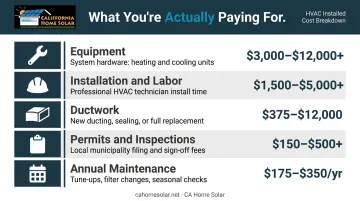
On permits: LA County's fee schedule (effective July 1, 2025) includes $39.99 for permit issuance, $39.32 per furnace or compressor, plus plan check fees. Total permit cost depends on system components and city — budget at least $250–$400 for most straightforward installations.
On maintenance: Skipping annual service has real consequences. DOE data shows a neglected heat pump can use 10–25% more energy than a well-maintained one. At $250 per year, routine service costs far less than the $800–$3,000 you'd pay for a compressor repair caused by neglect.
On operating costs: Maintenance savings are just one piece — efficiency ratings affect your bills every month for the life of the system. In Southern California's warm climate — where AC runs through long summers — the DOE estimates that homeowners in hot-dry climates can save $3,154 over 25 years by choosing the highest-efficiency central AC over a base-rated model.
How to Reduce Your HVAC Installation Costs
Get Multiple Itemized Quotes
Get at least three detailed quotes from licensed contractors. Each quote should break out equipment, labor, ductwork, and permits separately. The lowest bid isn't always the best — verify licensing, insurance, and warranty terms before deciding.
Time the Installation Strategically
Spring (March–May) and fall (September–November) are typically the most cost-effective windows. Demand drops, contractors have better availability, and some offer off-season pricing. Waiting until your system fails in August puts you at peak-demand pricing and limited availability.
Leverage Available Rebates and Tax Credits
Southern California homeowners have multiple incentive programs to stack:
- SCE TECH Clean California — $1,000 per new single-family heat pump system, up to $2,000 for two systems
- SoCalGas 2026 rebates — tiered rebates on qualifying ENERGY STAR furnaces (92%+ AFUE) plus a $75 smart thermostat credit
- Federal Inflation Reduction Act — 30% tax credit on qualifying heat pump installations, capped at $2,000 per year; confirm your 2026 eligibility with a tax professional before claiming
- HERO/PACE financing — finance your HVAC upgrade through your property tax bill with no money down, terms from 5–25 years, and approval based on home equity rather than credit score; eligibility for rebates and tax credits is unaffected
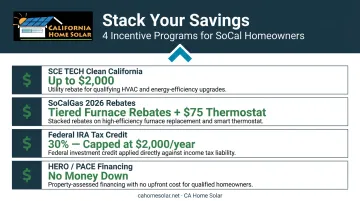
CA Home Solar is a registered HERO contractor, so Orange County and Los Angeles area homeowners can combine PACE financing with available rebates to reduce out-of-pocket costs from day one. Stacking these programs is one of the most effective ways to make a new system affordable without waiting for your old one to fail.
Conclusion
New HVAC system costs in 2026 range from $5,000 to $28,000+ — and the installed cost always includes more than the equipment price alone. Getting that balance right means looking beyond the sticker price before you sign anything.
Before committing to a system, Southern California homeowners should account for available rebates, tax credits, and financing options. The gap between a base-efficiency and high-efficiency system often narrows considerably once incentives are applied.
Navigating those incentives — and choosing the right system for a Southern California home — is easier with a contractor who knows the local landscape. CA Home Solar has served LA-area homeowners for 36 years, handling HVAC upgrades as part of a whole-home energy plan that can include solar, roofing, and windows. To get a free consultation, call 877-903-1012 or email info@cahomesolar.com.
Frequently Asked Questions
How much does it cost to install an HVAC system for a 2,000 sq ft house?
A 2,000 sq ft home typically requires a 3–4 ton system. National cost data puts installation at roughly $5,000–$9,000, though Southern California labor rates and permit requirements generally push that toward the higher end of the range.
What are the $5,000 rule and the 20-year rule for HVAC replacement?
The $5,000 rule multiplies your system's age by the estimated repair cost; if that total exceeds $5,000, replacement is likely the smarter financial move. The 20-year rule is simpler: if your system is over 20 years old, prioritize replacement regardless of repair cost. Treat both as starting points, not substitutes for a professional assessment.
What is the cheapest time of year to replace an HVAC system?
Spring (March–May) and fall (September–November) generally offer the best pricing and availability. Demand is lower than peak summer or winter, contractors are easier to schedule, and some offer off-season incentives.
Are there rebates or tax credits for a new HVAC system in California?
Yes. SCE's TECH Clean California program offers up to $2,000 for heat pump systems, and SoCalGas provides tiered rebates on high-efficiency furnaces plus $75 for qualifying smart thermostats. The federal Inflation Reduction Act adds a 30% tax credit (capped at $2,000/year) for qualifying heat pump installations; confirm 2026 eligibility with a tax advisor.
Is a high-efficiency HVAC system worth it in Southern California?
For most SoCal homeowners, yes. The region's long cooling season means AC runs heavily for months at a time, so the monthly savings from a higher SEER2-rated system compound faster than they would in a cooler climate. Over a 15–20 year system life, the difference is substantial.
How long does a new HVAC system last?
Most central HVAC systems last 15–20 years with proper maintenance. Heat pumps typically run 10–15 years, though well-maintained units can reach 20 years. Annual tune-ups and regular filter changes are the most effective way to reach the upper end of that range.