The frustrating part? Most of that waste isn't inevitable. It comes from equipment choices, maintenance habits, and how well the home itself holds conditioned air. All three are within a homeowner's control.
This article breaks down where HVAC energy costs actually come from, what drives the waste, and which strategies deliver the most meaningful, lasting reductions — with Southern California's hot-dry climate in mind throughout.
Key Takeaways
- HVAC accounts for close to half of home energy use — and most of that cost is controllable
- Efficiency losses accumulate quietly: aging equipment, ignored maintenance, and duct leaks are the most common culprits
- Oversized or undersized equipment, thermostat drift, and poor attic insulation compound those losses over time
- The most effective approach combines high-efficiency equipment, smart management habits, and home envelope improvements
- SCE rebates, SoCalGas incentives, and federal tax credits can meaningfully offset upgrade costs for California homeowners
How HVAC Costs Typically Build Up
HVAC energy waste rarely announces itself with a sudden spike. It accumulates.
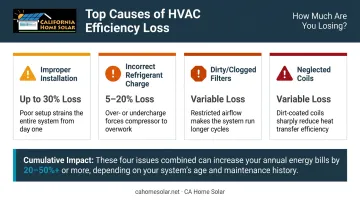
The culprits are ordinary: clogged filters, low refrigerant, loose duct connections, dirty coils. Each one trims efficiency by a few percentage points. Together, they can add up to a system working significantly harder than it should — month after month, without a clear warning sign.
ENERGY STAR notes that improper installation alone can reduce HVAC efficiency by up to 30%, and incorrect refrigerant charge can account for a 5–20% efficiency loss by itself. A homeowner who replaced their system eight years ago and never had it serviced since could be operating well below the rated efficiency they paid for.
The real problem is that none of this is visible. Unless you're comparing utility bills year-over-year, a 15% efficiency decline looks like nothing more than seasonal variation.
A few situations tend to expose the underlying issue:
- An unusually hot summer that pushes a marginal system past its limit
- A failing compressor that runs continuously to compensate for lost capacity
- A home addition or room conversion that overloads a system sized for a smaller footprint
By the time one of these moments surfaces, months or years of preventable costs are already in the rearview mirror — which is exactly why proactive maintenance and timely upgrades matter.
Key Cost Drivers for HVAC Energy Waste
Understanding where the waste comes from is the foundation of addressing it effectively. Three categories account for the vast majority of residential HVAC inefficiency.
Equipment-to-Home Mismatch
Oversized and undersized systems both waste energy, but in opposite ways.
An oversized system short-cycles: it reaches the setpoint quickly, shuts off, then restarts before the home stabilizes. Research from DOE/NREL found that air conditioners running at twice the needed capacity can increase energy use by up to 13%, on top of accelerated wear and poor humidity control.
An undersized system has the opposite problem. It runs almost continuously during peak demand, never fully meeting the load — and a properly sized system outperforms both scenarios by running in balanced, consistent cycles.
Duct Losses
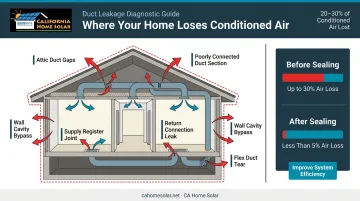
According to ENERGY STAR, a typical home with a forced-air system loses 20–30% of conditioned air through duct leaks, holes, and poorly connected sections. In Southern California's hot-dry climate, where cooling loads dominate the energy profile, that's a substantial portion of what you're paying to condition escaping into attic or wall cavities.
Duct sealing consistently ranks among the highest-ROI improvements available to homeowners — often more impactful than upgrading the equipment itself.
Operational and Maintenance Gaps
Choices made at installation set the system's efficiency ceiling. Choices made every day determine whether the system ever approaches it.
Common operational gaps that drive costs up:
- Thermostat setpoints drifting lower during summer heat waves, pushing the system harder than necessary
- Filters going unchanged for months, restricting airflow and forcing the system to work harder
- Dirty evaporator coils reducing heat transfer capacity
- Ignoring early warning signs (unusual cycling, uneven room temperatures) until failure
Cost-Reduction Strategies for HVAC Energy Efficiency
No single change eliminates HVAC energy waste. Meaningful savings come from addressing the right cost driver at the right level — equipment, operation, or the home itself.
Strategies That Change the Equipment Decision
Upgrade to a high-efficiency system rated for the Southwest climate
California falls under DOE's Southwest regional standards, which set higher efficiency floors than other parts of the country. As of January 2023, the minimum thresholds are:
- 14.3 SEER2 — split-system central ACs under 45,000 Btu/hr (13.8 for larger units)
- 15.2 SEER2 — minimum for ENERGY STAR certification
- 16.0 SEER2 — required for ENERGY STAR Most Efficient 2025 designation (heat pumps)
For most Southern California homes, a heat pump deserves serious consideration. DOE states that modern heat pumps can reduce electricity use for heating by up to 75% compared to electric resistance heating, while providing efficient cooling from the same system. One unit, two seasons, and efficiency ratings that often exceed standard central AC.
CA Home Solar installs high-SEER-rated HVAC systems designed for Southern California's hot-dry conditions, including systems with variable-speed technology that modulates output rather than cycling on and off.
Right-size the system with a Manual J load calculation
Equipment sizing isn't an estimate — it's a calculation. Manual J (ACCA's ANSI-recognized standard for residential load calculations) accounts for square footage, insulation levels, window area, orientation, and local climate data. Replacing a system "like for like" without running this calculation often perpetuates an existing oversizing or undersizing problem.
Seal and insulate ductwork before or alongside any equipment upgrade
Installing a high-efficiency system into leaky ductwork is like buying a fuel-efficient car and leaving the gas cap off. With 20–30% of conditioned air escaping through average duct systems, duct sealing should happen before or in parallel with equipment replacement — not as an afterthought. CA Home Solar's HVAC installation process includes ductwork assessment to confirm that rated system efficiency is achievable in the actual home.
Replace aging systems proactively
ENERGY STAR recommends evaluating systems that are more than 10 years old. A properly installed high-efficiency replacement can save up to 20% on heating and cooling costs compared to an older degraded unit. With California rebates and federal credits available now, replacing a struggling system before it fails typically delivers better financial outcomes than emergency replacement under pressure.
Strategies That Change How HVAC Is Managed
Install and configure a smart thermostat with occupancy scheduling
ENERGY STAR estimates that certified smart thermostats save about $50/year, or around 8% of heating and cooling bills, on average. The configuration matters as much as the device. A smart thermostat left at a fixed setpoint 24/7 provides no advantage over a manual one. The savings come from setback schedules aligned to when the home is empty or occupants are asleep.
DOE also notes that turning thermostats back 7–10°F for 8 hours per day can save up to 10% annually on heating and cooling.
Stick to a maintenance schedule
Two categories of maintenance keep efficiency from drifting:
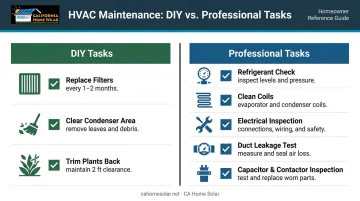
DIY-appropriate tasks:
- Replace or clean filters every 1–2 months during peak cooling season (more often with pets or dusty conditions)
- Clear debris from around the outdoor condenser unit
- Trim foliage at least 2 feet back from the unit
Tasks requiring a licensed technician:
- Check and adjust refrigerant charge
- Inspect and clean evaporator and condenser coils
- Test electrical connections and controls
- Measure airflow and identify duct leakage
- Inspect capacitors, contactors, and motor components
Annual professional tune-ups catch the gradual efficiency drift that most homeowners never notice until the utility bill does.
Use ceiling fans strategically
DOE notes that a ceiling fan allows residents to raise the thermostat setting by about 4°F without any reduction in perceived comfort. Central AC can consume more than 2,000 kWh/year in the average home. Ceiling fans use a small fraction of that per hour — so the trade-off during Southern California's long cooling season is strongly favorable.
Strategies That Change the Home Environment
Improve attic insulation and air sealing
ENERGY STAR estimates that 9 out of 10 U.S. homes are under-insulated. For Southern California homes, the attic is typically the highest-priority target — radiant heat from an under-insulated attic directly raises the cooling load the HVAC system must manage. CA Home Solar's internal documentation notes that approximately 25% of a home's energy can be lost through the attic.
ENERGY STAR's methodology estimates that homeowners in Southern climate zones can save 7–14% on heating and cooling costs through air sealing and insulation improvements. That's savings without changing the HVAC system at all.
Pair solar panels with HVAC upgrades
Space cooling is the main driver of residential peak electricity demand in California, according to CEC data. Solar panels generate peak output during midday hours, which aligns closely with peak cooling demand in a Southern California summer. The pairing reduces or offsets the electricity cost of running the AC during the hours it runs hardest.
CA Home Solar has 36 years of experience sizing and installing solar systems across Southern California, and can factor a home's HVAC energy profile into the system design during the initial consultation. Solar and HVAC upgrades can also be bundled into a single project engagement.
Leverage California rebate programs and federal tax credits
Southern California homeowners have access to multiple incentive pathways:
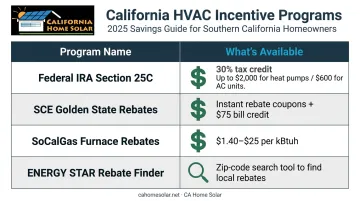
| Program | What's Available |
|---|---|
| Federal IRA Section 25C | 30% tax credit; up to $2,000/year for qualifying heat pumps; up to $600 for central AC |
| SCE (Golden State Rebates) | Instant rebate coupons for qualifying AC and smart thermostats; $75 bill credit for demand response thermostat enrollment |
| SoCalGas | Furnace rebates from $1.40 to $25 per kBtuh depending on efficiency tier (2025 program) |
| ENERGY STAR Rebate Finder | Zip-code-based search for available rebates on certified equipment |
Note: The federal 25C credit applies to qualified improvements made through December 31, 2025 — confirm current-year availability with a tax professional. CA Home Solar is a HERO Registered Contractor, meaning HERO PACE financing is available for qualifying HVAC improvements with zero upfront cost, and rebate eligibility is unaffected by HERO financing.
Conclusion
HVAC energy costs aren't fixed — they're the accumulated result of equipment choices, operational habits, and how well the home contains what the system produces. The homeowners who pay the least for the most comfort aren't necessarily the ones with the newest equipment. They're the ones who got all three pieces working together: the right system, running efficiently, inside a home that doesn't waste what the equipment produces.
For Southern California homeowners, that combination is genuinely within reach right now. High-efficiency heat pumps, updated SEER2 standards, California rebate programs, and the natural pairing of solar with peak cooling loads all work in your favor. The path to lower bills isn't mysterious — it's identifying which of the three layers is underperforming and fixing that first.
Frequently Asked Questions
Which HVAC system is the most energy-efficient?
Ductless mini-split and ducted heat pumps typically lead in efficiency, with SEER2 ratings well above minimum thresholds. For Southern California's hot-dry climate, a properly sized heat pump or high-SEER2 central AC (15.2 SEER2 or above) is usually the strongest long-term choice, offering efficient cooling and significantly better heating performance than a gas furnace.
How much can I save on energy bills with an efficient HVAC system?
ENERGY STAR estimates that replacing a system more than 10 years old with a properly installed high-efficiency unit can save up to 20% on heating and cooling costs. Actual savings depend on home size, the age and condition of the existing system, and usage patterns.
What SEER2 rating should I look for in Southern California?
California falls under the DOE Southwest regional standards, where the minimum SEER2 is 14.3 for most residential split systems. Look for ENERGY STAR certified models at 15.2 SEER2 or higher — and consider ENERGY STAR Most Efficient-designated units (16.0 SEER2+) for the strongest long-term return.
How often should I schedule HVAC maintenance to keep efficiency high?
Annual professional tune-ups and monthly filter checks during peak cooling season are the baseline. Southern California's extended cooling season means systems log more runtime than in milder climates, so consistent maintenance has an outsized effect on efficiency and equipment lifespan.
Does California offer rebates for energy-efficient HVAC upgrades?
Yes. California homeowners can access SCE utility rebates through Golden State Rebates, SoCalGas furnace rebate programs, and the federal Section 25C tax credit (30% of qualifying costs, up to $2,000/year for heat pumps). Use ENERGY STAR's Rebate Finder with your zip code to see current offerings.
Can solar panels help reduce my HVAC energy costs?
Yes. Solar panels produce peak output during midday hours, which aligns directly with peak cooling demand during Southern California summers. Pairing solar with a high-efficiency HVAC system can significantly reduce or offset your AC costs, with the offset depending on system size and home energy use.