According to EnergySage's April 2026 marketplace data, the national average residential solar price sits at roughly $2.58 per watt before incentives, with a typical home needing about 12 kW. In Los Angeles specifically, the average runs slightly lower at $2.40/W — but the real cost picture depends on far more than a single number.
This guide breaks down what LA-area homeowners should budget in 2026, which California incentives still apply, and how to avoid the most expensive mistakes when going solar without the federal credit.
Key Takeaways
- Typical residential systems range from $15,960 (6 kW) to $35,140 (14 kW) before incentives; the LA average runs about $24,000 for a ~10 kW system
- The federal 30% tax credit ended December 31, 2025 — new installations don't qualify
- California's property tax exclusion, SGIP battery rebates, and NEM 3.0 net billing are still active
- Under NEM 3.0, battery storage directly increases long-term savings — though it raises the upfront price
- EnergySage estimates California homeowners recoup their investment in roughly 7.6 years, driven by the state's above-average electricity rates
How Much Does Solar Installation Cost in 2026?
Solar pricing doesn't work like most home improvements. Contractors don't price by square footage — they price by watts of capacity installed, a metric that scales with your actual energy consumption.
That matters because two identical 2,000-square-foot homes with different energy habits (one has a pool, one doesn't) will need very different system sizes. Budgeting by home size is one of the most common ways homeowners under- or over-estimate what they'll spend.
Typical Cost Ranges by System Size
The table below uses EnergySage national data from April 2026. Los Angeles installations average $2.40/W, which puts most LA-area systems at or below these figures.
| System Size | Price Per Watt | Estimated Total (Before Incentives) |
|---|---|---|
| 6 kW | $2.66/W | $15,960 |
| 8 kW | $2.61/W | $20,880 |
| 10 kW | $2.55/W | $25,500 |
| 12 kW | $2.52/W | $30,240 |
| 14 kW | $2.51/W | $35,140 |
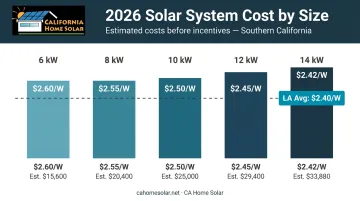
These figures typically include panels, inverter, racking hardware, installation labor, and permitting fees. They do not include battery storage, electrical panel upgrades, sub-panel additions, or roof repairs required before installation. They do not include battery storage, electrical panel upgrades, sub-panel additions, or roof repairs required before installation. These extras — commonly called "adders" — are where final project costs often diverge from initial quotes.
Cost Adders That Raise the Final Price
The most common adders in Southern California:
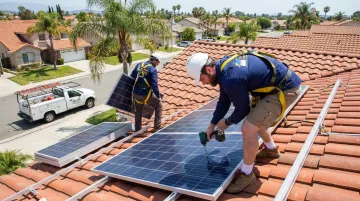
- Tile roofs — extremely common in SoCal, requiring specialized mounting hardware and more labor time
- Electrical panel upgrades — older panels (100-amp service) often can't support a solar system without upgrading to 200-amp
- Sub-panel installation — sometimes needed when the main panel is full
- Battery storage — a typical 13.5 kWh battery adds roughly $15,228 before incentives, per EnergySage's 2026 data
- Ground-mount systems — trenching and structural work push costs roughly 51% above rooftop equivalents
Complex permitting across LA County's many jurisdictions — each with its own requirements — can extend project timelines. Budget for at least one adder; most SoCal installs involve two or more.
Key Factors That Affect Solar Installation Cost
Pricing varies between quotes for real reasons, not just differences in contractor margin. Understanding these factors helps you read quotes accurately.
Your Energy Usage and System Size
System size is determined by your annual kilowatt-hour (kWh) consumption — pulled from 12 months of utility bills — not your home's square footage. Homes with EVs, pool pumps, or year-round air conditioning typically need larger systems. Larger systems cost more upfront, but they also offset more of your bill.
Panel and Inverter Quality
Not all equipment is equal:
- Standard vs. premium panels — higher-efficiency panels produce more power per square foot; important when roof space is limited
- String inverters — lower cost, simpler design, but one shaded panel affects the whole string
- Microinverters (like Enphase IQ8) — panel-level optimization, better for partial-shade roofs, higher upfront cost
- Power optimizers (like SolarEdge) — middle ground between string and micro, with panel-level monitoring
CA Home Solar installs all three inverter types and works with brands including Canadian Solar. Equipment selection is based on each project's roof layout and shading conditions — not a one-size-fits-all package.
Roof Conditions and Orientation
South- and west-facing roofs perform best in Southern California. Roof condition matters just as much as compass direction:
- Roof age — a roof with 5 years of life left shouldn't have a 25-year solar system installed on it; replacement before solar adds significant cost
- Tile roofing — the dominant material in SoCal — requires extra labor and specialized mounting hardware
- Steep pitches increase installation time and require additional safety equipment on-site
CA Home Solar handles roof work through its roofing remodeling service, which means projects that require a pre-solar roof repair or replacement can be managed through a single contractor rather than coordinating two separate companies.
Installer Experience and Local Knowledge
Price-per-watt varies between installers, but lower PPW doesn't automatically mean better value. The right contractor brings:
- Familiarity with LA County's varied permit requirements across municipalities
- Experience navigating both LADWP and SCE interconnection processes
- HOA approval experience for communities with architectural restrictions
- Post-installation support, monitoring, and warranty follow-through
CA Home Solar has operated in Southern California for 36 years, with Top 500 Solar Contractor recognition from Solar Power World in 2015, 2016, 2018, 2021, 2023, and 2025. Each installation gets a dedicated project manager who handles permitting, utility coordination, and customer communication from start to finish.
California Solar Incentives Still Available in 2026
California's incentive landscape still offers real value in 2026, even as federal program availability has shifted. The key is knowing which programs apply to your situation.
California Property Tax Exclusion
Under Revenue and Taxation Code Section 73, California exempts the added home value from a solar installation from property tax reassessment. Your taxes don't go up even though solar raises your home's appraised value.
This exclusion is currently active through the 2025–26 fiscal year and is scheduled to sunset on January 1, 2027, per the California State Board of Equalization. Homeowners installing in 2026 should confirm current status with their county assessor.
Self-Generation Incentive Program (SGIP)
SGIP is California's battery storage rebate program, administered by the CPUC. Rebates are measured per watt-hour (Wh) of storage capacity.
Important 2026 caveat: Most standard SGIP residential budget tiers are currently closed to new applicants across SCE, PG&E, and other investor-owned utility territories. Two tiers remain potentially accessible:
- Equity and Equity Resiliency tiers — for low-income households and properties in high fire-threat districts; waitlist availability varies by territory
- LADWP customers — should check directly with LADWP's SGIP program, which operates separately from investor-owned utility budgets
If you qualify for Equity or Equity Resiliency tiers, incentives can reach $1.00–$1.10/Wh of storage — a substantial offset against battery costs. Check current status at selfgenca.com.
Net Energy Metering (NEM 3.0) — What Changed
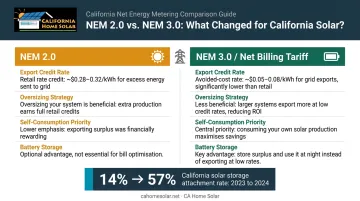
Since April 2023, new solar customers in California are enrolled in the Net Billing Tariff (NBT), not NEM 2.0. The core difference: export credits are now based on the grid's avoided-cost value rather than retail rates, which are typically much lower.
The practical effect on system design:
- Oversizing a system to maximize grid exports is no longer financially smart
- Self-consumption matters more than ever
- Battery storage increases self-consumption by storing excess daytime generation for evening use
The data confirms the shift is working: LBNL reported California residential storage attachment rates jumped from 14% in 2023 to 57% in 2024 following the NBT transition.
HERO Program Financing
While not a rebate, CA Home Solar's status as a HERO Registered Contractor gives Southern California homeowners access to PACE financing — zero down, repayment terms of 5–25 years, and payments billed through property taxes.
Approval is based primarily on home equity rather than credit score, and HERO financing doesn't affect eligibility for SGIP or other utility programs. CA Home Solar also works with California First and YGrene as additional PACE financing options.
What Most Homeowners Get Wrong About Solar Costs in 2026
Comparing Only on Price-Per-Watt
A lower price-per-watt can signal cheaper equipment, thinner warranties, less experienced labor, or a contractor with weak post-install support. Watch for:
- Equipment brand and panel efficiency ratings
- Warranty terms on panels, inverters, and workmanship
- Installer credentials and years in operation
- Post-install support and monitoring options
Over a 25-year system life, those factors matter far more than saving $0.10/W upfront.
Sizing for NEM 2.0 Logic
Under NEM 2.0, oversizing was often the right call — excess exports earned retail-rate credits. Under NEM 3.0, that math doesn't hold. Homeowners who oversize without adding storage end up sending cheap power to the grid and buying expensive power back at peak rates. Size for self-consumption first, then evaluate storage.
Underestimating the Payback Timeline Without the ITC
The 30% federal credit meaningfully shortened payback periods. Without it, the math shifts — but California's high electricity rates partially offset that change. EnergySage estimates California homeowners can expect to recoup their investment in about 7.6 years, aided by the state's residential rate of 33.35 cents/kWh as of March 2026 (per EIA data).
Expected 25-year savings average around $127,214 on the EnergySage California platform. Payback takes longer than it did pre-2026, but the long-term return on investment remains solid for most Southern California households.
How to Budget for Solar in Southern California
Follow these steps before requesting quotes:
- Pull 12 months of utility bills — total annual kWh consumption is the primary input for system sizing; don't skip this step
- Check your utility territory — LADWP and SCE customers have different interconnection processes, rate structures, and available programs
- Assess your roof — age, material, and orientation affect both cost and production; a roof that needs work should be addressed first
- Research your incentive eligibility — SGIP availability, property tax exclusion status, and HERO program eligibility all affect net cost
- Get at least 3 quotes — from licensed, bonded installers with experience in your municipality and utility territory
- Evaluate the full package — equipment quality, warranty terms, post-install monitoring, and installer track record, not just PPW
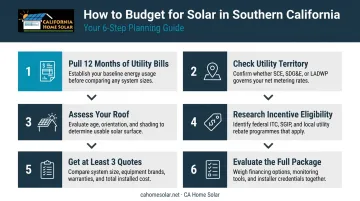
Step 6 is where many homeowners underestimate value. California Home Solar, a HERO Registered Contractor with 36 years in Southern California, includes free 24/7 system monitoring with every installation and offers HERO and PACE financing options. For LA-area homeowners, working with a single contractor for solar, roofing prep, and related upgrades keeps accountability clear and the project timeline tighter.
Frequently Asked Questions
Will solar panels get cheaper in 2026?
Panel and inverter prices have edged down — SEIA reported a 1% year-over-year decline through late 2025. That saving, however, is more than offset by customer acquisition costs Wood Mackenzie projects will rise 40% after the federal credit sunset. Most homeowners will pay more out of pocket in 2026 than in 2025.
Is solar still worth it in California without the federal tax credit?
Yes — California's electricity rates rank among the highest in the country, SGIP rebates offset battery costs for qualifying households, and the property tax exclusion adds real value. Payback periods are longer without the federal credit, but total 25-year savings stay well above the system cost for most Southern California homeowners.
What California solar incentives are available in 2026?
Available incentives include the property tax exclusion (through the 2025–26 fiscal year), SGIP battery rebates for qualifying households, and PACE financing through programs like HERO. California does not offer a sales tax exemption for residential solar equipment. Verify current availability at DSIRE and your utility's website.
How long does it take for solar to pay for itself in Southern California?
EnergySage estimates approximately 7.6 years for California homeowners in 2026. California's above-average electricity rates — 33.35 cents/kWh as of March 2026 — tend to shorten payback compared to national averages, partially offsetting the loss of the federal credit.
What size solar system does a typical Southern California home need?
System size depends on annual kWh usage, not home size. The LA-area average on EnergySage runs about 10 kW, though homes with EVs, pools, or heavy AC use often need 12 kW or more. Start with 12 months of utility bills: that's the only reliable sizing input.
Does California have a property tax exemption for solar panels?
Yes. Under Revenue and Taxation Code Section 73, solar installations are excluded from property tax reassessment. Your home's assessed value doesn't increase when you add solar, meaning no corresponding property tax increase. This exclusion is currently scheduled to sunset January 1, 2027.