This guide covers everything Southern California homeowners need to make a smart replacement decision: how to know when it's actually time to replace (not just repair), which system types make sense for SoCal's climate, what it realistically costs, and how to access rebates and financing that can significantly offset the upfront expense.
Key Takeaways
- Full HVAC replacement typically costs $5,000–$12,500+ depending on system type, home size, and LA-area labor rates.
- Replace when your system is over 10–15 years old, repairs are piling up, or rooms heat and cool unevenly.
- Heat pumps handle both heating and cooling efficiently, making them a strong fit for Southern California's mild winters.
- Proper sizing via a Manual J load calculation matters as much as equipment brand.
- California homeowners can access LADWP/SCE rebates, a 30% federal tax credit (up to $2,000/year), and PACE financing programs.
Signs It's Time to Replace Your HVAC System
The Age Question
Most homeowners assume their system will last forever. It won't. According to AHRI, the average lifespan of a central air conditioning system is 12 to 15 years with proper maintenance. Heat pumps average about 14 years. ENERGY STAR recommends considering replacement when an air conditioner or heat pump exceeds 10 years of age.
In Southern California's climate — where AC carries the bulk of seasonal load — systems age harder than in cooler regions. Running your compressor nine or ten months a year accumulates wear faster than a system in Minnesota running four.
Repair vs. Replace: A Practical Framework
Consumer Reports supports a straightforward 50% rule: if a repair costs 50% or more of what a replacement would cost, replace it. That math gets even clearer when you factor in that an older system will likely need another repair within 12–18 months.
Key signals that replacement makes more sense than repair:
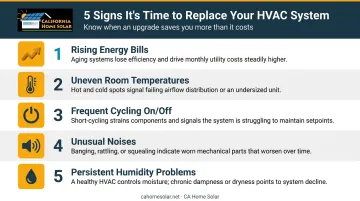
- Rising energy bills with no change in usage patterns (efficiency declining with age)
- Uneven temperatures room-to-room (ductwork issues or failing equipment)
- Frequent cycling on and off (oversizing, refrigerant loss, or compressor wear)
- Unusual noises — banging, grinding, or rattling (mechanical failure)
- Persistent indoor humidity problems (system not running long enough to dehumidify)
The R-22 Problem
If your system was manufactured before 2010, there's a good chance it uses R-22 refrigerant (commonly called Freon). The EPA banned new production and importation of R-22 as of January 1, 2020, leaving only recovered or reclaimed supplies on the market.
As that supply shrinks, prices climb — and repairing an R-22 system gets costlier with each passing season.
Modern replacement systems use R-410A, R-454B, or R-32. If a technician quotes you an R-22 recharge on an older system, that's a strong signal the economics favor replacement.
Don't wait for total failure. Between aging refrigerant costs and peak-season demand, the window for a calm, considered decision closes fast. During a SoCal heat event, HVAC contractors book up within hours — planning ahead means you compare quotes and choose on your schedule, not in a panic.
Types of HVAC Systems: What Southern California Homeowners Should Know
Three system types cover the vast majority of SoCal residential installations:
| System Type | How It Works | Best Fit |
|---|---|---|
| Central Split System | Separate outdoor condenser + indoor air handler connected via ductwork | Homes with existing ductwork in good condition |
| Ductless Mini-Split | Outdoor compressor + one or more indoor wall units, no ductwork needed | Additions, older homes without ducts, single-room solutions |
| Heat Pump | Single system provides both heating and cooling via refrigerant cycle; ducted or ductless | Most LA-area homeowners replacing aging AC or furnace+AC combos |
Why Heat Pumps Make Particular Sense Here
The DOE notes that air-source heat pumps provide both heating and cooling and can be more efficient than traditional air conditioners, especially in moderate climates. Southern California fits that profile well. Mild winters mean a heat pump can handle your heating load without a gas furnace as backup, while delivering the same cooling performance as a conventional AC.
California's 2025 Energy Code also expands heat pump requirements for new construction, reflecting a clear direction from state policy. For homeowners replacing aging equipment, that policy direction comes with a practical upside: heat pumps now qualify for federal tax credits and California utility rebates that can meaningfully offset the upfront cost.
Matching System Type to Your Home
Once you understand why heat pumps make sense for this climate, the next step is matching the right system format to your home's layout:
- Existing ductwork in decent condition → central split system or ducted heat pump
- No ductwork, or adding a room/ADU → ductless mini-split
- Replacing both furnace and AC → full heat pump system (ducted or hybrid)
One caution: always have a contractor inspect ductwork condition before choosing your new system. Leaky or undersized ducts can undermine even the best new system.
Choosing the Right System Size and Efficiency Rating
Why Sizing Gets Mishandled
Getting size wrong is one of the most common, and costly, HVAC mistakes. An oversized system short-cycles — reaching the thermostat setpoint quickly and shutting off before a full run completes — which drives up wear, energy use, and indoor humidity. An undersized system runs constantly and never quite reaches comfort targets.
Either way, the problem persists for the entire 15–20 year life of the equipment.
Manual J Load Calculation
The right fix starts with a proper load calculation. The industry standard is the Manual J, developed by ACCA, which accounts for:
- Home square footage and ceiling height
- Insulation levels (walls, attic, floor)
- Window types, sizes, and orientation
- Local climate data
- Sun exposure and shading
Any contractor who quotes you a system based solely on square footage — or just matches whatever was there before — is skipping this step. That's a red flag. Ask for a written proposal that lists the specific equipment model, capacity in Btu/h, and SEER2 rating before signing anything.
SEER2 Efficiency Ratings
SEER2 (Seasonal Energy Efficiency Ratio 2) measures cooling efficiency — higher numbers mean lower operating costs. Current federal minimums for the Southwest region are stricter than the national baseline:
- Split-system central AC: 14.3 SEER2 minimum (systems under 45,000 Btu/h)
- Split-system heat pump: 14.3 SEER2 minimum
- ENERGY STAR certification: 15.2 SEER2
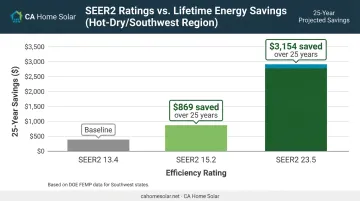
DOE FEMP data shows that in Hot-Dry/Southwest states, upgrading from SEER2 13.4 to 15.2 saves $869 over a 25-year system lifetime. Moving to a SEER2 23.5 model saves $3,154 over the same period. For SoCal homeowners running AC most of the year, the payback on higher-efficiency equipment is shorter than in most of the country.
Variable-Speed Equipment
Variable-speed compressors and blowers run at low capacity most of the time, adjusting output to match conditions rather than cycling on/off at full blast. Per the DOE, these systems deliver quieter operation, better dehumidification, and more consistent temperatures throughout the home. They cost more upfront, but in a climate where the system runs nearly year-round, the comfort gains and efficiency savings add up fast.
Gas Furnace Efficiency (AFUE)
Gas furnace efficiency is measured by AFUE (Annual Fuel Utilization Efficiency), which represents the percentage of fuel actually converted to heat. In Southern California's mild winters, furnace efficiency is rarely the primary cost driver. Still, it's worth knowing: the DOE will require non-weatherized gas furnaces to hit 95% AFUE by 2028 for new installations, so any system you install today should already meet that standard.
How Much Does HVAC Replacement Cost?
Cost Ranges by System Type
| System Type | Typical Range | Average |
|---|---|---|
| Central AC replacement only | $1,425 – $12,500 | ~$5,993 |
| Ducted heat pump installation | $4,241 – $7,941 | ~$6,089 |
| Ductless mini-split installation | $2,000 – $5,000 | ~$3,000 |
| Full HVAC system replacement | $5,000 – $22,000 | ~$7,500 |
Southern California labor rates push projects toward the higher end. BLS data shows LA-area HVAC mechanics and installers earn a mean annual wage of $68,090, compared to the national mean of $59,620.
What Drives the Total
Beyond equipment cost, your quote should account for:
- Labor and installation (the largest variable after equipment tier)
- Ductwork repair or replacement — often needed on older homes
- Permits — required for HVAC installation in both the City of LA and LA County
- Electrical panel upgrades — high-efficiency systems and heat pumps sometimes require a panel upgrade
Get at Least Three Written Quotes
Prices for identical equipment can vary by thousands of dollars between contractors. Three quotes is the minimum. The lowest bid isn't automatically the best — when comparing proposals, look at:
- Scope of work included
- How permits are handled
- Warranty terms on equipment and labor
- Contractor credentials and licensing
Watch for Predatory Financing Terms
Some HVAC companies offer deferred-interest loans that flip to steep rates once the promotional period ends. Equipment lease arrangements are another common upsell — and they almost always favor the company, not you. Read all loan terms carefully. Programs with transparent, fixed-rate structures are far safer than "no interest for 18 months" deals with compounding penalties.
How to Choose an HVAC Contractor You Can Trust
Credentials to Verify Before Hiring
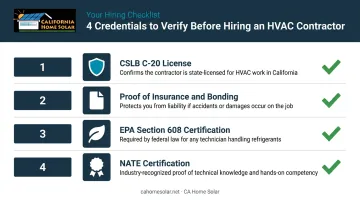
- CSLB C-20 license: California classifies HVAC work under the C-20 Warm-Air Heating, Ventilating and Air-Conditioning Contractor license. Verify any contractor through the CSLB license lookup before signing anything.
- Proof of insurance and bonding: Protects you if something goes wrong during installation.
- EPA Section 608 certification: Required for any technician handling refrigerants — mandatory since 2018 for HFC refrigerants as well as older ozone-depleting compounds.
- NATE certification: An industry credential indicating a technician has passed standardized competency exams. Not required, but a positive signal.
What a Legitimate Consultation Looks Like
A reputable contractor will:
- Visit the home and inspect existing equipment and ductwork
- Perform a Manual J load calculation (or equivalent)
- Provide a written proposal specifying brand, model, capacity, SEER2 rating, and warranty terms
- Pull required permits and handle inspections
Watch out for contractors who skip any of these steps:
- Quote you over the phone without visiting the home
- Provide proposals that omit equipment specs or SEER2 ratings
- Match your existing system size without performing any load calculation
- Decline to pull permits or handle inspections
Treat any of these as a dealbreaker.
For Southern California homeowners, California Home Solar is one local option that meets these benchmarks — licensed, bonded, and registered under the HERO program, with 36 years of service across Los Angeles County and surrounding areas. They offer HVAC upgrades as part of their broader home energy services, with free consultations and a dedicated project manager for each job.
Financing and Rebates for HVAC Replacement in Southern California
California homeowners have several programs available to reduce HVAC replacement costs — rebates, federal tax credits, and financing can together cut thousands off the final bill.
Utility Rebates
LADWP customers:
- HVAC system rebates: $100–$120 per ton
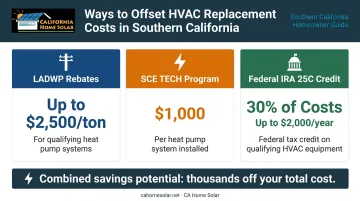
- Heat pump HVAC system rebates: up to $2,500 per ton
SCE customers (TECH Clean California program):
- $1,000 per new heat pump HVAC system, with up to two systems per home eligible
- TECH incentives require TECH-approved contractors and are available while funding lasts
Rebate programs change frequently — confirm current availability and eligibility with your utility before committing to equipment.
Federal Tax Credit (IRA 25C)
The IRS Energy Efficient Home Improvement Credit covers qualified heat pump installations. Key details:
- Credit amount: 30% of qualified installation costs
- Annual cap: $2,000 for heat pumps and heat pump water heaters combined
- Eligible equipment: ENERGY STAR Most Efficient-rated air-source heat pumps qualify starting January 1, 2025.
Consult a tax professional to confirm your eligibility.
PACE Financing
PACE (Property Assessed Clean Energy) financing lets homeowners fund energy-efficient improvements through their property tax bill with no large upfront payment and repayment terms typically ranging 5–25 years. CA Home Solar is a HERO Registered Contractor and also works with CaliforniaFIRST and YGrene financing programs.
One important note: the CFPB issued a residential PACE rule in December 2024 adding Ability-to-Repay requirements. PACE loans appear as a line item on your property tax bill, can affect mortgage escrow payments, and can complicate refinancing or selling.
CA Home Solar's finance team can walk you through all available options and help identify the best fit for your situation.
Frequently Asked Questions
What is the average cost to replace an entire HVAC system?
A full HVAC replacement (equipment plus installation) typically runs $5,000–$12,500 for most homes, with a national average around $7,500. System type, home size, ductwork condition, and permit requirements all affect the final number. Southern California projects often land toward the higher end due to local labor costs.
What are the top 3 residential HVAC systems?
The three most common residential types are central split systems, heat pumps, and ductless mini-splits. For Southern California specifically, heat pumps are often the best choice: they handle both heating and cooling in one unit, and mild local winters mean a gas furnace backup is rarely necessary.
What is the 20 rule for HVAC?
The "20 rule" holds that systems approaching or exceeding 20 years of age are strong replacement candidates regardless of current operating condition. Paired with rising repair frequency and efficiency decline, it gives homeowners a clear signal that replacement makes more financial sense than continued fixes.
How long does an HVAC replacement take?
A straightforward equipment swap typically takes one full day. If the job involves ductwork modifications, electrical panel upgrades, or permit inspections, expect 2–3 days. Ask your contractor for a realistic timeline before scheduling.
Should I replace my entire HVAC system at once or in stages?
Replacing components separately (just the AC, or just the furnace) often leads to mismatched equipment, efficiency losses, compatibility issues, and voided warranties. For aging systems, full replacement at once is the better long-term decision, and many contractors price the combined job more competitively than two separate visits.