But 2026 is a genuinely different year for solar decisions. A major federal incentive has expired, California's net metering rules have shifted, and the math has changed enough that the old "just go solar" advice deserves a harder look. This guide covers whether the ROI still holds up, which incentives remain on the table, and what Southern California homeowners need to know before signing anything.
Key Takeaways
- The federal 30% Residential Clean Energy Credit expired for new installations after December 31, 2025 — systems installed in 2026 do not qualify
- California still offers the SGIP battery storage rebate, a property tax exclusion (through January 1, 2027), and net billing under NEM 3.0
- Average payback period for Los Angeles solar is approximately 6.18 years based on May 2026 EnergySage data
- Battery storage now drives ROI under NEM 3.0 — without it, excess solar energy sells back at rates too low to justify the system cost alone
- Roof orientation, shading, and your utility rate tier all determine whether solar delivers strong returns — site-specific numbers matter more than averages
The 2026 Solar Incentives Landscape: What's Still on the Table
The Federal Credit Is Gone for New Systems
This is the news many homeowners haven't heard yet. H.R. 1, Public Law 119-21 ended the Section 25D Residential Clean Energy Credit for expenditures completed after December 31, 2025. A solar system installed in 2026 does not qualify for the 30% federal tax credit, regardless of what older IRS pages or salespeople may suggest.
Two important exceptions apply:
- Carryforward credits still apply. Homeowners who installed solar before 2026 and have unused credit balances can continue carrying those forward into 2026 and future tax years until exhausted.
- Commercial and utility installations follow different rules under separate tax code sections — this expiration applies specifically to residential (Section 25D) claims.
The practical implication: a 9 kW Los Angeles system that would have generated a ~$7,200 federal credit in 2025 now generates $0 at the federal level in 2026. That changes the net cost calculation significantly.
What California Still Offers
California's incentives don't fully replace the federal credit, but several programs still move the needle:
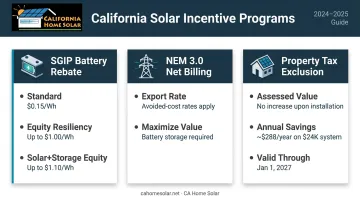
- SGIP (Self-Generation Incentive Program): California's battery storage rebate remains active, with residential rates at $0.15/Wh (Step 7) — and enhanced rates up to $1.00–$1.10/Wh for equity resiliency and low-income customers.
- Property tax exclusion: California's Active Solar Energy System exclusion prevents solar from raising your assessed property value. It sunsets on January 1, 2027, so 2026 installations still qualify — confirm the timing with your installer before signing contracts.
- Sales tax: California does not offer a broad residential solar sales tax exemption. Solar equipment installed under a construction contract is taxable. Don't build sales tax savings into your ROI estimate.
SGIP funding runs in tranches and categories close or reach waitlist status frequently. Verify current availability at selfgenca.com before committing to a battery storage system.
How to Calculate Your Solar ROI in Southern California
The Three-Step Payback Formula
- Net cost = Total system cost minus upfront incentives (SGIP rebate, any utility rebates)
- Annual benefit = Electricity bill savings + value of any remaining incentives
- Payback period = Net cost ÷ Annual benefit
A realistic Los Angeles example:
| Item | Amount |
|---|---|
| 9.99 kW system (LA average) | $24,000 |
| SGIP rebate (~14 kWh battery at $0.15/Wh) | ~$2,100 |
| Net cost | ~$21,900 |
| Annual electricity savings (est.) | ~$3,500–$4,500 |
| Estimated payback | ~5–6 years |
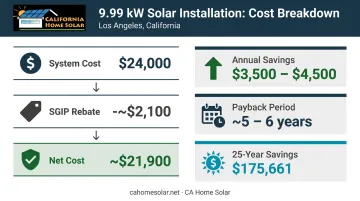
These figures are illustrative — your actual numbers depend on roof orientation, electricity consumption, and rate plan. EnergySage's May 2026 Los Angeles data puts the average LA payback at 6.18 years and estimated 25-year savings at $175,661.
Why Southern California Works
California's residential electricity rates average 33.60 cents/kWh statewide — nearly 78% above the national average. SCE TOU rates during summer peak hours can hit 58–74 cents/kWh. Every kilowatt-hour your panels produce offsets electricity you'd otherwise buy at those prices, which is why the math here outperforms most other U.S. markets.
How Financing Affects Your ROI
Your financing method changes the return:
- Cash purchase: Shortest payback, you own all savings and any tax credits (state-level)
- Solar loan: No upfront cost, you retain system ownership and tax credit eligibility; monthly payments offset some early savings, but equity builds over time
- PPA or lease: No ownership, no federal or state tax credits for you — the third-party owner claims those. Lower risk, but the long-term financial benefit is substantially reduced
Keep in mind that only system owners can claim incentives. If you lease, you give up the SGIP rebate and any future federal credits that might return.
That ownership distinction matters more than many homeowners realize. The DOE's savings framework notes that an 8-year payback over 20 years equates to roughly a 6.0% annual after-tax return, putting solar on par with many low-risk investment alternatives.
California-Specific Programs That Stack On Top
NEM 3.0 and Why Battery Storage Is Now Essential
California's Net Billing Tariff (NEM 3.0), effective April 15, 2023, replaced the older one-to-one retail credit for exported solar with avoided-cost pricing. The CPUC noted that NEM 2.0's retail compensation was 3.8 to 5.4 times higher than the avoided-cost values now used — so surplus power you export to the grid earns far less than what you pay to import it.
A home battery stores that surplus instead of sending it to the grid, then dispatches it during SCE or LADWP peak-rate hours — the hours when rates spike to 58–74 cents/kWh. You consume your solar at full retail value rather than exporting it at a fraction of that. Under NEM 3.0, solar-plus-storage is the configuration that holds up financially.
The Self-Generation Incentive Program (SGIP)
SGIP is California's primary battery storage rebate and is administered through the major utilities including SCE and LADWP. Key details for 2026:
- Standard residential storage: $0.15/Wh (Step 7)
- Equity Resiliency (high fire-threat districts, vulnerable customers): up to $1.00/Wh
- Residential Solar and Storage Equity: up to $1.10/Wh for storage, $3.10/W for solar
For homeowners in fire-prone communities across the Los Angeles area, the enhanced Equity Resiliency rate can dramatically improve the battery investment case. Funding allocations shift as steps fill, so confirm current availability through the CPUC's SGIP portal before committing to an installation timeline.
Property Tax Protection
California's Active Solar Energy System exclusion means your home's assessed value does not increase when you add solar panels. For a $24,000 system in LA County (where the average effective property tax rate runs around 1.2%), that's roughly $288/year in property tax savings you'd otherwise face — and it compounds over your ownership period. The exclusion runs through January 1, 2027, covering 2026 installations.
Key Factors That Shape Your Solar Payback in Los Angeles
Roof Condition and Orientation
South-facing roofs with a 15–40° slope and minimal shading consistently produce the most energy. If your roof needs replacement within the next five years, do that first — removing and reinstalling panels adds cost and disruption.
CA Home Solar handles both roofing and solar installation, so the roof can be evaluated and addressed in the same project. The new surface gets prepared for optimal panel mounting from day one.
Your Rate Plan and Electricity Usage
Homeowners on SCE or LADWP time-of-use plans can get significantly more value from solar-plus-storage by shifting high-draw activities (EV charging, laundry, dishwasher) to off-peak hours and dispatching stored solar during peak windows.
A homeowner on SCE's TOU-D 5–8 PM plan paying 74 cents/kWh during summer peak has far more to gain from smart battery dispatch than someone on a flat-rate plan.
Ownership and Tax Position
You must own your home to install rooftop solar. California's property tax exclusion doesn't require tax liability, but state-level credits do — confirm your eligibility with a tax professional.
With the federal credit gone for 2026, this is less of a concern than it was previously, but it's still worth a quick review before you commit.
When Solar Panels Might Not Make Sense Right Now
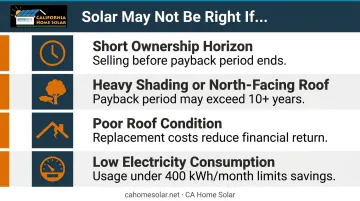
Not every Southern California home is a good solar candidate in 2026. Be honest about your situation:
- Short ownership horizon: If you plan to sell within a few years, compare your expected ownership period to the quoted payback period. The system may add home value, but not necessarily dollar-for-dollar
- Heavy shading or north-facing roof: Trees, neighboring structures, or a north-facing roof orientation can cut production enough to push payback well beyond 10 years — the threshold where DOE's framework considers the investment less attractive
- Poor roof condition: A deteriorating roof adds replacement costs on top of the solar project. The combination can stretch payback substantially
- Low electricity consumption: A homeowner using 400 kWh/month won't generate the same returns as one using 1,200 kWh/month — system sizing and economics need to match actual usage
For renters, HOA-restricted homeowners, or those with unsuitable roofs: California's Community Solar Green Tariff offers an alternative. Qualifying residential customers — particularly those in disadvantaged communities — can receive bill credits from a local solar project without owning a system. The CPUC administers this program, and checking eligibility directly on the CPUC website is a practical first step if rooftop solar isn't an option.
How to Get Started With Solar in Southern California
The single most useful thing you can do before talking to anyone about equipment or pricing is get a professional site assessment. The national average payback figures quoted throughout this article are useful benchmarks — but your actual payback depends on your specific roof, your rate plan, your consumption patterns, and which incentives you qualify for.
A qualified installer will evaluate:
- Roof condition, age, and structural suitability
- Panel orientation and shading analysis
- Your current utility bills and rate structure
- Which SGIP tier applies to your location
- Realistic system sizing and production estimates
CA Home Solar brings that kind of honest assessment to every job. The company has been installing solar across Los Angeles County and Southern California for 36 years, earning Top 500 Solar Contractor recognition in 2015, 2016, 2018, 2021, 2023, and 2025.
As a HERO Registered Contractor, CA Home Solar offers multiple financing paths — including HERO program financing, California First, and Ygrene — and handles roofing alongside solar when a roof upgrade is needed first. Their approach: if solar doesn't pencil out for your home, they'll tell you directly.
Contact CA Home Solar for a free, no-obligation consultation: call 877-903-1012 or email info@cahomesolar.com.
Frequently Asked Questions
Is the federal solar tax credit still available in 2026?
No. H.R. 1 (Public Law 119-21) ended the Section 25D Residential Clean Energy Credit for new installations completed after December 31, 2025. Homeowners who installed solar before 2026 and have unused credit balances can still carry those forward, but 2026 new installations receive $0 at the federal level.
How does California's NEM 3.0 affect my solar savings?
NEM 3.0 replaced the one-to-one retail export credit with avoided-cost pricing, which is considerably lower — making solar-only systems less profitable than they were under NEM 2.0. Pairing solar with battery storage compensates by keeping surplus energy on-site for use during peak-rate hours, restoring much of the lost value.
What is the typical payback period for solar in Southern California?
EnergySage's May 2026 data puts the average Los Angeles payback at 6.18 years and the California statewide average at 7.64 years. Financing method, system size, and electricity usage all affect where your number lands.
Do solar panels increase my property taxes in California?
No. California's Active Solar Energy System exclusion protects homeowners from assessed value increases tied to solar installations. The exclusion is currently scheduled to sunset on January 1, 2027, so 2026 installations still qualify.
Can I still claim solar incentives if I finance through a loan?
Yes. Homeowners who purchase solar with a loan retain system ownership and remain fully eligible for the SGIP battery rebate and any applicable state-level credits. This is a key difference from leases or PPAs, where the third-party owner claims all incentives.
Does adding battery storage qualify for additional incentives in California?
Yes. Battery storage qualifies for California's SGIP rebate separate from solar. When installed alongside a new solar system, it can also qualify for additional incentive tiers. SGIP funding varies by category and closes or waitlists quickly. Verify current status at selfgenca.com before your installation.