The quality of your design package determines whether a project gets approved, funded, and built on time. A poorly assembled package leads to failed inspections, utility rejection letters, and change orders that erode project margins fast. According to SEIA's 2025 Year in Review, California represented 39% of national commercial solar installations in 2025, with 28% year-over-year growth — the stakes for getting design right have never been higher.
This guide covers exactly what a complete commercial solar design package includes, how to build one step by step, the key variables that shape the final design, and the mistakes that derail projects in Southern California.
Key Takeaways
- A complete package covers site assessment, energy modeling, single-line diagrams, structural calculations, equipment specs, interconnection docs, and permit-ready drawings
- Professional teams follow 30%, 60%, and 90% design milestones — errors caught at 30% cost a fraction of what they cost during construction
- Roof condition, shading, utility requirements, and load profile are the four variables that most directly determine system design
- Never order equipment before receiving formal approval-to-construct from the utility
- In Southern California, SCE follows CPUC Rule 21 while LADWP operates under a separate municipal framework with its own distinct process
What a Complete Commercial Solar Design Package Includes
A design package is not just a plan set. It is the full collection of technical, electrical, structural, and regulatory documents required to get a commercial project permitted, approved by the utility, and handed off to a construction crew.
Three separate reviewers depend on this package before a project moves forward:
- Lenders need it to evaluate project viability
- The AHJ needs it to issue a building permit
- The utility needs it to process an interconnection application
An incomplete package at any of those three windows stops the project cold.
Core documents in a complete commercial solar design package:
- Site assessment report
- 12-month energy consumption analysis and load profile
- System sizing calculations (kWp, DC/AC ratio, production model)
- Single-line electrical diagram
- Array layout drawings with setbacks and dimensions
- Structural/load calculations for the mounting system
- Equipment specifications (modules, inverters, racking)
- Shading analysis using approved tools
- Interconnection application and supporting utility forms
- Bill of materials
- Permit-ready drawings (PE-stamped where required)
California adds utility-specific requirements on top of those core documents. Key additions by authority:
- SCE: GFIA Form 14-957 interconnection application, Load Justification Form, Customer Project Information Sheet, and CEC-listed equipment documentation
- LADWP: Load Schedule, Service Planning Information Form, and a BESS Technical Data Form when storage is included
- California Solar Permitting Guidebook: Structural drawings stamped by a California-licensed civil or structural engineer for non-qualifying rooftop systems
How to Create a Commercial Solar Design Package
Step 1: Conduct the Engineering Site Assessment
No design package can be built from satellite imagery. A proper engineering site visit requires at least two trained individuals and several hours on-site — longer for larger or more complex facilities.
NREL's site evaluation guidance identifies the following as required site-assessment inputs:
- Roof condition, age, and material type
- Structural integrity and available dead-load capacity
- Existing electrical infrastructure (panel size, available capacity, service entrance)
- Shading obstructions — HVAC equipment, parapets, adjacent structures, mechanical penthouses
- Available space for inverters, combiners, and balance-of-system equipment
- Feasibility of the proposed interconnection point
CA Home Solar conducts a comprehensive facility assessment at the outset of every commercial project, including a financial performance evaluation — so clients understand both the engineering constraints and the economic case before any design work begins.
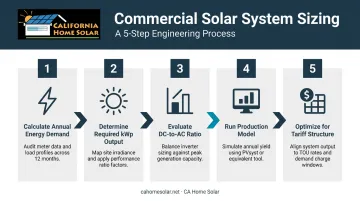
Step 2: Analyze Energy Consumption and Size the System
System sizing starts with 12 months of utility bills, not with roof area. Review interval data to identify peak load periods, demand charge windows, and any planned operational changes at the facility.
From that baseline, the sizing process works as follows:
- Calculate total annual energy demand in kWh and identify peak demand in kW
- Determine required kWp output using local irradiance data and a target production model
- Evaluate DC-to-AC ratio — NREL's 2024 inverter clipping research confirms that clipping impacts should be modeled explicitly, not estimated with rules of thumb
- Run a production model using tools like PVWatts, which applies a default 14% total system loss, or commercial-grade platforms like Helioscope or Aurora
- Optimize for the tariff structure — under California's Net Billing Tariff (NEM 3.0), oversizing for maximum export has diminishing financial returns; size for self-consumption first
Step 3: Design the System in Stages (30/60/90 Methodology)
The three-stage design approach used by professional engineering teams mirrors the framework documented in DOE's Standard Review Plan for engineering projects. Each stage has defined deliverables and a review gate before advancing.
| Stage | Deliverables | Purpose |
|---|---|---|
| 30% | Conceptual array layout, preliminary equipment selection, approximate electrical routes | Establish direction, identify major constraints |
| 60% | Detailed drawings, conduit routes, combiner box locations, preliminary BOM | Internal and client review, catch coordination issues |
| 90% | Final string diagrams, equipment wiring details, updated energy model, construction-ready drawings | Permit submission, procurement authorization |
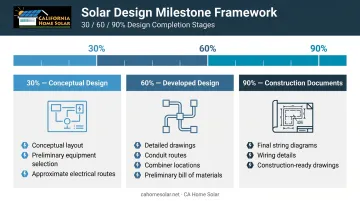
Each stage includes an internal peer review. Per the Construction Industry Institute, rework on industrial projects exceeds 12% of project cost on average — a figure that reflects how expensive late-stage corrections become across any complex engineering project.
A design error caught at 30% costs a few minutes of markup. Caught during construction, it means a change order, a schedule delay, and a likely inspection failure.
Step 4: Select Equipment and Coordinate With Third-Party Engineers
Equipment selection happens at the 60% stage, not before. Locking in equipment earlier skips the layout and routing work that determines what will actually fit and perform as modeled.
For modules, evaluate performance in Southern California's climate, energy density, shade tolerance, and vendor reliability. CA Home Solar's commercial projects have included products from established manufacturers including SolarEdge and Enphase, with racking systems from Unirac and Rooftrac.
For inverters, confirm compliance with California utility requirements before shortlisting any product. Requirements differ by utility:
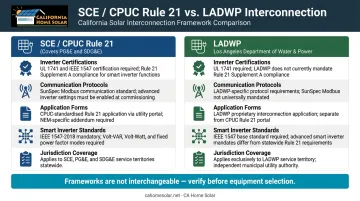
- SCE and SDG&E: CPUC Rule 21 compliance, smart inverter Phase 2 communication attestation, and UL 1741 Supplement SB / IEEE 1547:2018 certification
- LADWP: UL 1741 SB and IEEE 1547-2018 certification, with TCP/IP and IEEE 2030.5 as the default communication protocol
- All utilities: verify current listing status on the CEC Solar Equipment Lists before procurement
For third-party structural engineers, the need is straightforward: NREL documents that rooftop PV systems add approximately 3 to 6 psf of dead load, and the California Solar Permitting Guidebook requires stamped structural drawings for non-qualifying systems.
Define the full scope of work in writing before issuing an RFP. A vague scope produces bids that omit critical components — and those gaps resurface as change orders during construction.
Step 5: Manage Interconnection Documentation and Permit Submission
Interconnection and permitting run on parallel tracks, but the utility timeline governs procurement decisions.
SCE Rule 21 timeline (Fast Track path):
- Initial Review: 15 business days after the application is deemed complete and valid
- Supplemental Review: 20 business days after the $2,500 supplemental review fee
- Distribution Group Study windows: typically March and September
SCE's Rule 21 review does not begin until the application package clears a completeness check. Missing forms, unsigned documents, or unlisted equipment pushes that clock back to zero.
Permit submission to the AHJ requires:
- PE-stamped structural and electrical drawings (required by most California AHJs)
- Verification of local zoning, setback, and fire access requirements
- Timeline coordinated with the construction schedule
In Los Angeles County, the plan check process begins with a completeness screening, then agency referral, then plan and specification review. Requirements vary by jurisdiction within the county, so confirm with the AHJ before submitting.
Key Parameters That Shape Your Commercial Solar Design
Two commercial buildings with identical square footage can require dramatically different system designs. These four variables drive most of that difference.
Roof Condition and Structural Capacity
The mounting system must be compatible with the roof material, age, and load capacity. A commercial roof nearing end-of-life may need replacement before solar installation — a discovery that affects both timeline and budget.
The DOE Better Buildings program is direct on this: a solar installer should conduct a roof assessment before installation and determine whether repair or replacement is needed. NRCA guidance adds that roof and PV system service lives should be equivalent, and drainage and warranties must be evaluated together.
When roofing work is needed, handling it within the same project scope avoids the coordination delays and warranty gaps that come with separate contractors — which is part of how CA Home Solar structures its commercial engagements.
Shading Analysis and Array Orientation
Even partial shading from HVAC units, parapets, or adjacent structures can produce disproportionately large output losses depending on module and string configuration. NREL's partial shading research confirms the effects are condition-specific and can be severe — which is why project-specific shading analysis is required, not optional.
California's Joint Appendix JA11.4 approves Aurora Solar, Helioscope, and Scanifly for documenting shading conditions. Physical tools like Solar Pathfinder are also widely used by permitting agencies. When shading is unavoidable, module-level power electronics (MLPEs) such as optimizers or microinverters are often specified to reduce string-level losses.
Utility Interconnection Requirements
SCE and LADWP are not interchangeable. CPUC Rule 21 covers SCE, PG&E, and SDG&E. LADWP operates under its own municipal interconnection process with distinct smart inverter technical requirements. Designing to one framework and submitting to the other means equipment replacement: not just paperwork revisions.
Confirm the applicable utility framework, inverter certification requirements, and anti-islanding and metering configurations before finalizing equipment selections at the 60% stage.
Load Profile and NEM 3.0 Strategy
CPUC Decision 22-12-056 replaced standard NEM with the Net Billing Tariff, compensating exports at avoided-cost rates rather than full retail. Maximizing grid export is no longer the optimal strategy for most California commercial systems.
Design decisions should reflect that shift directly:
- Size the array around on-site self-consumption, not maximum export
- Model interval load data to identify when the building draws power and at what cost
- Evaluate battery storage dispatch to shift consumption away from peak demand periods
- For buildings with significant demand charges, treat storage as a base design element, not an add-on
Common Mistakes That Derail Commercial Solar Design Packages
Even well-resourced commercial solar projects stall when these four mistakes slip through:
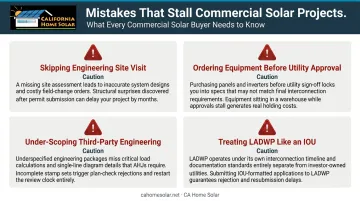
Skipping the engineering site visit. Satellite imagery misses hidden obstructions, roof material incompatibilities, and electrical panel limitations that generate expensive change orders once construction starts. The site visit is where the design actually begins.
Ordering equipment before confirming utility requirements. Procuring modules or inverters before receiving formal approval-to-construct — or before verifying CEC listing and UL 1741 SB certification status — is the fastest path to a warehouse full of non-compliant equipment. Approval-to-construct first, procurement second. Always.
Under-scoping third-party engineering. A vague RFP to a structural engineer produces a bid missing critical deliverables: wind and seismic load calculations, stamped drawings for all mounting locations, and roof penetration details. Those gaps surface as change orders during permit review or construction.
Treating LADWP like an IOU. SCE follows CPUC Rule 21. LADWP operates its own municipal interconnection process with separate smart inverter requirements, application forms, and timelines. The workflows are not interchangeable.
CA Home Solar manages third-party engineering coordination and utility interconnection as part of a full design-to-installation process for commercial clients throughout the Los Angeles area.
Frequently Asked Questions
What documents are included in a commercial solar design package?
A complete package includes a site assessment report, single-line electrical diagram, array layout drawings, structural load calculations, equipment specifications, shading analysis, interconnection application, and permit-ready PE-stamped drawings. For California projects, it also includes utility-specific forms such as SCE's GFIA Form 14-957 or LADWP's equivalent application documents.
How long does it take to create a complete commercial solar design package?
Timelines vary by project complexity but typically range from 6 to 16 weeks. That window covers the engineering site visit, staged design reviews (30/60/90), utility interconnection processing (15–20 business days minimum), and AHJ permit review — each of which varies by jurisdiction.
Do commercial solar projects in California require a licensed engineer stamp?
Yes — most California AHJs require a PE stamp on structural and electrical drawings before issuing a commercial solar permit, as outlined in the California Solar Permitting Guidebook for non-qualifying systems. Several utilities extend this requirement to interconnection documentation as well.
What is the difference between 30%, 60%, and 90% design stages?
The 30% stage establishes conceptual layout, preliminary equipment selection, and approximate electrical routes. The 60% stage produces detailed drawings — conduit routes, combiner locations, preliminary BOM — for peer and client review. The 90% stage delivers construction-ready plans with all string diagrams, wiring details, and final calculations complete.
How does NEM 3.0 affect commercial solar system design in California?
Under NEM 3.0 (Net Billing Tariff), grid exports are compensated at avoided-cost rates rather than full retail, which reduces the financial return on oversized systems. Commercial design strategy now prioritizes self-consumption optimization and often incorporates battery storage to shift load and reduce demand charges.
When should equipment be ordered for a commercial solar project?
Hold off on ordering materials until you receive formal approval-to-construct from the electric distribution company — utility or AHJ review can require design changes that make pre-ordered equipment incompatible. Before any procurement, confirm CEC listing and UL 1741 SB certification for all major components.