Introduction
Electricity is one of the highest operating costs for most businesses — and it's one of the few that solar can permanently reduce. But getting that reduction requires sizing the array correctly. Too small, and you're still paying significant utility bills. Too large, and you've spent capital on capacity your building will never use.
Most business owners hit a wall early in their research. Terms like kW versus kWh, peak sun hours, system efficiency factors, and roof setbacks appear without a clear framework for connecting them to an actual system size.
This guide provides that framework. It covers how commercial solar panels are physically sized, how to calculate the right system capacity for your business, how much roof space a commercial array actually needs, and what factors specific to Southern California — including Los Angeles's strong solar resource and California's current net billing rules — should shape your sizing decisions.
TL;DR: Key Takeaways at a Glance
- Commercial solar systems range from roughly 20 kW for small businesses to 500 kW or more for large facilities
- Commercial panels are larger than residential — typically ~80 × 40 inches with 400–615W per panel
- Core sizing formula: Annual kWh ÷ (daily peak sun hours × 365 × 0.86)
- Los Angeles averages ~5.65 peak sun hours per day — among the highest in the continental US
- A 100 kW system needs roughly 4,000–10,000 sq ft of usable roof space, depending on layout
Commercial Solar Panels: Physical Dimensions and System Capacity
Sizing a commercial solar system involves two distinct concepts. Panel size covers the physical dimensions and wattage of individual modules. System size refers to total installed capacity, measured in kilowatts (kW) or megawatts (MW). Both matter, and each affects a different part of the planning process.
Panel Dimensions: Commercial vs. Residential
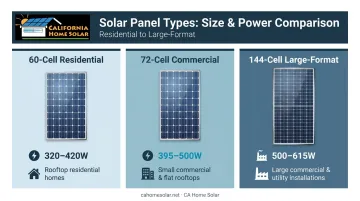
Commercial panels are meaningfully larger than residential panels. A verified 72-cell commercial module — like the LG NeON 2 72-cell — measures approximately 79.7 × 40.3 × 1.6 inches and produces 395W. Newer large-format TOPCon commercial modules, such as Canadian Solar's 144 half-cut bifacial panels, measure 93.8 × 44.6 inches and produce 590–615W at 21.8–22.8% efficiency.
| Panel Type | Typical Dimensions | Wattage Range | Typical Application |
|---|---|---|---|
| 60-cell residential | ~66 × 40 × 1.6 in | 320–420W | Residential rooftops |
| 72-cell commercial | ~80 × 40 × 1.6 in | 395–500W | Commercial rooftops |
| 144-cell large-format | ~94 × 45 × 1.2 in | 500–615W | Warehouses, industrial |
Commercial System Capacity Ranges
System sizes vary widely based on building type and energy use. As a rough orientation:
- Small commercial (20–100 kW): Offices, retail spaces, smaller warehouses
- Mid-size commercial (100–500 kW): Larger warehouses, light manufacturing, schools
- Large commercial/industrial (500 kW–5+ MW): Distribution centers, campuses, big-box facilities
These aren't official industry tiers. NREL models commercial PV using a 200 kWdc flat-roof benchmark, but the ranges above provide a useful starting point before running detailed calculations.
NREL data shows that panels and standard racking add about 3 lb/ft² to a roof. Ballasted mounting systems can push that to 4–6 lb/ft². Most commercial flat roofs are engineered to handle this, but a structural review is a standard part of any professional installation process.
How to Calculate the Right Commercial Solar Array Size
Here's a four-step framework to estimate your system size before talking to an installer. The numbers won't replace a professional site assessment, but they'll give you a solid baseline before any installer conversation.
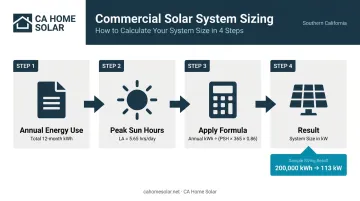
Step 1 – Determine Annual Energy Consumption
Pull 12 months of utility bills and total your annual kWh consumption. Use the full year, not a single month — commercial energy use varies significantly with seasons, HVAC load, and operating hours. Businesses with irregular hours or seasonal peaks should note that variability, since it affects both system sizing and how you evaluate storage options later.
Step 2 – Apply Peak Sun Hours for Your Location
Peak sun hours measure the daily hours of sunlight intense enough to produce rated panel output (at 1,000 W/m²). According to NASA POWER climatology data, Los Angeles averages 5.6455 kWh/m²/day, effectively about 5.65 peak sun hours per day.
The sizing formula:
System Size (kW) = Annual kWh ÷ (Peak Sun Hours per Day × 365 × 0.86)
The 0.86 output factor reflects NREL PVWatts v5's default total system loss assumption of approximately 14%, accounting for wiring losses, inverter efficiency, temperature effects, and soiling.
Sample calculation: A business consuming 200,000 kWh per year in Los Angeles:
200,000 ÷ (5.65 × 365 × 0.86) = 113 kW system
Step 3 – Convert System Size to Panel Count
Divide total system wattage by your chosen panel's wattage:
- 100 kW system using 450W panels: 100,000 ÷ 450 = ~222 panels
- 200 kW system using 550W panels: 200,000 ÷ 550 = ~364 panels
Panel count drives installation cost, roof space requirements, and structural load calculations — all of which factor directly into Step 4.
Step 4 – Estimate Required Roof or Ground Space
Each commercial panel occupies roughly 17–22 square feet of mounting area. But raw panel footprint isn't the number you plan around. Add:
- Row spacing to prevent self-shading on flat roofs
- Fire code access pathways (see the next section)
- HVAC and vent clearances
- Maintenance walkways
NREL's rooftop technical potential research uses a 70% flat-roof packing factor and a module power density of 160 W/m². That translates to roughly 96 ft²/kW before site-specific exclusions — a more conservative planning benchmark than raw panel area alone. Use this figure as your working estimate until a site survey confirms actual usable space.
Roof Space Requirements for a Commercial Solar Array
Roof space is often the limiting factor — especially for businesses with high energy usage but modest building footprints. Knowing what "usable" actually means prevents oversizing a design that can't physically fit.
Usable Area vs. Total Roof Area
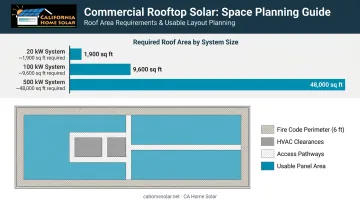
Total roof area and installable solar area aren't the same. Common deductions include:
- Fire code perimeter access (see below)
- HVAC unit clearances — mechanical equipment on commercial flat roofs requires buffer zones
- Skylights, vents, antennas — each creates a no-panel zone
- Interior pathways — required at intervals across larger roofs
- Shading exclusions — NREL excludes areas where shading loss exceeds 20%
California Fire Code access requirements differ by building type. The 36-inch pathway rule most people reference applies to Group R-3 (residential) buildings only.
For commercial and nonresidential buildings, 2025 California Fire Code Section 1205.3 requires a 6-foot clear perimeter around roof edges — reducible to 4 feet where either building axis is 250 feet or less — with interior pathways at intervals no greater than 150 feet.
Estimated roof area requirements by system size (based on NREL packing factor):
| System Size | Approximate Roof Area Needed |
|---|---|
| 20 kW | ~1,900 ft² |
| 100 kW | ~9,600 ft² |
| 500 kW | ~48,000 ft² |
Higher-wattage panels shrink these numbers accordingly — one practical reason to consider premium modules when roof space is tight.
Flat Roofs, Tilt, and Row Spacing
Most commercial buildings have flat or low-slope roofs. For optimal output, panels are typically mounted at a 10–15° tilt rather than flat. That tilt means each row of panels casts a shadow on the row behind it — requiring spacing between rows to avoid self-shading losses, especially during winter when the sun angle is lower.
Row spacing varies by latitude and tilt angle. As a general rule:
- Gaps between rows run roughly 1.5–2.5× the panel height in ground distance
- On large flat roofs, this can increase total array footprint by 30–50% beyond panel area alone
When roof dimensions are tight, that extra spacing is often what pushes a design over the available area.
When Roof Space Is Insufficient
If the roof can't fit the full system size your consumption requires, several alternatives work well for commercial properties:
- Ground-mounted arrays on adjacent land — offer optimal orientation flexibility and easier maintenance access
- Solar carport structures over parking areas — generate power while adding covered parking
- Higher-efficiency panels — upgrading to 590–615W modules reduces panel count and footprint for the same kW target
Key Factors That Influence Commercial Array Sizing
Energy Consumption Profile and Demand Charges
Commercial energy bills include two components: consumption charges (per kWh) and demand charges (based on peak kW draw, often 30–40% of the total bill). A solar array sized purely for annual kWh offset may do little to reduce demand charges — because demand peaks often occur during brief intervals that don't align with peak solar production.
Addressing demand charges typically requires battery storage paired with solar, rather than panels alone. Factor this into sizing decisions before committing to a system design.
Panel Efficiency and Technology
The efficiency of the panels you choose affects how much roof space you need per kW of capacity:
- Monocrystalline TOPCon panels run 21–23% efficiency (500–615W) — the dominant choice for commercial rooftops where space is limited
- Standard mono PERC panels offer 19–21% efficiency (400–500W) — still widely used with a lower per-panel cost
- Thin-film (CdTe) panels reach 18–19% efficiency (455–540W) — their lower weight suits structurally constrained roofs in some configurations
Higher-efficiency panels cost more per panel but require fewer units for the same system size — often the right trade-off when roof area is limited.
Panel selection directly shapes total system cost, which brings California's financial incentives into the picture.
California Incentives and NEM 3.0
Federal ITC: Commercial solar projects commencing construction in 2023 or later qualify for a 30% Investment Tax Credit, with potential bonus credits under the Inflation Reduction Act for domestic content and energy community criteria.
California Net Billing Tariff (NEM 3.0): Since April 15, 2023, new commercial solar applicants fall under California's Net Billing Tariff. Unlike NEM 2.0, which credited excess generation at retail rates, the NBT compensates exports at avoided-cost values — typically well below retail import rates. The practical implication: oversizing a system to maximize grid export no longer makes financial sense. Systems sized to on-site consumption deliver measurably better economics.
SGIP (Self-Generation Incentive Program): California's SGIP offers incentives for non-residential battery storage, with current rates varying by category and equity status. LADWP also runs commercial solar programs including interconnection pathways for PV and battery storage systems.
Commercial Solar Array Size by Business Type
Every building is different, but common business types tend to fall within recognizable ranges. The table below uses EIA Commercial Buildings Energy Consumption Survey (CBECS) electricity intensity data for the Western US region to illustrate how building type and size translate to approximate solar system needs:
| Business Type | EIA Electricity Intensity (West) | Example Building | Indicative System Range |
|---|---|---|---|
| Office | 11.6 kWh/ft² | 5,000 ft² office | 30–60 kW |
| Warehouse/Storage | 8.1 kWh/ft² | 20,000 ft² warehouse | 100–250 kW |
| Mercantile/Retail | 13.8 kWh/ft² | 10,000 ft² retail | 80–150 kW |
| Education | 8.8 kWh/ft² | 30,000 ft² school | 150–350 kW |
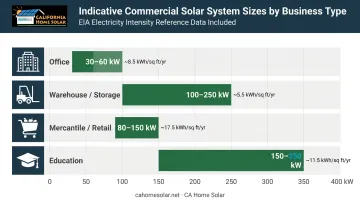
These ranges are illustrative starting benchmarks. Actual system size depends on your specific utility bills, roof availability, and site conditions — not building category alone.
For Southern California businesses, these benchmarks shift in your favor. Los Angeles's 5.65 peak sun hours per day means a given system produces more energy annually than the same system would in most other US markets — allowing many businesses to meet consumption targets with a smaller (and less expensive) array.
California Home Solar has completed commercial solar installations throughout Los Angeles and Southern California for 36 years, including a 240 kW commercial system in Pacoima. That experience covers the roof types, LADWP interconnection processes, local fire code requirements, and permitting timelines specific to this region.
A site assessment converts these benchmarks into specific system sizes, cost estimates, and production projections for your building — contact California Home Solar to schedule one.
Frequently Asked Questions
What is the size of a commercial solar system?
Commercial solar systems typically range from 20 kW for small businesses to 500 kW or more for large industrial facilities. System size is determined by annual energy consumption, available roof or land space, and local peak sun hours — not a fixed standard.
What is the 36-inch solar rule, and does it apply to commercial roofs?
The 36-inch pathway rule applies to Group R-3 (residential) buildings. For commercial and nonresidential rooftops, California Fire Code Section 1205.3 requires a 6-foot clear perimeter (reducible to 4 feet for smaller buildings) and interior pathways at intervals no greater than 150 feet. These requirements reduce usable installation area compared to residential rules.
How many solar panels do I need for a commercial building?
Panel count depends on energy usage and panel wattage. A 100 kW system using 450W panels needs approximately 222 panels; a 500 kW system would require over 900 panels at that wattage. Higher-wattage panels reduce the count proportionally.
How much roof space does a commercial solar array require?
Based on NREL packing assumptions: a 20 kW system needs ~1,900 ft², a 100 kW system needs ~9,600 ft², and a 500 kW system needs ~48,000 ft². Fire code setbacks, HVAC clearances, and row spacing all increase the required area beyond the raw panel footprint.
What is the difference between commercial and residential solar panels?
Commercial panels are physically larger — typically ~80 inches long vs. ~66 inches for residential — and produce more power per panel (400–615W vs. 320–420W). They're designed for flat commercial rooftops and large-scale arrays; residential panels are optimized for pitched roofs and smaller systems.
How do I calculate what size solar system my business needs?
Divide your annual kWh consumption by (daily peak sun hours × 365 × 0.86) to get approximate system size in kW, then divide total wattage by panel wattage for panel count. Los Angeles averages 5.65 peak sun hours. A licensed installer should validate the result with a site assessment before finalizing the design.