The challenge isn't just the dollar amount. Commercial solar permitting involves multiple agencies, each with its own timeline, fee schedule, and documentation requirements. A project in Pasadena gets priced and reviewed differently than an identical system in the City of Los Angeles — even though they're less than 15 miles apart.
This guide covers the permits commercial solar installations require, typical fee ranges under California law, the factors that push costs up, a practical application checklist, and strategies to keep the process on budget. California property owners — particularly those in the LA metro and surrounding jurisdictions — will find specific context throughout.
Key Takeaways
- Commercial solar typically requires 5 distinct approvals: building permit, electrical permit, zoning clearance, fire department sign-off, and utility interconnection agreement
- California caps rooftop commercial PV permit fees at $1,000 for systems up to 50 kW (plus $7/kW from 51–250 kW and $5/kW above 250 kW), excluding engineering and interconnection costs
- Permit timelines for commercial projects generally run 4–12 weeks from submission, with utility interconnection running on a separate and often longer schedule
- Skipping permits risks fines, inability to connect to the grid, and timeline delays that can threaten federal Investment Tax Credit eligibility
What Permits Does a Commercial Solar Installation Require?
Unlike residential solar, where a single building permit often covers the scope, commercial installations typically require approvals from multiple departments running in parallel — or worse, in sequence. Missing one early means discovering it late, when it costs the most.
Building Permit
The building permit covers the structural side of the installation: roof attachment methods, load analysis, and compliance with the California Building Code. For any rooftop system, your structural engineer must document roof adequacy before installation begins — making this the first permit in the queue and a hard dependency for everything that follows.
Electrical Permit
The electrical permit covers compliance with NEC Article 690 (California's 2025 Electrical Code adopts the 2023 NEC, effective January 1, 2026). Key requirements include:
- Wiring methods and conduit sizing
- Breaker ratings and disconnect placement
- Licensed electrical engineer review (required by most jurisdictions for commercial systems)
That engineer review step alone can add 1–2 weeks to the electrical permit track.
Zoning and Fire Department Approvals
Ground-mounted commercial arrays frequently trigger a separate zoning review covering setbacks, height limits, and land-use compatibility. Rooftop and ground-mounted systems alike require fire department sign-off on:
- Roof access pathways and setback clearances
- Emergency responder labeling
- NEC 690.12 rapid-shutdown compliance
These run concurrently in some jurisdictions, but sequentially in others — worth confirming early, since a sequential fire review can push your interconnection timeline out by weeks.
Utility Interconnection Agreement
The utility interconnection application is a separate process entirely — parallel to, but independent from, the building and electrical permits. For commercial systems in SCE territory, this runs through Rule 21. LADWP routes commercial projects through its Type 1, Type 2, or Type 3 interconnection process depending on system size and grid impact.
Larger systems may trigger a full interconnection study, which adds both cost and weeks to the schedule. Confirming study requirements before committing to a placed-in-service date matters because interconnection studies alone can run 3–6 months — long enough to invalidate a project's financial projections if discovered late.
How Much Do Commercial Solar Permitting Fees Cost?
Commercial permit fees are more variable than residential, and they're calculated differently depending on which jurisdiction you're in. Three fee models dominate:
| Fee Model | How It Works | Common In |
|---|---|---|
| Capacity-based ($/kW) | Fee scales with system size | Most California jurisdictions |
| Valuation-based (% of construction value) | Fee = % of total project cost | City of Los Angeles (generally 3.5%) |
| Flat tiered schedule | Fixed fee by KVA or kW band | Pasadena ($225–$456 by KVA tier) |
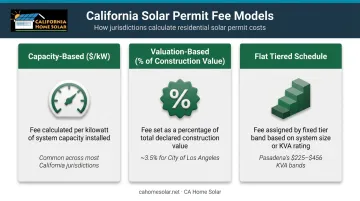
These models determine your base permit fee — but California law also sets a ceiling on what jurisdictions can charge. California Government Code Section 66015 establishes the statutory rooftop PV permit fee cap for commercial systems. These are the maximum permit fees a local jurisdiction can charge without written findings justifying a higher cost:
Smaller Commercial Systems (Under 100 kW)
The California statutory cap allows up to $1,000 for systems under 50 kW, reaching $1,350 at 100 kW ($1,000 + $7/kW for each kW above 50). For a small retail or office building, the base permit fee is relatively contained.
What these fees typically include: plan review and one or two inspections.
What they typically exclude: electrical engineering review, PE-stamped structural drawings, utility interconnection fees, and any expedited review surcharge.
As system size grows, so does plan review complexity — and the soft costs that stack on top of the permit fee.
Mid-Size Commercial Systems (100 kW – 500 kW)
The statutory cap reaches $2,400 at 250 kW and $3,650 at 500 kW ($2,400 + $5/kW above 250 kW). At this scale, engineering documentation becomes a required line item, not an optional one.
Expect to also budget for:
- Structural engineering documentation (PE-stamped drawings often required)
- Full electrical engineer review
- Utility interconnection study fees, which vary significantly based on your utility provider and local grid capacity — sometimes exceeding the permit fee itself
Large Commercial / Industrial Systems (500 kW+)
At 500 kW and above, the statutory cap formula continues at $5/kW above 250 kW, but soft costs grow substantially and often dwarf the permit fee itself. A large system should budget for:
- Multiple inspections across structural, electrical, and fire tracks
- PE-stamped structural and electrical drawings
- Fire department review fees
- Potential CEQA review for ground-mounted systems not covered by the SB 226 exemption (which applies to rooftop and existing parking lot installations)
For a reality check on total soft costs, NREL's Q1 2023 benchmark puts total permitting, inspection, and interconnection at approximately $0.07/Wdc for commercial PV. If a contractor's soft-cost estimate runs significantly higher, ask for a line-item breakdown.
Key Factors That Affect Commercial Solar Permit Costs
Two commercial projects of identical capacity can carry very different permit costs. The gap comes from a combination of where the project is, what the system looks like, and how well the application is prepared.
Jurisdiction and Local Fee Schedules
Fee schedules are set at the city or county level. Pasadena publishes flat KVA-tiered fees ($225 for 0–10 KVA, $270 for 10.1–50 KVA, $456 for over 50.1 KVA). Los Angeles generally calculates building permit fees at approximately 3.5% of construction value, though solar-specific caps constrain rooftop PV charges. A nearly identical system can cost considerably more to permit in one municipality than a neighboring city . Budget estimates should always be based on the actual AHJ's fee schedule, not regional averages.
System Size and Installation Type
System size shapes permit costs in two ways: more capacity means more documentation and inspections, and in capacity-based jurisdictions, fees scale directly by formula. Larger systems also tend to trigger more involved reviews. Ground-mounted systems carry additional exposure:
- Zoning review (setbacks, height, land-use compatibility)
- Structural engineering beyond standard roof-load calculations
- Potential CEQA review for open-land installations not covered by SB 226's exemption for existing buildings and parking lots
Rooftop systems with SB 226 CEQA coverage are generally less expensive to permit than equivalent ground-mounted systems on undeveloped land.
Documentation Complexity and Expedited Review
Incomplete or non-compliant plan sets are the single largest controllable cost in commercial solar permitting. Each correction cycle adds weeks and, in some jurisdictions, a resubmittal fee. California AHJs require detailed documentation, typically including:
- Three-line electrical diagrams
- PE-stamped structural drawings
- Title 24 compliance documentation for nonresidential permits submitted on or after January 1, 2023
When project timelines are tied to federal ITC begin-construction or placed-in-service deadlines, paying for expedited review often makes financial sense. Most jurisdictions offer this option at a premium, but the cost of faster processing is almost always lower than a delayed interconnection or missed tax credit window.
Commercial Solar Permit Application Checklist
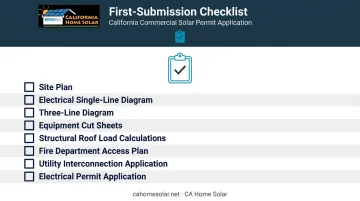
A complete first-submission application is the most reliable way to avoid resubmittal fees and review delays. The documents below cover what most California AHJs require for commercial solar permits.
Core Documentation Checklist
- Site plan with panel layout, property lines, and required setbacks
- Electrical single-line diagram
- Three-line diagram (required by many jurisdictions for commercial systems)
- Equipment cut sheets and spec sheets for panels, inverters, and racking
- Structural roof load calculations or PE-stamped structural engineer's letter
- Fire department access plan, roof pathway documentation, and rapid-shutdown compliance plan (NEC 690.12)
- Utility interconnection application (SCE Rule 21 or LADWP Type 1/2/3, as applicable)
- Electrical permit application with NEC Article 690 compliance documentation
California-Specific Considerations
Several additional items apply to LA-area and California projects:
- Title 24 energy compliance documentation — required for nonresidential permits submitted on or after January 1, 2023
- Interconnection pre-application (LADWP or SCE) — confirm the interconnection type before locking in a project schedule
- HOA or California Coastal Commission approvals, if the property sits in a restricted coastal zone or governed community
- CEQA review — applies to ground-mounted systems on open land that don't qualify for the SB 226 exemption
- SolarAPP+ is designed for residential systems (detached one- and two-family dwellings) only; don't assume it's available as a commercial pathway without AHJ confirmation
CA Home Solar manages permit procurement directly as part of its commercial installation work, with a dedicated project manager handling documentation, submittals, and agency coordination across Southern California. After 36 years working with LA-area AHJs, the team prepares plan sets to each jurisdiction's specific requirements — which tends to reduce correction comments and keeps projects on schedule.
How to Reduce and Budget for Commercial Solar Permitting Fees
The permit fees themselves are largely fixed by the AHJ. What's controllable is everything surrounding them: revision cycles, engineering corrections, and delayed utility screening. Budget gaps caused by these issues often don't surface until after the contract is signed — making early planning the most effective cost-control tool available.
Research Local Requirements Before Design Begins
Contact the local building department before finalizing system design. Get the actual fee schedule and documentation checklist. This prevents the costly scenario where a system is designed to a capacity or layout that conflicts with local setback or code requirements — requiring a redesign, a new structural package, and a fresh submission.
Submit Complete, Code-Compliant Plan Sets the First Time
Each correction comment from plan check adds weeks to the schedule and sometimes triggers a resubmittal fee. The most common correction triggers in California commercial solar applications:
- Missing or non-PE-stamped structural calculations
- Incomplete rapid-shutdown or fire access documentation
- Single-line diagrams that don't match equipment cut sheets
- Title 24 documentation gaps for nonresidential projects
Investing in accurate, jurisdiction-specific plan sets upfront — including PE stamps where required — is cheaper than a second submission. Getting it right the first time also keeps your interconnection timeline on track, which directly affects when the system starts generating a return.
Budget for the Full Permitting Cost
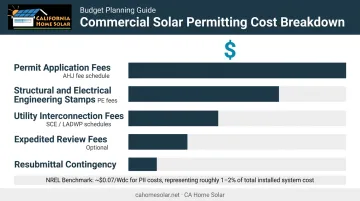
A complete commercial permitting budget should include more than just the application fee:
- Permit application fees (per AHJ fee schedule)
- Structural and electrical engineering stamps (PE fees vary by scope)
- Utility interconnection application fees (SCE and LADWP each have their own schedules)
- Expedited review fees (if timeline requires it)
- Contingency for one resubmittal cycle
For reference, NREL's $0.07/Wdc PII benchmark puts total permitting, inspection, and interconnection at roughly 1–2% of a typical commercial project's installed cost. If your contractor's soft-cost line runs significantly higher without a clear explanation of what's included, ask for an itemized breakdown.
Frequently Asked Questions
How much does commercial solar cost in terms of permitting fees specifically?
NREL's Q1 2023 benchmark puts permitting, inspection, and interconnection at approximately $0.07/Wdc for commercial PV systems. California's statutory rooftop PV cap ranges from $1,000 for systems under 50 kW to $3,650 at 500 kW — but engineering, utility interconnection, and expedited review fees add to the total. Always request an itemized breakdown, not a single bundled number.
Do contractors charge permitting fees for commercial solar installation?
Most commercial solar contractors include permit procurement in their contract, but fees paid to the AHJ are typically passed through as a separate line item. Confirm in writing whether permit fees are included in the quoted price or billed additionally before comparing bids.
What permits are required for a commercial solar installation?
Commercial installations typically require a building permit, electrical permit, zoning clearance, fire department approval (access pathways and rapid shutdown), and a utility interconnection agreement. Requirements vary by jurisdiction — some cities add fire department plan check fees as a separate line item.
How long does the commercial solar permit process take?
Commercial permits generally take 4–12 weeks from submission to approval, depending on jurisdiction, documentation quality, and whether expedited review is used. Utility interconnection runs on a separate timeline. SCE Rule 21 and LADWP's interconnection program each have their own review and study steps, which can extend well beyond the building permit approval.
What happens if you install commercial solar without the required permits?
Consequences include code enforcement action, fines, and inability to obtain Permission to Operate — meaning the system cannot legally export energy under SCE Rule 21 or LADWP's program. ITC eligibility is also at risk if permitting delays push the placed-in-service date outside IRS timing requirements.