Many commercial property owners in Southern California underestimate what this process involves. Unlike residential solar, a commercial project requires coordinated submittals to multiple reviewing authorities — and missing or incorrect documentation at any point creates revision cycles that push timelines out by weeks. SEIA data estimates direct permitting costs at roughly $0.13 per watt, and even a single week of delay in the permitting and interconnection process can increase customer cancellation rates by 10%.
This guide covers what a commercial plan set must contain, how the review process works step by step, what California-specific rules apply, and which mistakes most reliably derail projects.
Key Takeaways
- Commercial solar permits require PE-stamped engineering, three-line electrical diagrams, and sign-off from multiple authorities
- A complete plan set must clear the AHJ building department, fire marshal, and utility company before installation begins
- California projects must also meet Title 24, CPUC Rule 21 interconnection standards, and the 2025 California Electrical Code
- Documentation errors are the leading cause of permit delays; each revision cycle adds weeks to the timeline
- Working with a licensed contractor who knows local AHJ requirements gives you the best shot at first-submission approval
What Is Commercial Solar Permit Design and Review?
Commercial solar permit design is the creation of a coordinated package of engineering drawings, calculations, equipment specifications, and compliance documentation submitted to one or more regulatory authorities to legally authorize installation of a commercial PV system.
The goal is regulatory approval confirming the proposed system is structurally sound, electrically safe, fire-code compliant, and grid-ready — so installation can proceed without delay.
How It Differs from Residential Permitting
Residential projects typically involve a single building department review, a straightforward single-line diagram, and no PE stamp requirement in most jurisdictions. Commercial projects operate under a different set of rules entirely.
Commercial projects require:
- PE-stamped engineering on structural and often electrical documents
- Three-line electrical diagrams for three-phase systems
- Multi-authority review covering the building department, fire marshal, and utility interconnection department
- CPUC Rule 21 compliance for investor-owned utility connections
- Interconnection impact studies for larger systems — none of which are standard in residential permitting
The practical result: a commercial plan set is far more complex and costly than most property owners anticipate — and the timeline reflects that.
What Goes Into a Commercial Solar Plan Set
A commercial plan set is the core deliverable of the permit design process. Every reviewing authority evaluates this document package, so completeness and internal consistency matter as much as technical accuracy.
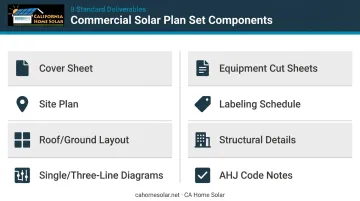
Standard Plan Set Components
- Cover sheet with project scope and code references
- Site plan showing array layout, setbacks, and access pathways
- Roof or ground-mount layout with module placement and equipment locations
- Single-line and three-line electrical diagrams
- Equipment cut sheets for all major components
- Labeling and signage schedule
- Structural details or calculations
- AHJ-specific code notes
Electrical Documentation
Electrical errors are the most common source of plan review revision requests. A complete electrical package includes:
- Single-line diagrams showing DC and AC circuit flow, overcurrent protection, and grounding
- Three-line diagrams for three-phase commercial systems showing individual phase connections
- Conductor sizing and voltage drop calculations
- NEC Article 705.12 busbar calculations for load-side interconnections
- Rapid shutdown system design per NEC Article 690.12
California's current electrical code is the 2025 California Electrical Code, Title 24 Part 3, based on the 2023 NEC and effective January 1, 2026. Plan sets must reference the specific code cycle the AHJ has adopted — not necessarily the most recently published edition.
Structural Documentation
Beyond electrical, commercial rooftops carry structural requirements that don't apply to most residential projects:
- Roof type (TPO, EPDM, standing seam metal, concrete) determines the attachment method
- Ballasted vs. mechanically attached racking changes dead load calculations
- Wind, snow, and seismic loads must be calculated per ASCE 7-22 standards
- Older buildings may require existing structural member analysis
- Unapproved penetrations can void roof membrane warranties — coordination with the roofing manufacturer is often required
Fire Safety and Equipment Documentation
Fire marshal review is a separate approval track from the building department. California Fire Code Chapter 12 and local fire official requirements govern commercial rooftop PV access and safety.
Every major component requires a current manufacturer cut sheet in the submittal package:
- Solar modules
- Inverters (including UL 1741 SB compliance documentation)
- Racking hardware
- Disconnects
- Energy storage equipment
Submitting outdated cut sheets for updated models is one of the most common — and easily preventable — reasons plan sets get rejected.
How the Commercial Solar Permit Review Process Works
Unlike residential projects reviewed by a single building department, commercial solar typically involves parallel submittals to multiple authorities. Sequencing these correctly is as important as the documentation itself.
Step 1: Pre-Application and Site Assessment
Before any design work begins, verify:
- AHJ-specific requirements (which vary significantly across Los Angeles County jurisdictions)
- Zoning allows the proposed installation
- Structural drawing availability for the building
- Utility territory and applicable interconnection rules (SCE, LADWP, or other)
- Whether the project triggers a PE stamp requirement
Step 2: Plan Set Preparation and Engineering
Licensed engineers prepare the full plan set based on site survey data, equipment selections, and AHJ requirements. Structural and electrical scopes often require different licensed PEs. The engineer must hold an active California PE license. A stamp from an out-of-state engineer is not accepted by California's BPELSG.
Step 3: Permit Submission and Multi-Authority Review
AHJ building permit, fire marshal submittal, and utility interconnection application are often submitted simultaneously but follow different review tracks.
For utility interconnection under SCE's Rule 21:
- Fast Track is available for non-exporting projects and exporting projects up to 3 MW
- Projects that fail Initial Review screens move to Supplemental Review or Detailed Study
- LADWP uses a separate Type 1/2/3 framework — Type 1 covers simpler commercial interconnections up to 30 kW; Type 2 and 3 apply to more complex configurations
CALSSA reported in 2025 that PG&E and SCE missed state-mandated interconnection timelines, with compliance rates as low as 27%-45% for some steps. Budget additional schedule contingency for utility review — it runs on its own clock, independent of AHJ plan check.
Step 4: Responding to Plan Review Comments and Resubmittal
Commercial projects almost always receive at least one set of reviewer comments. Responding correctly requires:
- Addressing every flagged item in writing — unanswered comments trigger another round
- Updating the revision block on every affected sheet to show what changed and when
- Resubmitting only the revised documents, clearly marked to distinguish them from the original set
Partial or inconsistent resubmittals trigger additional review cycles — each one adds weeks to the schedule.
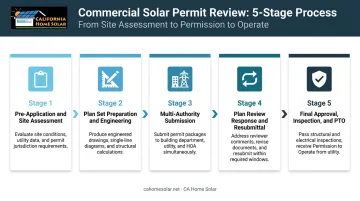
Step 5: Final Approval, Inspection, and Interconnection
Once all reviewing authorities issue approval, installation can proceed. A final field inspection by the AHJ and fire marshal verifies that installed work matches approved drawings exactly — any deviation requires a permit amendment before the system can operate.
One distinction that catches many owners off guard: a building permit does not authorize the system to be energized. Utility Permission to Operate (PTO) is a separate, final step.
Commercial systems cannot operate on the grid until PTO is issued — and that requires completing both the AHJ inspection and the utility's own interconnection process. Plan accordingly.
Key Factors That Shape Commercial Solar Permit Design in California
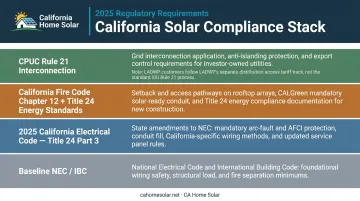
California adds compliance layers that go beyond baseline NEC and IBC requirements. Contractors unfamiliar with these layers frequently submit non-compliant plan sets.
California-Specific Code Requirements
- 2025 California Electrical Code (Title 24 Part 3, based on 2023 NEC, effective January 1, 2026)
- Title 24 Building Energy Efficiency Standards — CEC's nonresidential BESS requirements apply to buildings where at least 80% of total floor area meets qualifying building type criteria
- California Fire Code Chapter 12 — covers PV and energy storage systems; references IFC but includes state-specific modifications
- CPUC Rule 21 — governs interconnection for investor-owned utilities (SCE, PG&E, SDG&E); separate from LADWP's municipal utility process
Jurisdiction Variation Across Los Angeles County
Cities like Los Angeles, Burbank, Glendale, Long Beach, and unincorporated LA County each maintain their own adopted code cycle, fee schedules, submittal formats, and review timelines. A plan set approved in one LA-area city can be rejected in a neighboring jurisdiction for a formatting or code-reference difference.
That variation is where local experience directly affects approval speed. CA Home Solar's 36 years of licensed commercial solar work across Los Angeles County means the team knows how individual AHJs interpret and apply these requirements — reducing rejection cycles and keeping projects on schedule.
System Size, Configuration, and Storage
System size and configuration directly drive engineering scope:
- Systems below roughly 100 kW on well-documented buildings may require minimal additional structural analysis
- Larger systems, buildings without available structural drawings, or projects involving service upgrades almost always trigger PE stamp requirements
- Energy storage additions invoke NEC Article 706 and IFC Section 1207, requiring battery siting documentation, fire-rated enclosures, ventilation details, seismic anchorage calculations, and an expanded interconnection package
Storage is growing but still not universal — Berkeley Lab reported that 8% of new non-residential PV installations included battery storage in 2022, with 46% of large non-residential PV systems being ground-mounted in 2023.
Common Mistakes That Delay Commercial Solar Permits
Documentation Errors That Trigger Rejection
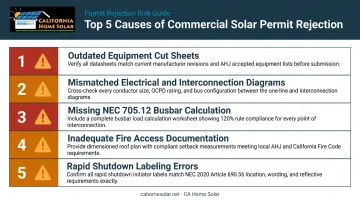
The most common plan review failures involve:
- Using outdated equipment cut sheets for components whose models have changed since the spec was written
- Submitting electrical diagrams that don't match the interconnection drawings submitted to the utility
- Omitting the NEC 705.12 busbar calculation on load-side interconnections
- Applying residential-standard rapid shutdown labeling when commercial requirements differ
- Failing to include the fire marshal access pathway plan as a separate document
Each missed item typically costs at least a week. Stacked errors can delay a project by a month or more.
The Owner Involvement Misconception
Permit design is a shared responsibility — and property owners are more involved than most expect. Applications require:
- Owner signatures
- Utility account information
- Structural documentation the owner controls (roof drawings, building permits)
- Occasionally zoning variances that only the property owner can initiate
Owners who aren't ready to provide this information slow down their own projects. Having roof drawings, building permits, and utility account details on hand before design work begins is the fastest way to avoid preventable delays.
When Commercial Solar Permit Design Requires Additional Engineering Scope
Some commercial projects require a more extensive engineering package than a standard plan set.
Expanded PE stamp requirements are triggered by:
- Commercial rooftops without available structural drawings
- Roof attachments that exceed standard load thresholds
- Service upgrades or main panel replacements
- Non-standard equipment configurations
- Ground-mount systems above the AHJ's capacity threshold
- Any project where the building department requests engineering documentation during review
Ground-mount commercial solar is a distinct permit scenario. Beyond the standard plan set, these projects require additional engineering and permitting layers that rooftop installations typically do not:
- Geotechnical scope (soil bearing capacity, pile or ballast design)
- Civil engineering (grading, drainage, access roads)
- Zoning or planning review in addition to standard AHJ permits
CA Home Solar has completed ground-mount commercial installations, including a 240 kW system in Pacoima. These projects consistently involve longer permit design timelines than rooftop work.
Solar-plus-storage plan sets require a different documentation package. Battery placement drives more redesigns than any other single variable, and the interconnection application must be updated to cover charge, discharge, and export controls beyond standard generation data.
Several additional factors shape the layout before a permit is submitted:
- Indoor vs. outdoor siting requirements
- Separation distances from other equipment
- Seismic anchorage calculations
Conclusion
Commercial solar permit design creates the documented proof that a proposed installation is structurally sound, electrically code-compliant, fire-safe, and grid-ready. In California, it is a prerequisite for any legal commercial solar installation.
Projects that skip this groundwork early routinely stall in revision cycles — adding weeks to timelines and costs that compound fast. Commercial property owners across Southern California can avoid that by engaging a licensed contractor experienced in California commercial permitting from the start.
California Home Solar is that contractor — providing A-to-Z commercial solar installation services across Southern California for 36 years. Reach the team at 818-650-8169 or info@cahomesolar.com to discuss a commercial project.
Frequently Asked Questions
How long does commercial solar permit design and review take in California?
Timelines vary by jurisdiction and system complexity. Straightforward rooftop systems can move through review in several weeks; larger systems or storage-integrated projects in high-volume jurisdictions can take several months. Incomplete documentation is consistently the most common cause of extended timelines.
Do commercial solar installations always require a PE stamp in California?
Many California AHJs require a PE stamp on every commercial submittal; others only require one when specific conditions are triggered, such as missing structural drawings or non-standard configurations. In all cases, the engineer must hold an active California license. Out-of-state stamps are not accepted.
What is the difference between a commercial and residential solar plan set?
Commercial plan sets require three-line electrical diagrams, PE-stamped engineering, and multi-authority review including fire marshal and utility interconnection. California-specific layers like CPUC Rule 21 and Title 24 compliance apply to commercial projects and are not part of standard residential permitting.
How does the utility interconnection process work for commercial solar in California?
Commercial projects must submit a separate interconnection application to the utility (SCE, LADWP, or other) under CPUC Rule 21 and IEEE 1547. System size determines the review path: projects up to 3 MW may qualify for Fast Track, while larger or more complex systems enter a study tier that can add months to the schedule.
What are the most common reasons commercial solar permits get rejected?
The top causes include outdated equipment cut sheets, mismatches between permit drawings and interconnection diagrams, missing NEC 705.12 busbar calculations, inadequate fire access documentation, and rapid shutdown labeling errors.
Does adding battery storage change the commercial solar permit requirements?
Storage additions invoke NEC Article 706 and IFC Section 1207, requiring battery siting documentation, fire department access planning, and seismic anchorage calculations. The interconnection application must also be expanded, typically adding weeks or months to the overall permit design process.