Installation must be performed by a licensed California contractor — either a C-46 Solar specialty license or C-10 Electrical license issued by the Contractors State License Board (CSLB) — to qualify for incentives, pass inspections, and maintain equipment warranties.
When installation is mishandled, the consequences are real:
- Poor ROI — incorrect system sizing under NEM 3.0 means exporting power at near-worthless rates
- Forced removal — unpermitted systems can be ordered removed by the local building department
- Roof leaks — improper mounting hardware or sealant fails within the first rainy season
- Dead system — skipping utility interconnection means the panels legally cannot export power
This guide walks through the entire California solar installation process, costs, incentives, and common pitfalls — with everything you need to make an informed decision.
Key Takeaways
- Installation follows a fixed sequence: site assessment → system design → permits → physical installation → utility inspection → Permission to Operate (PTO)
- NEM 3.0 makes system sizing and battery pairing critical; oversized systems that export excess power earn minimal bill credits
- Permits are mandatory statewide; total project timeline is typically 2–4 months from contract to PTO
- Average installed cost in California is $2.53/watt (EnergySage, 2026); the federal 30% residential tax credit ended December 31, 2025
- A licensed, experienced contractor is the single biggest factor in avoiding delays, rejections, and long-term performance issues
What to Know Before Installing Solar Panels in California
California's Solar Mandate (Title 24)
California's Building Energy Efficiency Standards took effect January 1, 2020, requiring solar PV systems on all new low-rise residential construction. The 2022 Energy Code extended PV requirements to newly constructed high-rise multifamily buildings as well.
If you're retrofitting an existing home, the mandate's sizing formula doesn't directly apply — but all other code requirements do, including permitting, licensed installation, and compliance with current electrical standards.
Roof Readiness
Solar panels have an expected operational lifetime of 25–35 years. Your roof needs to match that lifespan. Before any installer puts panels on your home, evaluate:
- Remaining roof life — asphalt shingles near end of life should be replaced before installation. California Home Solar, which offers both roofing and solar installation, can handle both in a single project
- Structural load — standard rooftop solar arrays add no more than 4 psf of dead load, per the California Solar Permitting Guidebook; older or damaged structures may still need engineering review
- Shade analysis — heavy shading from trees or adjacent buildings can disqualify a rooftop or require microinverters instead of string inverters
Utility Compatibility and California Non-Negotiables
Before moving forward, identify your utility provider — PG&E, SCE, SDG&E, LADWP, or a municipal utility — because billing rules vary significantly between them. That choice directly affects your payback math under NEM 3.0. Every California solar installation also requires:
- A CSLB-licensed contractor (C-46 or C-10)
- Compliance with California Building Energy Efficiency Standards
- A building permit — there is no permit-exempt path for grid-tied residential solar in California
The Battery Storage Decision
Battery storage is not mandated for existing homes, but it's effectively essential for PG&E, SCE, and SDG&E customers under NEM 3.0. Without storage, excess daytime solar generation is exported at avoided-cost rates — significantly below retail — reducing your savings.
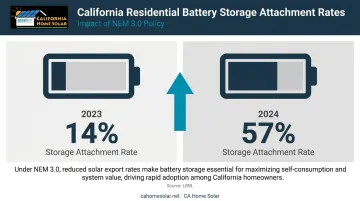
LADWP customers operate under separate net metering guidelines and have more flexibility, as their program is not subject to the CPUC's Net Billing Tariff. According to LBNL research, California residential storage attachment rates jumped from 14% in 2023 to 57% in 2024 — a direct response to NEM 3.0's lower export rates. If you're on a CPUC-regulated utility, plan for battery storage from the start.
The California Solar Panel Installation Process: Step by Step
The full process — from first contact with an installer to Permission to Operate — typically takes 2–4 months in California. Physical installation is the shortest part; permitting and utility interconnection eat up most of that timeline.
Site Assessment and System Design
A licensed installer visits the property to evaluate:
- Roof orientation (south-facing is optimal in California), pitch, and available square footage
- Shading from trees, chimneys, or neighboring structures
- Structural integrity and electrical panel capacity
- Whether battery storage is advisable given your utility and usage patterns
The output is a system design specifying panel count, total wattage, and inverter type. System sizing is based on your 12-month electricity consumption history, obtained from utility bills or a utility data release form. PG&E's interconnection documentation, for example, allows sizing up to 150% of the customer's most recent 12-month usage when accounting for future load additions.
Under NEM 3.0, oversizing creates a real problem: production beyond what the home can self-consume gets exported at avoided-cost rates, not retail. Getting sizing right from the start is critical.
Permitting and Utility Interconnection
The installer submits a permit application to the local AHJ — typically the city or county building department — along with engineer-stamped plan sets, structural calculations, and electrical diagrams.
Some California jurisdictions have adopted SolarAPP+ for automated permit review, including Sacramento County, Simi Valley (where licensed contractors are required to use it for roof-mounted systems up to 38 kW), and San Marcos (standard residential permits estimated at 1–3 business days). Manual review in other jurisdictions can take several weeks longer.
The utility interconnection application runs concurrently. PG&E, for example, typically issues PTO within 5–10 business days after all required paperwork is submitted, though the process can extend to 30 business days. Skipping or rushing this step means the system cannot legally export power to the grid.
Physical Installation
On installation day(s), the crew works through a specific sequence:
- Roof penetrations — lag bolts and flashing installed and sealed
- Racking rails — mounted to the penetration hardware
- Panels — secured to the rails
- Electrical wiring — panels to inverter, inverter to main electrical panel
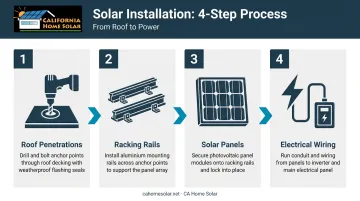
A typical residential installation takes 1–3 days of on-site work. Licensed electricians must perform the electrical tie-in.
The most structurally critical step is roof penetration waterproofing. Every lag bolt penetrates the roof deck, and improper flashing or sealant at these points is a leading cause of post-installation leaks.
The California Solar Permitting Guidebook requires these penetrations to be sealed with approved flashing or caulking. A qualified installer uses manufacturer-approved flashing hardware and backs the work with a workmanship warranty.
Utility Inspection and Permission to Operate (PTO)
After physical installation, a local building inspector verifies the system was installed per the approved permit and California electrical code. Inspectors check:
- Mounting hardware and panel setbacks
- Electrical connections and labeling
- Compliance with California fire access ("Solar Access Pathway") requirements — typically 3-foot clearance pathways on the roof
Once the building inspection passes, the installer submits a PTO request to the utility. The utility then schedules a meter upgrade or configuration change. Only after PTO is granted can the system legally be turned on.
Turning the system on before PTO is a common mistake with real consequences. PG&E's interconnection agreement explicitly states that unauthorized parallel operation creates liability for injury, equipment damage, or property damage. The utility may also disconnect facilities that endanger the public or safe system operation.
Solar Panel Installation Costs and Incentives in California
What a System Costs
EnergySage reports the California average installed cost at $2.53/watt as of May 2026, with the NREL residential benchmark at $2.68/watt for an 8 kW system. Here's what that translates to for common system sizes:
| System Size | At $2.53/W | At $2.68/W |
|---|---|---|
| 5 kW | $12,650 | $13,400 |
| 7 kW | $17,710 | $18,760 |
| 10 kW | $25,300 | $26,800 |
Southern California labor markets — Los Angeles, San Gabriel Valley, South Bay — can push costs toward or above the higher end of this range.
What You're Paying For
Per NREL's cost breakdown, the installed price isn't just panels. Here's the approximate component share:
| Component | Approx. Share |
|---|---|
| Modules (panels) | 14% |
| Inverter | 20% |
| Structural & electrical hardware | 17% |
| Field labor | 9% |
| Office work, permitting, acquisition | 20% |
| Profit, logistics, sales tax | 19% |
Key California Incentives
SGIP (Self-Generation Incentive Program) — RSSE Pathway For income-qualified households, the CPUC's Residential Solar and Storage Equity program offers $1,100/kWh for storage and $3,100/kW for solar, with $280 million in available budget. Reservations opened June 2, 2025.
DAC-SASH For homeowners in disadvantaged communities, this CPUC program provides $3/watt (CEC-AC) for systems between 1–5 kW. GRID Alternatives administers the program and is currently accepting applications.
California Property Tax Exclusion Active solar energy systems are excluded from property tax reassessment — meaning going solar won't increase your property taxes. The exclusion is currently scheduled to sunset January 1, 2027.
Federal Tax Credit — No Longer Available After 2025 One significant change affects every California homeowner planning a 2026 installation: the federal Residential Clean Energy Credit (IRS Section 25D) has been eliminated. Following the signing of the One Big Beautiful Bill Act on July 4, 2025, the credit is not available for expenditures made after December 31, 2025.
Financing Options
- Cash purchase — highest long-term ROI, large upfront cost
- Solar loan — retain ownership and incentive eligibility, spread cost over time
- HERO/PACE financing — California Home Solar is a HERO Registered Contractor, so PACE financing is available to qualifying homeowners. Approval is based on home equity and payment history rather than credit score, with repayment through property taxes. PACE creates a lien on the property and is not a government grant.
- Solar lease/PPA — no upfront cost, but you don't own the system and can't claim incentives
Payback Period
EnergySage reports a California average solar payback of 7.64 years, with average 25-year savings of $128,461. Under NEM 3.0, payback runs longer without battery storage, because the system's self-consumption rate becomes the primary driver of savings rather than grid export credits.
Common Solar Installation Problems in California (and How to Fix Them)
Permit Delays and Plan Rejections
The problem: The permit application sits in review for weeks — or gets rejected outright.
The most common culprit is a generic plan set that doesn't meet the local Authority Having Jurisdiction (AHJ) formatting or engineering requirements. Two fixes exist: work with an installer who prepares jurisdiction-specific, engineer-stamped plan sets, or check whether your city has adopted SolarAPP+ for same-day automated permit review.
System Undersized or Oversized for NEM 3.0
The problem: Electricity bills don't drop as expected — either the system isn't producing enough, or excess generation is being exported at NEM 3.0's low avoided-cost rates.
This usually means the system design skipped a full 12-month consumption analysis, or the installer never modeled self-consumption under NEM 3.0 export pricing. Insist on verified utility data and a self-consumption projection — gross production estimates alone aren't enough under the current rate structure.
Roof Leaks Following Installation
The problem: Water intrusion appears at or near panel mounting points within the first rainy season.
This is a common sign the crew lacks roofing experience. The usual causes:
- Lag bolts installed without proper flashing kits
- Sealant applied incorrectly or in insufficient quantity
- Mounting hardware not from the panel manufacturer's approved list
To prevent it, vet the installer's roofing background before signing. If leaks do appear, remediation falls under the workmanship warranty — or requires a separate licensed roofing contractor if that coverage is absent.
Pro Tips for a Smooth Solar Installation in California
A few practical habits separate installations that go smoothly from those that drag on for months. Keep these in mind before and during your project.
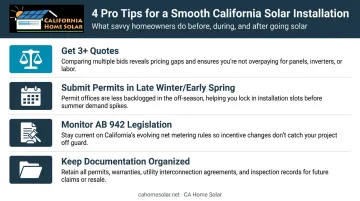
Get at least 3 quotes from CSLB-licensed contractors. Compare price per watt, equipment brands, workmanship warranty terms, and each installer's familiarity with your utility's interconnection process. Installers with dozens of completed SCE or LADWP projects navigate permit timelines noticeably faster.
Submit permits in late winter or early spring to avoid the late-summer backlog when installation demand peaks.
Watch AB 942 if you have an older system. The bill currently in California's 2025–2026 legislative session would move long-standing NEM 2.0 customers to NEM 3.0 rates. It has not yet been enacted, so monitor its status closely.
Keep all documentation organized from day one: permit approvals, engineering plans, installer contracts, equipment serial numbers, and the PTO letter from your utility. This paperwork is essential for claiming incentives, enforcing warranties, and disclosing solar accurately when selling the home.
Frequently Asked Questions
How much does it cost to get solar panels installed in California?
The California average is $2.53/watt as of 2026, translating to roughly $12,650–$25,300 for a 5–10 kW system before incentives. State programs like SGIP and DAC-SASH, plus financing options like HERO/PACE, can substantially cut out-of-pocket costs for qualifying homeowners.
Do I need a permit to install solar panels in California?
Yes — permits are mandatory for all grid-tied residential solar installations in California, submitted to your local Authority Having Jurisdiction. Some jurisdictions use SolarAPP+ for same-day automated approvals; others require manual review that can take several weeks.
How long does solar panel installation take in California?
Physical installation typically takes 1–3 days on-site, but the full project — including permitting and utility interconnection — takes 2–4 months from contract signing to Permission to Operate in most California jurisdictions.
Is solar required on new homes in California?
Yes. California's Title 24 Standards (effective January 1, 2020) require solar PV on new low-rise residential construction, and the 2022 Energy Code extended that mandate to newly built high-rise multifamily buildings.
Can I install solar panels myself in California?
California law doesn't prohibit homeowner self-installation, but DIY systems are disqualified from most state incentives, face steep permitting hurdles, and often void equipment warranties. For the vast majority of homeowners, hiring a CSLB-licensed contractor is the only practical path.
What happens to my solar system under NEM 3.0 in California?
Under NEM 3.0 (Net Billing Tariff), PG&E, SCE, and SDG&E customers receive export credits at avoided-cost rates — well below retail. Battery storage is essential to maximize savings by storing excess solar for self-consumption during peak evening rate hours rather than exporting it at low rates.