On top of rate pressure, the 2022 Title 24 Energy Code — effective January 1, 2023 — turned solar from optional to mandatory for most new commercial construction. The policy environment has changed fast, and the incentive stack has too.
This guide covers what building owners and developers need to know: the Title 24 commercial mandate, available financial incentives, system sizing basics, panel selection, and the installation process from site assessment to Permission to Operate.
Key Takeaways
- New commercial buildings in California must include both solar PV and battery storage under Title 24 (effective January 1, 2023)
- The federal ITC provides a 30% tax credit on commercial solar installations through 2032
- NEM 3.0 (Net Billing Tariff) reduced grid export value significantly, making battery storage central to commercial ROI
- System size is formula-driven, based on conditioned floor area, building type, and climate zone
- California's commercial electricity rate is more than double the U.S. average, making on-site generation especially valuable
Why California Is Prime Territory for Commercial Solar
California's solar market isn't just large — it's the largest in the country. SEIA reports 55,056 MW of installed solar capacity, and the CEC confirms solar accounted for 21.3% of California's total system electric generation in 2024 — roughly 59,283 GWh.
That scale matters for commercial buyers: a mature contractor ecosystem, widely available CEC-listed equipment, and established interconnection processes all reduce project risk compared to less-developed markets. That infrastructure foundation also makes the financial case unusually strong.
California's Commercial Electricity Rates Make Solar Pay
At 28.18 cents per kWh for commercial customers versus the U.S. average of 13.92 cents, every kilowatt-hour generated on-site displaces a purchase that costs twice what it would in most other states. That price gap is the foundation of the commercial solar financial case in California — not a marginal efficiency gain.
Policy Tailwinds Aren't Going Away
California's SB 100 requires 100% of electric retail sales to come from renewable and zero-carbon resources by 2045. That mandate has driven — and will continue to drive — the solar-friendly policies, rate structures, and incentive programs that make commercial installations financially attractive. Building owners who go beyond minimum Title 24 compliance are positioned to capture more of that upside as the grid evolves.
California's Commercial Solar Mandate: What Building Owners Must Know
The California Energy Commission's 2022 Energy Code, effective for permit applications on or after January 1, 2023, expanded solar requirements well beyond the residential-only 2020 mandate. For most newly constructed commercial buildings, solar PV and battery storage are now code requirements.
Covered Building Types
The mandate applies to newly constructed nonresidential buildings including:
- Office buildings, retail centers, restaurants, and financial institutions
- Hotels and motels, schools, medical offices, and clinics
- Warehouses, grocery stores, libraries, and theaters
- Convention centers, auditoriums, and high-rise multifamily buildings
- Unleased tenant spaces
How Solar System Size Is Calculated
Minimum PV system size follows a formula: conditioned floor area × building-type-specific PV capacity factor (A) ÷ 1,000 = kW DC. Two factors shape the final number:
- Capacity factor (A): Varies by building type — the CEC's Table 140.10-A provides the specific values
- Climate zone: California's 16 climate zones affect sizing, so two identical buildings in different locations can have different minimums
Battery Storage Requirements
BESS sizing is formula-driven under Section 140.10(b), proportional to the required PV system size. Battery storage is not required when:
- The installed PV system is less than 15% of the required size
- The calculated ESS requirement is under 10 kWh
- A single-tenant building is under 5,000 sq ft of conditioned floor area
- The building type (office, school, or warehouse) is in Climate Zone 1
Note that BESS exemptions are separate from full solar exemptions — a building can be exempt from battery storage while still being required to install PV.
When Solar Is Not Required
Key exemptions from the mandate include:
- Solar Access Roof Area (SARA) is less than 3% of conditioned floor area
- The minimum required PV system calculates to under 4 kW DC
- SARA contains less than 80 contiguous square feet
- Snow-load standards or specific access/program constraints make compliance infeasible, as confirmed by the enforcement authority
Key Financial Incentives for Commercial Solar in California
Commercial solar in California draws from multiple overlapping incentive programs — federal tax credits, state rebates, depreciation provisions, and tariff structures. Knowing which ones apply to your building, and how they interact, directly affects your project's payback period.
Federal Investment Tax Credit (ITC)
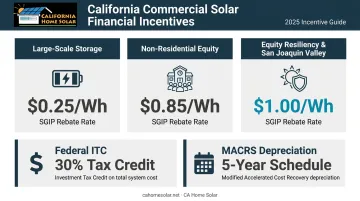
Commercial property owners can deduct 30% of total solar system installation costs from federal tax liability for systems placed in service through 2032. The credit steps down to 26% in 2033 and 22% in 2034. DOE confirms this schedule, though proposed Congressional changes could affect timelines — verify current status with a tax advisor before committing to a project schedule.
MACRS Accelerated Depreciation
Commercial solar installations may qualify for the Modified Accelerated Cost-Recovery System (MACRS), allowing businesses to depreciate the system cost over 5 years for federal tax purposes. Recent IRS guidance also introduced potential bonus depreciation provisions — timing, acquisition date, and clean-energy property classification all affect eligibility. A tax advisor review is strongly recommended before modeling depreciation benefits.
Self-Generation Incentive Program (SGIP)
SGIP provides rebates for battery energy storage systems installed alongside solar. Program administrators include PG&E, SCE, SoCalGas, and CSE for SDG&E customers. Current rebate tiers for nonresidential storage include:
- $0.25/Wh — Large-Scale Storage, Step 5 (general)
- $0.85/Wh — Non-Residential Storage Equity tier
- $1.00/Wh — Equity Resiliency and San Joaquin Valley Non-Residential tiers
SGIP budgets move quickly — some categories are currently on waitlist or closed by territory. Check selfgenca.com for live program status before quoting incentives into a project pro forma.
California Property Tax Exclusion
Under Revenue and Taxation Code Section 73, adding a qualifying solar energy system to a commercial property does not trigger reassessment or increase property taxes. The exclusion is scheduled to sunset on January 1, 2027 — the California BOE has clarified that construction must be completed before that date to qualify. Commercial owners with projects in planning should factor this deadline into their timeline.
NEM 3.0 and What It Means for Commercial Solar
California's Net Billing Tariff (effective for interconnection applications on or after April 15, 2023) replaced NEM 2.0's retail-rate export compensation with avoided-cost pricing. In practice, avoided-cost rates run roughly 75–80% lower than retail rates, which sharply reduces the value of energy you export to the grid.
For commercial solar strategy, this changes the math significantly:
- Size systems to cover on-site consumption first — exporting surplus now yields far less return than using it directly
- Pair solar with battery storage to capture daytime generation and deploy it during peak-rate evening hours, when grid power is most expensive
- Optimize around time-of-use rate schedules; under NEM 3.0, when you consume power matters as much as how much solar you generate
How Many Solar Panels Does a Commercial Building Need?
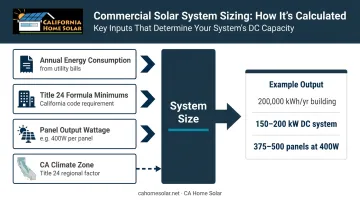
There's no fixed panel count for commercial buildings. Three factors determine the right system size:
- Annual energy consumption — drawn from 12 months of utility bills
- Title 24 formula minimums — conditioned floor area × building-type factor ÷ 1,000
- Panel output wattage — higher-wattage panels mean fewer units for the same system capacity
For sizing context: a commercial building consuming 200,000 kWh annually would need a system in the range of 150–200 kW DC, depending on location and panel selection. At 400W per panel, that's roughly 375–500 panels — though NREL's PVWatts Calculator run against the specific address and roof configuration is the accurate way to model this.
Climate Zone Matters More Than Most Owners Expect
Those calculations don't exist in a vacuum — California's 16 climate zones produce meaningful differences in annual solar output. Buildings in sunnier inland zones — the San Fernando Valley, San Gabriel Valley, or Antelope Valley — generate more kWh per panel per year than buildings in coastal or marine-layer-affected zones. That means fewer panels may be needed to meet the same energy target when located inland.
When Roof Space Is Limited
For buildings with constrained rooftop area, high-efficiency monocrystalline panels generate more power per square foot. Warehouses and retail properties with large parking areas often supplement rooftop capacity with solar carport systems — which also provide covered parking at no extra infrastructure cost.
California Home Solar has designed and installed commercial systems up to 240 kW across Southern California, sizing each project to the building's actual consumption data and available space.
Which Solar Panel Types Work Best for Commercial Buildings?
Three technologies dominate commercial installations:
| Type | Best Use Case |
|---|---|
| Monocrystalline | Limited roof space; highest efficiency per sq ft |
| Polycrystalline | Large flat roofs with abundant area; lower per-panel cost |
| Bifacial monocrystalline | Flat rooftops, carports, ground mounts; captures reflected light |
For most California commercial buildings — which typically have flat or low-slope roofs — monocrystalline or bifacial monocrystalline panels are the better choice. California's high electricity rates mean that maximizing output per square foot directly translates to faster payback.
Whichever panel type you choose, all PV modules installed to meet Title 24 commercial requirements must appear on the CEC Solar Equipment List. Confirm equipment eligibility with your installer before committing to a specific product.
The Commercial Solar Installation Process in California
California Home Solar follows a structured process for commercial installations — from initial assessment through Permission to Operate. The company has been installing solar systems across Southern California for 36 years and has been recognized on Solar Power World's Top Solar Contractors list.
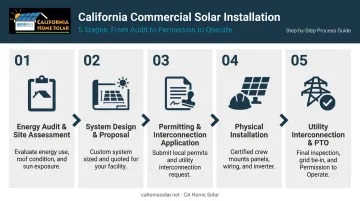
The Five Stages
- Energy audit and site assessment — utility bill review (12 months), roof inspection, shading analysis, and financial performance modeling
- System design and proposal — engineering plans, equipment selection, projected output, and ROI analysis
- Permitting — building and electrical permits, plus utility interconnection application under CPUC Rule 21. SolarAPP+ can expedite permitting in participating California jurisdictions, though not all jurisdictions apply it to commercial projects
- Installation — physical installation, with a dedicated project manager maintaining communication throughout
- Utility interconnection and PTO — California Home Solar handles the interconnection application and coordinates with the utility for Permission to Operate, so commercial clients don't manage that process themselves
Permitting and Interconnection Realities
Commercial permitting timelines vary significantly by city and utility. Working with a contractor who knows the relevant building departments and utility interconnection requirements in your jurisdiction can substantially cut delays. For LA-area commercial properties, navigating LADWP, SCE, and local building departments requires hands-on experience with local procedures — not just familiarity with the paperwork.
Those permitting timelines also make financing strategy worth addressing early. California Home Solar is a HERO Registered Contractor, offering PACE-based financing with zero down payment and terms from 5 to 25 years. Commercial property owners looking to preserve capital while meeting Title 24 requirements can use this to get a system in place before the 2027 property tax exclusion sunset — without tying up capital upfront.
Frequently Asked Questions
Is solar required on new commercial buildings in California?
Yes. As of January 1, 2023, Title 24 requires most newly constructed commercial buildings to include both a solar PV system and a battery energy storage system. Building type, conditioned floor area, and climate zone determine sizing — with specific exemptions available in limited circumstances.
How many solar panels are needed to power a commercial building in California?
The number depends on the building's annual energy consumption, roof area, climate zone, and panel wattage. Title 24 sets a formula-based minimum, but most businesses size their system to offset as much actual usage as possible — often requiring dozens to hundreds of panels depending on building size.
Which type of solar panel is best for commercial use in California?
Monocrystalline and bifacial monocrystalline panels are generally the strongest choice for California commercial buildings, given their higher output per square foot and performance in warm, sunny conditions. All panels must appear on the CEC-approved equipment list regardless of type.
What incentives are available for commercial solar in California?
The main programs are the 30% federal ITC, MACRS accelerated depreciation, SGIP battery storage rebates, and California's property tax exclusion under RTC Section 73. Stacking these incentives can substantially reduce net installation cost, though eligibility varies by utility territory and project timing.
What is NEM 3.0 and how does it affect commercial solar in California?
California's Net Billing Tariff (effective April 15, 2023) replaced retail-rate export compensation with avoided-cost pricing, making grid export far less valuable than under the previous NEM 2.0 structure. Self-consumption and paired battery storage are now the primary drivers of commercial solar financial returns.
How long does commercial solar take to pay for itself in California?
Payback period depends on system size, financing terms, incentives used, and how well battery storage reduces peak-hour grid purchases. California's high commercial rates and stackable incentives typically produce shorter payback periods than most other states — often in the 5–8 year range for well-designed systems.