Solar isn't just an environmental statement. For Southern California businesses, it's a financially defensible way to cut operating costs, hedge against rate increases, and strengthen your bottom line for decades.
This guide covers what commercial solar actually costs, what you'll save, which tax incentives apply, and why the Los Angeles market specifically favors commercial solar ROI.
Key Takeaways
- California commercial electricity costs twice the national average — making solar savings worth more per kilowatt-hour
- The federal Investment Tax Credit (ITC) and MACRS depreciation can reduce your net system cost by more than 50%
- Commercial payback periods typically run 4–8 years, after which solar generation directly reduces your operating costs
- California's property tax exclusion means solar won't increase your assessed property value
- Working with a local contractor who knows LADWP, SCE, and LA-area permitting keeps your project on schedule and avoids costly permitting delays
What Is Commercial Solar and Is It Right for Your Business?
How Commercial Solar Differs from Residential
Commercial solar operates at a larger scale — typically from 25 kilowatts up through multiple megawatts, depending on the facility. Installation types include:
- Rooftop systems — the most common for commercial buildings with adequate roof space
- Ground-mounted systems — ideal for businesses with land but limited or unsuitable rooftops
- Solar carports — dual-purpose structures that shade parking while generating electricity
Most commercial systems are grid-tied, meaning they connect to the utility grid and allow the business to draw additional power when solar generation falls short — at night or on cloudy days. The grid acts as a backup, but your panels handle the bulk of daily consumption. SEIA classifies this as distributed generation — electricity produced at or near the point of use.
Understanding your system type is only half the picture. The bigger question is whether your specific operation makes solar a strong financial fit.
Which Businesses Benefit Most
Not every business is an equally strong solar candidate. The best fits share a few characteristics:
- High daytime electricity usage — solar produces during business hours, so daytime-heavy operations capture the most value
- Monthly bills above $1,000 — California's commercial average is already $1,378/month, giving most businesses a meaningful offset opportunity
- Owned commercial property — ownership is required to claim the federal ITC; tenants need landlord cooperation or a different structure
- No near-term relocation plans — payback periods run 4–8 years, so stability matters
Businesses planning to relocate within 2–3 years — or those running primarily overnight operations — are unlikely to recoup the investment before they leave. A site-specific assessment is the clearest way to find out where you stand.
How Much Can Your Business Save with Solar?
The Core Savings Mechanism
Solar panels offset electricity you'd otherwise purchase from the utility. A well-sized system can cover 80–100% of your annual consumption, converting a recurring operating expense into a one-time capital investment with a clear payback period.
To put that in concrete terms:
| Scenario | Annual Figure |
|---|---|
| CA commercial avg. electricity cost (EIA) | ~$16,500/year ($1,378/mo) |
| Savings at 90% offset | ~$14,850/year |
| 20-year avoided costs (flat rates) | ~$300,000 |
Why Rate Trends Amplify the ROI
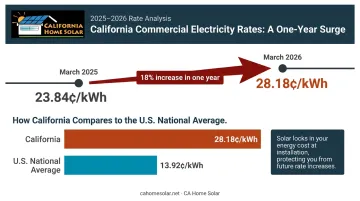
California's commercial rate jumped from 23.84 cents/kWh in March 2025 to 28.18 cents/kWh in March 2026 — an 18% increase in a single year. Solar locks in your energy cost at installation. Every rate hike after that increases the value of your solar output. Year-15 savings will likely exceed year-1 savings, simply because the electricity you're not buying keeps getting more expensive.
Net Metering and Billing Credits
California has transitioned from NEM 2.0 to a Net Billing Tariff (adopted by CPUC in December 2022). SCE closed NEM 2.0 to new customers in April 2023. Businesses can still receive credits for excess electricity exported to the grid — but export rates and credit structures vary by utility. LADWP operates its own commercial solar programs with different metering requirements than SCE. Verify current tariff details with your utility before finalizing system sizing.
Payback Period Expectations
According to EnergySage, commercial solar installations often achieve payback in less than five years, with ROI typically exceeding 10%. National benchmarks generally cite a 4–8 year range. After payback, the remaining 20+ years of system life produce electricity at no fuel cost — pure savings on your bottom line.
Tax Incentives and Financing: Making Solar Affordable for Businesses
The Federal Investment Tax Credit
The federal ITC is the most powerful financial lever for commercial solar buyers. It provides a **dollar-for-dollar reduction in federal taxes owed, not a deduction from income. A $200,000 system with a 30% ITC saves $60,000 directly off your tax bill.
The current credit structure requires meeting prevailing wage and registered apprenticeship requirements to reach the full 30% rate. The phase-out timeline is tied to either 2032 or when U.S. power-sector emissions reach a specific statutory threshold — whichever comes later. Verify the current ITC schedule and qualification requirements with a tax professional before installation.
MACRS Accelerated Depreciation
Solar equipment qualifies for a 5-year MACRS recovery period under IRS Publication 946, allowing businesses to write down the asset cost rapidly and reduce taxable income in early years. Bonus depreciation rules can accelerate deductions further, though the applicable percentage has been subject to annual changes. When ITC and MACRS are stacked, EnergySage estimates combined incentives can reduce effective net system cost by more than 50%. Confirm current depreciation rates with your tax advisor.
Illustrative Cost Table by System Size
| System Size | Est. Gross Cost* | After 30% ITC | After ITC + MACRS (~50%+ total reduction) |
|---|---|---|---|
| 25 kW | $62,500–$107,500 | $43,750–$75,250 | ~$31,250–$53,750 |
| 100 kW | $170,000–$310,000 | $119,000–$217,000 | ~$85,000–$155,000 |
| 250 kW | $425,000–$775,000 | $297,500–$542,500 | ~$212,500–$387,500 |
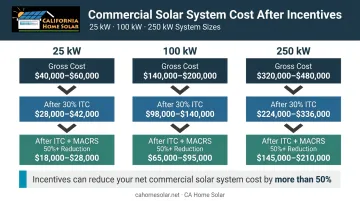
*Based on LBNL 2023 benchmarks of $2.50–$4.30/Wdc (≤100 kW) and $1.70–$3.10/Wdc (>100 kW). Prices vary by location, equipment, and installation complexity. Consult a tax professional for incentive calculations.
California-Specific Benefits
- Property tax exclusion — Under Revenue and Taxation Code Section 73, qualifying solar installations do not trigger a property reassessment. Solar adds no assessed value. This exclusion is currently scheduled to sunset January 1, 2027 — verify current status before installation.
- SGIP (Self-Generation Incentive Program) — CPUC's program provides financial incentives for on-site distributed generation including battery storage. Eligibility and incentive rates should be confirmed with a program administrator.
Financing Options
Businesses that prefer not to deploy capital upfront have several paths:
- Solar loans — Business retains ownership and qualifies for ITC and MACRS
- Leases — Lower barrier to entry, but the business doesn't own the system and doesn't claim tax credits directly
- Power Purchase Agreements (PPAs) — A third-party developer owns and maintains the system; the business pays per kWh produced, often below utility rates, but tax credits flow to the developer
- PACE financing — Zero down, no application fees, repaid through property taxes over 5–25 years, with approval based primarily on property equity rather than credit score
CA Home Solar is a HERO Registered Contractor, giving commercial clients direct access to PACE financing. Approval is based primarily on property equity, not credit score.
Why Southern California Businesses Have a Solar Advantage
Irradiance and Rate: A Dual Advantage
The southwestern United States — including the Los Angeles basin — receives among the highest solar radiation levels in the country, per EIA's solar resource data sourced from NREL. More peak sun hours means more kilowatt-hours produced per panel, per year. More production means more offset value.
Combine that production advantage with California's commercial rate of 28.18 cents/kWh — more than double the 13.92-cent national average — and the math becomes compelling fast. Every kilowatt-hour your system generates is worth twice as much in avoided cost as the same kilowatt-hour generated by a business in an average-rate state.
Navigating LA's Utility Landscape
Southern California businesses typically fall under LADWP or SCE jurisdiction, each with distinct net metering structures, demand charge policies, and interconnection requirements. Key differences to know upfront:
- LADWP requires performance meters for commercial PV systems over 30 kW AC
- SCE processes systems over 1 MW under Electric Rule 21, with higher application fees
- Both utilities have distinct interconnection timelines and documentation requirements
CA Home Solar has been recognized on Solar Power World's Top 500 Solar Contractors list in 2015, 2016, 2018, 2021, 2023, and 2025. With 36 years working in Southern California, the company handles permits, utility approvals, and interconnection from start to finish, assigning a dedicated project manager to each commercial installation.
Beyond the Savings: Other Business Benefits of Going Solar
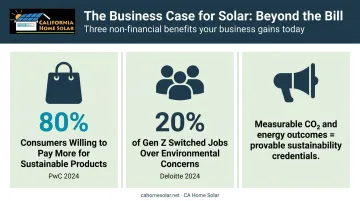
The financial case is strong on its own, but commercial solar delivers additional value that doesn't show up on the energy bill. Three areas stand out:
- Consumer purchasing: PwC's 2024 Voice of the Consumer Survey found 80% of consumers are willing to pay more for sustainably produced goods, with an average premium of 9.7%. A visible solar installation is a tangible, provable sustainability credential for B2C businesses.
- Talent and retention: Deloitte's 2024 Gen Z and Millennial Survey found 20% of Gen Zs and 19% of millennials had already switched jobs due to environmental concerns. Going solar gives employers a concrete commitment to sustainability — not just a policy statement.
- Marketing and PR: Solar generates measurable outcomes — CO₂ reduced, barrels of oil avoided — that translate directly into marketing content. That specificity makes solar a genuinely marketable sustainability credential.
Key Considerations Before Installing Solar for Your Business
Financial Readiness and Tax Appetite
The ITC is only valuable if your business has sufficient federal tax liability to absorb it. Businesses with lower tax exposure may benefit from structuring the project as a lease or PPA rather than an ownership model. Run the numbers for your specific tax situation before deciding on structure.
Physical and Structural Suitability
Every building is different. Key factors in a site assessment include:
- Roof condition: Panels last 25–30 years — a roof nearing end-of-life should be replaced before installation
- Orientation and tilt: South-facing roofs at optimal angles maximize daily energy output
- Shading: Nearby buildings, HVAC equipment, or trees can cut production by 10–25%
- Available square footage: Sets the ceiling on system size for rooftop installations
For buildings with unsuitable rooftops, ground-mounted systems and solar carports are viable alternatives. CA Home Solar handles both roofing and solar installation under one contract, so the roof is properly prepared before panels go in — no handoffs between separate contractors.
Battery Storage
Standard grid-tied solar systems must shut down during grid outages under California utility interconnection rules — a safety requirement that prevents power from feeding back into downed lines. This means no solar power during an outage unless you have battery backup.
Businesses that need continuous uptime (cold storage, medical operations, data centers) should evaluate battery storage alongside the solar system. It increases upfront cost, but adds outage resilience and can reduce demand charges.
Frequently Asked Questions
Is solar worth it for businesses?
For most businesses with moderate-to-high electricity costs, owned commercial property, and daytime operations, solar delivers strong ROI — especially in high-rate, high-sunlight markets like Southern California. Specific savings depend on system size, utility rates, and available incentives, so a site-specific assessment is the right first step.
How long does it take for commercial solar to pay for itself?
Payback periods typically range from 4 to 8 years nationally, and can be shorter in Southern California due to high utility rates and abundant sunlight. After payback, the system generates free electricity for the remaining 20+ years of its lifespan.
What tax incentives are available for businesses that go solar in California?
Key incentives include the federal ITC (up to 30%), MACRS 5-year accelerated depreciation, California's solar property tax exclusion, and net metering credits. Verify the current ITC schedule, bonus depreciation rules, and California exclusion status with a tax professional before installation.
How much can a business save with solar panels?
Savings vary by system size and electricity usage. Based on California's average commercial bill of $1,378/month, a system offsetting 90% of consumption saves roughly $14,850 annually, with totals growing each year as utility rates rise. Over a 20-year system life, many small-to-mid-sized businesses save well over $100,000.
What size solar system does my business need?
System size is calculated from your annual electricity consumption divided by the local production ratio. A professional solar assessment uses actual utility bill data and site conditions to produce a precise recommendation, so an on-site evaluation is the starting point.
Does installing solar increase my property taxes in California?
No. California's property tax exclusion under Revenue and Taxation Code Section 73 means a qualifying solar installation does not increase your property's assessed value. This exclusion is currently scheduled to sunset January 1, 2027. Confirm current status before installation.