Introduction
If you run a small business in Southern California, electricity is almost certainly one of your largest recurring operating costs — and it's getting worse. According to the U.S. Energy Information Administration, California commercial electricity rates hit 28.18 cents/kWh in March 2026, up from 23.84 cents/kWh just one year earlier. The national commercial average sits at 13.92 cents/kWh — meaning California businesses pay roughly twice the national rate.
Solar panels offer a direct way to cut that cost. For Southern California businesses specifically, the combination of strong sunshine, steep utility rates, and generous tax incentives creates one of the most compelling financial cases for commercial solar anywhere in the country.
This guide covers what small business owners need to evaluate the decision: the real financial benefits, available incentives, system sizing, financing options, and how the installation process works.
Key Takeaways
- California commercial electricity rates are nearly double the national average and rose ~18% year-over-year in early 2026
- The federal Investment Tax Credit covers 30% of installation costs, dollar-for-dollar off your tax bill
- MACRS depreciation lets businesses deduct 85% of system cost over five years
- California's Net Billing Tariff credits excess solar energy sent back to the grid at avoided-cost rates
- How you size your system and structure financing directly shapes payback period — most California small businesses see ROI in 5–8 years
Why Southern California Is One of the Best Places for Small Business Solar
Three converging factors make Southern California one of the strongest commercial solar markets in the country.
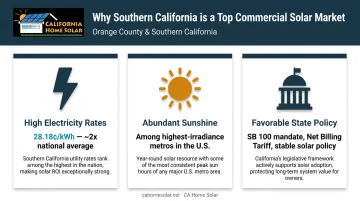
High electricity rates. At 28.18 cents/kWh, California commercial customers pay among the highest rates in the country. Every kilowatt-hour your solar system produces displaces electricity you'd otherwise buy at that rate. At that rate, a 50 kWh daily offset translates to over $500 in monthly savings.
Abundant sunshine. Los Angeles consistently ranks among the highest-irradiance metro areas in the U.S. More sun hours mean more production per installed kilowatt, improving your return on every dollar invested.
Favorable state policy. California's Net Billing Tariff (NBT), administered by the CPUC, credits businesses for excess solar energy exported to the grid. New interconnection applications filed on or after April 15, 2023, fall under NBT rules, where exports are compensated using Avoided Cost Calculator values. This is different from the older retail-rate NEM credits — which means system sizing for self-consumption matters more than ever.
California's SB 100 mandate requires 100% renewable electricity by 2045 and at least 60% renewable by 2030. That legislative commitment keeps the policy environment stable and signals continued support for commercial solar investment well into the future.
Understanding the policy landscape sets the stage for a more practical question: which utility are you actually on, and what does that mean for your solar economics?
Which Utilities Serve Small Businesses in Southern California?
SCE and LADWP are the dominant providers across CA Home Solar's service territory:
- SCE TOU-GS-1 covers business customers with demand of 20 kW or less
- LADWP Schedule A-1 applies to commercial customers below 30 kW
Most small businesses fall within these tariff classes, which include both energy charges and — depending on the rate option selected — demand charges. Knowing your tariff determines whether demand charge reduction or daytime energy offset should drive your system design.
The Real Financial Benefits of Solar Panels for Small Businesses
Cutting Your Monthly Electricity Bill
When your solar system produces power during business hours, that electricity offsets what you'd otherwise draw from the grid — at California's steep commercial rates. The financial impact is most pronounced for businesses that operate during daytime hours, since solar production and business consumption align closely.
Beyond simple energy charges, solar directly addresses demand charges — the fees utilities assess based on your peak power draw in a given billing period. NREL research found demand charges can exceed 50% of a commercial customer's monthly electric bill, particularly for offices, restaurants, and retail operations. Since solar generation peaks during the day when business loads are typically highest, it reduces those demand spikes — and the fees that come with them.
Businesses with energy-intensive daytime operations — refrigeration, HVAC, equipment loads, commercial kitchens — tend to see the strongest financial results. The key is designing the system around your actual load profile, not just a generic savings estimate.
Protection Against Rate Increases
Once your solar system is running, the cost of the electricity it generates is essentially fixed. You're not exposed to utility rate volatility — and California's rate trajectory makes that stability worth noting.
California commercial rates rose from 23.84 cents/kWh in March 2025 to 28.18 cents/kWh in March 2026 — an increase of roughly 18% in a single year. A business that locked in solar generation last year is insulated from that increase on the portion of its load covered by solar.
For small business owners managing tight margins, predictable energy costs simplify cash flow planning — a fixed generation cost means one fewer variable when forecasting monthly operating expenses.
Property Value and Brand Differentiation
Commercial properties with solar installations tend to command stronger resale and lease valuations. A Lawrence Berkeley National Laboratory survey of commercial appraisers confirmed that solar can be a meaningful property asset — though valuations vary depending on appraiser experience with solar assets.
Solar also carries a brand signal that property value alone doesn't capture:
- Consumers increasingly factor sustainability into purchasing decisions
- A visible rooftop installation communicates environmental commitment without a dedicated marketing campaign
- For retail, hospitality, or service businesses, that visibility offers a competitive edge in Southern California's crowded local markets
Solar Incentives and Tax Breaks Available to Small Businesses
The Federal Investment Tax Credit (ITC)
The ITC is the most powerful financial tool available to businesses that purchase a solar system outright — and it works like this:
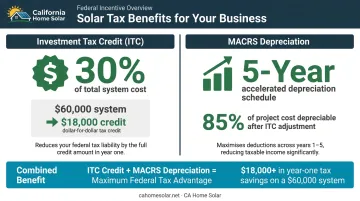
- 30% of your total installation cost comes directly off your federal tax liability — not as a deduction, but as a dollar-for-dollar credit
- Applies to systems where construction begins before 2033
- Example: a $60,000 installation generates an $18,000 federal tax credit
Business owners also get something residential buyers don't: MACRS depreciation. Under the Modified Accelerated Cost Recovery System, solar equipment qualifies for 5-year accelerated depreciation. With a 30% ITC, your depreciable basis is reduced by half the credit (per IRS rules), leaving 85% of the project cost available to depreciate over five years.
That combined impact — ITC plus MACRS — makes outright ownership significantly more compelling than leasing for most taxable businesses.
Always work with a tax professional to confirm how these benefits apply to your specific tax situation.
California-Specific Incentives
Beyond the federal ITC, California businesses have access to several additional programs worth evaluating:
- SGIP (Battery Storage Rebates): Pairs with solar to offset battery storage costs. Non-Residential Storage Equity Step 5 is currently listed at $0.85/Wh under SCE, SCG, and PG&E — but step availability shifts as funding is claimed. Verify current status at selfgenca.com before budgeting.
- Utility Programs (SCE, LADWP, PG&E): These utilities offer commercial support for interconnection and net billing enrollment. Current official sources don't list large direct commercial PV rebates, but confirm current offerings directly with your utility before installation.
- USDA REAP Grants (Rural Businesses): Covers up to 50% of eligible project costs, with combined grant and loan guarantee funding up to 75%. Applies to communities with populations of 50,000 or less — businesses in Palmdale, Lancaster, and the Antelope Valley may qualify. Check eligibility at rd.usda.gov.
How to Size and Choose the Right Solar System for Your Business
Understanding Your Business's Energy Needs
System sizing starts with your utility bills — specifically, at least 12 months of data to capture seasonal consumption patterns and identify peak usage months. The goal is a system that offsets 80–100% of your annual consumption without oversizing.
In California, the Net Billing Tariff framework limits system size to what your actual consumption justifies. Under NEM rules, systems generally cannot be sized to produce more than 120% of the business's annual electricity consumption. Your installer will use your utility bill history to ensure the proposed system falls within this limit.
Roof and Site Considerations
Before pricing a system, a site assessment evaluates:
- Roof condition and age — panels carry 25–30 year warranties; a roof with 5 years of useful life left needs replacing first
- Available square footage — usable roof area limits maximum system size
- Shading — trees, neighboring buildings, and rooftop equipment all reduce production
- Orientation — south-facing roof surfaces are optimal in Southern California
If the roof isn't suitable, alternatives are available. CA Home Solar installs ground-mounted systems and has handled commercial projects where rooftop constraints made a ground-mount the better solution. Parking lot solar carports are another option that can serve double duty — generating power while providing covered parking for customers or employees.
Grid-Tied vs. Hybrid Systems
| System Type | How It Works | Best For |
|---|---|---|
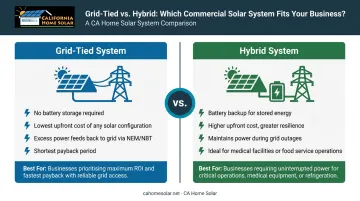
| Grid-Tied | Produces power, feeds excess to grid via NBT, no battery | Lowest upfront cost; standard for most small businesses |
| Hybrid | Adds battery storage for backup during outages | Businesses with resilience needs or SGIP rebate eligibility |
Most small businesses start with grid-tied systems. Installation costs run lower, payback periods are shorter, and California's NBT program handles excess production. Hybrid systems make sense when an outage means real financial exposure — medical practices, food service operations, or any business where downtime creates significant financial loss.
Solar Financing Options: Making the Switch Affordable
Three primary paths exist for commercial solar financing, each with different implications for tax benefits and long-term cost:
| Option | Ownership | ITC & MACRS | Best For |
|---|---|---|---|
| Outright Purchase | You own the system | Full access to both | Businesses with capital and taxable income |
| Solar Loan | You own the system | Full access to both | Businesses preserving cash flow while capturing tax benefits |
| PPA / Lease | Third party owns it | You generally don't get the tax credits | Businesses with no tax liability or minimal capital |
Ownership — whether purchased outright or financed through a loan — preserves access to the 30% ITC and MACRS depreciation. PPA arrangements transfer the tax benefits to the system owner (typically a financier), not the business using the power.
PACE Financing: For businesses that don't qualify for traditional lending, Property Assessed Clean Energy (PACE) financing is a California-specific option. Through programs like those administered by CSCDA, qualifying commercial property owners can finance solar installations repaid through property tax assessments. CA Home Solar is a HERO Registered Contractor, which means the company can help Southern California businesses access PACE-based financing, including those that don't meet conventional credit requirements.
When comparing options, evaluate total cost of ownership over the system's life, not only the monthly payment. Factor in which financing path preserves your access to federal and state tax benefits, and model the cash flow impact during the payback period. Consult a tax professional familiar with energy credits before committing.
What to Expect: The Small Business Solar Installation Process
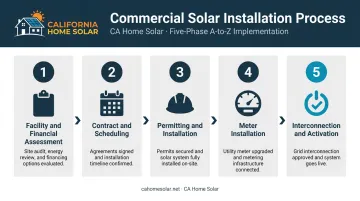
CA Home Solar's commercial installation process follows five phases:
- Facility and financial assessment — Energy consumption analysis, site evaluation, and system design tailored to your load profile and roof or ground conditions
- Contract and scheduling — Project timeline established to minimize operational disruption; a dedicated project manager assigned to your job
- Permitting and installation — CA Home Solar handles permit applications across LA County and surrounding jurisdictions; physical installation is planned to accommodate your business schedule
- Meter installation — Utility meter change coordinated with an authorized service provider
- Interconnection and activation — SCE's Rule 21 interconnection process issues Permission to Operate (PTO) typically within 5–10 business days of the engineer's review. Once approved, the system goes live and monitoring begins.
Timing varies by phase — here's what drives the schedule at each stage:
- Permitting timelines vary by jurisdiction within LA County — your project manager will give you a realistic estimate for your specific location
- Physical installation typically takes 1–3 days for most small commercial systems once permits are approved
- Interconnection is the final step and is utility-controlled; experienced installers submit complete applications to minimize back-and-forth
After activation, CA Home Solar provides 24/7 system monitoring and professional solar panel cleaning services to keep the system producing at peak output. Regular cleaning matters — accumulated dust and debris reduce output, and many panel warranties require documented maintenance.
Frequently Asked Questions
Are solar panels worth it for a small business?
For most businesses with significant electricity bills planning to stay at their location five or more years, yes. The 30% federal ITC, MACRS accelerated depreciation, and California's above-average utility rates typically combine to produce a strong ROI. Your specific payback timeline depends on system size and which incentives you capture.
What is the 120% rule for solar?
It's a sizing limit under California's net metering framework: a solar system generally cannot be designed to produce more than 120% of your business's annual electricity consumption. Your installer will use 12 months of utility bill data to ensure the system proposal stays within this cap.
Can I write off solar panels as a business expense?
Yes, in two ways: the 30% federal ITC reduces your federal tax liability dollar-for-dollar, and MACRS accelerated depreciation lets you deduct 85% of the system cost over five years. Consult a tax professional to optimize both for your business's situation.
How long does it take for solar panels to pay for themselves for a small business?
Typical commercial solar payback periods range from 3–7 years, depending on system size, utility rates, and which incentives are captured. With California commercial rates among the highest in the country, many Southern California businesses land toward the shorter end of that range.
What size solar system does a small business need?
It depends on your annual kWh consumption, available roof or ground space, and California's 120% NEM sizing rule. A professional site assessment is the most reliable way to size the system correctly, since generic estimates rarely account for your specific load profile.
What happens to solar energy my business doesn't use?
Excess electricity flows back to the utility grid. Under California's Net Billing Tariff, your business receives credits for that exported energy, which offset electricity costs during evenings or periods when the system isn't producing. Maximizing self-consumption remains the stronger financial strategy under current NBT export rates.