But the first question almost everyone asks isn't about cost — it's: how many panels do I actually need?
Generic national estimates routinely miss the mark for SoCal homeowners. Your local sun exposure, roof setup, utility provider, and planned energy loads all shift the number meaningfully. Using a national average without checking your own data can result in a system that's undersized from day one.
This guide walks through the step-by-step solar calculator method, the variables that adjust your panel count, and what Southern California homeowners specifically need to know before sizing a system.
Key Takeaways
- Most U.S. homes need 15–25 solar panels, but Southern California's high sun exposure often pushes that number toward the lower end
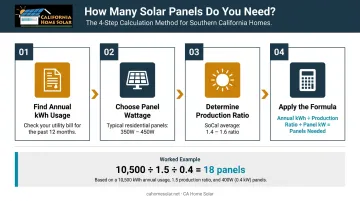
- Core formula: Annual kWh ÷ Production Ratio ÷ Panel Wattage (in kW) = Number of Panels
- SoCal production ratios typically fall between 1.4 and 1.6 — more favorable than most of the country
- Panel wattage, roof orientation, shading, and future loads (EVs, pools, HVAC) all shift your final count
- A professional on-site assessment catches shading patterns, roof conditions, and electrical limits that online calculators can't evaluate
How to Calculate How Many Solar Panels You Need
The solar industry uses a three-input formula that's consistent across installers and tools like NREL's PVWatts Calculator. With accurate inputs, the result gives you a reliable starting estimate.
Step 1: Find Your Annual Energy Usage
Pull 12 months of electricity bills and add up the kilowatt-hours (kWh). Most bills display monthly usage directly; your utility can provide historical data if you've misplaced older statements.
Why 12 months? A single bill misses seasonal peaks. Summer cooling in the San Fernando Valley or San Gabriel Valley can easily double a typical winter month, so annualizing captures the full picture.
Reference benchmarks:
- U.S. average: ~10,791 kWh/year (2022 EIA data)
- California average: approximately 503 kWh/month (~6,036 kWh/year), notably lower than the national figure
California homes tend to use less electricity annually than the national average, partly because of milder climates in many areas and partly because of state efficiency standards. Don't plug in the national average if you haven't checked your own bills.
Step 2: Choose Your Panel Wattage
Modern residential panels typically range from 350W to 450W. 400W is a practical midpoint for most estimates. Check the panel's spec sheet for its exact wattage rating.
Higher-wattage panels mean fewer panels for the same system output, important when roof space is tight. A 450W panel produces roughly 25% more energy than a 360W panel, which can reduce your count by several panels on a mid-sized system.
Step 3: Determine Your Production Ratio
The production ratio measures how much usable AC energy a system produces annually relative to its rated capacity. It accounts for local sun hours, climate, inverter losses, wiring losses, and temperature effects.
According to EnergySage's production methodology, production ratios vary significantly by region:
| Region | Production Ratio Range | Examples |
|---|---|---|
| Pacific Northwest | 1.0–1.15 | Washington, Oregon |
| Northeast/Midwest | 1.1–1.3 | New York, Ohio |
| Southwest | 1.5–1.8 | Arizona, New Mexico |
| Southern California | 1.4–1.6 | LA area, typical range |
For most SoCal homeowners, 1.4–1.5 is a conservative working estimate. Inland areas like Palmdale tend toward the higher end; coastal communities with marine-layer influence sit closer to 1.4.
Step 4: Apply the Formula
Here's the calculation spelled out:
Formula: Annual kWh ÷ Production Ratio ÷ Panel Wattage (kW) = Number of Panels
Example — Southern California home:
- Annual usage: 10,500 kWh
- Production ratio: 1.5
- Panel wattage: 400W (0.4 kW)
10,500 ÷ 1.5 = 7,000 kWh system output needed
7,000 ÷ 0.4 kW = **17.5 panels → round up to 18**
Always round up to the next whole panel. Also build in a 10–15% buffer for real-world losses: wiring inefficiencies, temperature derating, and dust accumulation all reduce actual output below nameplate estimates.
Key Factors That Affect Your Solar Panel Count
The formula gives a starting number. These variables push it up or down.
Electricity Consumption Patterns
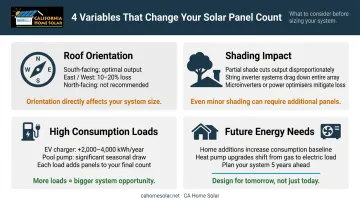
High-consumption households need more panels. Two major load adders in Southern California:
- Pool pumps: California residential pool filtration equipment uses an estimated 1,000–2,600 kWh/year for filtration alone; a pool with a booster pump can add roughly 3,300 kWh/year
- EV chargers: Energy use depends on vehicle efficiency and annual mileage — calculate it as
(vehicle kWh/100 miles × annual miles) ÷ 100; a Tesla Model 3 at 25 kWh/100 miles and 12,000 miles/year adds ~3,000 kWh annually
Miss either one during sizing and you'll be short on production from day one.
Roof Orientation and Shading
South-facing roofs at an optimal tilt generate the most energy per panel. Deviations cost you output:
- East/west-facing roofs: Lose approximately 10–20% of annual production compared to south-facing systems
- Non-ideal east/west angles: Can see up to a 20% production drop
- North-facing roofs: Generally not recommended for solar — significantly less sun exposure throughout the day
Shading matters even more than orientation on some systems. With string inverters, one shaded panel can drag down the output of an entire string. Even partial shading from a chimney, satellite dish, or neighbor's tree can meaningfully reduce system performance.
The 120% NEC Rule
Before finalizing your panel count, check your electrical panel capacity. Under NEC Article 705, your solar system's size is constrained by your main panel's busbar rating — and the math catches many homeowners off guard.
In practical terms, this means:
- A standard 200-amp panel has limited headroom for a large solar system
- Exceeding that limit requires a panel upgrade before the system can be permitted
- Discovering this late in the process adds cost and delays installation
Flagging your panel capacity early ensures the system you design is the system you can actually install.
Future Energy Needs
Plan for what's coming, not just what you use today:
- Adding an EV in the next few years
- Switching from gas to electric appliances or an electric heat pump
- Building an addition or ADU
- Installing a pool or spa
Expanding an existing solar system later costs more than slightly oversizing it now. If you're planning any of these within the next five years, factor them into your initial sizing conversation.
What Southern California Homeowners Should Know Before Sizing Their System
Southern California ranks among the top solar regions in the country — and local conditions shift the math in your favor. But they also introduce nuances that generic tools miss.
SoCal's Production Ratio Advantage
The Southwest consistently achieves production ratios of 1.5–1.8, placing SoCal homeowners in a favorable position compared to homeowners in the Northeast or Pacific Northwest. A homeowner in Portland with the same annual electricity usage as someone in Pasadena would likely need several more panels to produce the same output.
Use NREL's PVWatts Calculator to pull location-specific production estimates for your address — it accounts for tilt, azimuth, local solar irradiance, and system losses in one tool.
SoCal Microclimates Matter
Southern California isn't uniform solar territory. Coastal communities like Malibu and Hermosa Beach deal with more marine-layer overcast days than inland areas. Palmdale and the Antelope Valley receive substantially more direct sun hours annually than Santa Monica.
Your neighbor's system size isn't a reliable reference, and city-level estimates can be off by a meaningful margin. Your address — not your ZIP code — determines your actual production ratio.
California NEM 3.0 and Sizing Strategy
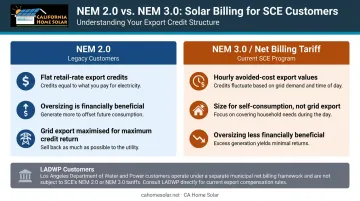
If you're in SCE territory (Southern California Edison), interconnection applications filed after April 14, 2023 fall under the Solar Billing Plan (NEM 3.0 / Net Billing Tariff). Export credits are now calculated on hourly avoided-cost values. NEM 2.0 customers received flat retail-rate credits — NEM 3.0 does not.
The practical impact: oversizing your system to export large amounts of power to the grid is far less financially beneficial than it once was. Under NEM 3.0, the goal is to size for self-consumption — generating what you actually use, not maximizing grid exports.
Important distinction: LADWP customers operate under a separate municipal net metering framework (Service Rider NEM) that isn't subject to CPUC's Net Billing Tariff rules. Don't apply SCE's NEM 3.0 assumptions to an LADWP account.
Getting a Local Professional Assessment
Online calculators are useful for ballpark estimates. They don't account for your specific roof geometry, shading from nearby trees or structures, electrical panel capacity, or local microclimate conditions.
CA Home Solar has been installing residential solar systems across Southern California for 36 years, serving Los Angeles County, Orange County, and surrounding communities. Their process includes a free consultation, site survey, and custom system design — each step tailored to your roof, your utility, and your actual usage.
Common Mistakes When Estimating Your Solar System Size
Using National Averages Instead of Local Data
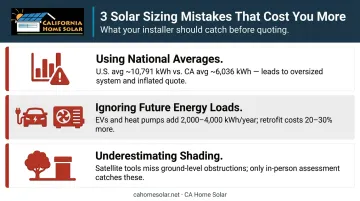
The U.S. average of ~10,791 kWh/year is a reference point, not your number. California homes average closer to 503 kWh/month (~6,036 kWh/year) — nearly half the national figure in some cases. Plugging in a national average without checking your bills is the most common cause of oversized systems and inflated quotes.
Ignoring Future Energy Loads
Homeowners routinely size for today's usage, then buy an EV or replace a gas furnace with a heat pump 18 months later. Either addition can add 2,000–4,000 kWh annually. Retrofitting a larger solar system after the fact can cost 20–30% more than sizing correctly from the start.
Underestimating Shading and Roof Losses
Most online calculators use satellite imagery that doesn't capture ground-level shading conditions. A chimney, a neighbor's mature tree, or even a rooftop HVAC unit can reduce panel output in ways satellite-based tools can't detect. An in-person roof assessment is the only reliable way to account for site-specific shading before finalizing your panel count.
These three mistakes — wrong baseline, unplanned loads, and missed shading — are exactly what a local site assessment catches before installation day.
How to Right-Size Your System for Your Energy Goals
The "right" number of panels depends on what you're trying to accomplish.
100% Offset vs. Partial Offset
- 100% offset: Eliminates the utility bill but requires a larger upfront investment
- 70–90% offset: Often the practical sweet spot, especially under NEM 3.0 where excess exports earn lower credits than they once did
Most SoCal homeowners find that targeting 80–90% offset balances cost with savings more effectively than chasing a zero bill through oversizing.
Planning for Battery Storage
Adding a battery (a Tesla Powerwall or equivalent) changes the sizing equation. The solar array now needs to cover both daytime household load and provide enough surplus to charge the battery. As EnergySage notes in their battery sizing guide, the solar system and battery must be sized together — a large battery with an undersized array doesn't deliver meaningful backup.
If either of these goals applies to you, bring storage sizing up early in your installer consultation:
- Grid independence during outages: Your array needs enough surplus to reliably charge the battery each day
- Avoiding SCE's peak TOU rates: Those rates hit 58 cents/kWh during summer weekday on-peak hours — storage lets you draw from the battery instead
Validating with a Solar Calculator Tool
Before meeting with an installer, run your address through NREL's PVWatts Calculator. It takes about five minutes and gives you a location-specific production estimate to benchmark against installer quotes.
- Enter your estimated system size (in kW)
- Input your roof's tilt angle and compass-facing direction (azimuth)
- Compare the annual output estimate against any proposal you receive — if an installer's projected production runs significantly higher than PVWatts, ask for an explanation
Frequently Asked Questions
How do I calculate the number of solar panels I need?
Divide your annual kWh usage by your local production ratio, then divide again by your panel wattage in kW. For example: 10,500 kWh ÷ 1.5 production ratio ÷ 0.4 kW (400W panel) = ~17.5 panels, rounded up to 18. Always add a 10–15% buffer for real-world losses.
What is the 120% rule for solar?
Under NEC Article 705, a solar system's breaker contribution cannot push the total load beyond 120% of the electrical panel's busbar ampacity. This caps system size on a standard 200-amp panel — exceeding the limit requires a panel upgrade before installation can be permitted.
How many solar panels does an average Southern California home need?
Most SoCal homes fall in the 15–20 panel range, thanks to strong sun exposure and favorable production ratios. Actual needs vary based on your energy usage, roof orientation, and high-load additions like an EV charger or pool pump.
Does roof direction affect how many solar panels I need?
Yes. South-facing roofs generate the most energy per panel. East- or west-facing roofs lose roughly 10–20% of annual production, meaning you may need 2–4 additional panels for the same output. North-facing roofs are not suitable for solar in the continental U.S.
Should I oversize my solar system?
Adding 10–15% capacity accounts for future loads and real-world losses. In California under NEM 3.0, oversizing purely to export excess power is less financially beneficial than it was under NEM 2.0 — size for what you consume, not maximum grid export.
How much roof space do solar panels typically require?
A modern 400W panel covers approximately 19–20 square feet of roof area. A 20-panel system needs roughly 380–400 square feet of unshaded, usable roof space — plus fire setback clearances required by local codes.