Introduction
Most U.S. commercial rooftops sit empty — and largely untapped for solar. Despite decades of industry growth, adoption remains low: Lawrence Berkeley National Laboratory research shows market penetration has only recently cleared the low single digits among U.S. commercial buildings.
That gap is closing fast. Rising electricity costs, shifting federal policy, and new financing models are pushing commercial solar into the mainstream — particularly in high-rate markets like Southern California, where California's commercial electricity averaged 25.54 cents/kWh in 2024 according to EIA data.
This article breaks down the four trends reshaping the commercial rooftop solar market: site lease models turning idle rooftops into revenue, the rise of solar-plus-storage, the complicated federal-vs.-state policy picture, and the technology advances making these systems measurably more efficient.
Key Takeaways
- Commercial property owners can earn passive income from unused roof space through site leases — no installation costs to the property owner
- Solar-plus-storage is becoming the default for commercial installations, not an optional upgrade
- Federal solar tax credits face new timing and eligibility restrictions — commercial property owners should act before current incentive windows close
- NREL estimates 386 GW of technical solar potential on U.S. commercial buildings — yet adoption sits in the low single digits
- High-efficiency panels and AI monitoring tools are making commercial systems easier to manage and more productive per square foot
Trend 1: Rooftop Solar Site Leases Are Turning Idle Rooftop Space into Long-Term Revenue
How the Model Works
A rooftop solar site lease is a real estate agreement between a commercial property owner and a solar developer. The developer leases the roof, finances the system, handles installation, and manages ongoing maintenance — the property owner contributes nothing upfront and receives contractually defined lease payments over a 20–25 year term.
For property owners, this translates directly to net operating income improvement without capital expenditure. The solar revenue shows up as a recurring income stream tied to roof space that was previously generating nothing.
The Right Property Profile
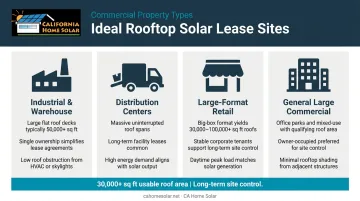
Not every commercial building is a strong candidate. The strongest fits typically include:
- Industrial and warehouse properties with large, flat, unobstructed roof areas
- Distribution centers with consistent long-term occupancy
- Large-format retail with significant square footage and stable tenancy
- Properties with 30,000+ sq ft of usable roof area and long-term site control
One practical complication: triple-net lease properties where tenants pay utilities directly can complicate the economics, since the party bearing electricity costs isn't always the party receiving lease income. Both parties need to resolve this structural issue before signing.
The Federal Timing Window
The current federal Investment Tax Credit structure is a major driver of commercial lease economics — for developers and property owners alike. SEIA describes the commercial clean energy credit as a 6% base that rises to 30% when prevailing wage and apprenticeship requirements are satisfied.
That 30% credit is a defining factor in project economics. Under IRS Notice 2025-42, the "begin construction" rules now emphasize the Physical Work Test — meaning preliminary activities like planning, permitting, and financing don't qualify. Developers need documented physical work started before key deadlines to preserve credit eligibility.
For property owners evaluating lease proposals, this means the timing of signing and project initiation directly affects the economics your developer can offer.
The California Opportunity
Those federal credit dynamics play out particularly well in California. The U.S. commercial solar segment installed 2,118 MWdc in 2024 — a record year, up 8% year over year — with California among the strongest deployment states. At 25.54 cents/kWh for commercial electricity, Southern California property owners have particularly strong avoided-cost economics backing these deals.
For commercial property owners in Los Angeles and Southern California who want to own their system outright rather than lease the roof to a developer, California Home Solar has handled commercial solar installations across the region for 36 years — from site assessment and permitting through meter installation and system activation.
Trend 2: Solar + Battery Storage Integration Is Becoming the Commercial Standard
The Shift from Add-On to Default
A few years ago, battery storage was an optional upgrade on commercial solar proposals. That's changing. For commercial buyers facing time-of-use rates and demand charges, standalone solar often leaves significant savings on the table. Storage captures what solar alone can't.
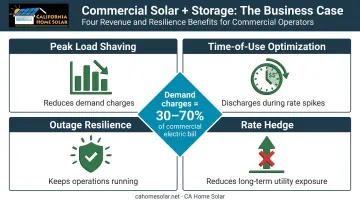
The core business case for solar-plus-storage comes down to four specific advantages:
- Shaves peak load to reduce demand charges when grid draw is highest
- Discharges stored energy during rate spikes to cut time-of-use costs
- Keeps operations running during outages without relying on the grid
- Reduces long-term exposure to utility rate increases
The Demand Charge Factor
According to Clean Energy Group, demand charges can account for 30% to 70% of a commercial customer's electric bill. Storage pencils out for customers paying $15/kW or more in demand charges — and for most commercial properties in Southern California served by SCE or SDG&E, that threshold is well within range. Because actual savings depend heavily on load shape and tariff structure, project-level modeling matters more than industry averages.
Market Adoption Signals
Commercial storage momentum is real. The American Clean Power Association and Wood Mackenzie reported 145 MW of community, commercial, and industrial storage installed in 2024 — up 22% year over year — with California, Massachusetts, and New York accounting for 88% of that capacity. California's dominance reflects both strong incentive programs (SGIP, DSGS, ELRP) and the state's persistent demand charge exposure.
What This Means for Property Owners
Integrating storage requires more detailed system design than a standard solar installation — load analysis, tariff modeling, sizing decisions, and long-term energy management capability. Property owners shopping for commercial solar contractors should be asking about storage design competency, not just panel installation experience.
CA Home Solar offers battery storage installation alongside commercial solar and provides 24/7 system monitoring as a standard component of its commercial installations.
Trend 3: Federal Policy Uncertainty vs. California's Solar Momentum
What's Actually Happening at the Federal Level
The 30% federal Investment Tax Credit has not been eliminated, but it has been materially constrained. Public Law 119-21, enacted July 4, 2025, added termination rules for applicable wind and solar facilities under tax credit Sections 45Y and 48E.
The July 7, 2025 executive order directed Treasury to enforce those termination rules. IRS Notice 2025-42 then clarified that credits terminate for applicable wind and solar facilities placed in service after December 31, 2027 where construction begins after the statutory cutoff.
The practical implication: commercial solar developers and property owners need to demonstrate documented physical construction work — not just planning or permitting — to lock in current credit eligibility. The 5% cost safe harbor, which was a widely used alternative method, now applies only to "low output solar facilities" under Notice 2025-42.
For commercial property owners, the question isn't whether the ITC exists — it does — but whether your project's timeline qualifies. That federal uncertainty makes California's own incentive stack worth understanding directly.
California Is Filling the Gap
California has programs that continue to support commercial solar adoption regardless of federal uncertainty:
- Net Billing Tariff (NBT) — CPUC's current successor to NEM for new customers, providing export compensation credits
- Self-Generation Incentive Program (SGIP) — CPUC program supporting distributed energy resources including battery storage
- Demand Side Grid Support (DSGS) — CEC program incentivizing load reduction and backup generation during grid stress events
- Emergency Load Reduction Program (ELRP) — CPUC 5-year pilot paying customers for load reduction during grid emergencies
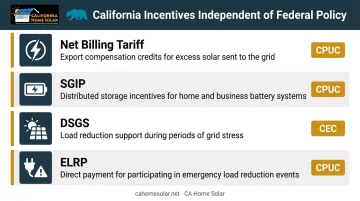
Each of these programs operates on state authority and state funding — they don't move when federal policy shifts. That insulation from Washington is exactly what makes California's incentive stack durable for long-term commercial project planning.
What This Means Practically
At 25.54 cents/kWh, California commercial electricity rates amplify the ROI of solar even in a reduced-incentive environment. A commercial property owner who waits for federal clarity risks missing both current Safe Harbor windows and California's active program enrollment periods.
For commercial property owners in Southern California, working with a contractor who understands California's specific tariff structures — including how NBT export compensation interacts with system sizing decisions — can shift project ROI by thousands of dollars annually.
California Home Solar has been navigating California's solar incentive landscape for 36 years and handles permit acquisition and utility coordination as part of every commercial installation.
Beyond the Headlines: Technology Advances and the Untapped Rooftop Market
Advanced Panel Technology and AI-Driven Monitoring
Panel technology has moved well past the standard modules of a decade ago. According to IEA PVPS's 2024 Trends Report, today's commercial solar market looks markedly different:
- Monocrystalline commercial cell efficiencies now reach 20–25%
- Bifacial modules represented approximately 50% of the annual market in 2023
- Commercial modules now range from 350W to 600W, with some bifacial glass modules reaching 740W
TOPCon technology is increasingly prevalent in commercial procurement, offering efficiency gains over earlier PERC-based panels. For commercial rooftops where usable area is fixed, higher output per square foot means more total system capacity from the same footprint — a meaningful advantage when roof space is the constraint.
Getting the most from that capacity depends on keeping systems running clean. AI-based monitoring platforms have become critical here — Raptor Maps, analyzing more than 125 GW of solar assets, found equipment-fault-related underperformance increased nearly 180% since 2019. Automated monitoring catches performance degradation early, before it compounds into significant generation losses.
The Massive Untapped Commercial Rooftop Market
The opportunity ahead is substantial. NREL's technical potential study estimates 386 GW and 506 TWh/year of rooftop solar potential on medium and large U.S. commercial buildings. Within that, Environment America Research & Policy Center found more than 450,000 medium and large U.S. warehouses collectively hold nearly 16.4 billion sq ft of rooftop area with 185.6 TWh/year of generation potential.
Against that backdrop, commercial adoption remains in the low single digits. LBNL's research found penetration had only recently surpassed 1% across commercial property types, with a related analysis citing 1.5% of commercial buildings with solar by year-end 2019.
That gap persists largely because of financing complexity, permitting friction, and the lack of contractors who can navigate both the technical and regulatory sides of a commercial project — not a shortage of usable roof space or solar resources.
What's Fueling the Commercial Rooftop Solar Surge — and What's Coming Next
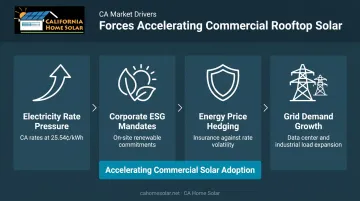
Several market forces are converging to accelerate commercial adoption:
- Electricity rate pressure — California commercial rates at 25.54 cents/kWh make avoided-cost economics compelling
- Corporate sustainability commitments — ESG mandates are driving businesses to prioritize on-site renewable generation
- Energy price hedging — businesses treat solar as insurance against utility rate volatility
- Grid demand growth — data center and industrial load expansion is driving grid stress and demand charge exposure
These pressures aren't easing. Over the next 1–3 years, the policy and technology landscape will shift in ways that directly affect the economics of commercial solar:
- IRA incentive structure: Ongoing federal budget negotiations will determine whether the current termination timeline holds or shifts
- Virtual power plant programs: California's ELRP and DSGS programs point toward a future where commercial rooftop solar owners earn grid services revenue, not just bill reduction
- Community solar expansion: Emerging models could extend commercial rooftop economics to smaller tenants and multi-tenant properties
For commercial property owners in Southern California, the window for capturing current federal Safe Harbor protections while California's state programs remain active is narrowing. CA Home Solar has served the Southern California commercial market for 36 years and holds Top 500 Solar Contractor recognition — a useful starting point if you're assessing a commercial installation.
Frequently Asked Questions
Has Trump cancelled the solar tax credit?
No — the 30% federal Investment Tax Credit hasn't been fully eliminated. Public Law 119-21 and IRS Notice 2025-42 have created tighter begin-construction deadlines and eligibility rules for wind and solar. Commercial projects must now prioritize accurate begin-construction documentation and timeline compliance to protect their eligibility.
What is a rooftop solar site lease and how does it work?
A rooftop solar site lease is a zero-upfront-cost arrangement where a solar developer leases a commercial property's roof, installs and maintains the system at no cost to the owner, and pays the property owner predictable lease income over a 20–25 year contract term.
What types of commercial properties are best suited for rooftop solar?
Industrial, warehouse, distribution, and large-format retail properties with 30,000+ sq ft of usable roof space and stable long-term occupancy are typically the strongest candidates. Properties where tenants pay utilities directly require additional deal structuring.
How long does commercial rooftop solar take to pay for itself?
Most commercial systems pay back in 5–10 years, though the range varies with system size, financing model, and local electricity rates. California's high commercial rates generally push payback toward the shorter end — project-specific modeling will give you an accurate number.
What are California's current incentives for commercial rooftop solar?
Key programs include the Net Billing Tariff for export compensation, SGIP for distributed storage, the Demand Side Grid Support program, and the Emergency Load Reduction Program. Enrollment windows and program availability shift frequently, so confirm current status with a licensed California solar contractor before planning around any incentive.
How does adding battery storage change the economics of commercial rooftop solar?
For commercial customers where demand charges make up 30–70% of their electric bill, storage can be the difference between a good project and a great one. It enables demand charge reduction, time-of-use rate optimization, and backup power — improving overall ROI beyond what solar alone delivers.