Commercial rooftop solar gets discussed in broad, vague terms. The actual value shows up in specifics: lower monthly bills, federal tax credits, protection from future rate hikes, and a productive use of roof space that otherwise generates nothing.
This article covers five concrete, outcome-focused reasons why commercial rooftop solar makes financial sense — especially for businesses operating in the Los Angeles area and across Southern California.
Key Takeaways
- California commercial electricity costs more than twice the national average, making on-site solar generation especially impactful here
- The 30% federal Investment Tax Credit and MACRS accelerated depreciation can recover a significant portion of installation costs in year one
- Once installed, solar locks in your cost of self-generated power — it won't rise with utility rates
- Green-certified commercial properties command measurable rent premiums, and a rooftop solar system signals exactly that
- With 25+ year system lifespans and minimal upkeep, the years after payback translate directly to savings
What Is Commercial Rooftop Solar?
Commercial rooftop solar is a photovoltaic (PV) system installed on a commercial building's roof that converts sunlight into electricity used on-site. Instead of buying all your power from the utility, you generate a portion — or all — of it yourself.
It's commonly installed on:
- Warehouses and distribution centers
- Office buildings and professional spaces
- Retail locations and shopping centers
- Manufacturing and industrial facilities
- Mixed-use commercial properties
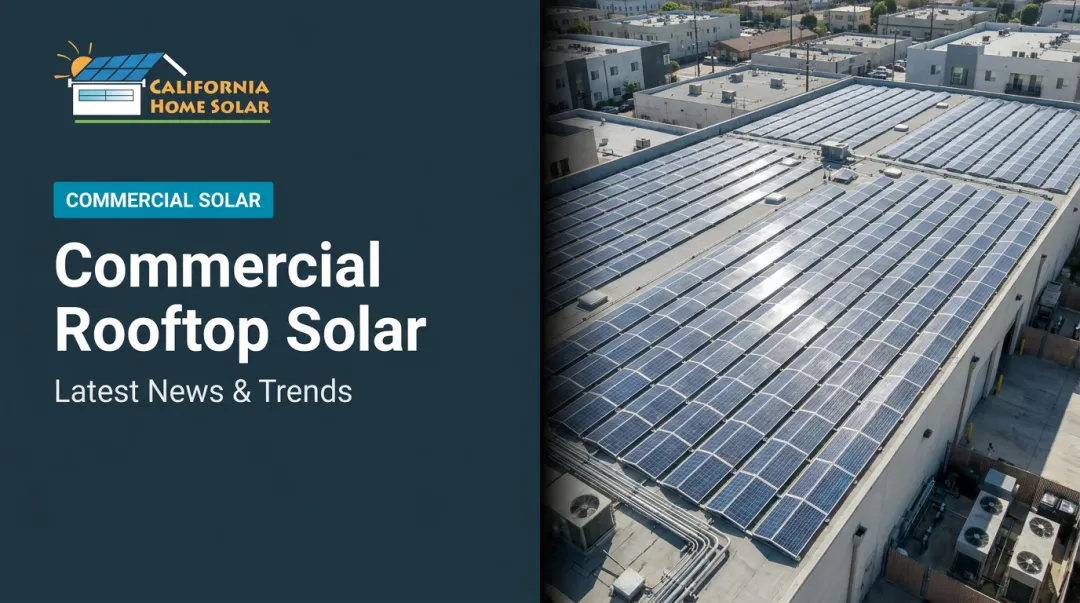
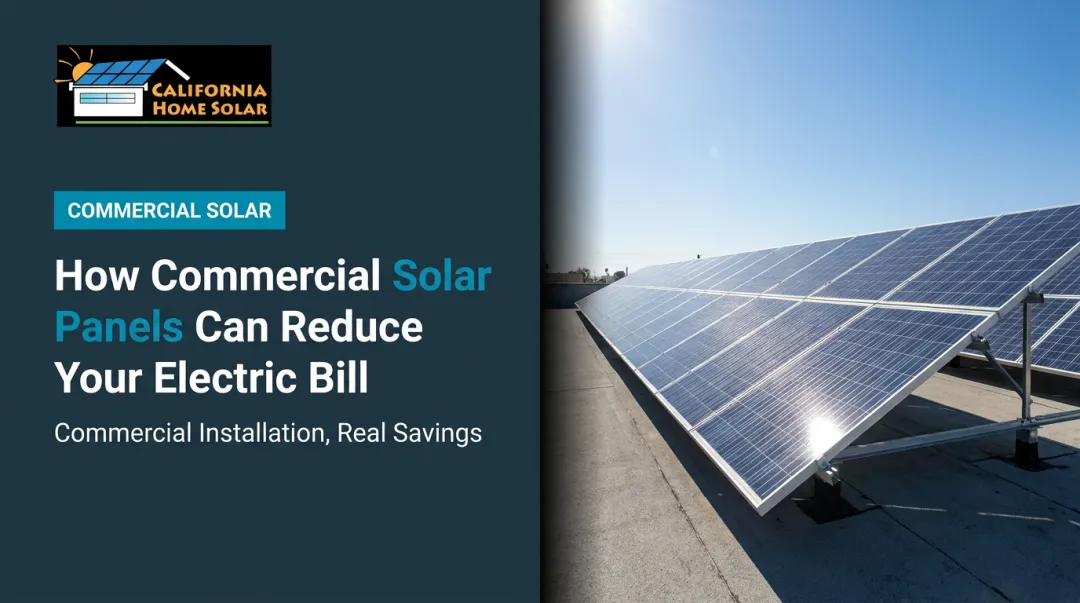
Roof configuration plays a direct role in system performance. Flat and low-slope commercial roofs — the most common setup in Southern California — work well with solar mounting systems designed to tilt panels for peak output.
What the panels produce matters most: lower operating costs, meaningful tax advantages, and greater control over your energy supply.
Five Reasons Commercial Rooftop Solar Makes Sense for Your Business
Reason 1: It Dramatically Cuts Your Monthly Electricity Costs
Commercial buildings are heavy electricity consumers. HVAC systems, lighting, refrigeration, machinery, servers — the load adds up fast. Every kilowatt-hour you generate on-site is one you don't buy from the utility.
Here's why this matters more in Southern California than almost anywhere else:
| Location | Commercial Rate (2026) |
|---|---|
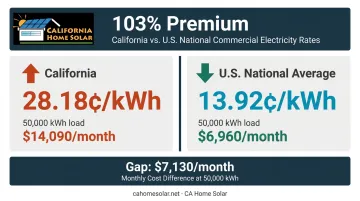
| California (statewide) | 28.18 cents/kWh |
| U.S. national average | 13.92 cents/kWh |
That's a 103% premium over the national average. A business consuming 50,000 kWh per month pays roughly $14,090 in California versus $6,960 nationally — a gap of over $7,000 every month before any solar offset.
Solar panels produce power during peak daylight hours, which typically coincide with a commercial building's highest consumption periods. You're displacing the most expensive power first, not just trimming off-peak consumption — which means the savings hit where your bill hurts most.
Reason 2: Tax Incentives and Financial Returns Make the Numbers Work
This is where commercial solar separates itself from most capital investments. The federal tax treatment is genuinely favorable.
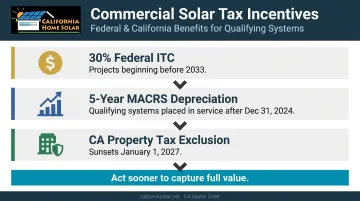
Federal Investment Tax Credit (ITC): Businesses that own their solar system can claim a 30% federal tax credit on the total installation cost in the year the system is placed into service, for projects beginning construction before 2033. That's a dollar-for-dollar reduction in federal tax liability — not a deduction. The DOE's business solar guide confirms this figure, with a scheduled phase-down after the full-value period.
MACRS Accelerated Depreciation: The IRS confirms that qualifying clean energy property placed in service after December 31, 2024 may be eligible for 5-year MACRS cost recovery. Accelerating depreciation on a solar asset reduces federal income tax liability in the early years of ownership, improving cash flow during the payback period.
California Property Tax Exclusion: The state's active solar energy system property-tax exclusion has been extended through the 2025–26 fiscal year, with a scheduled sunset of January 1, 2027. Installing before that deadline means the added property value from your solar system won't trigger a higher property tax assessment.
These incentives are time-sensitive. The ITC phase-down is scheduled, and the California exclusion has a hard sunset. Businesses that act sooner capture more of the financial upside.
Reason 3: It Shields Your Business from Rising Utility Rates
California's commercial electricity rates don't hold still. Businesses that rely entirely on grid power absorb every rate increase with no ability to offset it — and California's rates are already among the highest in the country.
Once a solar system is installed, the economics shift permanently. The cost of self-generated electricity is effectively fixed — your capital investment is made, and sunlight carries no invoice. What grows over time is the gap between that fixed solar cost and whatever SCE or LADWP charges for the same kilowatt-hours.
That gap widens every time SCE or LADWP raises rates.
What this means for financial planning:
- Solar provides a stable, predictable energy baseline
- Grid exposure is reduced — rate hikes affect a smaller portion of your total consumption
- Energy cost forecasting becomes more reliable over a 5-, 10-, or 20-year horizon
For businesses with thin margins or long operational planning cycles — manufacturing, logistics, hospitality — that predictability has real value beyond the monthly savings figure.
Reason 4: It Strengthens Your Brand and Increases Property Value
Rate stability is a financial argument. But solar also changes how your property and your business are perceived — and that has its own bottom-line implications.
Customers, employees, and business partners increasingly factor sustainability into their decisions. A rooftop installation communicates environmental commitment without advertising spend.
CBRE's analysis of 20,000 U.S. office buildings found that LEED-certified buildings commanded a 31% average rent premium, with a 3.7% premium after controlling for building quality and location. That's a green-building proxy rather than a solar-specific figure, but it reflects the market's willingness to pay for sustainable properties — and rooftop solar is one of the most visible sustainability signals a commercial building can display.
Beyond valuation, the brand-side outcomes include:
- Attracting environmentally conscious talent in competitive hiring markets
- Differentiating from competitors who haven't made the transition
- Supporting ESG reporting, sustainability certifications, and corporate responsibility commitments
- Strengthening relationships with customers and suppliers who prioritize supply chain sustainability
Reason 5: Commercial Rooftop Solar Is Low-Maintenance and Built to Last
Solar PV systems are passive technology. No moving parts means very little can go wrong mechanically. Routine maintenance is limited to periodic inspection and cleaning — and for commercial rooftop systems, California Home Solar offers professional cleaning services that include performance checks after each session to confirm output improvement. With 36 years of experience and Top 500 Solar Contractor recognition, the team understands what commercial systems need to perform over the long haul.
NREL's research on PV degradation supports the 25-year manufacturer warranty benchmark for quality commercial systems. O&M costs across the industry average roughly $17 per kW per year based on NREL data, covering inspection, cleaning, inverter maintenance, and monitoring — a manageable ongoing expense relative to the electricity savings generated.
The rooftop advantage is practical:
- Panels are out of the way of ground-level operations
- No additional land required
- Installation can typically be completed without shutting down business operations
- Systems integrate with existing electrical infrastructure
For a commercial property owner, payback is the inflection point — not the finish line. A system placed in service today will still be generating electricity in the 2040s and 2050s. Every year beyond payback is pure savings, with no additional investment required.
What Happens When Businesses Keep Delaying
Every month a commercial property stays fully grid-dependent, it pays current California utility rates — 28.18 cents/kWh — with no offset. As rates rise, the gap between what that business could be paying and what it actually pays only widens.
Three specific risks compound with delay:
The 30% federal ITC is scheduled to phase down after 2032. California's property-tax exclusion sunsets January 1, 2027. Neither timeline extends indefinitely, and the further out a business waits, the less favorable the financial structure becomes.
SCE customers who applied for solar after April 15, 2023 are now under the Net Billing Tariff rather than NEM 2.0. Businesses evaluating solar today are working within this current framework — understanding it now, before further policy shifts, puts you in a stronger planning position.
A commercial roof that sits empty generates no return. A roof with solar generates electricity, tax savings, and sustainability credentials — three categories of value from the same square footage you're already paying to maintain.
How to Get the Most from Your Commercial Rooftop Solar Investment
The value of a commercial rooftop system is maximized when it's properly sized to actual energy consumption. An oversized system generates excess power that may not be fully compensated under current net billing rules; an undersized system means you're still paying more to the grid than necessary. A professional energy and facility assessment is the right starting point.
Financing structure matters too. The three main options carry different tradeoffs:
- Outright purchase — Full ownership, full access to ITC and depreciation benefits, maximum long-term ROI
- Solar loan — Preserves tax benefit access while spreading costs over time
- Power Purchase Agreement (PPA) — No upfront cost, but the system is owned by a third party, which transfers most tax incentives to the provider
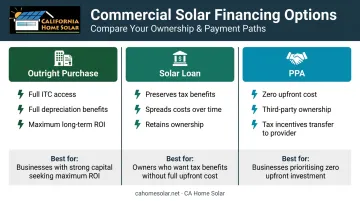
The right choice depends on your tax position, cash flow, and how long you plan to own the property.
CA Home Solar has been installing commercial solar systems across Southern California for 36 years. Their five-step commercial process starts with a facility and financial assessment that outlines expected system performance before any commitment is made. As a HERO Registered Contractor, CA Home Solar can also walk commercial property owners through PACE financing options, which offer zero down payment and flexible terms structured as a property tax line item.
Scheduling a no-commitment consultation is the fastest way to get a clear picture of projected savings and the right system size for your building.
Conclusion
The case for commercial rooftop solar comes down to five outcomes that compound over time:
- Lower electricity costs in one of the country's most expensive utility markets
- Federal and state tax incentives that offset upfront investment
- Rate protection that stabilizes long-term operating expenses
- Brand credibility and measurable property value gains
- A passive system designed to run 25+ years with minimal maintenance
Each of these outcomes grows more valuable the sooner a system is in place. Rates keep rising. Incentive windows close. Every month without solar is a month of full utility exposure.
For Southern California commercial property owners, the financial case is straightforward — and the longer a system is delayed, the more value is left on the table. California Home Solar has helped commercial clients across the LA area navigate the process from site assessment through final inspection. To find out what a rooftop system could realistically save your business, reach out for a no-obligation consultation.
Frequently Asked Questions
What are the 20% and 33% rules for rooftop solar panels?
The 33% rule comes from the California Fire Code: arrays covering 33% or less of roof area face different fire-access and setback requirements than larger arrays. A universal "20% coverage rule" is not codified in California — verify any such figure against your specific jurisdiction before using it for system sizing.
How much can a commercial business save by switching to rooftop solar?
Savings vary by system size, roof orientation, and energy consumption. California's commercial rate of 28.18 cents/kWh (more than double the national average) means the potential is significant, but a site-specific assessment based on your actual usage is the only reliable figure.
What tax incentives are available for commercial rooftop solar in California?
The primary incentives are the 30% federal ITC (for projects beginning construction before 2033), 5-year MACRS accelerated depreciation for qualifying systems placed in service after December 31, 2024, and California's active solar energy system property-tax exclusion, currently extended through the 2025–26 fiscal year with a sunset of January 1, 2027.
How long does it take for a commercial rooftop solar system to pay for itself?
Payback period varies based on system size, financing structure, local utility rates, and tax position , making a site-specific analysis the only reliable figure. Quality commercial systems carry 25+ year lifespans, meaning the post-payback period can represent decades of ongoing savings.
Does commercial rooftop solar work on all types of commercial roofs?
Flat and low-slope commercial roofs are generally well-suited for solar. Feasibility depends on roof age, structural load capacity, shading from adjacent structures, and orientation. A professional site assessment — like the facility evaluation CA Home Solar conducts before any commercial installation — determines suitability before any commitment is made.
What is the difference between buying a solar system outright and a solar PPA?
Purchasing outright gives the business full ownership plus access to the ITC and MACRS depreciation. With a PPA, a third party owns the system and the business pays a fixed rate for the electricity generated, reducing upfront cost but transferring most tax incentives to the system owner. The right structure depends on your tax position and cash flow.