Commercial rooftop solar is a different animal than residential. You're dealing with larger investments, more complex permitting, structural engineering requirements, utility interconnection timelines, and performance expectations that stretch 25+ years. According to LBNL's 2024 Tracking the Sun report, the average non-residential PV system size in 2023 was 229 kW—far beyond what most residential contractors are equipped to handle.
This guide walks through 10 critical considerations every commercial property owner should evaluate before committing to a rooftop solar installation in Los Angeles or the broader Southern California market.
TL;DR: 10 Considerations at a Glance
- Roof lifespan should match or exceed the solar system's 25+ year warranty
- Structural load capacity requires a licensed engineer's sign-off before design begins
- Sun exposure, orientation, and shading analysis all determine real-world output
- Panel layout must meet California fire code clearances and maintain drainage access
- Mounting method — ballasted, attached, or adhered — directly affects roof integrity
- Commercial permits require structural, electrical, and PV approvals—plus fire department review
- NEM 3.0 shifted the economics toward self-consumption and battery storage
- The 30% federal ITC and SGIP can significantly reduce your net cost
- Total cost of ownership, not sticker price alone, determines your actual payback period
- Vet your contractor and plan for long-term O&M before signing any contracts
Considerations 1 & 2: Roof Readiness and Structural Integrity
Consideration 1: Roof Lifespan Alignment
This is the first gate, and many property owners miss it entirely.
PV arrays have an expected service life of approximately 25 years. The problem? IIBEC/NRCA guidance cites the average low-slope commercial roof service life at just 17.4 years — a significant mismatch.
Installing solar on a roof that's already 10–12 years old without addressing that gap means you'll almost certainly need to remove and reinstall the entire array mid-life just to replace the membrane underneath. That's an expensive, disruptive project that's entirely avoidable with upfront planning.
The practical rule: the roof's remaining useful life should meet or exceed the solar system's warranty period. If it doesn't, plan a concurrent roof replacement.
CA Home Solar handles both solar and roofing, so you avoid the back-and-forth between separate contractors. Roof and solar work are coordinated from the start, with structural considerations built into the roofing scope before panels ever go up.
Consideration 2: Structural Load Capacity
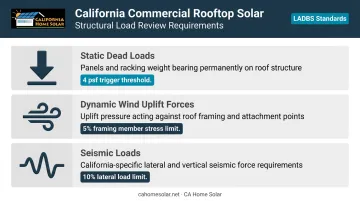
Rooftop solar adds real weight. Ballasted systems are particularly heavy, and the Los Angeles Department of Building and Safety (LADBS) sets clear thresholds:
- Module and support weight exceeding 4 psf triggers a full structural review
- Ballasted systems cannot increase roof-framing member demand by more than 5%
- Lateral-system demand cannot increase by more than 10%
That means a licensed structural engineer must assess whether your existing roof deck and building framing can handle:
- Static dead loads from panels and racking
- Dynamic wind uplift forces
- Seismic loads specific to California
Action item: Before soliciting solar bids, commission a professional roof inspection and obtain a structural engineering report. This protects you legally and gives solar designers accurate parameters to work with.
Considerations 3, 4 & 5: Solar System Design and Layout
Consideration 3: Sun Exposure, Orientation, and Shading
True south-facing roofs at an optimal tilt maximize energy yield in Southern California, but most commercial rooftops aren't perfectly oriented, and shading is almost always a factor.
Common shading culprits on commercial rooftops:
- HVAC units and mechanical equipment
- Parapets and roof edges
- Neighboring buildings
- Roof vents, skylights, and penetrations
NREL research found that shading greater than 40% of one cell can eliminate the entire power output of an 18-cell string in a grid-tied system. Run a full shading analysis using tools like NREL's PVWatts calculator before locking in the system design — the output numbers depend on it.
Consideration 4: Fire Safety Clearances
California's fire code imposes firm layout constraints that directly reduce your usable roof area. Under the 2022 California Fire Code Section 1205.3, nonresidential buildings must maintain:
- A 6-foot clear perimeter around all roof edges (reduced to 4 feet where either building axis is 250 feet or less)
- Array dimensions that don't exceed 150 feet in either axis
- Clear pathways to mechanical equipment, drains, skylights, and roof hatches
Local fire departments in Los Angeles County often conduct their own layout review before electrical permits are issued. Building these clearances into the initial design avoids permit delays and prevents costly redesigns mid-project.
Consideration 5: Drainage, Access, and Mounting System Selection
Beyond fire code and shading, the physical placement of your array affects roof performance for years after installation. PV arrays that cover roof drains create ponding water risk. All drains, scuppers, and penetrations must remain accessible, and conduit and racking should be elevated above the roof surface to allow water to flow freely.
Mounting system comparison for California commercial applications:
| Method | Key Advantage | Key Risk |
|---|---|---|
| Ballasted | No roof penetrations | Heavy; can shift in wind/seismic events |
| Mechanically attached | Structurally robust; NRCA-preferred | Requires careful flashing at penetrations |
| Adhered/flexible | Low-profile | Exposes membrane to extreme heat; compatibility-dependent |
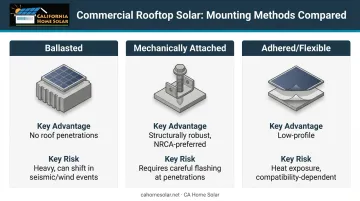
California's seismic and wind environment makes ballasted systems a higher-risk choice unless the structural analysis specifically supports them. Mechanically attached systems, while requiring proper flashing details, offer more predictable long-term performance in earthquake-prone areas.
One more factor: metal racking expands and contracts with Southern California's temperature swings. Racking systems need provisions for thermal movement, and arrays should never cross building expansion joints.
Considerations 6 & 7: Permitting, Compliance, and Utility Interconnection
Consideration 6: Permitting and AHJ Compliance
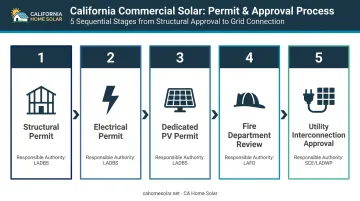
Commercial rooftop solar in California is not a one-permit process. A typical project requires:
- Structural permit for the support system
- Electrical permit for the PV system wiring
- Dedicated PV permit from the local municipality
- Fire department review of array layout and access pathways
- Utility interconnection approval before the system can energize
The City of Los Angeles processes commercial solar through LADBS, which requires LAFD approval before electrical permit issuance. LA County properties go through a separate LA County Public Works solar plan-check workflow. Timelines vary by jurisdiction—sometimes by weeks. Smaller systems may qualify for counter approval; larger commercial projects typically go through full plan check.
Working with a contractor who has pulled permits across Los Angeles County jurisdictions cuts delays and back-and-forth with local AHJs. CA Home Solar handles the full permitting process as part of their commercial installation service, with 36 years of experience working across jurisdictions throughout the region.
Consideration 7: Utility Interconnection and NEM 3.0
California's Net Billing Tariff (NEM 3.0) applies to SCE-served commercial customers submitting interconnection applications on or after April 15, 2023. Under this framework, excess solar energy exported to the grid is compensated at avoided-cost values—not retail rates. That's a meaningful reduction in the value of overproduction.
The practical implications for commercial property owners:
- Right-size your system for on-site consumption, not maximum export
- Pair solar with battery storage to shift stored energy to peak TOU periods
- Start the interconnection application early—Rule 21 processing with SCE involves technical screens and can take several months for commercial-scale systems
LADWP-served properties operate under separate municipal utility rules, not the CPUC's Net Billing Tariff. Check which utility serves your building before modeling the economics.
Considerations 8 & 9: Incentives, Costs, and ROI
Consideration 8: Federal and California Incentives
The current federal Investment Tax Credit (ITC) offers 30% of eligible system costs for commercial solar placed in service in 2022 or later, provided construction begins before 2033. For systems under 1 MW, eligibility requirements include:
- Meeting prevailing wage standards for all construction and alteration work
- Satisfying apprenticeship hour requirements for covered construction
- Beginning construction before the 2033 phase-down deadline
Timing matters: IRS Notice 2018-59 recognizes both the Physical Work Test and the Five Percent Safe Harbor for locking in the credit rate at the start of construction. Work with a tax advisor to confirm your eligibility and timeline.
California's Self-Generation Incentive Program (SGIP) provides incentives for paired battery storage systems—especially valuable under NEM 3.0, which favors self-consumption over grid export. SGIP incentive rates and available budget shift regularly; check SelfGenCA's live program metrics for current figures.
Consideration 9: Total Cost of Ownership and Financing
Installed cost benchmarks (2023, LBNL):
- Small non-residential systems (≤100 kW): $2.50–$4.30/W
- Large non-residential systems (>100 kW): $1.70–$3.10/W
Installed price is only one part of the equation. A complete cost-of-ownership model should include:
- Current SCE or LADWP TOU rates and projected escalation
- System degradation (NREL found a median rate of 0.5%/year for crystalline silicon)
- Fixed O&M costs (NREL ATB benchmarks approximately $19/kW-year for commercial PV)
- Any roof or structural upgrade costs that are part of the project
Financing options:
| Approach | Best For |
|---|---|
| Direct ownership | Maximizing ITC capture and long-term savings |
| PPA or solar lease | No upfront cost; reduced long-term savings |
| PACE/HERO financing | Property owners wanting on-bill repayment |
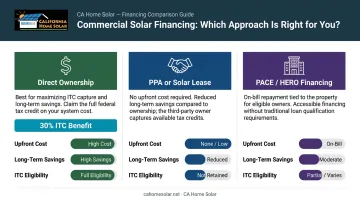
California Home Solar is a HERO Registered Contractor, making PACE financing a straightforward option for eligible commercial property owners in Southern California.
Consideration 10: Maintenance Planning and Choosing the Right Contractor
Long-Term O&M Planning
A commercial rooftop system will be on your building for 25+ years. Plan for ongoing maintenance before the contract is signed, not after.
Key O&M requirements for Southern California installations:
- Panel cleaning: Soiling is a real performance factor in this region. Studies on arid California conditions estimate annual soiling losses around 5%—cleaning frequency should be written into your maintenance plan
- Inverter inspections: String and central inverters require periodic checks; microinverter arrays have different monitoring needs
- Wiring and conduit inspections: Especially where conduit runs across roof surfaces exposed to UV and thermal cycling
- Roof membrane checks: Panels complicate membrane inspections; access paths must be maintained
CA Home Solar provides solar panel cleaning services for commercial properties, using soft brushes, biodegradable solutions, and deionized water. They note that scheduled maintenance is often required to keep panel warranties valid—something worth verifying with your specific panel manufacturer.
Vetting Your Contractor
Commercial solar differs from residential in scale, structural complexity, permitting depth, and roofing coordination. Not every solar contractor has the experience to manage all of those scopes simultaneously.
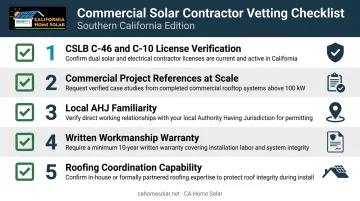
Contractor vetting checklist:
- Verify active CSLB C-46 (Solar Contractor) and C-10 (Electrical Contractor) licenses
- Ask for verifiable commercial project references at comparable system sizes
- Confirm familiarity with your local AHJ's specific requirements
- Get workmanship warranty terms in writing, separate from manufacturer warranties
- Ensure the contractor will coordinate with roofing professionals if roof work is involved
CA Home Solar has been named a Solar Power World Top 500 Solar Contractor six times (2015, 2016, 2018, 2021, 2023, and 2025). Their documented commercial work—including a 240 kW system in Pacoima—and in-house roofing capabilities make them a practical option for projects where solar and roof work need to happen at the same time.
Frequently Asked Questions
Do solar panels work at nighttime?
Standard solar panels don't generate electricity after dark—they need sunlight to operate. Pairing a commercial system with battery storage lets your business use stored solar energy during evening hours, which is increasingly important under NEM 3.0's reduced export rates.
How long does a commercial rooftop solar installation typically take?
Commercial projects in California typically span several months from signed contract to energization, accounting for design, structural review, permitting, fire department review, and utility interconnection. Starting the process early is the single most effective way to keep timelines on track.
How much roof space does a commercial solar installation require?
Usable roof space depends on system size and panel efficiency. A commonly used planning benchmark is roughly 100 square feet per kilowatt of capacity, though this varies with panel wattage and layout constraints. Buildings with large, unobstructed roof areas are best suited for meaningful commercial systems.
Do I need to replace my roof before installing commercial solar panels?
If your roof has less remaining useful life than the solar system's warranty period (typically 25 years), replace the roof at the same time as the installation. Removing and reinstalling an entire array mid-life to address a failed membrane costs far more than handling both projects together.
What permits are required for commercial rooftop solar in California?
Commercial installations typically require structural, electrical, and dedicated PV permits from the local municipality, plus fire department review for layout compliance and utility approval for interconnection. Requirements vary between City of LA (LADBS/LAFD), LA County (Public Works), and other jurisdictions.
What is California's NEM 3.0 and how does it affect commercial solar ROI?
NEM 3.0 (the Net Billing Tariff) replaced retail-rate export credits with lower avoided-cost values, reducing the return on overproduction. Right-sizing your system for self-consumption and pairing it with battery storage are now the most effective strategies for a strong ROI.