Introduction: The Rooftop Opportunity Most Commercial Property Owners Are Missing
Only 1.6% of U.S. commercial buildings had small-scale solar generation as of the most recent EIA survey — even in the West, where conditions are ideal, that figure reaches just 3.8%. Meanwhile, NREL estimates that medium and large commercial buildings alone represent 386 GW of untapped rooftop solar potential across the country.
Most commercial rooftops sit idle, generating nothing while their owners pay escalating electricity bills.
Southern California property owners face a particular urgency here. LADWP and SCE rates continue climbing, California's clean energy mandates grow stricter each year, and the region's sun exposure makes nearly every flat commercial roof a viable candidate for solar production. Federal incentives from the Inflation Reduction Act have also pushed the financial case further than it's ever been.
If you own commercial property in Southern California and haven't evaluated your roof for solar, the cost of waiting is measurable — and growing.
Key Takeaways
- Only ~1.6% of U.S. commercial buildings have solar installed, despite hundreds of gigawatts of available rooftop potential
- The federal ITC covers 30% of system costs, with bonus credits potentially pushing that higher
- Three financing paths exist: direct ownership, PPA, or rooftop lease, each with different cost and ROI profiles
- Roof condition, structural capacity, and shading determine site viability before any financial modeling begins
- CA Home Solar brings 36 years of commercial solar experience in Southern California, including large-scale installations
The Scale of the Untapped Opportunity
Why Commercial Rooftops Remain an Underused Asset
Energy analysts often describe commercial rooftops as an underutilized solar resource — and the numbers back that up. NREL's technical assessment found that medium buildings could support 154 GW of rooftop solar capacity, and large buildings another 232 GW. Combined, that's 386 GW of realistic generating potential sitting on rooftops that are mostly empty.
For context, EIA reported small-scale solar capacity at 44 GW as of mid-2023, projected to reach 55 GW by end of 2024. Commercial buildings account for about 27% of that installed base — meaning the gap between what's deployed and what's possible remains enormous.
What Changed the Economics
Slow C&I adoption historically came down to three barriers: high upfront costs, limited financing options, and policy uncertainty. Those barriers have largely eroded.
LBNL's 2024 Tracking the Sun report put 2023 median installed prices at $3.2/Wdc for small non-residential systems and $2.2/Wdc for large non-residential systems — roughly half what they were a decade ago. Module efficiency has improved alongside those cost declines, and financing structures like PPAs, rooftop leases, and tax credit transfers now exist at scale where they simply didn't before.
Corporate Deployments Proving the Model
The technology and business case are no longer experimental. Major corporations have deployed commercial rooftop solar at scale:
- Amazon deployed rooftop solar on 17 North American fulfillment centers by 2018, including an 813,000 sq ft facility in North Las Vegas
- Walmart had 6.5 MW installed across seven California stores through Sol Systems
- Target has 67.9 MW across 90+ retail sites, generating 92.3 million kWh annually and avoiding 31,000 tons of CO₂
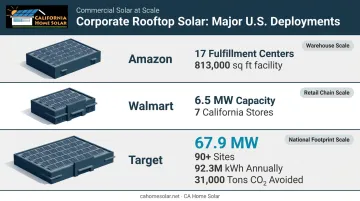
Each of these represents a fully operational system delivering measurable financial returns year after year.
The Front-of-Meter Option
Beyond on-site use, commercial properties can generate revenue from the grid itself. LADWP's Feed-in Tariff program allows eligible commercial properties to sell solar output directly to the utility at $0.145/kWh for in-basin solar systems between 30–500 kW, under contracts up to 20 years. Property owners earn lease or generation revenue regardless of tenant occupancy or on-site consumption levels.
The Business Case: Three Core Benefits
Financial Return
The most direct benefit is cost reduction. A properly sized system can offset a significant portion of a commercial building's electricity spend over its 25+ year life. In Southern California, where LADWP's commercial rates include both demand charges and tiered energy rates, and SCE's TOU-GS-2 and TOU-GS-3 tariffs add time-of-use complexity, the savings potential is substantial.
For property owners who prefer no capital outlay, the rooftop lease model flips the equation entirely: a solar developer finances, installs, owns, and operates the system while paying you a regular lease. The building's net operating income improves without a single dollar of capital expenditure from the owner.
Decarbonization and ESG Value
Onsite solar generates verifiable clean electricity at the point of consumption. For tenants with Scope 2 emissions targets, this directly reduces grid-sourced emissions rather than relying on renewable energy certificates.
The financial case for green buildings is well-established. Research from Eichholtz, Kok, and Quigley found that green-rated office buildings outperformed comparable non-certified properties across every metric:
- ~3.5% higher rents on a per-square-foot basis
- 6%+ effective rent premiums accounting for occupancy
- ~16% higher sale prices on disposition
LEED BD+C Core and Shell v5 awards up to 4 points for on-site renewable energy — a direct contribution toward certification that shapes tenant decisions in the competitive Southern California market.
Resilience Against Grid Disruptions
SCE's 2024 PSPS post-season report recorded multiple de-energization events affecting commercial and industrial customers — including a November event that cut power to over 28,000 customers. For businesses in affected areas, the consequences are direct: lost revenue and operational downtime.
Onsite solar paired with battery storage creates energy independence during these events. Islanding capability requires specific system design, so it isn't the right fit for every property. For businesses with critical operations, though, the resilience value alone can justify the investment — separate from the energy savings.
Financial Incentives Making Commercial Solar More Accessible
The federal Inflation Reduction Act created the strongest commercial solar incentive stack in U.S. history. Here's what's currently available:
Federal Investment Tax Credit (ITC)
- Base credit: 30% for systems placed in service after 2021, when under 1 MW or when prevailing wage and apprenticeship requirements are met
- Domestic content bonus: +10 percentage points if domestic content requirements are satisfied
- Energy community bonus: +10 percentage points for projects in qualifying energy communities
- Low-income community bonus: +10% or +20% for eligible facilities under 5 MW
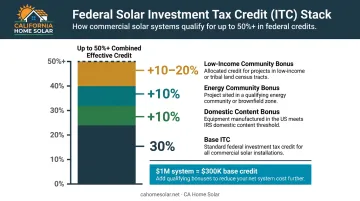
On a $1 million system, the base 30% ITC alone returns $300,000 in federal tax liability reduction. Bonus adders can push effective credits above 50%.
Bonus Depreciation
The ITC combines with accelerated depreciation. Under the current phase-down schedule:
- 60% bonus depreciation for property placed in service in 2024
- 40% for 2025 placements
- 100% bonus depreciation was reinstated for certain qualified property placed in service after January 19, 2025 under IRS Publication 946 guidance
A system placed in service in 2024 versus 2025 captures an additional 20 percentage points of bonus depreciation — a real dollar difference worth modeling before you finalize your timeline.
Credit Transferability
Businesses that lack sufficient tax liability to fully use ITC credits can now sell those credits to unrelated third-party taxpayers for cash, a mechanism the IRA introduced in 2022. Tax-exempt entities and governmental organizations — including nonprofits and municipalities — may access equivalent value through direct pay/elective pay provisions instead. Both pathways open commercial solar to property owners who previously couldn't capture the full credit.
California-Specific Programs
- LADWP Feed-in Tariff: $0.145/kWh for in-basin solar PV (30–500 kW) under 20-year contracts
- Net Billing Tariff (SCE): New interconnections after April 2023 receive export credits based on the Avoided Cost Calculator rather than retail NEM rates — making self-consumption optimization and storage analysis more important than ever
- SGIP: The Self-Generation Incentive Program offers non-residential battery storage incentives, including equity resiliency provisions; current incentive levels and budget status should be confirmed with the program administrator before modeling
Is Your Commercial Rooftop Solar-Ready? Key Factors to Evaluate
Not every rooftop qualifies, and identifying deal-breakers early saves time and money. Here's what a professional assessment examines:
Roof Age and Condition
Most solar developers require 10–15 years of remaining roof life before proceeding with installation. Removing and reinstalling solar panels mid-system-life to replace a deteriorating roof costs significantly more than coordinating both projects upfront.
CA Home Solar offers both commercial roofing and solar installation services, which means a single assessment can evaluate both roof condition and solar viability simultaneously — and if replacement is warranted, it can be structured as a coordinated project rather than two separate interventions.
Structural and Physical Suitability
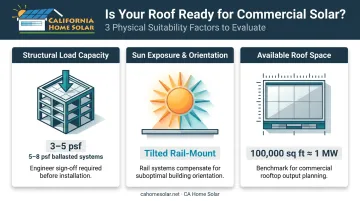
Three physical factors determine whether your roof can carry a system:
- Structural load capacity: Panels, racking, and ballast materials add 3–5 psf to roof load (ballasted systems reach 5–8 psf). Buildings not originally designed with solar overburden (the added weight from panels and hardware) in mind require a licensed structural engineer's sign-off before work begins.
- Sun exposure and orientation: Less of a concern for flat commercial roofs than for pitched residential ones. Southern California's solar angles make most flat roofs viable — tilted rail-mount systems can face optimal sun angles regardless of how the building is oriented.
- Available roof space: A useful benchmark is 100,000 sq ft of usable area per 1 MW of solar capacity. A 25,000–30,000 sq ft roof can host a meaningful system; smaller rooftops still deliver positive ROI when incentives are properly stacked.
Fire Code Compliance
Under the International Fire Code, PV arrays occupying not more than 33% of total roof area require at least 18 inches of clear setback on both sides of a horizontal ridge. Arrays exceeding 33% coverage require 36-inch setbacks. A professional layout design accounts for these setbacks from the start — maximizing panel count while keeping the array fully code-compliant.
Getting Started with Commercial Rooftop Solar in Southern California
The Evaluation Process
A professional site assessment covers:
- Roof condition and remaining useful life, including whether the deck needs replacement before solar installation
- Structural load capacity to confirm the building can support added panel weight
- Shading from HVAC equipment, parapets, and adjacent structures across different times of day and season
- Available square footage within fire code setback requirements, which sets the ceiling on system size
- Utility interconnection feasibility, covering service voltage, meter configuration, and queue status with LADWP or SCE
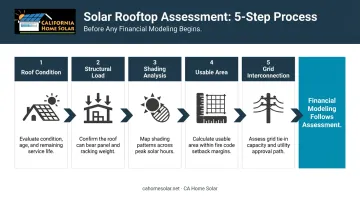
Financial modeling follows, incorporating current utility tariff rates, ITC credits, depreciation benefits, and California utility programs. That analysis directly informs which financing structure makes the most sense for your situation.
Choosing a Financing Path
| Structure | Upfront Cost | Ownership | Best For |
|---|---|---|---|
| Direct Purchase | High | Owner | Maximum long-term ROI, tax capacity available |
| Commercial Loan | Low/None | Owner | ROI with leverage, tax capacity available |
| PPA (20-year term) | Zero | Third party | Immediate savings, no tax capacity needed |
| Rooftop Lease | Zero | Third party | Revenue generation, no energy consumption required |
Each structure has different implications for tax benefit capture, balance sheet treatment, and long-term flexibility. The right choice depends on the owner's tax position, hold horizon, and capital allocation priorities.
Why CA Home Solar for Southern California Commercial Properties
CA Home Solar has served commercial and residential property owners across Los Angeles County and Southern California for 36 years, earning recognition as a Top 500 Solar Contractor by Solar Power World in multiple years including 2023 and 2025. Their commercial project portfolio includes a 240kW rooftop installation in Pacoima — well above typical residential scale.
For commercial work, three things set them apart:
- Roofing and solar under one contractor, so roof condition and solar viability get evaluated together
- Single-source accountability that avoids coordination gaps between separate vendors
- End-to-end project management from site assessment through permit filing, LADWP/SCE interconnection, and system energization
To start with a facility assessment and financial analysis, contact CA Home Solar at 877-903-1012 or info@cahomesolar.com.
Frequently Asked Questions
Can you put solar panels on a commercial rooftop?
Yes. Most commercial rooftops — particularly the flat membrane roofs common in commercial and industrial construction — work well with tilted rail-mount or ballasted systems that don't require roof penetration. A site assessment determines the appropriate mounting method based on roof type, age, and structural capacity.
What is the 33% rule for solar panels on commercial rooftops?
The 33% threshold comes from the International Fire Code and governs roof access requirements. Arrays covering 33% or less of total roof area require 18-inch setback pathways; arrays exceeding 33% require 36-inch setbacks. This is a fire access provision, not an economic cap on system size.
How much roof space is needed for a commercial rooftop solar system?
As a general screening rule, approximately 100,000 sq ft of usable roof area supports around 1 MW of solar capacity. Buildings with 25,000–30,000+ sq ft typically qualify, though smaller systems can still produce strong ROI when federal and California incentives are properly stacked — with final size driven by energy goals, roof layout, and setback requirements.
Do I need to replace my roof before installing solar panels?
If the roof has fewer than 10–15 years of remaining useful life, replacement before installation is generally recommended. Removing and reinstalling solar panels mid-system-life to address a failed roof costs significantly more than coordinating both projects at the outset. Contractors like CA Home Solar that handle both services can sequence the work efficiently.
What financial incentives are available for commercial solar in California?
Commercial owners can stack the federal 30% ITC (with potential bonus adders for domestic content, energy community, or low-income siting), accelerated depreciation, LADWP's Feed-in Tariff or SCE's Net Billing Tariff export credits, and SGIP incentives for battery storage. Properly stacked, these incentives can reduce net installation cost by 50% or more for eligible projects.
How long does it take to see ROI on commercial solar in California?
It depends on financing structure. Direct ownership in high-rate Southern California markets can reach payback in a competitive timeframe, particularly with full ITC and depreciation capture. PPA and lease structures generate immediate savings with zero upfront investment, so "payback period" is the wrong metric — revenue or savings start from day one.