Introduction
Southern California homeowners have a real solar advantage: year-round sunshine and high utility rates make it one of the strongest markets for residential solar in the country. But most people skip one decision entirely — which roofing material goes beneath those panels.
That oversight can be expensive. Solar panels are designed to last 25–30 years. If your roof fails first, you'll pay $1,500 to $6,000 or more to remove and reinstall the panels — plus permitting fees and lost energy production during downtime.
This guide covers which roofing materials work best for solar in Southern California, which ones to avoid, and which roof design factors — pitch, orientation, and shading — directly affect how much energy your system produces.
Key Takeaways
- Standing seam metal roofing is the top choice for solar: longest lifespan and no roof penetrations required
- Asphalt shingles are the most common and affordable option, but may need replacement mid-system life
- Clay and concrete tile roofs are solar-compatible but require specialized mounting hardware and higher labor costs
- Wood shake and slate are poor fits for solar; replacement is typically required before installation
- South-facing roofs at 15–40° generate the most solar output in Southern California
Why Your Roofing Material Matters for Solar Panel Installation
The Lifespan Mismatch Problem
Solar panel systems are designed to last 25–30 years, and most manufacturers back that with a 25-year warranty. Your roof needs to match — or outlast — that timeline.
When it doesn't, the math gets painful. Panel removal and reinstallation typically runs $1,500 to $6,000, with larger systems pushing costs above $7,000. That doesn't include the new roof itself, permit fees for reinstallation, or the energy production you lose during the gap.
Evaluate your roof's remaining lifespan before committing to solar — replacing a roof mid-system lifecycle is one of the most avoidable costs in residential solar. That evaluation also shapes which materials and mounting methods will work for your home.
How Material Affects Installation Method
Not all roofs mount the same way:
- Metal (standing seam): Clamp-on systems attach directly to raised seams — zero roof penetrations, lowest leak risk
- Asphalt shingles: Drilled mounts with flashing and sealant — widely compatible, but requires precise sealing to prevent water intrusion
- Tile roofs: Tiles must be carefully removed, specialized hardware installed beneath, and tiles replaced — more labor, more room for error if the installer lacks experience
- Flat membranes: Ballasted or tilt-rack systems minimize penetrations and work well on low-slope commercial rooftops
Installation complexity translates directly to cost and risk. A contractor who regularly works with tile roofs in Pasadena or Glendale will execute that job very differently than one who primarily works asphalt shingles.
Temperature and Efficiency
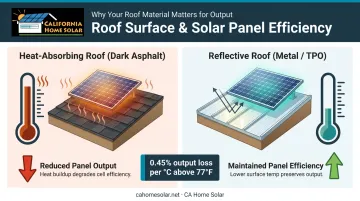
Solar panels lose 0.45% of output per degree Celsius above 25°C (77°F). In inland Southern California — the San Fernando Valley, San Gabriel Valley, Antelope Valley — summer temperatures regularly push roof surfaces well above that threshold.
A roofing material that reflects heat rather than absorbing it keeps the roof surface cooler, which directly supports better panel output. This is one reason metal and light-colored TPO membranes outperform dark asphalt in hot climates.
Best Roofing Materials for Solar Panels
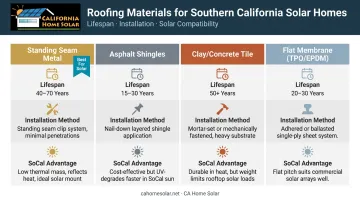
The four materials below are evaluated on lifespan alignment with solar panels, installation compatibility, and performance in Southern California's hot, dry climate.
Metal Roofing (Standing Seam and Stone-Coated)
Metal is the clear top choice for solar compatibility.
| Factor | Detail |
|---|---|
| Lifespan | 40–70 years — outlasts the solar system itself |
| Installation | Clamp-on mounting for standing seam; zero roof penetrations; lowest leak risk |
| SoCal Advantage | Reflects heat, reducing attic temperature and supporting panel efficiency in hot summers |
Standing seam metal roofs allow solar racking systems to clamp directly onto raised seams with no drilling required. That eliminates the primary source of solar-related roof leaks. Stone-coated metal variants offer the same durability with the visual profile of tile or shingles — useful for homeowners navigating HOA requirements in areas like Calabasas or Palos Verdes.
A homeowner installing solar on a new metal roof today will almost certainly replace their panels before they need a new roof. That's the ideal scenario.
Asphalt Shingles
Asphalt shingles cover more than 80% of American homes, which makes them the surface solar contractors work with most often. Standard drilled-mount racking systems are widely supported, and installation costs are typically the lowest of any pitched roof type.
| Factor | Detail |
|---|---|
| Lifespan | 15–30 years; may require replacement during the solar system's lifetime |
| Installation | Drilled mount with flashing; highly compatible and widely supported |
| SoCal Advantage | Affordable entry point; best value when paired with a concurrent roof replacement |
The critical question for Southern California homeowners: how old are the shingles? If they're more than 10–12 years old at solar installation time, you may be facing a roof replacement — and a full panel removal and reinstall — within the first half of your solar system's life.
The smarter play: Replace aging asphalt shingles at the same time as solar installation. You avoid future R&R costs, start fresh with matched lifespans, and may qualify for a single permit covering both projects.
Clay and Concrete Tile Roofing
Tile is the dominant roofing material across much of Southern California, particularly in communities with Spanish Colonial or Mediterranean-style architecture — think Arcadia, San Marino, or much of the San Gabriel Valley. The good news: tile roofs are durable enough to outlast a solar system.
| Factor | Detail |
|---|---|
| Lifespan | Long-lasting; typically suitable for the full solar system lifetime |
| Installation | Requires tile-removal mounting method; specialized hardware; higher labor cost |
| SoCal Advantage | Noncombustible (Class A fire rating); critical advantage in LA County wildfire-risk areas |
The installation process involves removing individual tiles, setting mounting hardware on the roof deck beneath, then replacing the tiles around the hardware. It works well — but only when done by an installer experienced with tile systems. Cracked tiles from foot traffic or improper mounting are a real risk with less experienced crews.
Concrete tile runs approximately 5.5 to 9.7 lbs per square foot — and solar panels add more. Before installation, schedule a structural assessment with a licensed engineer to confirm your roof framing can handle the combined load. This is especially relevant for older homes in the San Gabriel Valley and similar areas where tile roofs predate modern load standards.
Flat Roof Membranes (TPO, EPDM, Tar & Gravel)
Flat roofs are common on commercial properties across LA County and on some SoCal residential builds. They're well-suited for solar because ballasted or tilt-rack systems can position panels at the optimal angle regardless of roof direction.
| Factor | Detail |
|---|---|
| Lifespan | EPDM: 25–38+ years; TPO and tar-and-gravel vary — assess age before installation |
| Installation | Ballasted/tilt-rack systems minimize penetrations; flexible panel layout |
| SoCal Advantage | TPO's reflective white surface (65%+ initial reflectivity) helps maintain panel efficiency |
The flat-roof caveat mirrors asphalt shingles: check membrane age before committing. A 20-year-old EPDM roof installed under solar panels creates the same lifespan mismatch problem — you'll be tearing panels off mid-system-life for a membrane replacement. If the roof is past its midpoint, budget for a membrane swap as part of the solar project.
Roofing Materials to Avoid for Solar Panels
Wood Shake
Wood shake roofs are a poor fit for solar installation. In much of Southern California, the problems extend well beyond installation difficulty.
LA County's fire hazard severity zone regulations prohibit wood shingles and wood shakes in designated zones, requiring Class A roof coverings instead. Given that fire-prone areas span large portions of LA County — including the San Fernando Valley, foothill communities, and Malibu — a wood shake roof may be non-compliant regardless of solar plans.
From a practical standpoint, the fragile, uneven surface makes secure panel mounting difficult, and most experienced solar installers will require full roof replacement before proceeding.
Slate
Natural slate is extraordinarily durable: ASTM S-1 Grade slate carries a minimum 75-year life expectancy, and many roofs last well over a century. That longevity doesn't translate to solar compatibility.
The core issue is brittleness. Solar installation introduces three compounding problems:
- Installer foot traffic and mounting hardware pressure can crack tiles, leading to costly repairs
- Custom mounting hardware is required for every project
- Few installers have documented slate experience, which limits competition and drives up costs
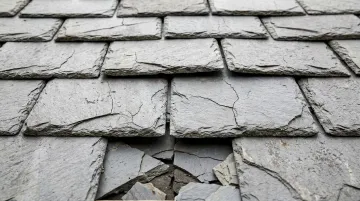
If you have a slate roof and want solar, get multiple installer quotes specifically from contractors with documented slate experience, and budget accordingly.
Beyond the Material: Roof Design Factors That Affect Solar Performance
Roofing material compatibility matters, but three design factors have a more direct effect on how much energy your system actually produces.
Orientation
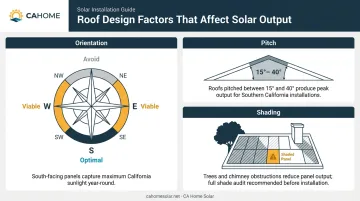
South-facing roofs receive the most direct sunlight in the Northern Hemisphere and deliver the highest annual energy output. In Southern California's latitude, even east- and west-facing roofs generate meaningful production — the California Energy Commission's solar-ready guidance supports orientations ranging well beyond due south.
West-facing installations are particularly worth considering for homeowners on time-of-use utility rates, since afternoon production aligns with peak pricing periods.
North-facing roof sections should generally be avoided as primary mounting surfaces.
Pitch
The 15–40 degree range captures the most production for fixed-tilt rooftop systems without requiring additional tilt racking. Most Southern California homes — whether ranch-style in the San Fernando Valley or hillside properties in Glendale — fall within or close to this range.
Flat roofs compensate with adjustable tilt mounts that can be set to the optimal angle for the installation's latitude.
Shading
Shading consistently causes more production loss than homeowners expect. Trees, chimneys, dormers, and adjacent buildings can all affect output — and partial shading of a single panel pulls down the entire connected string.
A pre-installation shade analysis is worth requesting from any installer. California Home Solar's site assessment process includes this evaluation. For properties with unavoidable shading, Enphase IQ8 microinverters or SolarEdge power optimizers allow each panel to operate independently, which limits (though doesn't fully eliminate) the drag that partial shade places on total system output.
Conclusion
The roofing material decision and the solar investment decision are effectively one decision. Treat them as separate projects and you risk tearing into a new system to address a roof that wasn't ready — an expensive, avoidable disruption. Coordinate them upfront and both systems reach their full lifespan without interference.
If your roof is aging or incompatible with solar mounting, replacing it at the same time as installation is the most cost-effective path — one project, one permit process, matched lifespans.
California Home Solar has 36 years of experience serving Southern California homeowners with both solar installation and roofing remodeling services. The team can evaluate your current roof material, age, and solar readiness in a single assessment . Contact California Home Solar at 877-903-1012 or info@cahomesolar.com to schedule a consultation.
Frequently Asked Questions
What is the best type of roof to install solar panels on?
Metal roofing — particularly standing seam — is the best option due to its 40–70 year lifespan, clamp-on mounting that requires zero roof penetrations, and heat-reflective properties. Asphalt shingles and clay or concrete tile are also fully compatible and remain the most common roof types across Southern California.
What is the 25% rule for roofing?
Under California's Existing Building Code (Section 706.3.1), reroofing more than 25% of a roof's area in certain seismic design categories can trigger additional compliance requirements, such as parapet bracing. It doesn't automatically mean full replacement, but it can affect project scope — get a professional inspection before committing to solar if your roof needs significant work.
Do I need to replace my roof before installing solar panels?
It depends on material and age. Asphalt shingles within 10 years of end-of-life should be replaced first — removing and reinstalling panels later adds significant cost. Metal and tile roofs in good structural condition typically don't need replacement before going solar.
Can solar panels be installed on a tile roof in Southern California?
Yes — tile roofs are among the most common roof types in SoCal and fully support solar panels. They require a qualified installer experienced with tile-specific mounting systems, and you should expect higher labor costs compared to asphalt or metal. Not every solar contractor has tile experience, so verify before signing.
What roof orientation is best for solar panels in California?
South-facing roofs deliver the highest annual energy production in California. East- and west-facing roofs still generate meaningful output — west-facing setups are especially useful for homeowners on time-of-use utility rates, capturing peak production during afternoon hours when rates are highest.
How does roofing material affect solar panel efficiency?
Heat-absorbing materials raise roof surface temperatures and drag down panel output — solar panels lose roughly 0.45% efficiency per degree Celsius above 77°F. Reflective materials like metal or white TPO keep surfaces cooler, which matters most in hot inland areas like the San Fernando Valley and Antelope Valley.