The honest answer is that roof suitability isn't a single yes/no decision. It's the sum of five factors, and most Southern California roofs clear at least some of them. Some roofs are ready to go today. Some need minor prep. Others need a roof replacement first — but even that situation has a clear, cost-effective path forward.
This guide walks through every factor so you can arrive at an informed position before your first conversation with an installer.
Key Takeaways
- Roof suitability depends on five factors: material, age and condition, orientation and pitch, shading, and available space
- South-facing roofs with a 30-degree pitch and roughly 336–483 sq ft of panel footprint (16–23 panels at ~21 sq ft each) yield the best output
- Roofs 15–20+ years old need evaluation before installation; panel removal and reinstallation for a future reroof costs $1,500–$6,000
- Imperfect roofs still have options: bundled roof-plus-solar installs, microinverters for shaded surfaces, or ground-mounted systems
What Makes a Roof Solar-Ready? The Five Factors
Roof suitability isn't assessed with one measurement. Installers evaluate five areas during any site visit, and homeowners can check most of them before scheduling anything.
Roof Material Compatibility
Some materials are straightforward. Others require specialized hardware. A few are unsuitable.
| Material | Solar Suitability |
|---|---|
| Asphalt / composite shingles | ✅ Compatible — most common, installers use studs and flashing |
| Standing-seam metal | ✅ Highly compatible — clamps attach without drilling |
| TPO / EPDM flat membrane | ✅ Compatible with ballasted racking systems |
| Clay or concrete tile | ⚠️ Workable but requires tile-specific mounting hardware and more labor |
| Corrugated metal | ⚠️ Compatible with hardware-dependent mounting |
| Wood shake | ❌ Brittle, flammable — LA County's VHFHSZ restrictions already prohibit wood shake in fire hazard zones |
| Asbestos-containing roofing | ❌ Requires professional hazardous material assessment before any installation work |
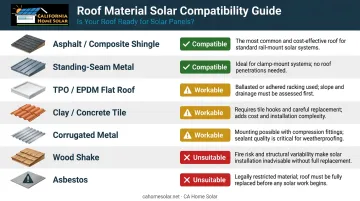
In Los Angeles County, wood shake is already restricted under City Roofing Ordinance #165047, which has limited its use since 1989, making it less of an issue than in other regions.
Roof Age and Structural Condition
A roof nearing the end of its life creates a specific financial problem: panels must come off when the roof is replaced. According to EnergySage, that removal and reinstallation runs $1,500–$6,000 in additional labor costs.
General age thresholds to work from:
- 0–5 years old — ideal, proceed with solar
- 5–15 years old — typically fine, get an inspection first
- 15–20+ years old — evaluate for replacement before solar
On structural load: NREL's Solar Ready Buildings Planning Guide puts typical rooftop PV dead load at 3–6 lb/sq ft. Most residential roofs are built to handle far more than that, but homes with unknown structural history or visible damage warrant a professional load verification.
Roof Orientation and Pitch
South-facing is optimal — it captures the most sunlight in the northern hemisphere. But east and west aren't deal-breakers. EnergySage data shows east-west systems typically lose 10–15% versus a perfect south-facing installation, meaning they still deliver meaningful production.
For pitch, the ideal range for Southern California is around 15–40 degrees, with 30 degrees cited as optimal for the region. Outside that range:
- Very flat roofs — tilted racking systems orient panels south at the correct angle; an 18-degree pitch loses only about 2% versus the ideal 30 degrees
- Steep roofs — workable up to roughly 55–60 degrees with appropriate hardware; true exclusions are uncommon
Shading and Obstructions
Shading impact depends on where shade falls, how long it lasts, and what inverter technology handles it — a partially shaded roof isn't automatically disqualifying.
Common shade sources in LA neighborhoods: mature trees, neighboring two-story homes, rooftop water heaters, HVAC equipment, and chimneys.
Microinverters (like Enphase) and DC power optimizers (like SolarEdge) operate at the individual panel level. NREL testbed research found module-level electronics recovered 25–35% of shade losses compared to traditional string inverter setups — so if your roof has moderate shading, inverter choice changes the math considerably.
That said, shading assessment isn't a single snapshot. Installers evaluate across all seasons, since winter sun angles are significantly lower and shift shade patterns from trees and adjacent buildings.
Available Usable Roof Space
Most residential systems need 16–23 panels, and each panel takes up roughly 21 sq ft of roof space. That works out to approximately 336–483 sq ft of panel footprint before accounting for required setbacks.
California's 2022 Residential Code (R324.6) requires pathways and setbacks for emergency roof access — typically 3-foot clearance zones from roof edges. Dormers, vents, skylights, and chimneys further reduce buildable area. The number that matters is usable, code-compliant space, not total roof square footage.
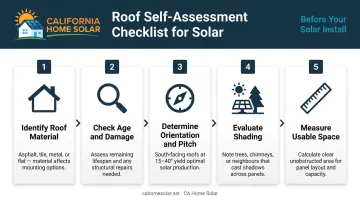
How to Assess Your Roof Yourself (Step-by-Step)
Use this checklist to get a clear picture of your roof before your first consultation — you'll save time and ask better questions.
Identify your roof material and cross-reference it against the compatibility table above. Not sure what you have? A free consultation with a solar installer or roofer will confirm it quickly.
Check for age and damage. Look for warning signs that may require repair before installation:
- Curling, cracking, or missing shingles
- Sagging roof lines or soft spots
- Water stains on interior ceilings
- Daylight visible through the attic
Determine orientation and pitch. Pull up Google Maps satellite view and identify which direction your main roof plane faces. A compass app works too. For pitch, a phone inclinometer app gives a fast estimate. North-facing is the one orientation that significantly limits your options.
Evaluate shading throughout the day. Walk outside (or use Google Earth) and observe your roof at morning, midday, and late afternoon. Do this in winter if you can — shade patterns shift when the sun is lower. Trees and neighboring structures matter more than most homeowners expect.
Measure your usable roof space. Use Google Earth's measurement tool or a tape measure to outline clear, rectangular sections. Then subtract:
- 3-foot setback zones from all edges
- Area around vents, chimneys, skylights, and dormers
What remains is your buildable area.
How to Read Your Results
After working through the five factors, most homeowners land in one of three scenarios.
Ready to Go
Your roof is solar-ready if it checks these boxes:
- Compatible material (asphalt, metal, or flat membrane)
- Under 15 years old and no signs of damage
- Predominantly south- or west-facing
- Minimal shading during peak hours
- 336+ sq ft of usable, unobstructed space
Next step: Schedule a formal site assessment to get a system design and quote.
Borderline — Needs Minor Preparation
These situations don't block solar but require some planning:
- Roof has 8–12 years of remaining life (an installer may recommend waiting or replacing first)
- Moderate shading that requires a microinverter-based system design
- Pitch outside the ideal range but still within workable limits
Next step: Consult both a roofer and a solar installer to weigh the cost difference between starting now versus replacing the roof first.
Needs Significant Work or Alternative Solutions
More intervention required when:
- Roof is 20+ years old or shows structural compromise
- Material is wood shake, damaged clay tile, or asbestos-containing
- Heavy all-day shading on all viable roof planes
Two options worth considering:
- Replace the roof and install solar simultaneously. This is usually the most cost-effective approach, since roofing and installation labor can be combined into a single mobilization.
- Ground-mounted solar, if the property has available space — though this is less common on denser Southern California lots due to zoning and setback constraints.
A Note on Southern California's Solar Case
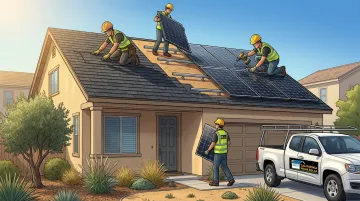
Even for borderline roofs, the financial case in Southern California is concrete. SCE's tiered rates reach 40 cents/kWh for Tier 2 usage, and LADWP's top tier hits $0.389/kWh. Combined with the 30% federal Investment Tax Credit (available for systems installed through December 31, 2025), a bundled roof replacement and solar installation often make more financial sense than waiting. Get a professional assessment before ruling yourself out.
Common Misconceptions
"My roof faces east or west, so solar won't work." East and west arrays typically produce 85–90% of what a south-facing system generates. For homeowners paying SCE or LADWP rates, that's still substantial savings. The only way to know your specific output is a production estimate based on your actual roof geometry and shading.
"My roof is too flat or too steep." Flat roofs use tilted racking to achieve the correct angle — they're entirely workable. Steep roofs remain viable up to about 55–60 degrees. Actual exclusions based on pitch alone are rare.
"Solar panels will damage my roof." Professionally installed panels — with proper flashing and waterproofing — don't cause leaks. Research from UCSD found that panels actually reduce heat transfer through the roof surface, lowering daytime ceiling temperatures by up to 2.5°C. The material beneath the panels is shielded from UV and weather, which can extend its life.
One thing that matters regardless of your roof type: verify your installer holds the correct California licenses before any work begins.
- C-46 Solar Contractor license — required for solar installation
- C-39 Roofing Contractor license — required for any roofing work
- When both are combined in one project, both classifications should be covered
- Verify any contractor at CSLB's online license lookup or call (800) 321-CSLB
When to Get a Professional Roof + Solar Assessment
Self-assessment has clear limits. Get a professional evaluation if any of these apply:
- Your home was built before 1980 with unknown structural history
- You see any sagging, visible rot, or interior water damage
- You have clay or concrete tile (requires specialized hardware and careful handling)
- You want to combine a roof replacement with solar installation for maximum value
A professional combined assessment typically covers:
- Roof condition and remaining lifespan
- Structural load verification
- Shading analysis using software tools
- System design based on actual roof geometry
- Permit coordination with the local Authority Having Jurisdiction
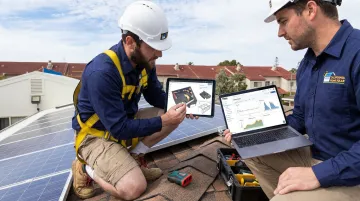
LA-area permitting timelines are something experienced local installers navigate regularly.
CA Home Solar has 36 years of experience serving Southern California and handles both roofing and solar installation in-house. For homeowners who need a roof replacement before going solar, working with a single licensed contractor for both projects eliminates the coordination headache of managing multiple vendors and timelines.
As a HERO Registered Contractor, CA Home Solar can also help homeowners access HERO PACE financing (a zero-down option billed through property taxes) to fund a combined roof and solar project without large upfront costs.
Frequently Asked Questions
What type of roof is not good for solar panels?
Wood shake, thatch, and asbestos-containing roofs are generally unsuitable — wood shake due to fire code restrictions (especially in LA's fire hazard zones), asbestos due to hazardous material handling requirements. Clay and concrete tile can work but require specialized mounting hardware and careful handling. Any structurally compromised roof needs repair or replacement before installation, regardless of material type.
How do I know if my roof is strong enough to hold solar panels?
Most residential roofs handle far more than the 3–6 lb/sq ft that panels add. A professional installer or structural engineer can confirm load capacity for your specific structure. Specifically consult a structural engineer for pre-1950 homes, homes with visible structural damage, or manufactured homes.
Does the direction my roof faces affect solar panel output?
Yes, but east and west roofs remain viable. South-facing roofs produce the most energy in North America, but east-west arrays typically generate 85–90% of that output — enough to substantially offset utility bills at SCE or LADWP rates. North-facing is the only orientation that significantly limits feasibility.
Can I install solar panels on an older roof?
Roofs 15–20+ years old should be evaluated carefully. If a roof needs replacing within the next few years, removing and reinstalling panels adds $1,500–$6,000 in labor costs. Replacing the roof and installing solar simultaneously is often the more cost-effective long-term approach.
What happens if I need a new roof after solar panels are already installed?
Panels must be temporarily removed before reroofing, which adds labor cost. Storm damage may be covered by homeowner's insurance, so check your policy before assuming out-of-pocket costs.
How much roof space do I need for a residential solar system in Southern California?
Most residential systems use 16–23 panels at roughly 21 sq ft each, requiring approximately 336–483 sq ft of panel footprint. Setback requirements, vents, chimneys, and shading all reduce the buildable area from that figure. A site assessment determines the exact usable space and resulting system size.