Here's the reality: Los Angeles sits at roughly 34°N latitude, and the vast majority of standard residential roofs in the area fall within an excellent range for solar production. Whether your roof is a modest 4:12 or a steeper 10:12, you're likely closer to optimal than you think.
This guide covers the optimal pitch for SoCal homes, how orientation factors in, what NREL's own modeling shows about real-world efficiency at different pitches, and what to do if your roof isn't perfectly angled.
Key Takeaways
- The optimal tilt for Southern California solar is 30–34°, matching a 6:12 to 8:12 roof pitch
- Most SoCal roofs (4:12 to 12:12) produce 97–100% of maximum possible output with standard flush-mount installation
- Orientation matters as much as pitch—south-facing is ideal; north-facing loses roughly half its potential output
- Tilted racking systems make flat roofs fully viable for solar installation
- Under California's NEM 3.0, using the power you generate beats exporting excess kWh to the grid
What Is Roof Pitch and Why Does It Matter for Solar?
Roof pitch describes the slope of your roof as a rise-over-run ratio. A 4:12 pitch, for example, rises 4 inches for every 12 inches of horizontal distance. Roofers use that ratio; solar engineers convert it to an angle in degrees.
Quick pitch-to-degrees reference:
| Pitch | Angle |
|---|---|
| 2:12 | 9.5° |
| 4:12 | 18.4° |
| 6:12 | 26.6° |
| 8:12 | 33.7° |
| 10:12 | 39.8° |
| 12:12 | 45.0° |
Why does angle matter? Solar panels generate the most electricity when sunlight strikes them as close to perpendicular as possible. As the angle of incidence increases—meaning light hits more obliquely—output drops according to the cosine of that angle. In Southern California's sunny climate, this effect is far more manageable than in cloudier regions.
Pitch alone doesn't determine performance, though. A well-pitched roof facing north will underperform a slightly sub-optimal pitch facing south. The two variables work together — and both matter when sizing a system for your home.
The Best Roof Pitch for Solar in Southern California
Los Angeles sits at 34.05°N latitude, making the theoretically optimal fixed tilt angle roughly 33–34°—which corresponds to an 8:12 roof pitch (33.7°). This is the well-known "match your latitude" rule, and NREL's PVWatts modeling for the LA area backs it up directly.
What the Data Actually Shows
Using PVWatts with a 1 kW south-facing fixed array in Los Angeles, here's how common roof pitches compare in annual output:
| Roof Pitch | Tilt | Annual Output (kWh/kW) | % of Optimal |
|---|---|---|---|
| Flat | 0° | 1,488 | 87.3% |
| 2:12 | 9.5° | 1,600 | 93.9% |
| 4:12 | 18.4° | 1,669 | 97.9% |
| 6:12 | 26.6° | 1,701 | 99.8% |
| 8:12 | 33.7° | 1,705 | 100.0% |
| 10:12 | 39.8° | 1,690 | 99.2% |
| 12:12 | 45.0° | 1,665 | 97.7% |
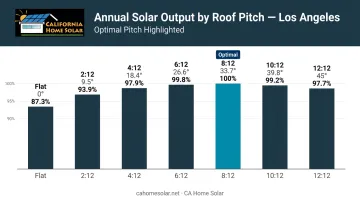
The spread from 4:12 to 12:12 is only about 2.3 percentage points. In LA's climate—averaging 5.6 kWh/m²/day of solar resource according to NASA POWER data—even a "less than perfect" pitch delivers excellent results. Shading, orientation, and equipment choice have far more impact than whether you're at 6:12 versus 8:12.
Pitch efficiency is just one piece of the picture, though. How California's billing policy treats your exported energy can matter just as much.
Seasonal Tilt and NEM 3.0 Considerations
The sun tracks lower in winter (~49° optimal) and higher in summer (~19° optimal). A fixed installation at latitude pitch balances both seasons effectively.
Under California's NEM 3.0 Net Billing Tariff (which applies to interconnection applications submitted after April 15, 2023), export compensation is now based on avoided-cost rates rather than retail rates. This shifts the priority from maximizing total annual kWh to maximizing self-consumption, particularly during peak rate hours (4–9 PM for most SoCal utilities). A slightly lower tilt favoring summer output can improve alignment with afternoon AC usage — worth discussing with your installer before finalizing your system design.
How Roof Orientation Works Alongside Pitch
Orientation determines when your panels receive sunlight; pitch determines how directly that light hits them. In Southern California, the combination drives your actual bill savings.
South-Facing: The Gold Standard
South-facing roofs (azimuth ~180°) receive the most consistent daily sun in the Northern Hemisphere. PVWatts modeling for Los Angeles at 34° tilt confirms this:
| Direction | Annual Output (kWh/kW) | % of South-Facing |
|---|---|---|
| South | 1,704 | 100% |
| West | 1,420 | 83.3% |
| East | 1,310 | 76.9% |
| North | 895 | 52.5% |
Here's what the numbers mean for your roof:
- West-facing arrays underperform south by about 17%, but peak output in the late afternoon aligns with SCE and SDG&E rate windows of 4–9 PM. Paired with a battery, that timing advantage offsets the lower annual kWh.
- East-facing roofs favor morning generation and produce roughly 77% of south-facing output at this tilt.
- North-facing planes lose nearly half their potential output and aren't recommended as a primary installation surface in Southern California.
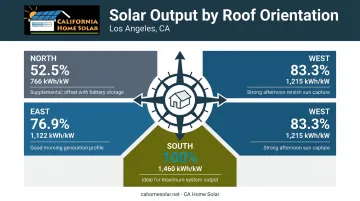
Many SoCal homes have multi-plane roofs combining south and west — or south and east — sections. A split-array across those planes lets you optimize for both peak daily output and afternoon rate-period generation, which matters especially under time-of-use billing.
Solar Installation Options for Every Roof Pitch
No matter what pitch your Southern California home has, there's a viable solar solution. The approach varies — flat roofs, steep pitches, and everything in between each call for a different setup. CA Home Solar has designed systems across every roof type throughout Southern California over 36 years of installations.
Flat and Low-Slope Roofs (0:12 to 3:12)
Flat roofs require tilted racking systems to achieve a useful angle—typically 10–20°. PVWatts shows flat arrays at 87.3% of optimal, and 2:12 roofs at 93.9%, so production is meaningful but does depend on proper racking.
Two common approaches:
- Ballasted systems — weighted frames with no roof penetrations; common on commercial flat roofs
- Mechanically attached tilt racking — anchored to the roof structure; better for higher-wind areas
Flat roofs appear frequently on commercial buildings and modern residential properties throughout Southern California. CA Home Solar has completed flat-roof installations across the LA area, including projects in Hollywood.
Racking typically represents roughly 3% of total installed cost. Tilted racking adds somewhat more than flush-mount hardware, so factor that into quotes—but it doesn't change the overall cost-benefit of going solar.
Standard Pitch Roofs (4:12 to 9:12)
This is the most common range for Southern California residential homes and the best-case scenario for solar. Key advantages:
- Flush-mount installation is sufficient—no special racking needed
- Production runs 97.9–99.8% of theoretical maximum
- Installation costs are straightforward
- Budget is better spent on panel quality and inverter technology
If your roof falls in this range, skip the pitch research and focus your budget on panel efficiency and inverter quality — that's where the real gains are.
Steep Pitch Roofs (10:12 and Above)
Steep roofs are frequently misunderstood. PVWatts shows 10:12 at 99.2% and 12:12 at 97.7% of optimal—so production isn't the problem. The real considerations are:
- Installation requires additional safety equipment and staging, which increases labor costs
- Steep roofs do self-clean better (rain sheds debris more efficiently)
- Above 14:12, rooftop installation becomes impractical for most crews
For homes with very steep pitches, CA Home Solar offers ground-mount solar as an alternative. Ground-mounted systems can be positioned at the exact optimal angle regardless of roof characteristics, are easier to maintain, and benefit from natural air circulation that keeps panels cooler and more efficient.
Tips for Maximizing Solar Production Regardless of Roof Pitch
Add Panels vs. Add Tilt Racking
For most SoCal homeowners with 4:12 to 10:12 pitches, the math on this is straightforward. PVWatts estimates roughly 1,704 kWh/year per kW DC at optimal tilt in Los Angeles. A 400W panel adds approximately 682 kWh/year in additional production.
California's average installed cost runs about $2.53/W according to EnergySage marketplace data, with LBNL's 2024 Tracking the Sun report placing residential system costs between $3.20/W and $5.50/W at the 20th to 80th percentile. Against those economics, adding one or two panels almost always beats spending on adjustable racking to recover a fraction of a percent in efficiency.
Microinverters and DC Power Optimizers
These module-level power electronics minimize production losses on imperfect roofs:
- Each panel operates independently, so shading or angle variations on one panel don't drag down the whole string
- NREL research shows string inverter mismatch losses average around 2%, while microinverters and DC optimizers reduce that to essentially 0%
- Especially valuable on multi-plane roofs where panels face different directions
CA Home Solar works with Enphase IQ8 microinverters and SolarEdge power optimizers. Enphase IQ8 suits roofs with moderate shading or mixed orientations; SolarEdge optimizers are a good fit when string wiring is preferred but panel-level control is still needed.
Use PVWatts Before Committing
The NREL PVWatts Calculator is free and genuinely useful. Enter your specific address, roof pitch, and orientation, and it returns a reliable annual production estimate. Run it for each usable roof plane before your installer visit—it gives you a concrete baseline and makes the design conversation much more productive.
Conclusion
For Southern California homeowners, the ideal roof pitch for solar lands around 30–34° (roughly 6:12 to 8:12). But given LA's exceptional solar resource, pitches from 4:12 to 12:12 all deliver strong returns—the difference between a "perfect" 8:12 and a "good" 5:12 is less than 2.5% in annual output.
Pitch is just one variable. These factors often have equal or greater impact on your system's performance:
- Roof orientation (south-facing vs. east/west split)
- Panel quality and inverter selection
- Shading from trees, chimneys, or neighboring structures
- System design aligned to your TOU rate schedule and NEM 3.0 self-consumption goals
If your pitch isn't textbook-perfect, a well-designed system can still deliver excellent returns.
Ready to find out exactly what your roof can do? California Home Solar has been installing solar systems across the Los Angeles area for 36 years and holds Top 500 Solar Contractor recognition from Solar Power World. Their team evaluates your roof pitch, orientation, and shading together—so your system is sized and designed around how you actually use energy, not just how your roof looks on paper.
Schedule a free consultation: 877-903-1012 | info@cahomesolar.com
Frequently Asked Questions
Is a 5/12 roof pitch good for solar panels?
A 5:12 pitch (about 22.6°) is very good for solar in Southern California. It falls within a few degrees of the latitude-optimal angle and typically produces around 96–98% of maximum possible output with a standard south-facing flush-mount installation. Tilt upgrades are unnecessary for most homeowners at this pitch.
What is the optimal roof pitch for solar panels in Southern California?
For the Los Angeles area at ~34°N latitude, the optimal pitch is approximately 8:12 (33.7°), closely followed by 6:12 (26.6°). Both produce nearly identical annual output. Pitches from 4:12 to 10:12 all fall within an excellent production range and require no pitch-related modifications.
Does roof orientation matter as much as roof pitch for solar efficiency?
Orientation is equally important—and often more impactful than pitch. PVWatts modeling for LA shows that a north-facing roof at ideal pitch produces only 52.5% of south-facing output at the same tilt. A slightly off-pitch south-facing roof will consistently outperform a perfectly pitched north-facing roof.
Can solar panels be installed on a flat roof?
Yes. Flat roofs use ballasted or mechanically attached tilted racking systems that angle panels between 10° and 30°. This adds some installation cost but allows full control over panel angle and is common on commercial buildings and modern homes throughout Southern California.
What roof pitch is too steep for solar panels?
Pitches above 12:12 (45°) still produce strong solar output—PVWatts puts 12:12 at 97.7% of optimal—but require specialized safety equipment that raises installation costs. Above roughly 14:12, a ground-mount system is usually a more practical and cost-effective alternative.
How do I find out what pitch my roof is?
Three easy methods: check your home's architectural or inspection documents, use a smartphone pitch-measuring app, or hold a level against an attic rafter and read the vertical rise over a 12-inch run. Any professional installer will also measure your pitch during their site assessment.