Introduction
Commercial electricity rates in Southern California aren't getting cheaper. According to EIA 2024 utility data, SCE customers pay an average of 23.09 cents/kWh for commercial power, while LADWP commercial customers pay 21.95 cents/kWh — and California's three largest IOUs saw rates climb roughly 50% between 2019 and 2023. For businesses running large HVAC systems, refrigeration, or production equipment, that trajectory makes energy cost management a genuine operational priority.
Solar adoption is accelerating as a result. The U.S. commercial segment installed 2,345 MWdc in 2025, up 6% year-over-year, as more businesses lock in predictable energy costs before rates climb further.
Not all solar systems perform the same way under LA's conditions. Real-world output depends on factors specific to this region:
- Intense summer heat reducing panel efficiency at peak hours
- Strong solar irradiance that rewards high-efficiency modules
- Urban rooftops with partial shading from adjacent structures
- Roof orientation, load profile, and applicable California incentives
This guide covers the top energy-efficient solar systems for businesses in 2026 and the key factors to evaluate before you commit.
Key Takeaways
- Commercial solar can significantly reduce electricity bills for Southern California businesses facing some of the highest utility rates in the U.S.
- Top systems for 2026: SunPower Maxeon 6 COM, REC Alpha Pro M, Silfab SIL-500 HM, and Q CELLS Q.PEAK DUO XL-G11S
- The federal ITC covers up to 30% of system cost — plus a 10-point Domestic Content Bonus for qualifying projects
- Panel efficiency and temperature coefficient matter as much as price, particularly during LA summers
- Choosing an experienced local installer shapes long-term system performance as much as panel brand does
Why Businesses Are Going Solar in 2026
The Financial Case Is Stronger Than Ever
California's commercial electricity rates aren't just high — they're rising faster than almost anywhere else in the country. LBNL data shows the state's three largest IOUs averaged 2.0 cents/kWh in annual rate growth, the second-highest among all states. For businesses on SCE or LADWP, that compounds quickly across a 25-year asset life.
Solar functions as a rate hedge. Once a system is installed and paid off, the energy it generates costs nothing — regardless of what utility rates do next year or the year after.
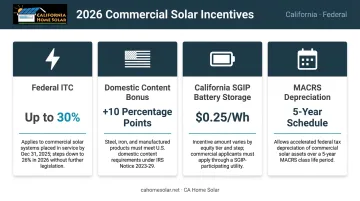
Key Incentives Driving 2026 Adoption
| Incentive | Amount | Key Condition |
|---|---|---|
| Federal ITC (Section 48E/48) | Up to 30% of system cost | Prevailing wage and apprenticeship rules must be met, or an exception applies |
| Domestic Content Bonus | +10 percentage points | Domestic content and PWA requirements met; manufactured-product threshold is 50% in 2026 |
| California SGIP (battery storage) | $0.25/Wh (or $0.18/Wh with ITC) | Large-Scale Storage Step 5; limited statewide funding remaining |
| MACRS Depreciation | 5-year accelerated schedule | For qualifying clean energy property placed in service after Dec. 31, 2024 |
Two details worth confirming before you model any project:
- Utility territory: SCE customers fall under CPUC's Net Billing Tariff — export credits are calculated at avoided-cost values, which run lower than import rates. LADWP operates its own NEM program for systems up to 1 MW-AC CEC with different credit rules.
- SGIP urgency: Large-Scale Storage Step 5 had only $6.88 million statewide remaining as of May 30, 2026. Businesses interested in battery incentives should confirm current availability before committing to a project timeline.
2026 is a meaningful window for several converging reasons. ITC percentages are tied to prevailing wage compliance requirements that add project complexity; panel efficiency gains now translate to faster payback periods than even five years ago; and at 2.0 cents/kWh annual rate growth, every year of delay means a higher baseline to hedge against.
Best Energy Efficient Solar Systems for Businesses in 2026
In Southern California, temperature performance matters as much as rated efficiency. Summer heat in the San Fernando Valley, Inland LA County, and the San Gabriel Valley can push rooftop temperatures well above the 25°C standard test conditions — costing businesses measurable output from panels that look identical on spec sheets.
Each system below was evaluated on real-world efficiency in high-heat climates, manufacturer stability, warranty coverage, commercial suitability, and compatibility with 2026 federal and California incentives.
SunPower Maxeon 6 COM
Best for: Businesses with limited roof space that need maximum output per square foot
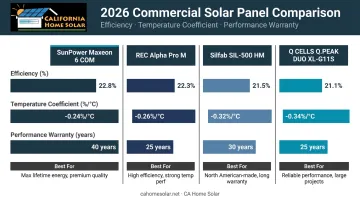
SunPower's Maxeon line has a well-documented efficiency track record in commercial solar. The Maxeon 6 COM (450–475 W) achieves up to 22.3% module efficiency — among the highest available for commercial panels in 2026.
What makes Maxeon different is the cell architecture. The copper-backed cell design eliminates the solder points where conventional panels typically degrade first, resulting in a maximum annual degradation rate of just 0.25% — roughly half of standard panels. Over 25 years, that difference in output retention is substantial.
| Spec | Maxeon 6 COM |
|---|---|
| Efficiency | Up to 22.3% |
| Temperature Coefficient (Pmax) | -0.29%/°C |
| Product Warranty | 40 years (with authorized installer) |
| Performance Warranty | 40 years, max 0.25%/year degradation |
| Best For | Space-constrained commercial rooftops |
One diligence note: Maxeon Solar Technologies is currently undergoing restructuring proceedings. Supply availability and warranty support should be confirmed directly with your installer before committing to this panel.
REC Alpha Pro M
Best for: Commercial buildings in high-heat locations — San Fernando Valley, Pasadena, Inland LA County
REC Group's commercial-grade panel is the Alpha Pro M — the verified C&I product reaching 640 Wp, designed for commercial and industrial rooftop and ground-mount systems.
The Alpha Pro M uses heterojunction (HJT) cell technology, which delivers better energy yield in hot conditions compared to standard PERC panels. HJT panels maintain more of their rated output as temperatures climb, which matters for LA-area buildings that bake through July and August.
| Spec | REC Alpha Pro M |
|---|---|
| Power Output | Up to 640 Wp |
| Performance Warranty | 25 years, 0.25%/year max degradation |
| Minimum Power at Year 25 | 92% |
| Product Warranty | 20 years |
| Best For | High-heat commercial rooftops and ground-mount |
REC Group is now owned by Reliance New Energy Solar (a Reliance Industries subsidiary), with operational headquarters in Singapore.
Silfab SIL-500 HM
Best for: Businesses pursuing maximum federal tax incentives on ground-mount systems
Silfab is a panel manufacturer with verified North American production across Burlington, Washington; Toronto, Canada; and a planned Fort Mill, South Carolina facility with 1 GW cell and 1.3 GW module capacity. That production base makes Silfab panels a strong candidate for the 10% Domestic Content Bonus under the IRA, which can stack on top of the 30% ITC for qualifying projects.
For a $500,000 commercial system, that potential 10-point adder represents $50,000 in additional tax credits — enough to offset premium panel costs meaningfully.
| Spec | Silfab SIL-500 HM |
|---|---|
| Module Efficiency | 21.0% |
| Temperature Coefficient (Pmax) | -0.36%/°C |
| Product Warranty | 25 years |
| Performance Warranty | 30-year linear guarantee, min. 82.6% at year 30 |
| Best For | Ground-mount commercial; IRA domestic content bonus projects |
Important: domestic content qualification is project-level and requires taxpayer certification. Silfab's manufacturing profile supports the diligence process — it doesn't automatically guarantee a project qualifies. Verify with your tax advisor and installer.
Q CELLS Q.PEAK DUO XL-G11S
Best for: Urban commercial rooftops with shading; large-scale projects where cost efficiency drives ROI
The Q.PEAK DUO XL-G11S series (580–605 Wp) uses half-cut PERC cell technology, which improves performance when parts of the array are shaded. That's a practical advantage for urban commercial rooftops with HVAC equipment, parapets, or neighboring structures blocking part of the array.
Q CELLS (a Hanwha company) manufactures at scale in the U.S., with combined capacity of 8.4 GW across two Georgia facilities — in Dalton and Cartersville.
The Q.PEAK DUO XL-G11S.3/BFG earned 2025 Kiwa PVEL Top Performer status in Thermal Cycling, Damp Heat, and Mechanical Stress Sequence testing, providing independent validation of real-world durability.
| Spec | Q.PEAK DUO XL-G11S |
|---|---|
| Efficiency | Up to 21.7% |
| Temperature Coefficient (Pmax) | -0.34%/K |
| Product Warranty | 12 years |
| Performance Warranty | 30 years, max 0.45%/year degradation after year 1 |
| First-Year Output | 98% of nominal power |
| Best For | Urban rooftops with shading; large cost-efficient installations |
What to Look for in a Commercial Solar System
Efficiency and Temperature Coefficient
Efficiency tells you how much power a panel generates per square foot — critical when roof space is limited. But in Southern California, temperature coefficient (Pmax) is equally important.
Every panel loses output as it heats up. The Pmax coefficient tells you how much output drops per degree Celsius above 25°C. Looking at the panels above:
- Maxeon 6 COM: -0.29%/°C (best of the group)
- REC Alpha Pro M (HJT): -0.25%/°C range
- Q CELLS Q.PEAK DUO: -0.34%/K
- Silfab SIL-500 HM: -0.36%/°C
For commercial buildings in the San Fernando Valley or Inland LA County — where summer temperatures regularly push past 100°F — panels with coefficients closer to -0.25% to -0.30%/°C will outperform lower-rated options on the hottest days of the year.
Panel Type: Monofacial vs. Bifacial
- Monofacial panels capture light from one side and work well for standard pitched or flat roof mounts
- Bifacial panels capture reflected light from below as well — they deliver meaningful additional yield on ground-mount systems or installations over reflective surfaces like white membrane roofs or gravel
NREL research on bifacial performance shows annual energy gains of 6% for PERC bifacial and 9% for HJT bifacial in tracked ground-mount configurations. For flush commercial rooftops, the gain is minimal.
Warranty Terms
Two warranties matter for a 25+ year asset:
- Product (workmanship) warranty: Covers manufacturing defects. Ranges from 12 years (Q CELLS) to 40 years (Maxeon). Longer terms reduce replacement risk.
- Performance (power output) warranty: Guarantees minimum output over time. The 2026 premium standard is 25–30 years with degradation rates under 0.45%/year.
Degradation rate is worth scrutinizing: a panel warrantied at 0.25%/year versus 0.45%/year produces measurably more power in year 20, which translates directly to energy savings.
System Components Beyond the Panel
Panels alone don't determine system performance. The full system matters:
- Inverters: String inverters work well for unshaded rooftops. Microinverters (like Enphase IQ) or power optimizers (SolarEdge) recover 23–35% of shading losses on partially obstructed commercial rooftops, per NREL testing
- Battery storage: SGIP incentives apply to battery additions — Step 5 is $0.25/Wh (or $0.18/Wh if ITC is claimed). Given limited statewide funding, systems planned for storage should prioritize early applications
Installer Experience and Local Knowledge
The best panels underperform with poor system design or incorrect installation. For commercial projects, this matters more than it does for residential work. Roof load calculations, three-phase inverter sizing, utility interconnection under SCE Rule 21 or LADWP's Type 1/2/3 process, and permitting timelines all require local expertise.
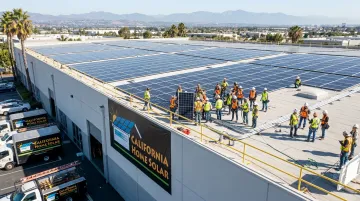
California Home Solar is a Top 500 Solar Contractor with 36 years of commercial installation experience across Southern California, including projects like a 240 kW commercial system in Pacoima. Each commercial project gets a dedicated project manager who handles the full process: permitting, utility interconnection, meter coordination, and activation.
How We Chose the Best Systems
Systems were evaluated on five criteria:
- Real-world efficiency in high-heat conditions — efficiency rating and temperature coefficient under Southern California operating conditions
- Manufacturer financial stability — corporate status, production capacity, and supply continuity risk
- Warranty coverage — both product and performance terms relative to a 25+ year asset life
- Incentive compatibility — eligibility for the federal ITC, potential domestic content bonus, and SGIP battery incentives
- Commercial installation suitability — available in commercial wattages, compatible with string inverters and microinverters, verified for C&I applications
The most common mistake businesses make when evaluating solar systems is comparing efficiency ratings in isolation. A panel that's 22% efficient but carries a -0.40%/°C temperature coefficient will produce less power on an August afternoon than a 21% panel rated at -0.29%/°C. Beyond heat performance, total installed cost — including inverters, racking, permitting, and balance-of-system components — determines actual ROI, not panel price per watt alone.
The practical takeaway: the system that fits your load profile, roof layout, and tax position will outperform a higher-spec system that doesn't.
Conclusion
For Southern California businesses evaluating solar in 2026, three factors should drive the decision: how well the technology performs in local heat conditions, how well the warranties protect a 25+ year investment, and how effectively the system qualifies for available incentives.
Each panel on this list serves a different commercial profile:
- Maxeon — leads on efficiency and low degradation over the system's lifetime
- REC Alpha Pro M — purpose-built for high-heat environments like Southern California summers
- Silfab — strongest domestic content case for larger ground-mount projects
- Q CELLS — reliable performance and cost efficiency at scale, especially on shaded urban rooftops
Before comparing spec sheets, focus on total installed cost, projected energy savings at your actual utility rate, and payback period specific to your building. A site-specific assessment produces those numbers — no generic estimate will account for your roof orientation, local utility rate structure, and shade profile.
CA Home Solar — a Solar Power World Top 500 Solar Contractor serving Southern California for 36 years — provides free commercial facility assessments and walks businesses through every phase from panel selection to utility activation. Call 877-903-1012 or email info@cahomesolar.com to schedule yours.
Frequently Asked Questions
What are the best energy efficient solar systems for businesses?
The top-performing commercial systems in 2026 use monocrystalline high-efficiency (SunPower Maxeon), heterojunction HJT (REC Alpha Pro M), or large-format PERC (Q CELLS, Silfab) technology. The best fit depends on your roof configuration, energy load, budget, and applicable incentives — a commercial solar installer can assess your specific situation.
Can I write off solar as a business expense?
Businesses can claim up to 30% of system cost through the federal Investment Tax Credit under the Inflation Reduction Act (prevailing wage rules apply), plus MACRS accelerated depreciation over 5 years. Consult a tax professional for guidance specific to your business's tax position.
What is the typical payback period for a commercial solar system?
Payback timelines vary by system size, utility territory, and available incentives — Southern California's high electricity rates and strong solar irradiance often improve payback versus other regions. A site-specific financial assessment gives you the most accurate projection.
What size solar system does my business need?
System size is based on your monthly electricity consumption (kWh), available roof or ground space, and peak demand. A qualified installer reviews your utility bills and site conditions to determine the right system size accurately.
What solar incentives are available for businesses in California?
Key incentives include the 30% federal ITC, 10% Domestic Content Bonus, California SGIP battery storage credits ($0.25/Wh at Step 5), MACRS depreciation, and NEM/Net Billing Tariff compensation. Availability and amounts change, so verify current terms at the time of installation.
How long does commercial solar installation take?
A typical commercial installation in California takes 8–16 weeks from site assessment to activation, covering design, permitting, utility interconnection approval (SCE Rule 21 Fast Track is typically 15 business days per review phase), physical installation, and final inspection. Timeline varies by system size and local permitting workload.