According to the U.S. Department of Energy, solar PV systems typically last 25–35 years. Your roof needs to match that lifespan. If it doesn't, you're either paying to remove and reinstall panels during a future roof replacement, or watching your system underperform on a compromised surface.
This guide walks Southern California homeowners through a complete roof assessment — covering structural load, orientation, pitch, shading, and material compatibility — so you know exactly where you stand before committing to an installation.
Key Takeaways
- A solar-ready roof needs five things: structural soundness, south-facing orientation, a pitch between 15–40 degrees, minimal shading, and a compatible roofing material.
- Roofs older than 15–20 years should be inspected before installation, since replacing panels mid-roof-life adds significant labor costs.
- Three assessment methods exist — DIY visual inspection, online tools, and professional inspection — each suited to a different stage of the process.
- Catching roof issues before installation avoids costly mid-project delays and rework.
What You Need Before Assessing Your Roof for Solar
Before starting any assessment, gather three pieces of basic documentation:
- Roof age — check original building permits, your home inspection report, or HOA records
- Roofing material type — asphalt, tile, metal, or other; this affects mounting method and installation cost
- Any prior structural or roofing reports — previous inspection findings can flag known issues before a contractor arrives
These basics inform every step that follows. When California Home Solar contractors conduct an initial consultation, having this documentation on hand lets them scope the right system before the site survey even begins.
Tools for a DIY Visual Inspection
You don't need to get on the roof. Most of this assessment can be done from the ground or attic:
- Binoculars — scan shingles from ground level without climbing
- Compass or smartphone app — confirm which roof faces are south-, east-, or west-facing
- Tape measure or laser distance tool — estimate available roof area
- Flashlight — essential for attic inspection
Only assess on a clear, dry day. Ground-level and attic checks are safer and sufficient for most homeowners — no climbing required.
Key Factors That Determine If Your Roof Is Solar-Ready
Solar installers evaluate five factors on every professional assessment. Homeowners can pre-screen these same factors before scheduling a formal inspection.
Roof Age and Condition
Solar panels last 25–35 years. Your roof should have comparable life remaining. Here's how common roofing materials stack up, according to GAF's roofing FAQ:
| Material | Expected Lifespan |
|---|---|
| Asphalt shingles | 20–30 years |
| Metal roofing | 50+ years |
| Clay/concrete tile | 50–100 years |
| Cedar shake | ~30–40 years |
Asphalt shingles carry the highest replacement risk. If your home has them and the roof is approaching 20 years old, it warrants a close look before you commit to solar.
Visual signs of a roof nearing end-of-life:
- Missing, cracked, or curling shingles
- Granule buildup in gutters (asphalt shingle degradation)
- Visible sagging along the ridgeline
- Water stains or mold visible from the attic interior
The SEIA's residential solar guide is clear: if you're planning to replace your roof soon, do it before installing solar. Most installers won't touch a roof with fewer than 10 years of useful life remaining.
Roof Orientation and Pitch
In the Northern Hemisphere, south-facing roofs receive the most direct sunlight year-round. SEIA notes that due-north roofs in the U.S. generally don't receive enough direct sunlight to make installation worthwhile.
East- and west-facing roofs are workable, though they typically produce less than an optimally oriented south-facing setup. If your home's best roof section faces east or west, that's worth noting upfront.
Pitch matters too. The DOE identifies a slope of 15–40 degrees as the optimal range for solar efficiency. Roofs outside this range can still support panels using tilt-adjusted mounting hardware, though some output may be lost.
Use a compass app to identify your roof's primary orientation. Most smartphone compass apps are accurate enough for a preliminary check; just point it toward the roof plane, not the front door.
Shading and Obstructions
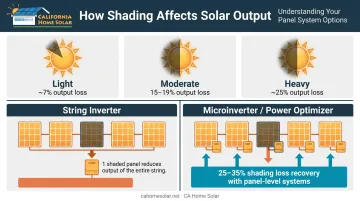
Shading is one of the most underestimated factors in roof assessments. NREL's shading testbed research categorizes annual shading losses as:
- Light shading: ~7% annual irradiance reduction
- Moderate shading: 15–19% reduction
- Heavy shading: ~25% reduction
The inverter type determines how much of that loss you can recover. With string inverters, shading on one panel pulls down the output of the entire string. Microinverters and power optimizers let each panel operate independently. NREL research shows these panel-level systems typically recover 25–35% of shading losses compared to string inverters.
Walk the property and identify potential shade sources: mature trees, chimneys, HVAC equipment, neighboring structures. Check them in the morning, midday, and afternoon; shadows shift significantly by season. A roof that looks clear in July may be heavily shaded in December when the sun sits lower in the sky.
Roofing Material Compatibility
| Material | Solar Compatibility | Notes |
|---|---|---|
| Asphalt shingles | Excellent | Standard flashed mounts; most common installation |
| Standing seam metal | Excellent | Non-penetrating clamp mounts (S-5! system) — no roof penetration needed |
| Concrete/clay tile | Compatible | Requires specialized brackets (e.g., IronRidge All Tile Hook) |
| Wood shake | Not recommended | Fire susceptibility; CAL FIRE recommends Class A roof assemblies |
| Flat/built-up roofs | Viable | Ballasted mounts; common for commercial applications |
Southern California homes predominantly use tile or asphalt. Both work well with solar; tile just requires additional mounting hardware and slightly more labor.
Structural Load Capacity
Most standard residential solar arrays weigh ≤4 psf, which falls within simplified review thresholds used by both NREL and LA County structural criteria. LA County's baseline loads assume 10 psf for non-tile assemblies and 20 psf for tile; solar addition stays well under these figures in most cases.
Where it gets complicated is aging or compromised structures. Even when the load math looks fine, these conditions may require reinforcement before installation:
- Damaged or undersized rafters
- Multiple stacked shingle layers adding dead load
- Soft or deteriorating roof decking
- Prior water damage affecting structural members
This evaluation requires an attic inspection, not just a look at the roof surface.
How to Assess Your Roof: Three Practical Methods
The most accurate assessment combines all three approaches. Each method has a different purpose and different limitations.
Method 1: DIY Visual Inspection
Purpose: Screen for obvious issues before spending time or money on professional evaluation.
Steps:
- Ground-level scan — Use binoculars to examine shingles for missing pieces, cracks, or curling edges. Check gutters for granule buildup. Look for sagging ridgelines or uneven surfaces.
- Orientation check — Open your compass app and identify which roof faces are south, east, or west. Note the approximate pitch by observing the slope relative to known dimensions.
- Attic inspection — Enter the attic with a flashlight and scan rafters and decking for water stains, mold, rot, or cracked structural members. This step is frequently skipped and frequently where the real problems hide.
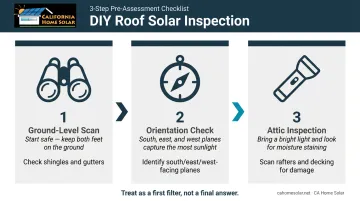
Limitations: Can't reveal precise load capacity, hidden structural compromise, or accurate seasonal shading patterns. Treat it as a first filter, not a final answer.
Method 2: Online Solar Assessment Tools
Purpose: Get data-backed ballpark estimates on solar potential, orientation, and annual output without a site visit.
Recommended tools:
- Google Project Sunroof — Enter your address for an estimated solar potential score, system size recommendation, and production estimate based on local irradiance data
- NREL PVWatts Calculator — Industry-standard tool that estimates grid-connected PV system energy production; useful for confirming orientation and pitch assumptions
Both tools use satellite imagery to flag tree canopy and building shadows across different seasons. Review the shading analysis output carefully — it's one of the most useful things these tools provide.
Limitations: Satellite imagery can be outdated. Neither tool assesses structural integrity, roof material condition, or attic framing. Use them to build context, not to make a final decision.
Method 3: Professional Roof and Solar Inspection
Purpose: Definitive assessment that confirms solar readiness, identifies required repairs, and produces documentation needed for permitting.
What happens during a professional inspection:
- A contractor assesses roof surface condition, material type, and estimated remaining lifespan — and recommends whether installation can proceed or roof work is needed first.
- Solar design software (such as Aurora Solar, which uses LiDAR-based shade analysis validated by NREL) models panel placement, seasonal shading impact, and projected annual output for your specific address.
- If the roof's load-bearing capacity requires verification beyond standard simplified review, a licensed structural engineer may provide a formal sign-off letter — often required for permitting in LA County jurisdictions.
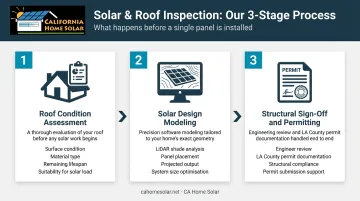
For Southern California homeowners, working with a contractor that handles both roofing and solar in one visit cuts out the back-and-forth coordination. California Home Solar's process covers the site survey, structural review (when needed), design, and permitting as part of a single project — and the initial consultation is free. If you're serious about going solar, this is where to start.
How to Interpret Your Roof Assessment Results
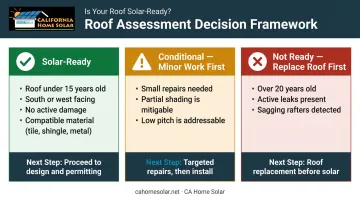
Assessment results generally fall into three categories. Each calls for a different next step.
Solar-Ready — Proceed with Installation
Your roof qualifies when:
- It's under 15 years old with no visible structural damage
- It faces south or west with minimal shade obstructions
- Attic framing shows no signs of water intrusion or rot
- Material is asphalt, tile, or metal
Next step: Move to solar system design and permitting.
Needs Minor Work First — Conditional Readiness
Moderate concerns that don't require full replacement:
- One or two damaged shingles or minor granule loss
- A partially shaded section that microinverters can mitigate
- Slightly low pitch addressable with tilt mounts
Next step: Complete targeted repairs before installation. This is much cheaper than removing panels later.
Not Ready — Roof Replacement Recommended
Red flags that indicate roof-first action:
- Roof is over 20 years old (especially asphalt)
- Multiple shingle layers present
- Active leaks or water stains visible in attic
- Sagging rafters or structurally compromised framing
Installing solar on a failing roof is a costly mistake. When the roof eventually needs replacement, the entire panel system must be removed and reinstalled — adding thousands in labor. Coordinating both projects with a single contractor like California Home Solar cuts permitting complexity, limits disruption, and avoids paying twice for the same labor.
When Roof-Mounted Solar Isn't Viable
Some roofs aren't suitable regardless of repairs: north-facing only, structural failure beyond repair, or wood shake that can't meet fire safety requirements. In these cases, ground-mounted solar is the practical alternative. California Home Solar installs ground-mount systems throughout the LA area for exactly these situations. Properties with adequate yard space can often outperform rooftop arrays, since panels can be positioned at the ideal angle regardless of roof orientation.
Common Mistakes to Avoid
- Skipping the attic inspection — water damage and rotten rafters aren't visible from the outside. This is where projects get halted mid-installation.
- Assuming orientation from the front door — roof orientation and home orientation are different. Always use a compass.
- Evaluating shading only in summer — a clear roof in July can be heavily shaded in December when the sun sits much lower — NREL confirms that seasonal variation in solar radiation is substantial.
- Prioritizing installation speed over roof condition — installing on a roof with five years of life left creates a guaranteed future expense. The cost of repairs now is almost always lower than removal and reinstallation later.
Safety Tips for Roof Assessment
A roof assessment doesn't require you to climb up and take risks. Follow these precautions to keep the process safe:
- Stay off the roof — NRCA guidance is clear: steep-slope inspections can be performed from the ground or from a ladder at the roof edge. For most homeowners, this is both sufficient and far safer than climbing up.
- Prepare before entering the attic — ensure ventilation, bring a high-lumen flashlight, and check for pest activity or active mold before spending time inside.
- Avoid midday heat in summer — Southern California rooftops radiate significant heat from late morning through early afternoon. Early morning is the safest window for any roof-adjacent work.
- Leave structural evaluation to professionals — DIY inspection is a screening tool. Any structural sign-off required for LA County or Orange County permitting must come from a licensed roofing contractor or structural engineer.
Conclusion
A thorough roof assessment covers age, orientation, pitch, shading, and material — each factor feeding into whether your roof is ready now, needs work first, or should be replaced alongside your solar install. A DIY walkthrough gets you started. Online tools add data. A professional inspection closes the loop.
The homeowners who avoid costly mid-project surprises are the ones who complete this assessment before signing anything. Knowing your roof's condition upfront gives you real options: proceed immediately, make targeted repairs first, or coordinate a roof-and-solar project as one combined job. If you're in Southern California and want both assessments handled by one contractor, California Home Solar manages roofing and solar installation together — so nothing falls through the cracks before or after installation.
Frequently Asked Questions
How do I know if my roof is strong enough for solar panels?
NREL and LA County structural criteria both use ≤4 psf as the threshold for PV system weight under standard residential review. Most homes handle this without reinforcement. A professional inspection (and sometimes a structural engineer's sign-off) confirms whether your specific framing qualifies.
What roof pitch is ideal for solar panels?
The DOE identifies 15–40 degrees as the optimal pitch range for solar efficiency. Roofs outside this range can still work with tilt-adjusted mounting hardware, though output may be slightly reduced depending on how far off the range falls.
How old can my roof be before it's too old for solar panels?
The standard installer guideline is to avoid solar on any roof with fewer than 10 years of useful life remaining. Asphalt roofs approaching 20 years old should be inspected and likely replaced before installation, since removing and reinstalling panels later adds significant cost.
What roofing materials are compatible with solar panels?
Asphalt shingles, metal (especially standing seam), and concrete or clay tile are all compatible. Tile requires specialized mounting brackets. Wood shake is generally not recommended due to fire susceptibility and CAL FIRE's Class A roofing standards.
Can I install solar panels on a shaded roof?
Partial shading reduces output, but the impact depends on your inverter type. Microinverters let each panel operate independently, limiting shading losses; string inverters make the entire system vulnerable to one shaded panel. Heavy or all-day shading typically makes a roof section unsuitable.
Should I replace my roof before installing solar panels?
Yes, if the roof has fewer than 10 years of life remaining. Bundling roof replacement and solar installation together from the start is far more cost-effective than scheduling them separately.