The federal government offers a tax credit to offset the cost of upgrading to energy-efficient windows. But many homeowners either miss it entirely or claim less than they're entitled to, usually because they bought the wrong product, skipped a certification check, or lacked the required documentation at tax time.
This guide covers how the Energy Efficient Home Improvement Credit works for windows, what determines your savings, and how Southern California homeowners can layer federal credits with utility rebates and financing programs to get the most from a window upgrade project.
Key Takeaways
- The federal credit covers 30% of qualifying window product costs, capped at $600 per year for windows and skylights
- Windows must meet ENERGY STAR Most Efficient certification — standard ENERGY STAR does not qualify
- Starting in 2025, a Qualified Manufacturer Identification Number (QMID) must appear on your tax return
- The $600 window credit falls under a broader $1,200 annual limit; credits reset every year through December 31, 2032 with no lifetime cap
- Southern California homeowners can stack the federal credit with utility rebates (LADWP, SCE) and PACE/HERO financing to cut out-of-pocket costs significantly
How Window Upgrade Costs Add Up — And What the Credit Actually Offsets
Window replacement isn't a minor expense. National data from Angi puts the average full-project cost at $7,351, with a typical range of $3,438–$11,839. Per window, expect to pay $300–$2,100, with a national average around $850.
What the 30% Credit Actually Covers
- The credit covers 30% of product cost only — not the full project cost
- For windows specifically, the credit is capped at $600 per year
- On a $5,000 window project, your maximum federal benefit is $600, not $1,500
The credit won't erase your project cost, but it does provide a meaningful offset — particularly when combined with utility rebates or state-level programs.
The Nonrefundable Limitation
This credit is nonrefundable, which matters more than most people expect. It reduces your federal tax liability dollar-for-dollar, but it cannot generate a refund beyond what you owe. If your total federal tax bill is $400 and your credit is $600, you get $400 back — the remaining $200 is forfeited.
Unlike some credits, the unused portion does not carry forward to the next tax year. If your annual federal tax bill typically falls below $600, consider confirming your projected liability with a tax professional before timing a window replacement around this credit.
What Determines How Much You Can Claim
Five eligibility factors determine whether you can claim this credit. Miss any one of them and the credit disappears, no matter how efficient your windows actually are.
ENERGY STAR Most Efficient Certification (Not Just ENERGY STAR)
This is the most common disqualifying mistake. Standard ENERGY STAR-labeled windows do not qualify. The IRS specifically requires ENERGY STAR Most Efficient certification.
Marketing language like "high performance," "premium efficiency," or "triple-pane technology" means nothing for tax credit eligibility. The window either appears on the ENERGY STAR Most Efficient certified models list, or it doesn't.
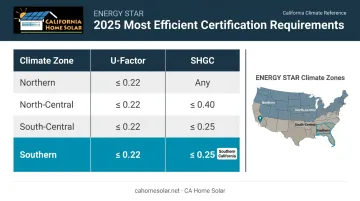
The 2025 Most Efficient criteria are strict. For the Southern zone (which covers much of Southern California):
| Climate Zone | U-Factor | SHGC |
|---|---|---|
| Northern | ≤ 0.20 | ≥ 0.20 |
| North-Central | ≤ 0.20 | ≤ 0.40 |
| South-Central | ≤ 0.20 | ≤ 0.23 |
| Southern | ≤ 0.21 | ≤ 0.23 (or U=0.22 with SHGC ≤ 0.21) |
Climate Zone Verification
ENERGY STAR's Climate Zone Finder lets you confirm which performance specs apply to your specific county. A window model that qualifies in one zone may not qualify in another — zone verification is not optional.
Primary Residence Requirement
The credit applies only to an existing home that serves as your principal residence. Vacation homes, rental properties, and second homes are excluded for windows specifically. You must own and live in the home where the windows are installed.
The 2025 QMID Requirement
Beyond residency, there's a documentation requirement that catches many homeowners off guard. For windows installed in 2025, your tax return must include a valid QMID — a four-character alphanumeric Qualified Manufacturer Identification Number. This number comes from manufacturers who have registered with the IRS as "qualified manufacturers."
If your manufacturer hasn't registered or can't provide this number, you cannot claim the credit. Confirm the QMID in writing before signing any contract.
What Costs Count
Only the product cost of qualifying windows applies to the 30% credit calculation. Labor and installation costs for building envelope components like windows are not eligible under current IRS rules. Ask your contractor for an itemized quote that separates materials from installation. You'll need that breakdown when calculating your credit.
Strategies to Maximize Your Total Savings
Homeowners who plan ahead consistently capture more value than those who treat the credit as an afterthought. The strategies below fall into three categories.
Smart Purchase Decisions
Verify before you buy, not after. Use the NFRC Certified Products Directory with the product's CPD number to confirm the window is certified for your California climate zone. NFRC detail pages show U-factor, SHGC, and whether the product meets standard ENERGY STAR or ENERGY STAR Most Efficient requirements — look for the Most Efficient designation specifically.
Get the QMID in writing. Before signing any contract for 2025 installations, ask the manufacturer or your contractor for the four-character QMID. If they can't provide it, the credit is off the table regardless of what the window achieves in performance.
Right-size your project to the cap. Since the window credit maxes out at $600 regardless of total spend, there's no tax credit benefit to spending $15,000 on windows versus $5,000 in a single year. Consider phasing larger replacement projects across multiple tax years.
Combining Credits Across Tax Years
The Energy Efficient Home Improvement Credit has no lifetime dollar limit — it resets annually. This creates planning opportunities:
- Year one: Replace windows and add insulation or air sealing to reach the $1,200 envelope cap ($600 windows + up to $600 for other envelope improvements)
- Year two: Install a qualifying heat pump or heat pump water heater for up to $2,000 in additional credits
- In the same year: Add a home energy audit (up to $150 credit) to identify all qualifying improvements and establish documentation for each
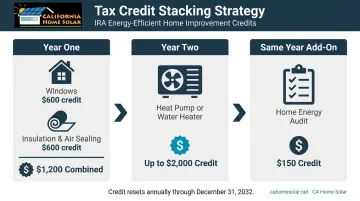
This multi-year approach can yield far more total credits than replacing everything at once, since single-year projects often push spend past any one cap.
Important note: Current IRS guidance states this credit applies to qualifying property placed in service through December 31, 2025. Verify current law before planning projects into 2026.
California-Specific Programs
Three local programs are worth stacking alongside your federal credit:
- LADWP rebate: LADWP's Consumer Rebate Program pays $2 per square foot for qualifying ENERGY STAR windows (U-factor ≤ 0.30, SHGC ≤ 0.25). Applications must be postmarked within 12 months of purchase; new construction and ADUs are excluded.
- Federal credit interaction: The IRS reduces your qualified cost basis when rebates function as purchase price adjustments. Many utility rebates like LADWP's are structured differently and may not reduce your federal credit — but the distinction has real tax implications. Consult a tax professional before finalizing your calculation.
- PACE financing: Property Assessed Clean Energy financing covers energy-efficient improvements with no money down, repaid through property tax assessments over 5–25 years. California Home Solar is a HERO Registered Contractor, meaning installations can be financed through the HERO program. Be aware that PACE creates a lien on your property, which can affect future sale or refinancing — review the California DFPI's consumer guidance before committing.
How to Claim the Energy-Efficient Windows Tax Credit
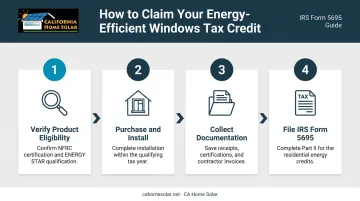
Claiming the credit takes four steps — and most of the work happens before you file:
- Verify product eligibility — Confirm ENERGY STAR Most Efficient certification via the NFRC CPD database and ENERGY STAR's climate zone tool before purchase
- Purchase and install qualifying windows in the tax year you intend to claim
- Collect all documentation — purchase receipts, manufacturer certification statement, QMID (for 2025 installations), and installation records
- File IRS Form 5695, Part II with your federal return for the year the windows were placed in service
Documentation to Keep
You don't submit these records with your return, but keep them in case of an audit:
- Purchase receipts with itemized product costs
- Manufacturer's certification statement
- QMID (2025 and later)
- ENERGY STAR label and NFRC documentation
- Installation completion date records
Timing Matters
The credit applies in the tax year the windows are installed — not when they're ordered or paid for. One day's difference can shift the credit to the following tax year. If you're scheduling a late November or December installation, confirm with your installer that the job wraps up before December 31.
Once you've locked in your installation date and gathered your paperwork, filing Form 5695 is the final step to put that credit to work.
Conclusion
Two things determine whether you actually capture this credit: choosing the right products upfront and planning your upgrade timeline deliberately. Homeowners who verify ENERGY STAR Most Efficient certification and obtain the QMID before signing a contract avoid the most common disqualifying errors. Those who plan across tax years extract more total value from a credit that resets annually.
The federal credit works best as one piece of a stacking strategy — and Southern California homeowners have strong options to layer. Combining programs can cut your out-of-pocket cost well beyond what any single incentive delivers on its own:
- Federal tax credit: Up to $600 per year for qualifying windows
- LADWP rebate: $2/sq ft for eligible replacements in the LADWP service area
- PACE financing: Covers upfront costs with repayment tied to your property tax bill, available through HERO Registered Contractors like CA Home Solar
Working with a contractor who knows each program's requirements is the simplest way to make sure none of that value gets left on the table.
Frequently Asked Questions
How do I know if my windows qualify for the tax credit?
Windows must meet ENERGY STAR Most Efficient certification (not standard ENERGY STAR) for your specific climate zone, and the manufacturer must be registered with the IRS and able to provide a valid QMID. Verify eligibility using the NFRC Certified Products Directory with your window's CPD number before purchase.
What home improvements qualify for energy credits?
Two main tracks exist: the Energy Efficient Home Improvement Credit (Section 25C) covers windows, doors, insulation, heat pumps, and water heaters up to $3,200 annually; and the Residential Clean Energy Credit (Section 48) covers solar panels, geothermal heat pumps, and battery storage at 30% with no annual dollar cap.
Does the energy-efficient windows tax credit carry over if I don't owe enough taxes?
No. The credit is nonrefundable and does not carry forward. If your tax liability is less than the credit amount, the unused portion is forfeited for that year. Confirming your estimated tax liability before scheduling a large window project helps you time the purchase to maximize the benefit.
Can I claim the federal window tax credit and also receive a California utility rebate?
Generally yes — both programs can be pursued. However, rebates classified as purchase price reductions (rather than taxable income) lower the qualified cost basis used to calculate the federal credit, which reduces your credit amount. Ask your utility provider how your rebate is classified before filing.
Do window installation labor costs count toward the energy-efficient home improvement credit?
No. For building envelope components including windows, skylights, and exterior doors, only the product cost qualifies. Labor and installation costs are excluded from the credit calculation for these items — unlike heat pumps and other residential energy property where installation costs may be included.