Introduction
Your Southern California home doesn't need a harsh winter to waste energy through its windows. According to the U.S. Department of Energy, heat gain and heat loss through windows account for 25–30% of residential heating and cooling energy use — and in a region where air conditioning runs nearly year-round, that number hits differently than it does in Minnesota.
SoCal's real window problem isn't drafts on cold nights. It's afternoon sun hammering west-facing glass in July, forcing your AC to work overtime while you wonder why your Edison bill keeps climbing. Older single-pane windows — still common in pre-1990s homes throughout the LA basin and Orange County — make that heat load far worse, with little to stop radiant gain before it reaches your living room.
This guide walks through what SoCal homeowners actually need: how to read window efficiency ratings, which specs matter for our climate, what replacement costs look like, and how to use current incentives to reduce what you pay out of pocket.
Key Takeaways
- Windows account for 25–30% of home heating and cooling energy loss — old or single-pane windows are a major culprit
- In Southern California, prioritize low SHGC (≤ 0.23) — blocking solar heat gain reduces cooling costs far more than improving cold-weather insulation
- Look for the NFRC label and ENERGY STAR Most Efficient certification matched to the Southern climate zone
- ENERGY STAR certified windows may qualify for a 30% federal tax credit up to $600/year through 2032
- Even the best-rated windows underperform with poor installation — verify your contractor is licensed and experienced with energy-efficient upgrades
Why Your Windows Are Costing You More Than You Think
Two Ways Windows Drain Your Wallet
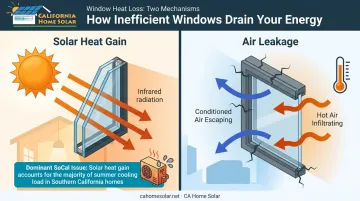
Inefficient windows drive up energy bills through two distinct mechanisms:
- Solar heat gain : sunlight passes through glass as infrared radiation, raising indoor temperatures and forcing your AC to compensate
- Air leakage — gaps and failed seals around frames let conditioned air escape and hot outside air infiltrate
Both matter, but in Southern California, solar heat gain is typically the bigger problem. Unlike homeowners in Chicago who are fighting to keep heat in, SoCal homeowners are mostly fighting to keep heat out — and older windows lose that battle badly.
Warning Signs Your Windows Need Replacing
Check for these indicators that your windows are underperforming:
- Foggy or condensation between panes — this means the gas seal has failed and insulating performance has dropped significantly
- Warm glass on sunny afternoons — glass that's hot to the touch is transferring solar heat directly into your home
- Drafts near the frame with windows fully closed
- Difficulty opening or closing the sash
- Faded furniture or flooring near windows, indicating high UV transmission
- Visible damage, rot, or deterioration on the frame itself
The Single-Pane Problem
Pre-1990s homes throughout Los Angeles and Orange County commonly still have single-pane aluminum-framed windows — and these are far less efficient than modern options. According to the U.S. Department of Energy, double glazing reduces heat loss by more than 50% compared with single glazing — a gap that explains why homeowners upgrading from single-pane to double-pane see the biggest energy and comfort gains.
What Makes a Replacement Window Energy Efficient?
Window Glass: The Most Important Factor
Double-pane vs. triple-pane: The air (or gas) space between panes acts as an insulating barrier. Double-pane is the standard for most SoCal homes and performs well in our climate. Triple-pane offers the highest performance — better noise reduction and maximum insulation — but at a premium cost that's harder to justify in a mild coastal climate than in a northern state.
Low-E coatings are a thin metallic layer applied to glass that reflects infrared heat while still transmitting visible light. There are two types:
- Hard-coat Low-E: Applied during manufacturing; durable, scratch-resistant, often with a slight blue tint
- Soft-coat Low-E: Applied in a vacuum chamber using silver, zinc, or tin; more delicate but enables more precise solar control
For west- and south-facing windows in California, Guardian Glass notes that Low-E applied to surface #2 (the inner face of the outer pane) is preferred in warm climates because it reflects solar energy before it enters the glazing. CA Home Solar typically recommends soft-coat Low-E for sun-exposed orientations, where tighter solar control delivers the most measurable cooling benefit.
Gas fills determine how well the space between panes resists heat transfer:
- Argon: Most common and cost-effective; the DOE notes it performs well in standard ½-inch spaces
- Krypton: Used in thinner triple-pane units where tighter spacing requires a more thermally efficient gas
Window Frame Materials
| Frame Material | Efficiency | Key Consideration |
|---|---|---|
| Vinyl | Good | Multi-chambered frames insulate well; low maintenance; most popular in SoCal |
| Fiberglass | Excellent | Best thermal resistance; dimensionally stable; premium price |
| Wood | Good | Naturally insulating; requires maintenance; suited for historic or upscale homes |
| Aluminum (standard) | Poor | Conducts heat rapidly — LBNL reports aluminum conductivity ~160 W/(m·K) vs. ~0.17 for vinyl; only acceptable with a thermal break |
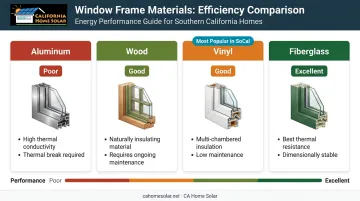
If your home has original aluminum-framed windows without a thermal break — common throughout Southern California — that's a clear case for replacement.
Window Style and Air Sealing
The way a window opens affects how well it seals:
- Fixed/picture windows — most airtight; no operable sash means no gaps
- Casement and awning windows — the sash compresses against the frame when closed, creating a tighter seal than sliding designs
- Double-hung and sliding windows — inherently more prone to air leakage over time due to their sliding mechanism; an LBNL study of 192 newly installed residential windows found 40% exceeded air leakage standards, with operating design as the most critical determinant
How to Read Energy Performance Labels
The NFRC Label
Every credible energy-efficient window carries an NFRC (National Fenestration Rating Council) label. This independent certification lets you compare products from different manufacturers using the same verified standards. If a window doesn't carry an NFRC label, its energy performance claims are unverified — skip it.
Key Metrics to Know
The NFRC label reports three core numbers. Here's what each one means and what to target in Southern California:
| Metric | What It Measures | Southern CA Target |
|---|---|---|
| U-Factor | Rate of non-solar heat transfer (insulation value) | Lower is better; ≤ 0.32 for ENERGY STAR |
| SHGC | Fraction of solar radiation entering the home | Focus here first — lower blocks more heat |
| Visible Transmittance (VT) | Amount of natural light passing through (0–1 scale) | Higher = brighter rooms; Low-E coatings reduce this slightly |
The SHGC is the number Southern California homeowners should prioritize — keeping solar heat out matters far more here than retaining warmth. Low-E coatings reduce VT somewhat, so discuss the solar control vs. daylight tradeoff with your installer.
ENERGY STAR Climate Zones
Those metrics don't exist in a vacuum — ENERGY STAR evaluates them against zone-specific thresholds, not a single national standard. Most of Southern California falls in the Southern climate zone.
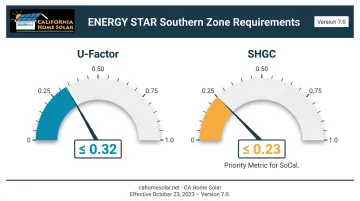
Under ENERGY STAR Version 7.0 (effective October 23, 2023), the Southern zone criteria are:
- U-factor ≤ 0.32
- SHGC ≤ 0.23
Use the ENERGY STAR Climate Zone Finder to confirm your specific city's zone before shopping.
One critical note: The federal 25C tax credit requires ENERGY STAR Most Efficient certification — a stricter standard than base ENERGY STAR. Confirm a product meets "Most Efficient" criteria before assuming it qualifies for the credit.
Choosing the Right Windows for Southern California
Your Climate Priority: SHGC First
Unlike homeowners in colder regions who prioritize U-factor above all else, Southern California homeowners should lead with SHGC. The goal is blocking the solar radiation that drives up indoor temperatures and AC runtime from April through October — and often well into November along the coast.
For most LA and Orange County homes, look for:
- SHGC ≤ 0.23 (current ENERGY STAR Southern zone requirement)
- U-factor ≤ 0.32
These are the minimums for ENERGY STAR certification. Higher-performing products will beat these numbers — ask your contractor specifically about products certified for the Southern zone, not just any ENERGY STAR label.
Orientation Strategy
Not every window in your home has the same exposure or the same need:
- South- and west-facing windows — these receive the strongest afternoon sun and deserve the best solar-control Low-E glass available; prioritize the lowest SHGC here
- East-facing windows — morning sun is less intense but still meaningful; good solar control glass is still worthwhile
- North-facing windows — receive minimal direct sun; focus here shifts toward U-factor and gas fill quality rather than solar control coatings
Insert vs. Full-Frame Replacement
Two replacement approaches exist, with meaningful differences in cost and scope:
Insert (pocket) replacement:
- New window fits into the existing frame
- Faster installation, less disruption, lower cost
- Appropriate when the existing frame is structurally sound
Full-frame replacement:
- Removes everything down to the rough opening
- Higher cost and more involved installation
- Necessary when frames show rot, damage, or significant deterioration
- Allows adding insulation around the frame opening, which reduces thermal bridging and improves overall frame performance
Choosing between insert and full-frame isn't always obvious from the outside — frame condition, local code requirements, and your home's orientation all factor in. California Home Solar's team has been making these assessments across Los Angeles and Orange County for 36 years and can walk you through the right fit for your home.
The Real Cost and Savings of Energy-Efficient Windows
What to Budget
Current consumer estimates put installed replacement window costs at $300–$2,100 per window, with an average around $850–$1,000 depending on size, frame material, and glass package. Whole-home replacement for a typical SoCal house with 15–20 windows could run anywhere from $10,000 to $30,000+ depending on specifications. Get at least three quotes from licensed contractors.
For context, the 2025 JLC Cost vs. Value Report puts vinyl window replacement at a $22,073 average job cost with $16,657 in resale value recouped — a 76% return — making windows one of the stronger home improvement investments from a resale standpoint.
Energy Savings
ENERGY STAR data shows certified windows save an average of up to 13% on annual household energy bills nationwide when replacing older windows. ENERGY STAR also publishes city-specific savings estimates for California cities including Los Angeles, which may better reflect local utility rates.
Homeowners upgrading from single-pane windows typically see the largest savings — the efficiency gap between single-pane and quality double-pane Low-E is substantial.
Beyond the Energy Bill
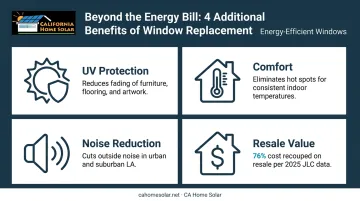
Financial ROI is only part of the picture. Replacement windows also deliver:
- Reduces UV fading of furniture, flooring, and artwork
- Eliminates hot spots for more consistent indoor temperatures
- Cuts outside noise — a real advantage in urban and suburban LA
- Increases resale value, as the JLC data above shows buyers pay more for updated windows
Payback timelines vary based on your starting point, local utility rates, and how many windows you replace — but single-pane homes generally see the fastest returns.
Tax Credits, Rebates & Financing Options
Federal Tax Credit (25C)
ENERGY STAR Most Efficient certified windows qualify for the Energy Efficient Home Improvement Credit (25C):
- 30% of the product cost (installation labor excluded)
- Capped at $600 per year for windows and skylights
- Available for qualifying improvements through 2032
- Non-refundable — reduces your tax owed, not a cash refund
Keep your ENERGY STAR Most Efficient certification and NFRC label documentation. Consult a tax professional for your specific situation.
California Utility Rebates
Current SCE and SoCalGas programs did not list standalone residential window rebates at the time of this research — rebate availability changes frequently. Use the ENERGY STAR Rebate Finder with your ZIP code to find current local incentives before applying.
PACE Financing
When rebates aren't available, PACE financing can bridge the gap. Property Assessed Clean Energy (PACE) loans cover energy-efficient upgrades with no money down — repayment is added to your property tax bill over time.
CA Home Solar works with PACE financing partners to offer options such as:
- No upfront cost — project funded immediately, repaid through property taxes
- Flexible terms from 5 to 25 years
- Fixed interest rates set at the time of approval
Note: The original HERO program (WRCOG HERO and California HERO) became inactive in 2020–2021 per California Treasurer records. Contact CA Home Solar directly to confirm which PACE programs are currently active for your project.
Frequently Asked Questions
Are energy-efficient replacement windows tax deductible?
ENERGY STAR Most Efficient certified windows qualify for a federal tax credit — not a deduction — equal to 30% of product costs, capped at $600 per year through 2032 under the 25C Energy Efficient Home Improvement Credit. Consult a tax professional for your situation.
Can I get a grant to upgrade my windows?
Direct grants for window replacement are uncommon for most homeowners. However, the federal 25C tax credit, California utility rebates (where available), and PACE financing programs can significantly reduce the upfront cost. Check the ENERGY STAR Rebate Finder for currently active local programs in your ZIP code.
Are energy-efficient windows worth the cost?
For most homeowners (especially those with single-pane or aging windows), yes. Energy savings, UV protection, improved comfort, noise reduction, and increased resale value typically justify the cost — and current tax credits reduce what you pay out of pocket.
What is the most energy-efficient replacement window?
Fixed/picture windows are the most airtight since they don't open. Among operable styles, casement and awning windows outperform double-hung designs because of their compression seal. For glass, triple-pane with Low-E coating and argon fill delivers peak performance, though double-pane Low-E is the practical standard for most Southern California homes.
What U-factor and SHGC should I look for in Southern California?
Target SHGC ≤ 0.23 and U-factor ≤ 0.32 to meet current ENERGY STAR Southern zone criteria (Version 7.0). SHGC is the priority in SoCal's hot climate. Confirm your city's ENERGY STAR climate zone using the Climate Zone Finder.
How do I know when it's time to replace my windows?
Key signs include: foggy condensation between panes, drafts with windows fully closed, difficulty opening or closing, noticeably hot glass on sunny afternoons, visible frame rot or damage, and significant fading of nearby furniture or flooring. Any of these points to a window that's no longer doing its job.