The installation type you choose determines where and how panels are physically deployed, which directly shapes your system's energy yield, upfront cost, structural demands, and long-term ROI. Get it right and you have a system that performs for 25+ years. Get it wrong and you're looking at underperforming output or expensive retrofits down the road.
This guide covers the three primary solar PV installation types — rooftop, ground-mount, and BIPV — how they differ, and which fits different homes and goals across the Los Angeles and Southern California region.
Key Takeaways
- Installation type defines how panels are mounted, not what they're made of — it directly affects output, cost, and fit.
- The three options: rooftop (most common), ground-mount (best for open land), BIPV (integrated into the building itself).
- Rooftop suits most homeowners on budget; ground-mount wins on output flexibility; BIPV prioritizes aesthetics over efficiency.
- The right choice depends on roof condition, orientation, available land, budget, and local HOA rules.
- Get a site assessment before committing — roof condition, shading, and lot size all change the answer.
What Are Solar PV Installation Types?
Solar PV installation type refers to the method and location used to physically mount and integrate solar panels onto or into a property. It determines panel tilt, orientation, structural load, and how the system connects to the grid.
Installation type is a separate decision from panel type. Monocrystalline, polycrystalline, and thin-film describe the technology inside the module. Installation type describes where and how the system is physically deployed — a choice made before panel selection even begins.
The distinction matters because installation type is a foundational choice. SEIA defines distributed solar as systems located "on rooftops or ground-mounted," while NREL defines BIPV as solar cells installed directly into the building envelope — serving as the outer layer of the structure itself.
This decision has lasting consequences. A poor match between property and installation type creates problems that are costly to reverse:
- Mounting panels on a deteriorating roof that needs replacement within a few years
- Choosing BIPV where conventional rooftop would deliver 30% more output
- Installing ground-mount where no viable land exists
Types of Solar PV Installations
The three primary installation types each serve different property configurations, energy goals, and budgets. Understanding what separates them prevents homeowners from defaulting to whichever option they've seen most often.
Rooftop Solar
Rooftop solar mounts photovoltaic panels directly onto an existing roof structure using racking systems. Panels capture sunlight and feed electricity into the home's electrical panel — the most widely used residential installation method.
Two sub-types exist:
- Pitched roof mounts — rail-and-clamp systems attached to rafters; standard for most California homes with angled roofs
- Flat roof mounts — ballasted systems that use weight rather than roof penetration; more common on commercial buildings
Best suited for: Homeowners with south- or west-facing roofs in good condition, adequate unshaded space, and no imminent roof replacement planned. According to LBNL's 2024 Tracking the Sun report, 56% of 2023 residential systems faced south and 23% faced west — the two orientations that perform best in Southern California's climate.
Key strengths:
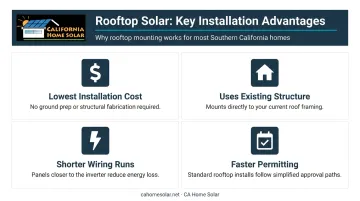
- Lowest installation cost among the three types
- Uses existing structure — no additional land required
- Shorter wiring runs between panels and inverter reduce DC losses
- Typically faster permitting than ground-mount
Limitations:
- Energy output is capped by roof orientation and pitch — a poorly oriented roof can't be corrected after installation
- Roof condition directly affects feasibility; the NRCA states PV-ready roofs should have service lives that match or exceed the solar system's lifespan
- Shading from trees, chimneys, or neighboring structures reduces output
- Expansion capacity is constrained by available roof area
One practical advantage for homeowners working with California Home Solar: the company handles both roofing and solar installation, meaning a roof in poor condition can be repaired or replaced before panels go up — avoiding the costly scenario of removing and reinstalling a system years later.
Ground-Mount Solar
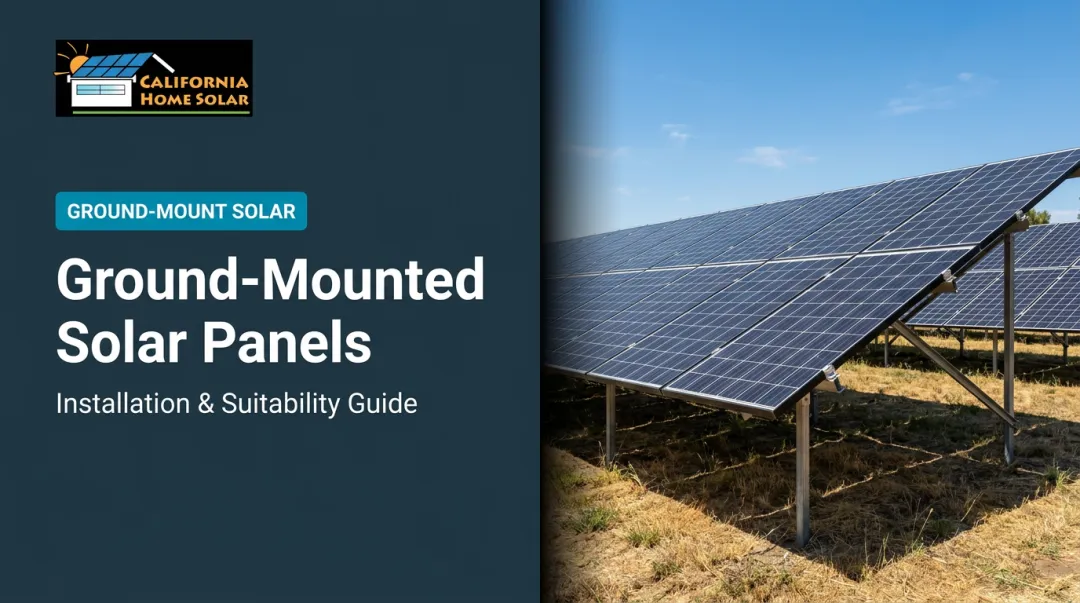
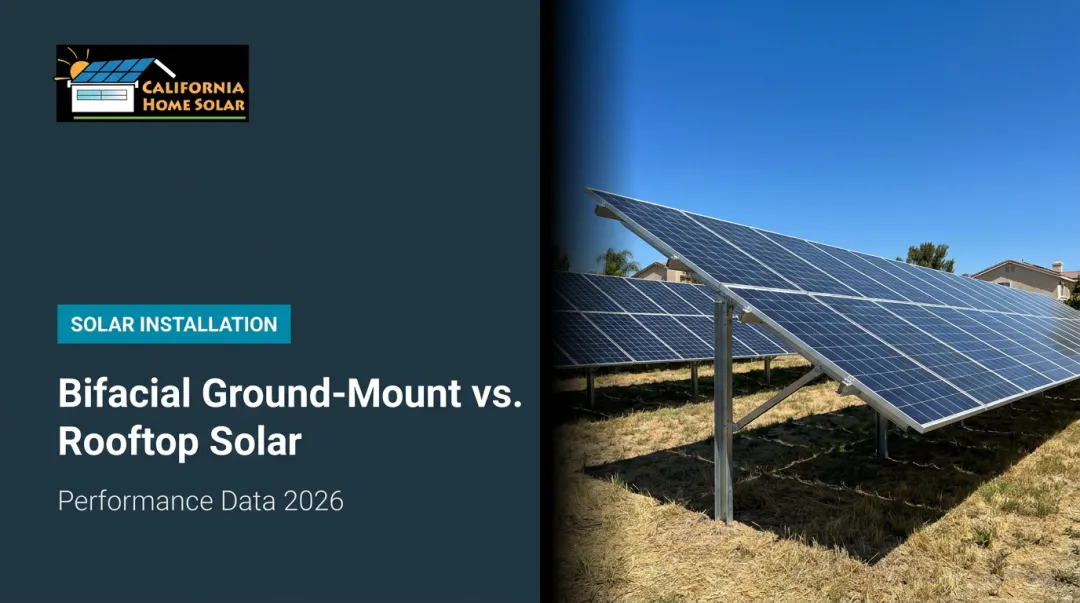
Ground-mounted systems install panels on freestanding structures anchored to open land — completely independent of any building. The system is optimized solely for energy output, unconstrained by existing roof geometry.
Best suited for: Properties with meaningful open, unshaded land where the roof is unsuitable, too small, heavily shaded, or due for replacement. California Home Solar installs ground-mount systems throughout the LA region, positioning arrays wherever sun exposure is strongest — something rooftop systems can't offer when roof geometry is fixed.
Key strengths:
- Full flexibility in panel tilt and azimuth for optimized output
- Can accommodate single-axis solar trackers for even greater yield
- Easier access for cleaning, inspection, and maintenance
- No risk of roof penetration or leak-related damage
- System size isn't capped by roof dimensions
Limitations:
- Requires significant usable land — a meaningful constraint on most suburban LA-area lots
- Higher installation cost due to foundation work and longer wiring runs
- Potential zoning or HOA restrictions on ground structures
- Greater exposure to dirt accumulation and vegetation overgrowth at ground level
On HOA restrictions: California Civil Code Section 714 voids covenants that effectively prohibit solar energy systems. Restrictions that add more than $1,000 in cost or reduce efficiency by more than 10% are unenforceable — but this applies differently to ground structures than to rooftop systems, so confirm local rules before committing to a ground-mount design.
Building-Integrated Photovoltaics (BIPV)
BIPV embeds photovoltaic technology directly into building materials — solar roof tiles, glass facades, skylights, canopies, or curtain walls. The solar element functions as the building envelope itself rather than sitting on top of it.
This is a fundamental distinction. Where rooftop and ground-mount systems add solar to an existing structure, BIPV replaces conventional building materials with solar-generating ones. Per IEA PVPS, removing a BIPV module requires replacing it with appropriate construction material — it's structural, not just supplemental.
Common BIPV formats:
- Solar shingles/tiles (Tesla Solar Roof, GAF Timberline Solar, Luma Solar)
- Solar glass facades and skylights
- Solar cladding for exterior walls
Best suited for: New construction or major renovation projects where aesthetics, HOA guidelines, or design requirements rule out conventional panel racking. Urban properties where visual profile matters, or homeowners who want a seamless architectural look.
Key strengths:
- Eliminates the visual profile of conventional panels
- Dual-function: building material + energy generator
- Offsets some material costs by replacing roofing or glazing
- Particularly relevant in neighborhoods with strict HOA aesthetic rules
Limitations:
- Most expensive installation type — NREL data puts average residential BIPV at approximately $5.02/W versus $3.92/W for conventional rooftop PV
- Output per square foot is typically lower than optimized rooftop panels since angle and orientation are fixed by building design
- Individual component repair or replacement is more complex
- Not cost-effective as a retrofit when the existing roof is in good condition
- BIPV residential adoption remains small — NREL reported roughly 2,100 residential BIPV systems in the US as of 2021
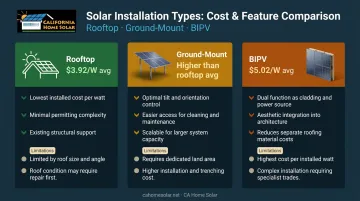
Each installation type has a distinct fit: rooftop for most standard residential properties, ground-mount where land is available and roof conditions fall short, and BIPV for new builds or renovations where design integration outweighs upfront cost. The sections below break down how to evaluate which fits your specific property.
How to Choose the Right Solar Installation Type
The right installation type comes from property-specific factors — not from what a neighbor installed or what's most popular.
Assess Your Roof First
Before anything else, evaluate:
- Orientation — south- or west-facing surfaces capture the most sun in SoCal
- Roof condition and lifespan — panels installed on a roof due for replacement in 5–7 years will need to be removed and reinstalled; that cost is avoidable with upfront planning
- Shading — trees, chimneys, and adjacent structures directly reduce output; NREL's PVWatts uses a 3% default shading loss for horizon blocking, but local shading can be far higher
If the roof fails on any of these, ground-mount or BIPV deserves serious consideration.
Factor In Available Land
Most suburban LA-area homeowners have limited land — which makes ground-mount impractical for most. But if you have usable open space on a side yard or back lot with good sun exposure, ground-mount may deliver meaningfully better output than a suboptimally oriented roof.
Run the Numbers on Cost and ROI
| Installation Type | Typical Cost Range | Key Cost Driver |
|---|---|---|
| Rooftop | $3.20–$5.50/W (2023 median) | Panel count, racking, wiring |
| Ground-Mount | Higher than rooftop | Foundation work, longer wiring runs |
| BIPV | ~$5.02/W and above | Specialized materials and labor |
Look at cost-per-watt and estimated payback period, not just installation price. BIPV's higher upfront cost is partially offset by replacing conventional roofing or glazing — but only if you were planning to replace those materials anyway.
Check HOA Rules Before Committing
In many LA-area neighborhoods and gated communities, HOA guidelines limit the visible profile of solar installations. BIPV and low-profile rooftop systems may be the only compliant options. California Civil Code Section 714 protects homeowners' right to install solar, but HOA rules around aesthetics still apply within legal limits — confirm before signing a contract.
Get a Professional Site Assessment
The most reliable path is a property assessment from a licensed contractor. California Home Solar's process includes site survey, shading analysis, design (architectural, electrical, and structural where needed), permitting, and utility connection review. That full picture is what separates a well-matched system from one that underperforms on your specific property.
Common Mistakes When Choosing a Solar Installation Type
These are the most common errors homeowners and property owners make before committing to an installation type:
- Installing on a roof with limited life remaining. Panels on a roof with 5–7 years of life left will eventually need to be removed, the roof replaced, and the system reinstalled — adding cost and disruption. Address roof condition before installation, not after.
- Choosing BIPV for looks without checking the output math. BIPV energy output per square foot is generally lower than optimized rooftop panels because panel angle follows building design, not solar optimization. If maximum energy production is the priority, BIPV may not be the right fit.
- Skipping shading analysis. A single tree or chimney can significantly cut a system's output. This analysis should be part of every installation decision — especially for rooftop and BIPV, where orientation can't be adjusted once the system is in place.
Conclusion
Rooftop, ground-mount, and BIPV solar installations each serve distinct needs. Rooftop is the practical and cost-effective starting point for most Southern California homeowners. Ground-mount offers superior output optimization for properties with viable open land. BIPV is the right call when aesthetics, HOA rules, or an active construction project make conventional racking impractical.
The difference between a well-performing system and an expensive regret usually comes down to whether the installation type was matched to the actual property — not just what the installer defaulted to. California Home Solar has handled that full process — site assessment, roofing, permitting, and installation — across Southern California for 36 years. That continuity of experience is how the right match gets made.
Frequently Asked Questions
What are the most common types of solar PV installations?
Rooftop and ground-mount are the most common for residential and commercial use. BIPV is growing in new construction and renovation projects. Floating solar — panels mounted on water bodies — is primarily utility-scale and not applicable to standard residential properties.
What are the most common types of BIPV systems?
The main formats are solar roof tiles and shingles (replacing conventional roofing), solar glass panels used in skylights and facades, and solar cladding for exterior walls. All are suited to properties where aesthetics or HOA rules prohibit conventional panel racking.
Which solar installation type is best for a residential homeowner?
Rooftop solar is the most practical and cost-effective starting point for most homeowners. The right answer depends on roof condition, orientation, shading, available land, and budget. A site assessment gives you a clear, property-specific answer.
Can I install ground-mounted solar on a suburban lot with limited yard space?
Ground-mount systems require meaningful open, unshaded space — more than most urban or suburban LA-area lots can accommodate. Smaller setups are possible, but a contractor should assess whether the available land can support a system that meaningfully offsets energy usage.
Does installation type affect my eligibility for the federal ITC or California incentives?
The federal ITC (30% in 2025) and most California incentives apply to all three installation types. For BIPV, only the solar-generating components qualify — conventional shingles and roof trusses do not. Confirm specifics with a tax professional and your installer.
Will rooftop solar damage my roof?
A properly installed rooftop system should not damage the roof. Reputable installers use flashed mounts and weatherproof sealing at all penetration points. Panels should only go on roofs in good condition, and all work should comply with local building codes and manufacturer guidelines.