Choose wrong, and you're either paying thousands more than necessary or leaving significant energy production on the table. A south-facing roof in good condition points clearly toward a roof mount. An aging, shaded, or awkwardly oriented rooftop tells a different story entirely.
This guide breaks down exactly how the two systems compare — on cost, efficiency, maintenance, permitting, and long-term value — so you can make a confident decision before signing anything.
Key Takeaways
- Roof mounts cost less upfront and work well for most suburban Southern California homes with well-oriented rooftops
- Ground mounts offer better airflow, optimal tilt control, and easier maintenance, though installation costs run higher
- LBNL's 2024 Tracking the Sun report found a +$0.40/W cost premium for residential ground-mounted systems in 2023
- Under NEM 3.0, production efficiency matters more than ever, so mount orientation carries more financial weight than it used to
- The right choice depends on your roof condition, yard space, HOA rules, and energy goals determine the right call
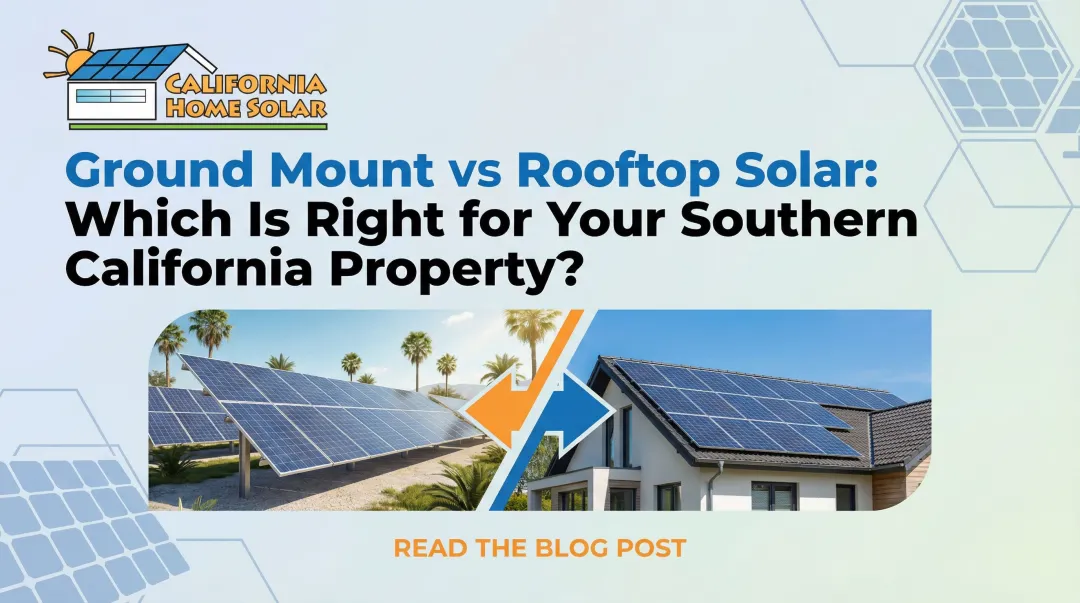
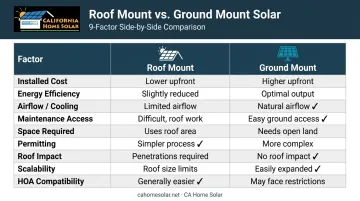
Ground Mount vs. Roof Mount Solar: At a Glance
| Factor | Roof Mount | Ground Mount |
|---|---|---|
| Installed cost | Lower (~$4.20/W median) | Higher (+$0.40/W premium) |
| Energy efficiency | Limited by roof pitch/orientation | Fully adjustable tilt and azimuth |
| Airflow/cooling | Restricted; panels run hotter | Open rack; better heat dissipation |
| Maintenance access | Requires ladder; riskier | Ground-level; straightforward |
| Space required | Uses existing roof | Requires open yard/land |
| Permitting | Expedited under CA Gov. Code 65850.5 | Treated as new accessory structure |
| Roof impact | Penetrations required | No roof involvement |
| Scalability | Limited by roof area | Expandable with available land |
| HOA compatibility | Strong state-level protections | More HOA scrutiny possible |
For Southern California homeowners specifically, LA's varied terrain and the prevalence of east/west-facing roof planes on suburban homes mean orientation differences between the two mount types translate directly into measurable production losses — sometimes 10–20% annually compared to an optimally angled ground array.
What Are Roof-Mounted Solar Panels?
Roof-mounted solar means panels secured directly to your home's roof using racking hardware that bolts into the rafters below. It's the dominant installation type in residential solar nationwide, with ground mounts accounting for roughly 5% of residential systems installed in 2023, according to LBNL.
How Installation Works
The process involves attaching brackets to roof rafters, running horizontal racking rails across those brackets, then securing panels to the rails. The hardware differs by roof type:
- Composition shingle roofs use flashings like IronRidge's FlashFoot2 or L-Mount attachments
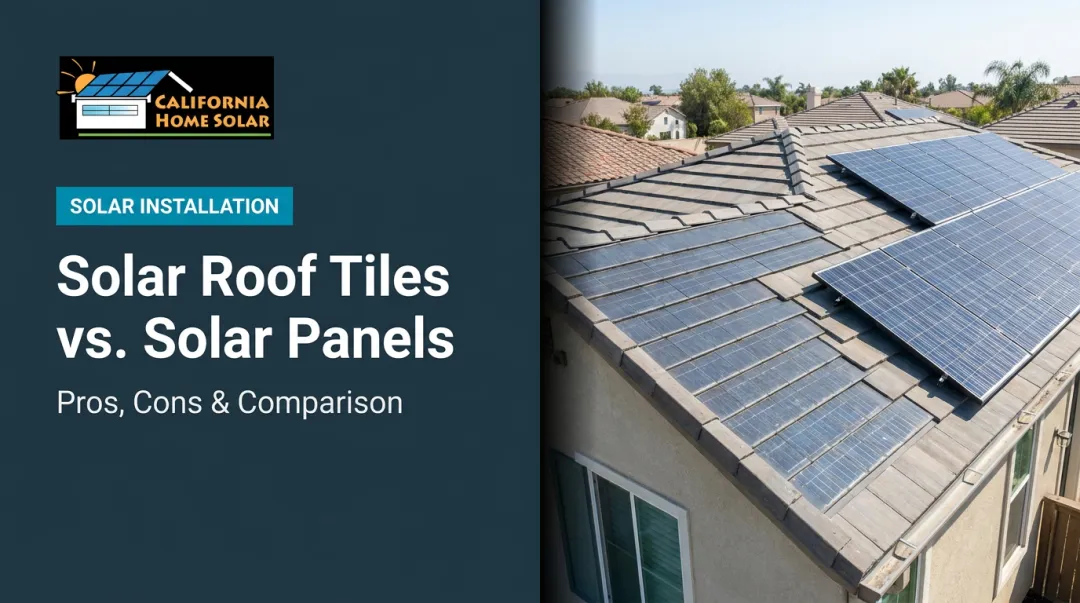
- Spanish tile and concrete tile roofs (very common in SoCal) require tile-specific solutions like QuickGrip Tile Mounts or Tile Replacement Flashings
- Flat roofs typically use tilted racking to set an effective panel angle, since the roof itself provides no natural tilt
Understanding these installation differences matters when evaluating your roof's readiness. CA Home Solar handles all three roof types across Southern California and pairs solar installation with roofing remodeling when a roof needs attention before panels go up.
Pros of Roof-Mounted Solar
- Lower upfront cost — no excavation, no concrete footings, no additional structural materials
- Uses otherwise wasted roof surface
- Permitting is streamlined: California Government Code 65850.5 requires expedited processing for residential rooftop systems of 10 kW AC or less
- Rooftop panels act as a shade layer — a Southern California study found they can reduce heat flux into the building by 63% and cut annual cooling load by 38%
Cons of Roof-Mounted Solar
- Output is constrained by your roof's existing pitch and orientation
- Cleaning and inspection require ladder access
- Roof penetrations carry leak risk if improperly sealed
- If the roof needs replacement mid-system life, panels must come off — at added cost
- Limited room to expand beyond the usable roof area
What Are Ground-Mounted Solar Panels?
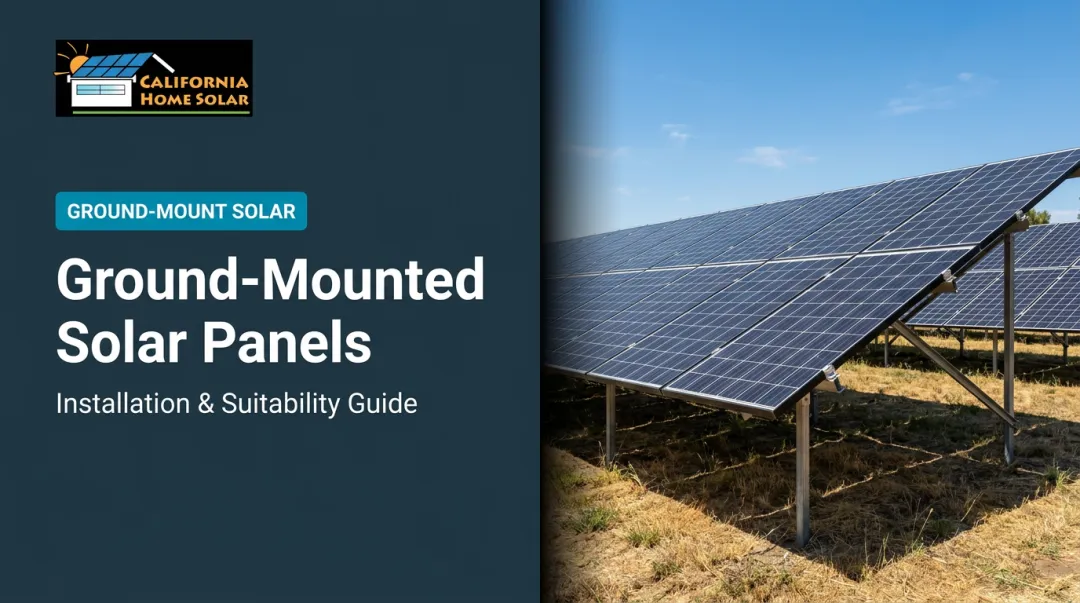
Ground-mounted systems are freestanding structures built on your property — steel posts or concrete footings anchor a rack into the ground, separate from the house entirely. The panels attach to that rack at whatever angle and orientation maximizes production for your specific site.
Two Main Variants
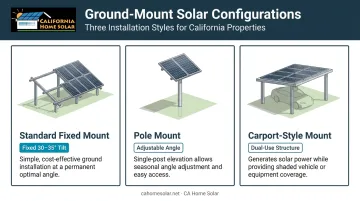
Three configurations cover most residential installations:
- Standard fixed mounts set the array at a single tilt angle (typically 30–35° for Southern California's ~34°N latitude) and don't change after installation
- Pole mounts elevate the array on a single post, allowing angle adjustment for seasonal sun variation or a smaller ground footprint
- Carport-style mounts combine covered parking with solar generation — a practical dual-use option for properties with limited open land
Pros of Ground-Mounted Solar
- Full control over panel tilt and true-south orientation regardless of how the house sits on the lot
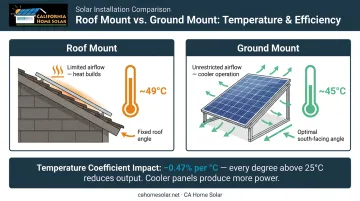
- Open-rack airflow keeps panels cooler — NREL's PVWatts data shows open-rack arrays run ~4°C cooler than roof-mounted systems (~45°C vs. ~49°C), which translates to measurable output gains
- Accessible at ground level for cleaning, inspection, and future expansion
- No roof penetrations; zero risk to home's waterproofing
Cons of Ground-Mounted Solar
- Significantly higher installation cost due to excavation, concrete footings, and heavy racking
- Takes up yard or land space permanently
- Classified as a new accessory structure — faces more complex local permitting, setback requirements, and zoning review than roof systems
- May face more HOA scrutiny than roof-mounted arrays
- Physical exposure increases risk of damage from lawn equipment or debris
Key Differences That Impact Your Decision
Cost
The single most verified cost figure comes from LBNL's 2024 Tracking the Sun report: residential ground mounts carried a +$0.40/W installed-price coefficient in 2023, with the national median residential installed price sitting around $4.20/W DC. On a 10 kW system, that's roughly $4,000 more for the ground mount before any other variables.
A roof already serves as the structural foundation for roof-mounted panels. Ground mounts require building that foundation from scratch — framing, footings, racking, and conduit runs all add up.
Energy Efficiency and Heat
Temperature matters more than most homeowners realize. PVWatts uses a standard temperature coefficient of -0.47%/°C for crystalline silicon panels (or -0.35% for premium modules), with a reference temperature of 25°C. When Pasadena or the San Fernando Valley pushes past 100°F in summer, cells can easily reach temperatures well above that reference point — and every degree costs output.
Ground mounts dissipate heat better due to unrestricted airflow on all sides of the panels. Roof mounts, pressed against the roof surface with limited clearance, trap more heat. The efficiency gap isn't enormous in mild coastal areas like Santa Monica or Hermosa Beach, but it's real and measurable in inland communities like Lancaster, Palmdale, or Burbank.
Heat performance is only part of the efficiency story. Ground mounts also allow ideal south-facing orientation at the optimal tilt for your latitude — something many LA-area homes can't offer. East or west-facing roof planes are perfectly usable for solar, but they don't match peak production from a properly aimed ground array.
Maintenance and Access
Roof mounts require ladder access for every cleaning visit, panel inspection, or debris removal. That adds cost, time, and risk — particularly on steep pitches or tile roofs.
Ground mounts sit at eye level, which changes the maintenance equation. CA Home Solar's solar panel cleaning service covers both mount types, but ground-level access makes routine visits simpler and potentially less expensive over the system's lifespan.
Permitting and HOA Rules
California provides meaningful legal protection for rooftop solar under Civil Code 714, which voids HOA restrictions that effectively prohibit solar energy systems. For PV specifically, the law treats a restriction as unreasonable if it adds more than $1,000 to system cost or reduces performance by more than 10%. Government Code 65850.5 separately requires expedited permitting for small residential rooftop systems of 10 kW AC or less.
Ground mounts exist in a different category. They're treated as new accessory structures, subject to local setback rules, zoning review, and more involved permitting. Civil Code 714's broad definition of solar energy systems may extend some protection to ground mounts, but the legal footing is less clear-cut.
HOAs in communities like Calabasas, Westlake Village, or Rancho Palos Verdes tend to scrutinize ground-mounted installations far more closely than roof systems — expect longer approval timelines and potentially more conditions on design and placement.
Scalability
Ground mounts can expand with your energy needs — add more panels, extend the rack structure, done. Roof mounts are constrained by available roof area, and adding a second sub-array on a different roof face creates wiring complexity and potential efficiency penalties.
Under NEM 3.0's Net Billing Tariff, where export credits are based on avoided cost values rather than retail rates, getting your system size right from the start matters more than it did under NEM 2.0. With a ground mount, you can size up later without a full redesign — a meaningful advantage when your electricity load changes after adding an EV, a pool pump, or a battery system.
Which Solar Mount Is Right for Your Southern California Home?
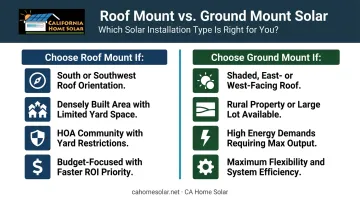
Choose Roof Mount If:
- Your roof faces south or southwest and is in good structural condition (under 10 years old, or recently replaced)
- You're in a densely built area like Sherman Oaks, Burbank, or Pasadena where yard space is limited
- You're in an HOA community and want the clearest legal path to approval
- Budget is a primary concern and faster ROI matters
Choose Ground Mount If:
- Your roof faces east or west, has significant shade, or isn't structurally sound enough for mounting hardware
- You're in a rural or larger-lot area — Antelope Valley, Malibu, Palos Verdes, or Lancaster — where land isn't a constraint
- You have high energy demands (multiple EVs, a pool, agricultural equipment, or multiple outbuildings)
- You want maximum long-term flexibility, easier maintenance, and optimal efficiency
Homeowners with aging roofs should consider whether to replace the roof first, or simultaneously with solar installation. CA Home Solar handles both roofing and solar installation, which avoids the cost and hassle of a mid-system roof replacement later. According to EnergySage, removing and reinstalling solar panels during a roof replacement typically costs $1,500–$6,000 — a real expense that changes the math on waiting.
That cost risk is exactly why the right call starts with a thorough property evaluation. CA Home Solar's site assessment covers roof condition, orientation, shading, and available land to determine which mount type genuinely fits your property. With 36 years of installation experience across Southern California — from Orange County to LA County and beyond — that assessment reflects real-world context most online guides can't replicate.
Conclusion
For most suburban Southern California homeowners — good roof, reasonable orientation, limited yard — a roof mount delivers lower cost, faster ROI, and strong output in a high-sunshine climate. For homeowners with the space and budget to invest upfront, a ground mount consistently edges ahead on efficiency, flexibility, and long-term maintainability.
California's electricity rates will keep climbing. Under NEM 3.0, maximizing self-consumption and system performance has a direct dollar value — and choosing the right mount type from the start is how you capture it.
If you're weighing the options and want a clear answer for your specific property, CA Home Solar's 36 years of local installation experience makes that call straightforward. Contact us at 877-903-1012 or info@cahomesolar.com for an evaluation of your roof condition, orientation, and available land — and a direct recommendation on which mount type will perform best for you.
Frequently Asked Questions
Is it better to put solar panels on the ground or on a roof?
It depends on your property. Roof mounts cost less and work well when your roof faces the right direction and is in good condition. Ground mounts deliver better efficiency and easier maintenance for homeowners with available land and higher energy needs, but require a larger upfront investment.
How much more does a ground-mounted solar system cost compared to a roof mount?
LBNL's 2024 Tracking the Sun report found a +$0.40/W installed-price premium for residential ground mounts in 2023. On a typical 10 kW system, that works out to roughly $4,000 more — driven by excavation, concrete footings, and additional racking materials.
Can I install ground-mounted solar if I have an HOA?
California Civil Code 714 limits HOA restrictions on solar energy systems but is more clearly tested for roof-mounted arrays. Ground mounts may face more HOA scrutiny and complex local permitting requirements. Always verify with your HOA before planning a ground mount installation.
Will roof-mounted solar panels damage my roof?
Properly installed roof mounts use waterproof flashing hardware to prevent leaks and don't damage sound roofs. The key is assessing roof age and condition first — panels shouldn't go on a roof that needs replacement within the next 5–7 years.
What happens if I need to replace my roof after installing solar panels?
Panels must be removed and reinstalled during a roof replacement. According to EnergySage, this typically costs $1,500–$6,000. If your roof is nearing end of life, replacing it before or alongside your solar installation avoids this expense entirely.
Do ground-mounted solar panels produce more electricity than roof-mounted ones?
Often, yes. Ground mounts allow true-south orientation at the optimal tilt angle and run cooler due to better airflow — both increase output. This advantage is most pronounced in hot inland areas like Lancaster, the San Fernando Valley, and Pasadena, where summer heat regularly cuts into panel efficiency.