The direction your roof faces, combined with its pitch and local sunlight conditions, directly determines how many kilowatt-hours your system generates each year. A small directional shift can mean a 15–20% difference in annual output. But in Southern California's high-irradiance environment, even east- or west-facing arrays can deliver strong financial returns — especially under the TOU rate structures used by SCE and LADWP.
This article covers how each compass direction ranks for solar production, how roof pitch interacts with orientation, what to do if your roof isn't south-facing, and why Southern California's specific conditions change the math.
Key Takeaways
- South-facing roofs produce the highest annual solar output in the Northern Hemisphere — the default best choice for U.S. homeowners
- East- and west-facing panels generate roughly 10–20% less energy than south-facing arrays, but west-facing panels capture peak afternoon output under California's TOU rate structures
- Roof pitch matters: a 30–35° tilt optimizes year-round energy capture at Southern California latitudes
- North-facing roofs are the least productive option; ground mounts or alternative roof sections are better solutions
- Even a non-ideal orientation can support a financially strong system — technology choices, utility rates, and incentives matter as much as compass direction
Why Roof Orientation Is One of the Biggest Factors in Solar Performance
Solar panels generate electricity when photovoltaic cells convert sunlight into energy. Those cells work hardest when sunlight strikes them at a perpendicular angle. As the U.S. Department of Energy explains, when the sun's rays are perpendicular to a surface, that surface receives the maximum possible energy. Any deviation from perpendicular reduces the solar radiation the panel absorbs — and that translates directly to fewer kilowatt-hours.
Why South Wins by Default
Because the continental U.S. sits north of the equator, the sun's path always arcs through the southern sky. Panels facing south intercept more direct solar radiation across more hours of the day than any other fixed direction. The greatest solar intensity occurs around solar noon — and south-facing panels are aligned to capture exactly that.
Two key variables work together here:
- Azimuth angle — the compass direction the array faces (south = 180°, east = 90°, west = 270°)
- Tilt angle — the steepness of the panel surface relative to horizontal
Sandia National Laboratories' PV Performance Modeling Collaborative defines the angle of incidence as the angle between incoming sunlight and the panel surface — and when that angle increases, optical losses increase because more light is reflected rather than absorbed.
The Shading and Seasonal Complication
Orientation sets the baseline — but two real-world factors can shift the equation considerably:
- Shading: A perfectly south-facing roof with significant tree cover can produce less than a slightly off-axis roof with full sun exposure. NREL notes that PV panels are susceptible to shading — even a narrow shadow across part of an array can cut output during peak production hours (10 a.m. to 2 p.m.).
- Seasonal sun position: The sun sits higher in the summer sky and lower in winter. A fixed-tilt, fixed-direction system averages across those shifts all year long.
That's why installers assess annual average performance rather than a single peak-day snapshot — and why shading analysis matters as much as compass direction when planning your system.
Best Roof Orientation: A Direction-by-Direction Breakdown
Here's how each compass direction performs in practice, relative to a south-facing baseline.
South-Facing: Highest Annual Output
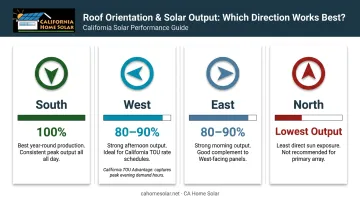
South-facing panels are the consistent top performer for Northern Hemisphere installations. They receive peak sunlight during midday when solar intensity is highest, maximizing both daily and annual energy output.
According to EnergySage, south-facing solar systems almost always generate the most electricity annually. Panels just 10° west of true south lose less than 1% of annual production — meaning you don't need a perfectly calibrated south-facing roof, just a reasonably south-oriented one.
South-facing arrays also align well with net metering export: they generate the bulk of their power during daylight hours when excess energy can be credited back to the grid.
West-Facing: The TOU Advantage
West-facing panels produce roughly 10–20% less energy annually than south-facing arrays. But that production gap doesn't tell the full financial story in California.
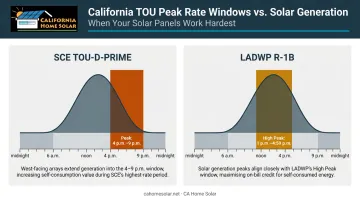
West-facing panels generate more power in the afternoon and early evening — precisely when grid electricity rates peak under Time-of-Use pricing:
- SCE TOU-D-PRIME: highest rates from 4 p.m. to 9 p.m.
- LADWP R-1B: High Peak from 1 p.m. to 4:59 p.m. on weekdays
Research published in Applied Energy found that southwest-oriented PV panels in California can carry higher total economic value because of afternoon demand peaks and elevated electricity prices at those hours. If you're an SCE or LADWP customer on a TOU rate plan, west-facing panels may deliver better financial returns than their lower production numbers suggest.
East-Facing: Viable, Not Ideal
East-facing panels also fall in the 10–20% annual production deficit versus south-facing systems, generating power primarily in morning hours. They don't carry the same TOU advantage as west-facing arrays. That said, east-facing roof sections aren't wasted space — splitting panels across east and west faces creates a flatter daily production curve, generating power from sunrise through sunset rather than concentrating output in midday hours. It's a practical approach when south-facing space is limited.
North-Facing: Generally Not Recommended
North-facing rooftop installations are the least productive option in the continental U.S. EnergySage notes that north-facing panels spend far less time in direct sunlight and that performance worsens as tilt angle increases. One installer quoted by EnergySage estimated north-facing panels make sense in only one out of every thousand installations.
For homeowners whose primary usable roof space faces north, the better solutions are:
- Ground-mounted systems positioned at the optimal south-facing angle
- East or west roof sections, if available, as a higher-yield alternative
- Available south-facing sections, even partial ones, to anchor the array
Forcing panels onto a north face is rarely worth it when these alternatives exist.
How Roof Pitch Amplifies (or Limits) Your Orientation Choice
Tilt angle (the steepness of your roof slope) determines how directly sunlight strikes the panel surface. The closer panels are to perpendicular with incoming sunlight at solar noon, the more energy they capture.
The general rule: the optimal tilt for a fixed solar array is approximately equal to the site's geographic latitude. The DOE confirms that solar panels typically perform best on south-facing roofs with slopes between 15 and 40 degrees.
For Southern California homes near Los Angeles (~34°N latitude), peer-reviewed research by Hartner et al. supports a tilt range between local latitude and local latitude minus 15° — roughly 19–34° for maximum annual energy output.
A few practical points:
- South-facing panels perform best in that 30–40° tilt range
- East- and west-facing panels generally benefit from a flatter tilt, which allows them to catch more low-angle morning and afternoon sun, partially closing the production gap versus south-facing systems
- Most homeowners can't change their roof pitch — but installers can use adjustable racking or tilt mounts to optimize panel angle independently of the roof surface
When the roof itself isn't workable, ground-mount systems solve the problem entirely. CA Home Solar installs ground-mount systems designed to set panels at the optimal angle for any roof type — flat, low-slope, or otherwise constrained.
What to Do If Your Roof Isn't South-Facing
A non-south-facing roof doesn't disqualify a home from solar. The first step is a professional site assessment — not an assumption. Actual shading patterns, available roof sections, system sizing, and local utility rates often show higher production potential than homeowners expect.
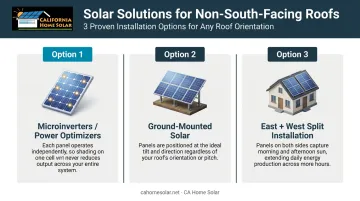
Three practical paths forward:
Microinverters or power optimizers — These allow each panel to perform independently, preventing one poorly oriented panel from pulling down an entire string. Useful when panels need to span multiple roof faces with different orientations.
Ground-mounted solar systems — CA Home Solar explicitly positions ground mounts as the solution when a roof isn't at the right angle, doesn't face south, or has obstructions like chimneys or skylights. Ground-mounted panels can be located wherever conditions are best on the property, set at the optimal angle, and sized to match electricity consumption without roof space restrictions. On a per-watt basis, they cost the same as rooftop solar and can be more productive per panel.
East + west split installations — Placing panels on both east and west-facing roof sections spreads production more evenly across the day, generating useful power from morning through evening rather than peaking heavily at midday.
Battery storage is worth considering for non-ideal orientations too. Even a slightly lower-producing system can be paired with a home battery to store midday generation for use during peak-rate evening hours. That combination maximizes bill savings regardless of which direction the panels face. CA Home Solar installs home battery storage systems as part of their solar packages — particularly valuable for customers on SCE or LADWP time-of-use rate plans.
Roof Orientation and Solar Efficiency in Southern California
Southern California homeowners have a significant geographic advantage: the region receives some of the highest solar irradiance levels in the country. That means even east- or west-facing arrays generate substantial energy — the production penalties from non-ideal orientation are smaller here in absolute terms than they would be in cloudier, lower-irradiance regions.
The NEM 3.0 and TOU Reality
California's current net energy metering framework — the Net Billing Tariff, which applies to systems interconnected after April 15, 2023 — changes how orientation affects finances. Under the CPUC's Net Billing Tariff, excess energy exported to the grid is credited at avoided-cost rates, which are generally lower than retail rates. This makes self-consumption more valuable than exports.
The practical implication: panels that generate power when your home is actually using it are worth more than panels that generate at peak production hours and export the surplus. West-facing arrays, which generate during afternoon and evening high-usage hours, align well with this structure for many households.
Those peak usage windows vary by utility. Customers on SCE TOU-D-PRIME face their highest electricity costs from 4 p.m. to 9 p.m., while LADWP's High Peak window runs 1 p.m. to 4:59 p.m. on weekdays. For homes in either territory, the orientation that generates power during those windows matters as much as total annual production — and that shifts the south-vs.-west calculation for some homeowners.
CA Home Solar's Approach Across Southern California
For homeowners across Los Angeles County — from Pasadena and Glendale to Long Beach, Torrance, and the San Fernando Valley — CA Home Solar conducts site-specific assessments before recommending any panel placement. Each assessment looks at:
- Roof orientation and available roof sections
- Shading conditions throughout the day
- Your utility rate structure and peak usage windows
- Available incentives that affect system design
With 36 years of experience and Top 500 Solar Contractor recognition, CA Home Solar connects panel placement decisions directly to how your specific utility rates work — not just peak annual output.

If your roof presents orientation challenges, ground-mounted solar, battery storage, and multi-face installation strategies are all options the company can assess for your property.
Frequently Asked Questions
What is the best roof orientation for solar panels?
South-facing roofs are the best orientation for solar panels in the Northern Hemisphere because they receive the most direct sunlight throughout the day and produce the highest annual energy output. East- and west-facing roofs can still support productive and cost-effective systems, particularly in sun-rich areas like Southern California.
What is the 33% rule for solar panels?
The "33% rule" refers to the Shockley-Queisser limit — the theoretical maximum efficiency of a single-junction silicon solar cell, calculated at approximately 33% of the solar energy that strikes the panel. This is a fundamental semiconductor physics constraint, not an installation issue. Better orientation and tilt simply minimize how much of that 33% ceiling you leave on the table.
Does roof pitch angle matter as much as roof orientation?
Pitch matters, but generally less than azimuth (compass direction). The ideal tilt is roughly equal to your site's latitude, and deviating 10–15° from optimal tilt has a more modest effect on output than a full directional shift from south to east or west. In practice, getting the azimuth right first, then optimizing tilt, is the more efficient approach.
Can solar panels work effectively on an east- or west-facing roof in California?
Yes. Given the region's high solar irradiance, east- and west-facing systems generate substantial energy. West-facing panels in particular can deliver strong financial returns under California's TOU utility rates by producing power during peak-price afternoon and evening hours when electricity costs most.
Does hot weather reduce solar panel efficiency?
Solar panels do lose a small amount of efficiency as temperatures rise. Manufacturers specify this as a temperature coefficient: REC's Alpha Pure 2, for example, rates -0.24% per °C above the 25°C standard test condition. California's warm summers cause minor thermal losses, but the region's abundant sunshine means annual production stays strong overall.
How much does roof orientation affect my solar savings in dollar terms?
A south-facing versus east/west-facing array of the same size can differ by 10–20% in annual energy production, which translates proportionally to bill offsets. Under TOU pricing, that dollar gap often narrows. If your non-south panels generate during peak-rate hours, the financial performance can be competitive with a higher-producing south-facing array.