That flexibility matters more than most people realize. Even a modest deviation from the optimal tilt angle can shave meaningful output from your system year after year — and unlike a rooftop install, you don't have to accept whatever angle your roof happens to give you.
This guide covers the optimal tilt angle and direction for ground-mounted solar panels across Southern California's diverse cities, how fixed versus adjustable systems compare under current utility rate structures, and what homeowners need to know before breaking ground on an installation.
Key Takeaways
- Optimal fixed tilt: 33–34° for most of SoCal, matching local latitude
- Best direction: True south at 180° azimuth (not magnetic south)
- Homes with high afternoon energy use may benefit from a slight southwest shift (190–200°) under NEM 3.0 TOU rates
- Ground mounts run cooler than rooftop systems due to better airflow, which supports better performance during SoCal's hot summers
- Dust, ash, and coastal marine layer soiling can cut output by 1–8% annually; ground mounts are easier to access and clean than rooftop systems
- LA County requires separate planning review for ground-mounted systems; permitting is more complex than for rooftop solar
Why Ground Mounts Excel in Southern California
Rooftop solar works well when a home's roof cooperates. In LA and surrounding communities, many don't. Ranch-style homes in the San Fernando Valley, craftsman bungalows in Pasadena, split-levels in Diamond Bar — roof orientations vary widely, and a lot of SoCal homes simply don't have a south-facing slope large enough for a full system.
Ground mounts solve that entirely. You pick the location, set the angle, and face the panels exactly where they need to go.
Practical advantages over rooftop installs:
- Position panels anywhere on the property to avoid shading from trees or structures
- Set any tilt angle at install time rather than accepting the roof's fixed pitch
- Access panels easily for cleaning — critical in dusty inland areas like Palmdale and Lancaster
- Scale the system larger than the roof would allow, which matters for homes with EVs or pool heating
Beyond positioning flexibility, ground mounts carry a thermal advantage too. NREL's PVWatts modeling assigns a 45°C nominal operating temperature to open-rack (ground-mount) systems versus 49°C for roof-mounted arrays — and a separate NREL study found roof-mounted modules under restricted airflow can reach up to 96°C compared to ~75°C for rack-mounted systems.
Since crystalline silicon panels lose roughly 0.47% of output per degree Celsius above optimal temperature, that gap matters during SoCal's inland summers when temperatures regularly exceed 100°F.
For properties with open yard space across communities from Arcadia to the Antelope Valley, California Home Solar's ground-mount installations routinely deliver more annual output than an equivalently sized rooftop system on the same lot — largely because of these combined advantages.
Optimal Tilt Angle for Ground-Mounted Solar Panels in Southern California
The Latitude Rule
The foundational rule for fixed ground mounts: set your tilt angle equal to your latitude. For most of Southern California, that means 33–34 degrees.
CaliforniaDGStats confirms that a fixed array tilt close to the location's latitude optimizes annual solar production — and for Los Angeles at 34.05°N, that puts the target at 34 degrees. Nearby cities follow similar logic:
| City | Approximate Latitude | Recommended Fixed Tilt |
|---|---|---|
| Los Angeles | 34.0°N | 34° |
| Long Beach | 33.8°N | 34° |
| Pasadena | 34.1°N | 34° |
| Lancaster / Palmdale | 34.5°N | 34–35° |
| Arcadia | 34.1°N | 34° |
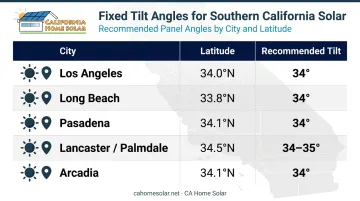
Homeowners in the northern part of CA Home Solar's service area (Lancaster, Palmdale, and the broader Antelope Valley at around 34.5°N) should round up slightly. Those in coastal cities closer to 33.5°N can shade down a degree.
For a precision number, NREL's PVWatts Calculator accepts your exact address and generates location-specific output estimates.
Seasonal Tilt Adjustments for Adjustable Ground Mounts
Adjustable ground mounts let you reposition panels seasonally, tracking the sun's arc as it shifts throughout the year. The standard adjustment formula:
- Winter: Latitude + 15° (roughly 48–49° for most SoCal locations)
- Summer: Latitude – 15° (roughly 18–19°)
- Spring and Fall: Return to base latitude angle
International peer-reviewed research supports seasonal adjustment as a meaningful yield booster. A study published in Renewable Energy found that adjusting panel orientation five times per year increased annual yield by 3.63% in Saudi Arabia, with Iranian research showing twice-yearly adjustments delivering around 8% annual gains.
SoCal's mild seasonal variation tempers these numbers compared to northern climates. The sun angle difference between June and December in Los Angeles is real, but less dramatic than in Minnesota or New York. For most homeowners here, a well-set fixed system captures the bulk of available annual energy — seasonal adjustments become most worthwhile for larger arrays where even a 3–5% yield gain translates to meaningful savings.
Best Direction (Azimuth) for Ground-Mounted Solar Panels in SoCal
True South vs. Magnetic South
Azimuth is the compass direction your panels face. For maximum annual output anywhere in the Northern Hemisphere, that direction is true south at 180° — and Southern California is no exception.
The catch: a compass doesn't show true south. It shows magnetic south, which in the Los Angeles area runs approximately 11 degrees 50 minutes east of true south according to NOAA's magnetic declination calculator. That's a meaningful gap. Align your ground mount to a standard compass reading and your panels will consistently miss peak production.
Use NOAA's magnetic declination tool with your specific address, or have a professional installer establish true south before setting the mount. Most installers can confirm true south in minutes using a GPS device or solar pathfinder.
Azimuth Strategy Under NEM 3.0
California's current net metering policy — the Net Billing Tariff for applicants after April 15, 2023 — changes the optimization math. Under NEM 3.0, the CPUC confirms that onsite generation first serves the customer's load, while energy exported to the grid earns reduced compensation — generally below the retail rate. Self-consumption now matters more than raw kilowatt-hour production.
Orientation trade-offs to consider:
- True south (180°): Highest annual output — ideal for homes with consistent daytime loads or occupants home during the day
- Southwest (190–200°): Shifts peak production into late afternoon; slightly lower total output, but better alignment with TOU rate windows when grid electricity is most expensive
- East or west only: Avoid as a sole orientation — output losses are too significant to justify except in unusual site conditions
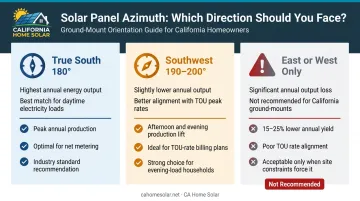
Homeowners with high afternoon or evening loads — working families, homes that charge EVs in the evening, or properties with pool equipment running on timers — may find the slight southwest shift provides real bill savings even if total kWh production is marginally lower.
Fixed vs. Adjustable Ground Mounts: What Delivers the Best ROI in Southern California
Fixed Ground Mounts
A fixed mount set at the latitude angle (~34°) is the straightforward choice for most residential installations. No moving parts, no seasonal repositioning, and lower upfront cost.
LBNL's 2024 Tracking the Sun report puts 2023 residential PV installed costs at $3.20–$5.50 per watt, with ground mounting carrying roughly a $0.40/W premium over equivalent rooftop systems. For a 7 kW system, that's approximately $2,800 in additional cost for the ground structure — a reasonable trade-off given the positioning and performance benefits.
Fixed systems deliver strong annual output for most SoCal homeowners without any ongoing maintenance beyond cleaning.
Adjustable Ground Mounts
Manually adjustable mounts let you reposition panels 2–4 times per year. This pays off most for inland properties in the Antelope Valley, where seasonal sun angle variation is more pronounced and energy demands from EVs or pool heating push annual consumption higher.
Cost data for residential manually-adjustable systems isn't well-documented in published industry sources — this is a detail worth discussing directly with your installer based on your specific configuration.
Solar Trackers
Single-axis trackers follow the sun from east to west throughout the day. NREL research shows this delivers 15–25% more energy compared to fixed-tilt systems. Dual-axis trackers add seasonal tilt adjustment for the highest theoretical output.
The trade-offs are worth weighing carefully:
- Higher upfront cost compared to fixed or adjustable systems
- Moving mechanical components that require periodic maintenance
- Complexity that typically only makes financial sense at larger or commercial scale
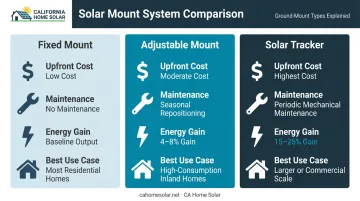
For most SoCal homeowners under NEM 3.0, a correctly sized and positioned fixed mount often delivers better ROI than an oversized tracking system. Excess production that gets exported earns reduced credit — so right-sizing to actual consumption, and optimizing the angle and direction of a fixed system, frequently beats throwing more production capacity at the grid.
That right-sizing calculation requires real knowledge of local utility rate structures and site conditions. CA Home Solar handles the full design, permitting, and installation process across Los Angeles County and the Antelope Valley — with 36 years of experience translating those site-specific variables into systems sized for actual consumption, not just maximum output.
What Southern California Homeowners Should Know Before Installing a Ground Mount
Permitting Is More Involved Than Rooftop Solar
Ground-mounted solar systems trigger a different permitting pathway than rooftop installs. LA County's planning department treats ground mounts as a separate category requiring Regional Planning review — a step that structure-mounted (rooftop) systems generally skip.
The California Solar Permitting Guidebook outlines that ground-mount installations may require building, electrical, structural, and zoning review depending on jurisdiction.
Setback rules vary by city: LA County agricultural zones require a minimum 30-foot setback, while non-agricultural zones follow base zoning rules. Irvine, for example, prohibits ground-mounted systems within front, side, or rear building setback areas.
Working with a local installer who knows your city's requirements saves significant time. CA Home Solar manages the full permitting process for their customers, including the architectural, electrical, and structural components, so homeowners don't have to navigate this themselves.
Yard Space, Shading, and Soiling
A few practical sizing and site considerations:
- Ground mounts need unobstructed, south-facing yard space — verify local setback rules for your specific city before committing to a layout
- Shade from mature trees is a real concern in neighborhoods like Pasadena, Arcadia, and San Marino; a professional shade analysis before design is worth the time
- NREL soiling research measured annual soiling losses across Southern California sites ranging from less than 1% to 8%, depending on location and cleaning frequency
- Santa Ana wind events, wildfire ash, and coastal marine layer all drive soiling rates in different parts of the region
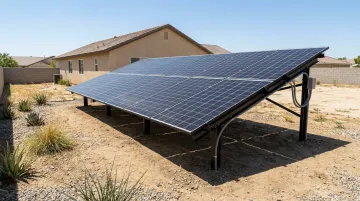
The ground-level accessibility of ground mounts keeps panels easy to reach and clean. CA Home Solar's panel cleaning service uses soft brushes, biodegradable cleaning solutions, and deionized water — and recommends at least twice-yearly cleaning, with more frequent service for dusty inland locations like Palmdale and Lancaster.
Conclusion
For most Southern California homeowners, the answer is clear: a fixed ground mount set at 33–34 degrees facing true south delivers strong year-round performance with minimal complexity. Homeowners in the Antelope Valley or those with unusually high energy demands may find adjustable systems worth the added cost. Those with high afternoon/evening loads under NEM 3.0 TOU rates should consider a slight southwest orientation.
No single configuration fits every property. The right answer depends on your exact latitude, yard layout, shading conditions, and how your utility bills break down by time of day.
CA Home Solar has been designing and installing ground-mount systems across Southern California for 36 years — from coastal Los Angeles to the Antelope Valley. If you're weighing a ground-mount installation, a professional site assessment gives you accurate production estimates before you commit — reach out for a custom ground-mount consultation.
Frequently Asked Questions
What is the best angle for solar panels on the ground?
The optimal tilt for a fixed ground mount equals your local latitude — approximately 33–34 degrees for most of Southern California. This angle produces the best average output across all seasons without requiring any adjustments.
What direction should solar panels face in California?
True south at 180° azimuth delivers maximum annual output. Homeowners with high afternoon or evening energy use may benefit from a slight southwest orientation (190–200°) to better align production with peak TOU rate windows under NEM 3.0.
How much more energy do ground-mounted solar panels produce compared to rooftop systems?
Ground mounts run cooler due to better airflow: NREL models ground-rack systems at a 45°C operating temperature versus 49°C for rooftop arrays. Combined with the ability to achieve optimal tilt and orientation regardless of roof angle, ground mounts consistently outperform equivalent rooftop systems in real-world conditions.
Should I use a fixed or adjustable tilt system for my Southern California ground mount?
Fixed mounts at latitude angle deliver strong annual output at lower cost, making them the right choice for most residential installations. Adjustable systems provide a meaningful production boost but cost more; they make the most sense for high-consumption households in inland areas with greater seasonal sun variation.
Do I need a permit for a ground-mounted solar system in Los Angeles County?
Yes. Ground-mounted systems in LA County require Regional Planning review in addition to standard building and electrical permits — a more involved process than rooftop solar. Requirements vary by zone and city, so working with a licensed local installer who handles permitting is strongly advisable.
Does the tilt angle of ground-mounted panels need to change with the seasons in Southern California?
Seasonal adjustments (latitude ±15°) can boost annual output by roughly 4–8% with consistent changes. SoCal's mild seasonal variation means fixed systems at latitude angle already capture most available energy — seasonal adjustment is useful but not essential for most homeowners.