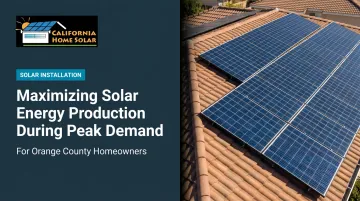
The answer is timing. Your solar system peaks when the sun is strongest, roughly 10 AM to 3 PM. But SCE's most expensive rate window runs from 4 PM to 9 PM — right when panels start fading and your household lights up for the evening. That gap is what's costing you money.
This article covers what peak demand actually means on a Southern California utility bill, why standard solar systems can't fully bridge the gap, and the specific strategies — battery storage, load shifting, and smart system design — that close it.
Key Takeaways
- SCE's most expensive hours run 4–9 PM weekdays; LADWP's High Peak runs 1–5 PM — knowing your utility matters
- Solar production peaks earlier in the day, creating an evening coverage gap
- Battery storage solves the gap by storing midday solar and discharging it during expensive evening hours
- Under NEM 3.0 (April 2023), self-consuming stored solar is worth more than exporting it back to the grid
- Per CPUC estimates, solar-plus-storage customers save at least $136/month versus $100/month for solar alone
What Peak Demand Is and Why It Costs You More
Peak demand, in the residential context, refers to the specific hours when grid-wide electricity consumption is highest — and when utilities charge you more for every kilowatt-hour you pull.
For most SCE customers on a standard residential TOU plan, that window is 4 PM to 9 PM on weekdays during summer. LADWP works differently: its TOU R-1B schedule lists High Peak from 1:00 PM to 4:59 PM and Low Peak from 5:00 PM to 7:59 PM. If you're an LADWP customer and someone tells you to worry about a "4–9 PM peak," that advice doesn't fully apply to your bill.
Why the Rate Structure Matters
California's move toward TOU pricing wasn't accidental. CPUC's residential rate reform pathway set default TOU as a policy goal, pushing more customers onto plans where the time of consumption — not just the amount — determines your cost.
Running your dishwasher, dryer, and AC simultaneously at 6 PM on a Tuesday can cost 2–3× more than running all three at noon on a Saturday. Same appliances, same duration — different price.
For SCE customers, the key rate plans to know:
- TOU-D-4-9PM — standard residential TOU with summer weekday on-peak from 4–9 PM
- TOU-D-PRIME — designed for homes with EVs, batteries, or heat pumps; same 4–9 PM peak structure
- Check current rates at SCE's residential TOU page
For LADWP customers, check your specific plan on LADWP's residential rates page — the peak windows differ enough that optimizing for SCE hours can actually work against your bill.
How Solar Production Aligns — and Misaligns — With Peak Hours
Here's the core problem visualized: imagine a graph of your home's solar output across a day. Output climbs after 9 AM, peaks around noon to 1 PM, then gradually declines through the afternoon. By 6 PM, most systems are producing little to nothing.
Now overlay your utility's pricing. For SCE customers, costs are lowest during those same midday hours and highest precisely when solar production drops off.
The Duck Curve Explained
CAISO's duck curve illustrates this at the grid level. Solar generation suppresses the need for other power sources during daylight hours — then as the sun sets, the grid must ramp up rapidly to meet evening demand. That ramp can reach 11,000 MW in a single late-afternoon climb.
For a Southern California homeowner, the duck curve maps directly to your bill. Your system produces its peak value before your most expensive rate window even begins.
Panel Orientation Affects the Timing
Orientation determines not just how much power your system generates, but when it generates it. That timing distinction has grown more consequential since NEM 3.0 restructured export credits in 2023.
Here's how the main configurations compare:
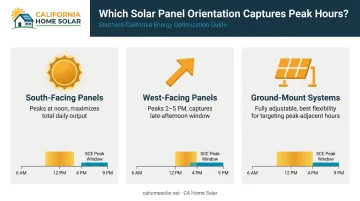
- South-facing panels maximize total daily output but peak around noon — well before SCE's highest-rate window
- West-facing panels shift production toward the 2–5 PM range, capturing more of the late-afternoon window before peak pricing kicks in
- Ground-mount systems offer the clearest advantage: orientation isn't fixed by roof pitch or compass direction, so the array can be positioned to capture late-afternoon sun that a fixed rooftop panel cannot
California Home Solar installs ground-mount systems as part of their residential offerings, which makes optimizing for late-afternoon production a practical option rather than a rooftop compromise.
For any specific setup, NREL's PVWatts tool models hourly AC output using your actual azimuth and tilt inputs — don't assume a fixed production window without modeling your site.
The Role of Battery Storage in Capturing Peak-Hour Solar Value
Battery storage is the most direct solution to the solar timing gap. Store the midday solar surplus that would otherwise export to the grid at low NEM 3.0 (net metering) credit rates, then discharge that stored energy during the 4–9 PM peak window to power your home without buying expensive grid electricity.
How TOU Optimization Mode Works
Modern home batteries — including systems like the Tesla Powerwall — can operate in Time-Based Control mode, which automatically recognizes your utility's rate periods. The battery charges when rates are low, holds stored energy through mid-afternoon, and discharges during peak hours. Once configured, the homeowner doesn't need to manage it manually.
During the expensive evening peak window, your home draws from the battery instead of the grid — keeping peak-period grid consumption near zero.
What the Numbers Look Like
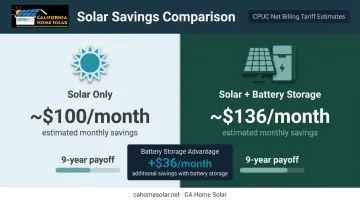
CPUC's Net Billing Tariff announcement estimated average savings benchmarks for California:
| System Type | Estimated Monthly Savings | Average Payoff |
|---|---|---|
| Solar only | ~$100/month | 9 years or less |
| Solar + battery storage | ~$136/month | 9 years or less |
On the cost side, NREL's residential storage benchmark modeled a standalone 5 kW / 12.5 kWh battery system at approximately $18,791 (Q1 2022 market price). LBNL's 2024 Tracking the Sun report found paired residential PV-plus-storage systems ran about $1.7/W higher than standalone PV installations — with California heavily influencing those figures.
California Home Solar installs battery storage as part of new solar packages and as retrofits for existing systems, handling everything from capacity assessment to peak-hour discharge configuration.
Practical Strategies to Maximize Solar During Peak Hours
Battery storage is the most impactful fix, but there are lower-cost steps that meaningfully reduce peak-hour exposure regardless of whether you have storage yet.
Load Shifting
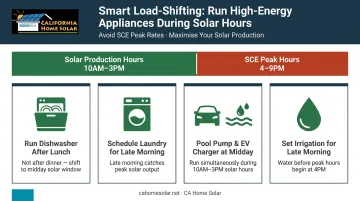
Move your high-energy tasks to solar production hours (10 AM–3 PM):
- Run the dishwasher after lunch, not after dinner
- Schedule laundry for late morning
- Run pool pumps and EV chargers during mid-day
- Set irrigation systems for late morning
Each appliance you move out of the 4–9 PM window reduces what your home pulls from the grid — or from your battery — during the most expensive hours.
Smart Home Integration
Programmable thermostats do something especially useful here: pre-cool your home. Setting your system to reach 72°F by 3 PM means the AC runs on cheap solar power, and the thermal mass of a cooled house extends comfort into early evening without a compressor spike at 5 PM.
Pair this with smart plugs and an energy management system, and the load-shifting behavior becomes largely automatic — especially when integrated with a solar-plus-battery setup.
Professional System Design
All of these strategies depend on one prerequisite: a well-designed system. Load shifting and smart controls can't compensate if the underlying array is undersized or poorly oriented. An undersized array that barely covers daytime loads leaves nothing stored for evening discharge. A system designed without accounting for your specific TOU plan optimizes for the wrong hours.
California Home Solar has been designing custom residential solar systems across Southern California for 36 years, with primary service coverage throughout Orange County and surrounding communities including Anaheim, Irvine, Huntington Beach, and the greater Los Angeles area. Their process starts with a free roof assessment and consultation that covers energy usage, roof characteristics, and system fit, followed by a detailed proposal with savings projections and install timeline. Reach their team at 877-903-1012 or info@cahomesolar.com.
California's TOU Rates and NEM 3.0: What LA Homeowners Must Understand
California's Net Billing Tariff (NEM 3.0) applies to customers who submitted interconnection applications on or after April 15, 2023 in investor-owned utility territories, including SCE. If you went solar after that date, you're on this structure.
The critical change from the earlier NEM 2.0: under NEM 3.0, excess solar exported to the grid during the day is credited at avoided-cost rates — far lower than the retail credits NEM 2.0 provided. Exporting kilowatt-hours at noon earns you much less than it used to.
What increased in value: energy you store and self-consume during peak hours. Under NEM 3.0, battery storage shifts from optional upgrade to a core part of getting real financial return from your system.
Key NEM 3.0 provisions:
- Applies to new IOU interconnections from April 15, 2023 onward
- 9-year lock-in of export credit values for the original customer
- Systems can be sized up to 150% of customer usage
- No charges specific to solar customers
The practical takeaway: a solar-only system installed after April 2023 exports its midday surplus at low avoided-cost rates, then buys back expensive evening grid power anyway. A solar-plus-storage system captures that midday surplus and deploys it when grid rates peak — turning the same solar production into meaningfully lower bills.
Long-Term Financial and Environmental Benefits
The financial case for peak-demand optimization compounds over time:
- Monthly bill reduction: CPUC benchmarks suggest $136+/month for solar-plus-storage customers
- Rate inflation protection: California electricity rates have risen consistently — locking in self-consumption reduces exposure to future rate increases
- Home resale premium: LBNL's analysis of over 22,000 home sales found solar homes sold at an average premium of approximately $4/W, or around $15,000 for an average 3.6 kW system
- Property tax treatment: California's active solar energy system new construction exclusion means installation won't increase your assessed property value — extended through 2025–26, with a January 1, 2027 sunset per the California Board of Equalization
- Federal tax credit: The 30% federal investment tax credit applies to qualifying solar and storage installations
The environmental benefits are just as concrete. When homes draw less from the grid during evening peak hours, utilities have less need to fire up peaker plants — older fossil-fuel generators activated specifically to cover demand spikes. These facilities tend to be located in or near urban communities and emit NOx, particulate matter, and CO₂ during operation.
A well-designed solar-plus-storage home that covers its own peak demand contributes directly to fewer hours of peaker plant operation across Southern California.
Frequently Asked Questions
What hours are considered peak demand in Southern California?
For most SCE customers on TOU plans, peak hours run from 4 PM to 9 PM on weekdays. LADWP's structure is different — its TOU R-1B High Peak window runs from 1 PM to 4:59 PM. Check your specific utility plan, as exact windows vary by rate schedule.
Can solar panels alone eliminate peak demand charges?
Solar significantly reduces overall electricity costs but typically doesn't eliminate peak-period costs on its own. Because panels produce the most power before the evening rate window, homes without storage still draw from the grid at peak TOU rates after sundown.
How does battery storage reduce peak energy costs?
Batteries store excess midday solar and discharge it during the 4–9 PM window, keeping the home's grid draw low during the utility's highest-priced hours. The result is lower peak-period consumption and a smaller bill.
What is NEM 3.0 and how does it affect solar savings?
NEM 3.0, effective April 15, 2023 for new SCE interconnections, credits daytime solar exports at lower avoided-cost rates rather than retail rates. Storing solar and self-consuming it during peak hours delivers more value than exporting it. Battery pairing is now the standard recommendation for new installations.
Which direction should solar panels face to maximize afternoon production?
South-facing panels maximize total daily output. West-facing panels shift peak production to roughly 2–5 PM, capturing more of the late-afternoon window ahead of peak pricing. Ground-mount systems offer the most flexibility for targeting a specific production window.
How much can Southern California homeowners save by optimizing solar for peak demand?
CPUC's estimate puts solar-plus-storage savings at $136/month or more for average California residential customers, versus $100/month for solar alone. Actual savings depend on system size, battery capacity, and usage patterns.