Introduction
Most Southern California homeowners researching solar spend their time comparing panel brands, wattage ratings, and installer quotes. Those are all worth evaluating—but the direction your panels face can have just as much impact on annual energy production as any of those factors.
That direction is called roof azimuth: the compass heading your panels point toward. Get it right, and your system produces at or near its maximum potential for 25+ years. Get it wrong, and you're losing kilowatt-hours every day for the life of the system — production losses that translate directly into dollars at California's electricity rates.
California's average residential electricity rate hit $0.32 per kWh in 2024 according to EIA data, with SCE customers facing rates closer to $0.35 per kWh. At those prices, even modest production losses add up fast.
Understanding azimuth — and what to do when your roof isn't ideally oriented — is how you protect that investment. This guide covers the definition, the optimal angle for SoCal homes, how deviations affect output, and your practical options.
Key Takeaways
- True south (180°) is the gold standard for solar azimuth in Southern California and the entire Northern Hemisphere
- Compass south ≠ true south: LA's ~11.4° east magnetic declination means aiming ~169° on a compass to reach true south
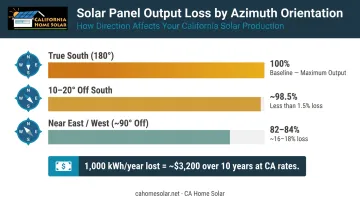
- Small deviations matter less than you think — 10–20° off true south causes minimal output loss; near-east or near-west orientations lose roughly 16–18%
- East/west roofs still work — under NEM 3.0, their spread-out production can reduce grid dependence during peak rate hours
- A professional site assessment combining azimuth, tilt, and shade analysis gives you a reliable production estimate
What Is Roof Azimuth and Why Does It Matter for Solar Panels?
Azimuth is the horizontal compass direction your solar panels face, measured clockwise from true north. Zero degrees is north, 90° is east, 180° is true south, 270° is west. This is distinct from tilt angle, which describes how steeply the panel is pitched relative to flat ground.
The reason azimuth matters comes down to simple geometry. In the Northern Hemisphere, the sun travels across the southern sky throughout the year. A panel facing south stays in direct sunlight from morning through afternoon, maximizing its exposure to peak irradiance. A panel facing east catches morning sun and misses the afternoon; a west-facing panel does the opposite.
According to the U.S. Department of Energy, fixed-mounted PV systems in the Northern Hemisphere should point due south and be tilted at the local latitude for the highest annual energy output. That's the engineering baseline every installer should start from.
Azimuth Deviation and Efficiency Loss
How much does pointing the wrong way actually cost? A 2019 peer-reviewed study in Clean Energy on residential rooftop PV systems provides the clearest published data:
| Azimuth Deviation from South | Approximate Output Loss |
|---|---|
| 10–20° off south | Less than 1.5% |
| Near-east (~87–90° off south) | ~16–18% lower than south |
Small deviations are mostly negligible. But near-east or near-west orientations represent a meaningful reduction — and at California's current electricity rates, that loss compounds significantly over a system's 25-year lifespan.
At California's 2024 average residential rate of $0.32/kWh, every 1,000 kWh/year of lost solar production equals roughly $3,200 over 10 years — before accounting for future rate increases. An orientation that costs you 2,000–3,000 kWh annually could easily represent $6,000–$10,000 in unrealized savings over a decade.
Both azimuth and tilt determine total yield, but azimuth comes first. If the panels face the wrong direction, no amount of tilt adjustment fully makes up the difference.
Finding the Optimal Solar Azimuth for Southern California Homes
For any home at Southern California's latitudes (roughly 33°–34°N), true south at 180° is the target azimuth. It maximizes daily sun exposure across all seasons without seasonal bias toward summer or winter output.
True South vs. Magnetic South: Why the Difference Matters
Your phone's compass and a standard magnetic compass don't point to true south. They point to magnetic south, which differs from true south by an amount called magnetic declination, and that difference varies by location.
For Southern California specifically:
| City | Magnetic Declination (2026) | Compass Reading for True South |
|---|---|---|
| Los Angeles | 11.37° East ± 0.35° | ~168.6° magnetic |
| San Diego | 10.89° East ± 0.34° | ~169.1° magnetic |
Source: NOAA World Magnetic Model calculator
Because Southern California has an easterly declination, true south sits slightly east of where your compass points. To aim at true south using a magnetic compass, subtract the declination from 180°, which puts you at around 169° on your compass dial.
That 11° gap is worth correcting before installation begins. Studies using PVWatts modeling show that a consistent azimuth error of 10–15° can reduce annual output by roughly 1–3% — a small but avoidable loss over a 25-year system life.
How to Determine Your Roof's Azimuth
Before calling an installer, you can get a reasonable estimate using free tools:
- Google Maps satellite view — align a straight line along your roof ridge and read the compass bearing
- NOAA's Magnetic Declination Calculator — enter your address to get the exact correction for your location
- NREL's PVWatts Calculator — enter your address, azimuth, and tilt to model estimated annual kWh output for your specific roof
Any roof azimuth within roughly 10–15° of 180° (true south) will support a high-performing south-facing installation.
Professional installers use tools like PVWatts and Aurora Solar to run precise production models for a specific address, including local irradiance data, shade analysis, and system size. That gives you a real production number rather than a rough approximation.
What to Do When Your Roof Doesn't Face True South
Not every SoCal home has a perfectly south-facing roof, and that's fine. The practical picture is more forgiving than the theory suggests.
Roofs in the south-southwest to south-southeast range — roughly 150° to 210° azimuth — experience very small output losses based on the available peer-reviewed research. Deviations of 10–20° from true south result in less than 1.5% reduction in annual output. For most homeowners, that's a non-issue.
East- and West-Facing Panels: A Workable Alternative
East- and west-facing roofs are a different story — but not necessarily a bad one. Research supports that near-east orientations produce roughly 82–84% of south-facing output in residential rooftop systems. The trade-off is real, but so are the benefits.
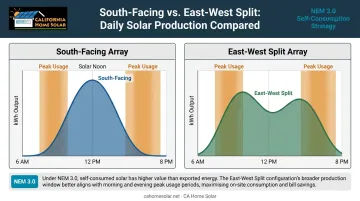
An east-west split — placing panels on both sides of a gabled roof — distributes production more evenly across the day:
- East-facing panels peak in the morning
- West-facing panels peak in the late afternoon and early evening
- Combined, they reduce the sharp midday production spike typical of south-facing systems
Under California's NEM 3.0 (Net Billing Tariff), this matters more than it used to. Utilities now calculate export compensation using avoided cost values that vary by time of day — not a flat retail rate credit. Self-consuming your own solar power, especially during morning and evening peak usage, is worth more than exporting midday surplus to the grid.
For households that run most loads in the morning and evening, an east-west configuration aligns better with actual consumption patterns than a pure south-facing array.
For north-facing roofs, the situation is more challenging. Panels facing due north (0° azimuth) receive substantially less direct sunlight in Southern California. When a home's primary usable roof face points north, ground-mounted solar is the more practical solution. CA Home Solar offers ground-mount systems that can be positioned anywhere on a property at whatever azimuth and tilt delivers maximum production — independent of the house's roof orientation.
Azimuth and Tilt: Two Angles That Define Your System's Output
Azimuth tells panels which direction to face. Tilt angle tells them how steeply to lean. Both matter, and they interact.
For Southern California at ~34°N latitude, the DOE's guidance recommends a fixed tilt equal to your local latitude — approximately 33–34°. Most LA-area homes with standard pitched roofs fall naturally within a workable range of this target.
Fixed vs. Adjustable Tilt
| System Type | Tilt Flexibility | Best For |
|---|---|---|
| Fixed rooftop | Determined by existing roof pitch | Most residential installs |
| Adjustable ground mount | Seasonally adjustable | Maximum optimization |
Most residential rooftop installs use the existing roof pitch as the fixed tilt, which is perfectly adequate for grid-tied systems. Ground-mount systems can be adjusted seasonally (lower in summer, steeper in winter) for additional output gains. When a rooftop pitch falls slightly short of the ideal angle, installers can add panels to cover the difference.
Tilt can partially compensate for an imperfect azimuth, but not fully. A southeast-facing roof at 150° can recover some deviation loss with a well-chosen tilt angle. A due-east roof, however, cannot be tilted back to south-facing output levels. That's why experienced installers measure azimuth before quoting panel count or system size.
How California Home Solar Maximizes Your Roof's Solar Potential
CA Home Solar has spent 36 years installing solar systems across Southern California — long enough to have seen nearly every roof configuration the LA basin and surrounding region produces. Their recognition as a Top 500 Solar Contractor by Solar Power World (most recently in 2025) reflects a track record built across thousands of installations.
A useful site assessment evaluates azimuth, roof pitch, shading obstructions, and local irradiance data together — each factor influences the others. CA Home Solar's process takes that integrated approach, producing production estimates based on your specific property conditions rather than regional averages.
For homes where the primary roof face isn't south-oriented, CA Home Solar's team can design around the limitation:
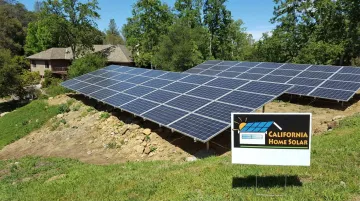
- Ground-mount systems positioned at the ideal azimuth and tilt anywhere on the property
- East-west panel configurations for gabled roofs with split exposure
- Increased panel count to offset the production difference from a non-ideal orientation
Those design solutions — particularly ground-mount systems or added panel count — do increase upfront costs, which is where financing matters. CA Home Solar is a registered contractor in the HERO program, a PACE (Property Assessed Clean Energy) financing structure that requires no down payment, carries no application fees, and bills through your property tax rather than a separate loan.
Repayment terms run 5–25 years, and HERO financing doesn't affect eligibility for federal tax credits or utility rebates.
Frequently Asked Questions
What is the best azimuth angle for solar panels?
180° (true south) is the optimal azimuth for any home in the Northern Hemisphere, including all of Southern California. It maximizes direct sun exposure across all seasons. Deviations up to about 10–20° from true south have minimal impact on annual output.
What is the difference between true south and magnetic south for solar panel installation?
Magnetic south (what your compass shows) and true south differ by the local magnetic declination — approximately 11.4° east in Los Angeles. To point panels at true south using a compass, aim at roughly 169° rather than 180°. NOAA's free online calculator provides the exact declination for any address.
How much does azimuth deviation reduce solar panel output?
Peer-reviewed rooftop studies put losses at under 1.5% for 10–20° deviations from south. Near-east orientations (~90° off south) show roughly 16–18% lower output than south-facing systems. Those losses accumulate meaningfully across a 25-year system lifespan.
Can east- or west-facing solar panels still be worth it in California?
Yes. East- and west-facing panels produce roughly 82–84% of south-facing output, with the trade-off being a more distributed production curve across the day. Under NEM 3.0, that spread can reduce grid dependence during morning and evening peak usage periods — a financial benefit for many California households.
How do I find out the azimuth angle of my roof?
Start with NOAA's Magnetic Declination Calculator and Google Maps satellite view for a quick estimate, then use NREL's free PVWatts tool for address-specific production modeling. A professional installer will run solar design software to generate accurate annual output projections for your exact roof.
Does roof azimuth affect my solar system's payback period?
Yes — a non-ideal azimuth reduces annual kWh output, which cuts bill savings and extends payback. At California's current rates, each 1,000 kWh/year of lost production represents roughly $3,200 over 10 years. An experienced installer can adjust panel count or system layout to keep returns competitive even on imperfect roofs.