Are Your Windows Costing You Money?
Your AC runs constantly, your energy bills keep climbing, and certain rooms never quite cool down — even in a well-maintained home. For many Southern California homeowners, the culprit isn't the HVAC system. It's the windows.
Standard single-pane or older double-pane windows do almost nothing to block solar heat gain or stop radiant heat from pushing through the glass. In a climate where the sun bears down year-round, that heat has to go somewhere — and without the right glass, it goes straight into your living space.
Argon gas-filled Low-E windows address this directly. By combining a microscopically thin metallic coating with a dense inert gas fill, they reduce heat transfer in ways standard glass can't match. This guide covers what these windows are, why they perform well in Southern California's climate, and a practical walkthrough of the installation process, so you know exactly what to expect.
TLDR: Quick Takeaways
- Low-E coatings act as selective thermal mirrors, reflecting radiant heat while letting natural light through
- Argon gas fill slows conductive heat transfer between panes — denser than air makes it more resistant to heat movement
- Southern California's solar exposure makes solar-control Low-E the right choice, not passive Low-E designed for cold climates
- ENERGY STAR Southern Climate Zone specs: U-factor ≤ 0.32, SHGC ≤ 0.23
- Professional installation matters: argon is factory-sealed, but the frame seal determines long-term performance
What Are Argon Gas-Filled Low-E Windows?
These windows combine two distinct technologies inside a single sealed unit called an insulated glass unit (IGU).
The Argon Fill
Argon is a noble gas — colorless, odorless, and non-toxic. It makes up about 0.93% of Earth's atmosphere, making it abundant and affordable. Its key advantage for windows: it's approximately 38% denser than air, which slows the movement of heat between glass panes more effectively than an air-filled cavity.
The gas is factory-injected between the panes and hermetically sealed. No special handling is required during installation; the IGU arrives ready to place.
The Low-E Coating
Low-E stands for low-emissivity. It's a microscopically thin metallic layer applied to the glass surface — thinner than a human hair — that acts as a selective thermal mirror. It reflects long-wavelength infrared (heat) radiation while transmitting visible light.
There are two types, and choosing the wrong one matters:
| Type | Best Climate | What It Does |
|---|---|---|
| Passive Low-E | Cold/heating climates | Reduces heat loss, admits solar gain |
| Solar-Control Low-E | Warm/cooling climates | Rejects solar heat, reduces cooling loads |
For Southern California, solar-control Low-E is the right specification — it rejects the heat you're trying to keep out rather than welcoming it in.
Why Combine Both Technologies?
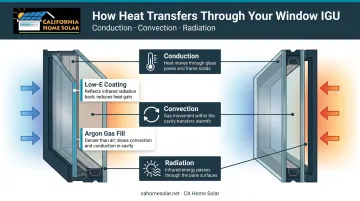
Each technology targets a different heat transfer pathway. Heat moves through glass via conduction, convection, and radiation. Low-E handles radiant transfer; argon suppresses convection currents and slows conduction between panes. Together, they cover all three mechanisms — which is why pairing them produces meaningfully better performance than either coating or gas fill alone.
Key Benefits of Argon Gas-Filled Low-E Windows
Energy Efficiency and Lower Cooling Costs
Argon's density reduces how quickly heat conducts through the window assembly. The performance difference is measurable: according to Vitro Glazings, using 90% argon fill in a Low-E IGU instead of air delivers an up to 16% improvement in insulating value.
At the household level, ENERGY STAR estimates that replacing old single-pane windows with ENERGY STAR certified windows can lower energy bills by an average of up to 13% nationally. In California specifically, ENERGY STAR's regional estimates put annual savings at approximately $125 versus single-pane windows.
Improved Thermal Comfort
In winter, cold spots form near windows when interior glass surfaces drop well below room temperature. In summer, south-facing glass radiates heat into the room even with the AC running. Argon-filled Low-E windows bring that surface temperature closer to ambient, reducing HVAC strain and making rooms noticeably more comfortable.
UV Protection and Interior Preservation
Low-E coatings block a substantial portion of ultraviolet radiation — UV is the primary driver of fading in flooring, furniture, and fabrics. In Southern California, where direct sun hits homes nearly every day of the year, this protection is particularly relevant for south- and west-facing rooms.
Noise Reduction
Because argon is denser than air, it absorbs sound waves more effectively than a standard air gap. For homeowners near busy streets, freeways, or commercial areas across Los Angeles County, this translates to quieter rooms — though most of the acoustic improvement comes from the double-pane assembly itself, not the gas fill alone.
Home Value and Title 24 Compliance
The performance gains above aren't just comfort upgrades — they directly align with California's compliance requirements. California's Building Energy Efficiency Standards (Title 24) set fenestration limits for new construction and larger renovation projects. Key thresholds under the 2022 Energy Code for Climate Zones 8, 9, and 10 (which cover most of the LA basin):
- U-factor: 0.30 maximum
- SHGC: 0.23 maximum
- Effective date of next update: January 1, 2026 (2025 Energy Code tightens some climate zone requirements)
Argon-filled Low-E windows are one of the most straightforward ways to meet — or exceed — these thresholds.
From a resale standpoint, the JLC 2024 Pacific Cost vs. Value report shows vinyl window replacement recouping approximately 85.9% of project cost in Pacific region homes — one of the stronger returns among common home improvement projects.
How Low-E Coating and Argon Gas Work Together
Heat escapes and enters your home through windows via three mechanisms:
- Conduction — heat flowing through solid materials (glass, frame)
- Convection — heat transferred by gas movement within the cavity between panes
- Radiation — heat energy transmitted directly through space as infrared light
Argon gas primarily suppresses convection currents within the IGU cavity and reduces conductive transfer. Low-E coating reflects radiant infrared energy — both outbound interior heat in winter and inbound solar heat in summer.
Because each technology targets a different heat transfer pathway, they perform better together than either does alone — and that's where the real efficiency gains show up.
A Southern California Summer Scenario
Direct afternoon sun hits a west-facing window. The solar-control Low-E coating on surface 2 (inside face of the outer pane) reflects a significant portion of that solar infrared energy before it enters the cavity. Whatever heat does penetrate the outer pane encounters the argon-filled gap, which resists conductive transfer to the inner pane. The result: less heat reaches the interior glass surface, the room stays cooler, and the AC doesn't have to compensate as aggressively.
In mild California winters, the same system works in reverse — the coating reflects interior radiant heat back inside, and the argon gap slows the outward loss.
Key Performance Numbers to Know
When selecting windows, ask for these three specifications:
- U-factor: Rate of heat loss — lower is better. ENERGY STAR Southern Zone requires ≤ 0.32
- SHGC: Solar Heat Gain Coefficient — lower is better for hot climates. ENERGY STAR Southern Zone requires ≤ 0.23; for south- and west-facing exposures, aim for below 0.25
- ENERGY STAR certification: Confirm the unit is certified for the Southern Climate Zone, which covers the Los Angeles area
Argon vs. Krypton: Which Makes Sense Here?
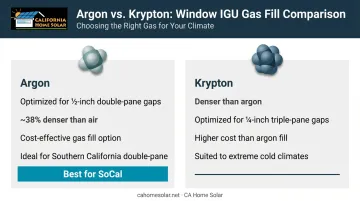
Krypton gas is denser than argon and performs better in narrow gaps (around ¼ inch) typical of triple-pane units. Argon is optimized for standard ½-inch double-pane cavities and costs significantly less. For most Southern California homeowners, the climate simply doesn't require triple-pane performance. Argon-filled double-pane with solar-control Low-E delivers the right balance of efficiency and value for this region.
Step-by-Step Installation Guide
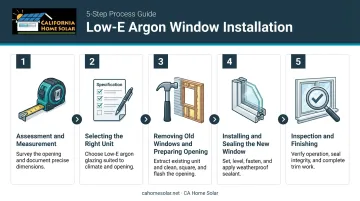
Step 1 — Assessment and Measurement
A professional evaluates each window opening: exact dimensions, framing condition, signs of rot or moisture damage, and the rough opening square. Precision matters here because argon-filled IGUs are custom-sealed units — an incorrectly measured opening creates gaps that compromise both performance and weatherproofing.
CA Home Solar offers free consultations for homeowners across Southern California — including Los Angeles County, Orange County, and surrounding communities — covering assessment of existing window conditions before recommending a replacement specification.
Step 2 — Selecting the Right Unit
For Southern California installations, specify:
- ENERGY STAR Southern Climate Zone certification
- SHGC ≤ 0.23 (below 0.25 for south/west exposures)
- U-factor ≤ 0.32 (0.30 or lower to meet Title 24 prescriptive for new windows)
- Manufacturer seal warranty of 20+ years on the IGU
Step 3 — Removing Old Windows and Preparing the Opening
The existing window, old flashing, deteriorated caulk, and any damaged frame material are carefully removed. The rough opening is cleaned, checked for square, and inspected for rot or moisture intrusion. Any compromised framing should be repaired before the new unit goes in — skipping this step undermines performance regardless of window quality.
Step 4 — Installing and Sealing the New Window
The IGU is set into the opening, shimmed for level and plumb, and fastened per the manufacturer's specifications. The critical work here is the perimeter seal:
- Weather-resistant flashing tape applied continuously around the exterior
- Exterior-grade caulk sealing all joints
- Interior air seal at the interior perimeter
One important clarification: the argon gas is already factory-sealed inside the IGU before it arrives on-site. No special gas handling or on-site filling is required.
What the installation seal controls is air infiltration and moisture intrusion around the frame — the factors that determine whether the IGU performs as rated over its service life.
Step 5 — Inspection and Finishing
After installation, a qualified crew performs final checks:
- Verifies level and plumb
- Tests operating function on operable units
- Inspects all perimeter seals visually
- Applies interior trim
Before the crew leaves, request documentation of the window's ENERGY STAR certification, U-factor, SHGC, and the manufacturer's IGU seal warranty. You'll need these records for HERO financing applications, utility rebate claims, or Title 24 compliance sign-off.
Cost, ROI, and Financing
What to Expect on Cost
Window replacement costs vary based on window size, frame material, installation complexity, and number of units. Based on current market data for the Los Angeles area:
- Per-window range: roughly $500–$2,000 for double-pane Low-E units installed
- Whole-home projects: typically $7,000–$12,000 depending on scope, with a national average around $7,351 according to Angi's 2026 data
These figures are estimates — actual pricing for a specific home depends on the window count, sizes, and any framing repairs needed.
The ROI Case
Window upgrades pay off through several channels:
- Lowers monthly energy bills by reducing cooling loads
- Reduces HVAC wear as the system cycles less frequently
- Adds resale value: Pacific region vinyl window replacement recoups approximately 85.9% of project cost (JLC 2024)
- Satisfies Title 24 compliance for planned additions or renovations, avoiding specification changes during permitting
Financing Through PACE Programs
CA Home Solar is a HERO Registered Contractor, which gives homeowners access to PACE (Property Assessed Clean Energy) financing for qualifying energy-efficient upgrades including windows. Key features:
- Zero down, zero upfront costs
- Repaid through property tax assessments over 5–25 years
- Approval based primarily on home equity and payment history, not credit score
- Doesn't affect eligibility for separate utility rebates or tax credits
California also offers GoGreen Home financing for energy-efficient improvements including windows, available through participating lenders. Current utility-specific rebates from SCE and SoCalGas don't include direct window replacement incentives.
The federal Energy Efficient Home Improvement Credit (25C) may apply to qualifying window upgrades — consult a tax professional for current eligibility.
Frequently Asked Questions
Are Low-E argon windows worth it in Southern California?
Yes. In a high-sun climate, solar heat rejection and reduced conductive transfer directly lower cooling loads — Southern California's biggest household energy expense. UV protection and improved indoor comfort add further value beyond the utility bill savings.
How much do Low-E argon windows cost?
Installed costs in the Los Angeles market range from $500 to $2,000 per window, with whole-home projects typically falling between $7,000 and $12,000. Size, frame material, and installation complexity all affect the final number — a quote from CA Home Solar will give you an accurate figure for your home.
What's the difference between argon and krypton gas?
Argon is cost-effective and performs well in standard ½-inch double-pane gaps — the right choice for most Southern California homes. Krypton is denser and better suited to narrow ¼-inch gaps in triple-pane configurations, but it costs significantly more. Unless you're specifying triple-pane units, argon is the practical choice.
How long does argon gas last in windows?
According to the NFRC Consumer Guide, gas-filled windows can lose approximately 0.5% of their gas per year and still perform at 90% of original capacity after 20 years. Seal quality is the determining factor — which is why choosing a unit with a long manufacturer seal warranty matters.
Do argon gas-filled Low-E windows need special maintenance?
No special maintenance is required beyond routine cleaning. The one thing to watch for: fogging or condensation between the panes, which indicates seal failure. When that happens, the argon has escaped and moisture has entered the cavity — the IGU needs replacement, not repair.