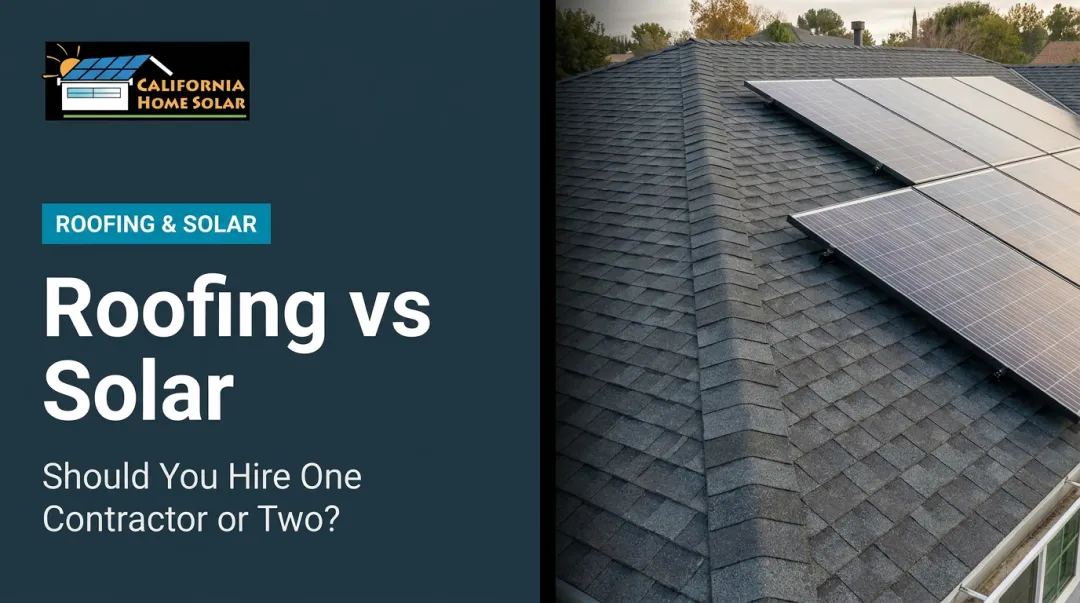
For many LA-area homeowners, this creates a real decision point: do you add solar now, replace the roof now, or tackle both together?
The answer depends on numbers that vary widely. A roof replacement could cost $15,000 or $45,000. A solar system might run $12,500 or $30,000 before incentives. Getting those figures confused—or ignoring how one affects the other—leads to serious budget shortfalls. This guide breaks down what each project actually costs, what moves those numbers, and how to plan for both intelligently.
Key Takeaways
- Roof replacement in Southern California typically runs $15,500–$54,000+ depending on size and material; solar installation runs $12,500–$30,000+ before incentives
- The federal 30% Investment Tax Credit applies to solar through 2032; California's SGIP offers battery storage rebates for qualifying homeowners
- Installing solar on an aging roof is a costly mistake—panel removal and reinstallation adds $1,500–$6,000 when the roof eventually fails
- Bundling both projects with one contractor saves on mobilization, permitting, and avoids future removal costs
- California's payback period averages 7.64 years per EnergySage; after that, your system generates power at no additional cost for its remaining lifespan (typically 10–18 more years)
How Much Do Roof and Solar Installations Cost in California?
Neither roofing nor solar has a fixed price. Costs shift based on home size, materials, roof complexity, and local labor rates, which makes ballpark estimates misleading without knowing the specifics of your property.
Common budget mistakes include:
- Looking at solar-only estimates while ignoring a deteriorating roof underneath
- Over-specifying a premium system that exceeds actual energy consumption
- Discovering the real cost only when an unreplaced roof fails and panels have to come off
Roofing Cost Ranges in Southern California
| Tier | Typical Scope | Cost Range (LA Area) |
|---|---|---|
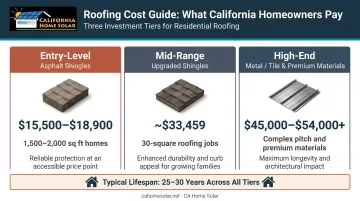
| Entry-level | Standard asphalt shingles, 1,500–2,000 sq ft home | $15,500–$18,900 |
| Mid-range | Upgraded shingles, moderate complexity, 30-square job | ~$33,459 |
| High-end | Metal, tile, complex pitch, reinforced decking | $45,000–$54,000+ |
Angi's Los Angeles roofing data puts the LA average at $8.60/sq ft, with a 1,500 sq ft home running approximately $15,500 and a 2,000 sq ft home around $18,900. The JLC/Cost vs. Value 2024 report benchmarks a standard 30-square asphalt job in LA at $33,459—and a standing-seam metal roof at $54,809 for the same scope.
What's typically included: tear-off and disposal, underlayment, drip edge, aluminum flashing, ridge treatment, and basic permitting (~$245 in LA).
What's commonly excluded: structural decking repair, fascia/soffit work, solar-readiness upgrades, and valley flashing replacements.
Mid-range asphalt work is the most common fit for older Southern California homes preparing for solar. A 25 to 30-year material lifespan aligns with a solar panel's expected output life, which matters when you're bundling both projects. High-end tile and metal roofing is typical in Malibu, Palos Verdes, and hillside communities where aesthetics and structural load from panels both matter. CA Home Solar installs across the full material range in these areas, from asphalt shingles to metal and tile.
Solar Installation Cost Ranges in California
According to EnergySage's 2026 California data, the statewide average is $2.53/watt, with a typical 8.81 kW system coming in at $22,284 before incentives. Los Angeles specifically averages $2.40/watt, which is slightly below the state average and notably below the national average of $2.58/watt.
| Tier | System Size | Pre-Incentive Cost | Best For |
|---|---|---|---|
| Entry-level | 5 kW | ~$12,647 | Smaller homes, moderate bills |
| Mid-range | 10 kW | ~$25,294 | Most LA households, post-NEM 3.0 |
| High-end + storage | 12 kW + battery | $30,505+ (solar) + $13,473 (Powerwall 3) | Self-consumption focus, backup power |
Battery storage is quoted separately from the solar system. A Tesla Powerwall 3 runs approximately $13,473 installed before incentives, and general battery additions typically add $10,000–$20,000 to a project total. Storage has become more financially relevant post-NEM 3.0: the value of what you export to the grid dropped roughly 75% compared to NEM 2.0, making self-consumption a stronger economic argument than it was before.
Before these figures can translate into a real project budget, incentives—particularly the federal ITC and California-specific programs—need to be factored in.
What Drives the Cost of Roof and Solar Installations Up or Down
Cost is not just about material prices. Technical, site-specific, and contractor-level factors push your final number well above or below any advertised range.
Roof Characteristics and Solar Suitability
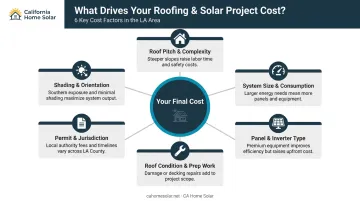
Roof pitch, number of planes, dormers, skylights, and orientation all affect both projects simultaneously. A multi-plane roof with dormers requires custom cuts, additional racking complexity, and longer install time, which raises labor costs for both the roofing crew and the solar installer.
South-facing roof planes maximize solar production. East/west-facing arrays still work but require more panels to hit the same output target, increasing system cost. Flat or low-slope roofs may need ballasted racking, which adds material cost.
System Size and Energy Consumption
Larger systems generally cost less per watt due to bulk pricing, but total spend is higher. Size to actual consumption: pull 12 months of utility bills and calculate average monthly kWh use.
Getting the size wrong costs you either way:
- Undersized system: Continued high utility bills because solar covers only part of your load
- Oversized system: Capital tied up in panels producing more electricity than you use
- Right-sized system: Maximum payback speed based on your actual consumption pattern
Panel and Inverter Type
- Monocrystalline panels: High efficiency, most common, higher upfront cost
- Polycrystalline panels: Lower cost, lower efficiency, requires more panels for same output
- Thin-film: Rarely used residentially
Inverter selection matters as much as panel choice, particularly in hilly LA neighborhoods with shading or complex roof angles:
- String inverters: Lowest cost, but shading on one panel reduces output for the entire string
- Microinverters (e.g., Enphase IQ8): Panel-level optimization, ideal for shaded or multi-angle roofs, higher cost
- Power optimizers (e.g., SolarEdge): Middle ground between string and micro
CA Home Solar installs all three inverter types, selecting based on site conditions. This matters most for hillside properties in areas like Palos Verdes, Topanga, and the San Gabriel foothills, where partial shading and multi-angle rooflines are common.
Roof Condition and Pre-Solar Prep Work
If a roof is more than 10 years old, most installers will recommend replacement before mounting panels. Removing and reinstalling a solar array for a future roof replacement costs $1,500–$6,000, and sometimes more than $7,000 for larger systems, according to EnergySage.
Other pre-solar costs that rarely appear in initial quotes:
- Electrical panel upgrade: $1,000–$3,000 if the existing panel is under 200 amps
- Structural reinforcement for heavy tile or complex racking
- Tree removal for shading obstructions
Location and Permit Complexity
LA County, the San Fernando Valley, the South Bay, and the San Gabriel Valley each have different permitting timelines, fee structures, and utility interconnection requirements. No two jurisdictions process solar permits on the same schedule.
The LA area's $2.40/watt average sits below both the state and national averages. Projects involving complex permits, hillside engineering reviews, or slow utility interconnection queues can stretch timelines significantly, adding indirect costs even when hard costs stay on budget.
Full Cost Breakdown: Where Your Money Actually Goes
Solar System Components
The sticker price of a solar installation includes far more than panels. According to EnergySage, solar panels themselves represent only about 12% of the total installation cost. What you're paying for is the full ecosystem.
A typical California residential installation at $2.40–$2.53/watt breaks down roughly as:
- Panels (~12%): The modules themselves
- Inverter(s) (~10%): String, micro, or optimizer-based system
- Racking and mounting (~3–5%): Rails, attachments, roof penetration hardware
- Electrical wiring (~9%): DC/AC wiring, conduit, disconnect hardware
- Permitting and interconnection (~8%): City permits, utility application, inspection fees
- Installation labor (~7%): Rooftop crew, electricians
- Overhead, sales, and profit (~30%+): Installer operations, warranties, customer acquisition
Quotes that look well lower than the market range are often cutting corners on electrical work, using lower-tier inverters, or excluding interconnection fees.
Roofing Cost Components
A standard roofing invoice covers:
- Materials (shingles, tiles, or metal panels)
- Tear-off and disposal of existing roof
- Underlayment (standard or upgraded)
- Flashing replacement
- Drip edge and ridge treatment
- Inspection and permitting
Solar-ready roofing adds cost upfront but prevents larger costs later. This typically means reinforcing structural anchor points and pre-positioning mounting hardware so panels are securely attached and optimally angled. Handled during the roofing project, this prep work costs a fraction of retrofitting those same features after the roof is finished.
The Hidden Cost: Doing Them Separately
If a homeowner installs solar today and replaces the roof in five years, they'll pay for panel removal and reinstallation on top of full roofing costs. That's $1,500–$6,000 added to an already significant project. For a 20-panel system, the per-panel removal rate of $200–$300 adds up fast.
When a roof is already aging, coordinating both projects eliminates that removal cost entirely — and locks in a single mobilization, inspection, and permitting cycle instead of two.
Roof + Solar Together: Is It Worth Bundling?
The financial case for doing both at once is strong:
- One mobilization cost: Scaffolding, equipment, and labor setup happens once
- One permitting process: Structural and electrical reviews happen together
- No future removal fees: Panels go directly onto a properly prepped, fresh roof
- Sequencing advantage: Roofing crew completes and clears; solar crew mounts on a certified surface
In Southern California's climate, combining a cool roof with solar is an especially effective pairing. CA Home Solar's cool roof installations can keep a roof surface 50°F cooler than a standard dark roof under summer sun—directly reducing attic temperatures and AC load. Add solar generation on top, and both systems reinforce each other: lower attic heat means less AC demand, while the panels offset whatever electricity your HVAC still draws. With 36 years handling both services locally, CA Home Solar manages the trade coordination in-house—so homeowners get one point of contact instead of two separate contractors to schedule.
That said, bundling isn't always the right call. If your roof is less than 5–7 years old and in good condition, installing solar now and replacing the roof later is a reasonable approach. A site assessment will clarify the right sequencing for your situation.
How to Budget, Finance, and Maximize Savings
California Incentives That Reduce Your Net Cost
1. Federal Investment Tax Credit (ITC) The IRS Residential Clean Energy Credit equals 30% of qualified solar property costs for systems placed in service through 2032. This applies to the full solar system—panels, inverters, labor, and installation. Standard roofing materials don't qualify, but solar roofing tiles and certain structural work that directly enables solar installation may qualify. Consult a tax professional for your specific project.
2. SGIP Battery Storage Rebates California's Self-Generation Incentive Program offers:
- $150/kWh for standard small residential storage
- $1,000/kWh for Equity Resiliency participants
- $1,100/kWh + $3,100/kW for the Solar and Storage Equity program (reservations began June 2025)
SGIP is eligibility-limited, not universally available. Check CPUC's current program status before assuming you qualify.
3. NEM 3.0 (Net Billing Tariff) For anyone who applied for interconnection after April 15, 2023, California's net metering now compensates exported power at Avoided Cost Calculator values—not retail rates. Export credits dropped roughly 75% compared to NEM 2.0. The implication: self-consumption and battery storage now deliver better ROI than oversizing for grid export.
Financing Options
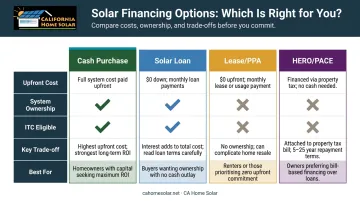
| Option | Upfront Cost | Owns System | ITC Eligible | Notes |
|---|---|---|---|---|
| Cash purchase | Full amount | Yes | Yes | Best long-term ROI |
| Solar loan | $0 down available | Yes | Yes | Interest reduces savings; over 90% pay off in under 6 years |
| Lease/PPA | $0 | No | No | Immediate bill reduction; complicates home sale |
| HERO/PACE financing | $0 | Yes | Yes | Billed through property taxes; 5–25 year terms |
California Home Solar is a registered HERO contractor, so HERO financing is available for both roofing and solar projects through them—not just solar. Approval is tied to home equity rather than credit score. They also work with California First and YGrene government programs, with zero-down financing and no application fees.
What Most Homeowners Get Wrong When Budgeting
Before signing a contract, watch out for these common budgeting errors:
- Compare lifetime cost, not just quote price. A cheaper, lower-efficiency system can cost more over 25 years. Calculate payback period and lifetime savings alongside the upfront total.
- Get your roof assessed before committing to solar. Skipping this turns one investment into two—with a $1,500–$6,000 panel removal fee sandwiched between them.
- Size to actual consumption, not a rough guess. Pull your utility bill and find your real monthly kWh. Homeowners who estimate tend to undersize, then wonder why their bills stay high after installation.
Frequently Asked Questions
What is the average cost to have solar panels installed on your roof?
In California, solar installations average $2.53/watt statewide and $2.40/watt in the LA area, translating to roughly $12,647 for a 5 kW system and $25,294 for a 10 kW system before incentives. The 30% federal ITC significantly reduces net cost. Actual price varies by roof type, system configuration, and installer.
What do the 20% and 33% rules mean for solar panel installations?
The 20% rule is a general guideline suggesting panels shouldn't cover more than 20% of a roof's surface for structural and airflow reasons. The 33% rule refers to a rough early estimate that solar offsets about a third of a typical electricity bill. Neither is a universal code; actual system sizing should come from a site-specific assessment.
Why is my electric bill so high if I have solar?
The most common reasons: the system is undersized for actual consumption, NEM 3.0 has reduced export credits making self-consumption habits more important, or there's a performance issue such as dirty panels or inverter degradation. Note that monthly fixed utility charges (for example, SCE's $14 baseline fee) apply regardless of solar output. Check your monitoring data and schedule an inspection if bills remain unexpectedly high.
Do I need to replace my roof before installing solar panels?
Not always — but if the roof is more than 10 years old or showing wear, replacing it first is strongly recommended. Panel removal and reinstallation runs $1,500–$6,000 or more, so bundling both projects upfront is almost always more cost-effective.
How long does it take for solar panels to pay for themselves in California?
EnergySage reports California's average solar payback at 7.64 years. For solar-plus-battery systems under NEM 3.0, SCE customers average around 8 years. After payback, electricity from the system is effectively free for the remaining 15–20 years of its life.
Does adding solar panels increase my home's value?
Yes. Zillow research found homes with solar sell for 4.1% more than comparable homes without it. Owned systems add value directly; leased systems or PPAs can complicate resale since the agreement transfers to the buyer. Outright ownership is the better choice for resale.