Manufactured homes make up a significant share of California's housing stock, and with the state's residential electricity averaging 33.35 cents/kWh as of March 2026 (among the highest in the nation), the financial case for solar has never been stronger. The path to installation just requires a different set of questions upfront.
This guide covers the structural reality of manufactured home solar, your installation options beyond rooftop mounting, how to choose the right components, what it will cost in California, and which incentives actually apply to your situation.
Key Takeaways
- Manufactured homes can go solar — rooftop installation just isn't always the right approach
- Ground-mounted systems and alternative-structure mounts bypass most structural limitations
- California offers equity-focused incentives (DAC-SASH, SGIP, SOMAH) beyond the standard federal credit
- Pairing solar with insulation and duct sealing upgrades can cut energy needs by up to 40%
- A smaller, cheaper array is often all you need once efficiency improvements are in place
Can a Manufactured Home Support Solar Panels?
The short answer: sometimes on the roof, often not — and that's fine, because alternatives exist.
The Structural Reality
Manufactured homes built under HUD Code have roof live-load ratings that vary by geographic zone:
- Zone South (California's climate zone): 20 psf
- Zone Middle: 30 psf
- Zone North: 40 psf
California's residential solar permitting guidebook uses a ≤4 psf threshold (modules plus support components) for expedited flush-mount approvals. That figure sounds comfortable against a 20 psf live-load rating — but it's an expedited permit screening tool, not a manufactured home approval standard. Complicating factors — wind uplift forces, snow load multipliers, and the home's specific framing condition — can all shift the math. A professional structural review is non-negotiable before any rooftop installation.
Foundation and Permitting Requirements
California's Housing and Community Development (HCD) department treats manufactured home solar installations as alterations requiring permits. Structural or load-bearing changes require engineered plans. Many local jurisdictions also require solar installations to be on structures with permanent foundations.
A HUD-compliant perimeter foundation can unlock rooftop installation eligibility in many California jurisdictions. Homes on pier-and-beam setups face higher permitting hurdles.
Older vs. Newer Homes
HUD's 1994 rule raised wind standards for manufactured homes, making pre-1994 vs. post-1994 the more defensible structural dividing line. Post-2000 is a reasonable rule of thumb in practice, but your home's HUD data plate and an engineering review are the actual determinants.
Quick Decision Framework
| Home Condition | Recommended Path |
|---|---|
| Post-1994, permanent foundation, passes load review | Rooftop installation viable |
| Pre-1994 or pier-and-beam setup | Ground-mount recommended |
| Park-owned land or rental situation | Community solar programs |
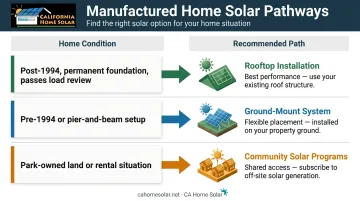
Solar Installation Options for Manufactured Homes
There are four viable paths. The right one depends on your structural assessment, lot configuration, and permitting jurisdiction.
Rooftop Installation
When it works, rooftop solar keeps ground space free and often reduces trenching costs. Conditions required:
- Structurally reinforced roof with verified load capacity
- Permanent, HUD-compliant foundation
- Local HCD permit approval with engineered plans
Lightweight thin-film or flexible panels (as light as 2.4 kg per panel for 100W flexible models) reduce load concerns compared to standard rigid panels at ~22 kg each. Trade-off: lower power output per square foot.
Ground-Mounted Solar Systems
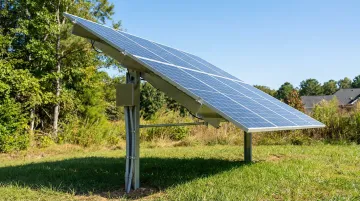
Ground-mounted systems are the recommended default for most manufactured home situations. Key advantages:
- Bypass roof structural concerns entirely
- Angle can be optimized for maximum sun exposure regardless of roof pitch
- Generally easier to permit in California jurisdictions
- Easier to clean and service without roof access equipment
The trade-off is cost. EnergySage's 2026 marketplace data shows ground-mounted systems run about 51% more than rooftop systems on average, largely due to posts, frames, and trenching. For most manufactured homes, that premium is worth it — and CA Home Solar's free site consultations cover shading analysis, lot configuration, and utility interconnection requirements throughout Southern California before you commit to anything.
Alternative Structure Mounting
A detached garage, carport, or sturdy shed on the property often meets the load and foundation requirements that the manufactured home itself doesn't. Panels mount on the structure, and wiring runs to the home. Permits are still required, and the structure must pass a load inspection — but this path avoids touching the manufactured home's roof entirely.
Community Solar: The No-Install Option
When all on-site paths are ruled out — whether you're renting in a manufactured home park or the lot configuration just doesn't work — California's community solar programs offer a real alternative:
- DAC-GT (Disadvantaged Communities Green Tariff): Income-qualified customers in disadvantaged communities receive a 20% bill discount
- CSGT (Community Solar Green Tariff): Similar 20% discount for DAC customers unable to install rooftop solar
These programs are especially relevant for manufactured home park residents where the park owner controls the property.
Choosing the Right Solar Panels and System Components
Panel Types Compared
| Panel Type | Efficiency Range | Typical Weight | Best Use Case |
|---|---|---|---|
| Monocrystalline (rigid) | 21%–22% | ~22 kg | Limited roof/ground space; maximum output per sq ft |
| Polycrystalline | 17%–18% | ~22 kg | Ground-mounted systems with more space available |
| Thin-film / Flexible | 15%–19% | 2–5 kg | Weight-sensitive rooftop applications |
For most manufactured home situations with a ground mount, monocrystalline panels deliver the highest watt-per-dollar output over a 25-year lifespan. Weight-constrained rooftop installs are the exception — there, flexible panels are the practical choice despite the efficiency trade-off.
Calculating Your Energy Needs
EIA data shows manufactured homes average roughly 8,034 kWh/year in electricity use — compared to about 10,800 kWh/year for single-family detached homes. That lower baseline often means a smaller, more affordable array will cover your needs.
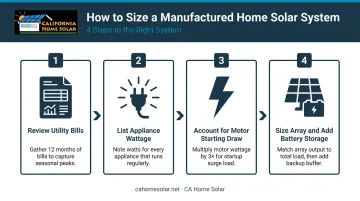
To size your system:
- Pull 12 months of utility bills and find your average monthly kWh
- List major appliances and their wattage (check the label, or multiply amps × volts)
- Account for starting wattage on motor-driven devices like AC units and refrigerators — starting draw can be 2–3× running wattage
- Size the array to cover average monthly usage, with battery storage bridging overnight gaps
Battery Storage
Battery storage lets you use daytime solar production at night or during outages. The table below draws on PNNL's grid-scale benchmarks for directional guidance — residential quotes will differ:
| Chemistry | Cycle Life | Round-Trip Efficiency |
|---|---|---|
| Lead-acid | ~1,370 cycles | 78% |
| Lithium-ion NMC | ~1,520 cycles | ~83% |
| Lithium Iron Phosphate (LFP) | ~2,400 cycles | ~83% |
LFP's roughly 2,400-cycle lifespan makes it the most durable option for residential use. For manufactured homes specifically, batteries typically cannot be mounted on the home's structure — a garage wall or ground-mounted pedestal is the standard placement.
Inverters and Charge Controllers
Once your battery bank is sized, everything still routes through two more components before powering your home:
- Inverter: Converts DC solar output to AC for home appliances. String inverters work for most setups; microinverters suit systems with shading or complex roof angles.
- Charge controller: Prevents battery overcharging. MPPT (Maximum Power Point Tracking) controllers are recommended for larger systems due to higher efficiency over PWM alternatives.
How Much Does Solar Cost for a Manufactured Home in California?
System Cost Benchmarks
LBNL's October 2025 update reports 2024 residential PV median prices of:
- $3.50/W cash purchase
- $4.70/W loan-financed
California's median residential system size was 5.7 kW in 2024. For a manufactured home with lower energy needs, a 3–4 kW system may be sufficient.
Rough cost estimates (before incentives):
| System Type | Size | Estimated Cost |
|---|---|---|
| Rooftop (if viable) | 3–4 kW | $10,500–$18,800 |
| Ground-mounted | 3–4 kW | $15,000–$25,000+ |
| With battery storage | Add 10 kWh | Add $8,000–$15,000+ |
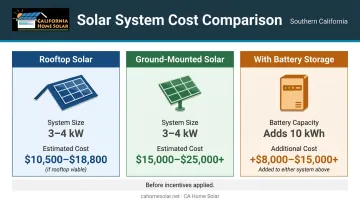
Ground-mount systems cost more due to posts, frames, and trenching. Battery pricing reflects residential installed estimates, not grid-scale benchmarks.
Payback Period
At California's current 33.35 cents/kWh average rate, solar savings accumulate faster than in most states. EnergySage reports an average California solar payback period of roughly 7.6 years — and that figure assumes larger systems typical of site-built homes. A smaller, right-sized system for a manufactured home can hit similar payback timelines.
Financing Options
- Cash purchase: Lowest total cost, maximum incentive capture
- Solar loans: Finance through third-party lenders; monthly payment offset by bill savings
- PACE / HERO financing: CA Home Solar is a registered HERO contractor, offering $0 down with repayment spread over 5–25 years through your property tax bill. Approval is based on home equity and payment history, making it accessible to owners who don't qualify for traditional loans.
California Solar Incentives Manufactured Home Owners Should Know
Federal Tax Credit Status
The IRS residential clean energy credit stood at 30% through December 31, 2025. Per 2025 Form 5695 instructions, expenditures after that date are not eligible. If you're planning a 2026 installation, confirm the current credit status with your tax advisor — tax law may have changed since this guide was published.
California-Specific Programs
Net Billing Tariff (NEM 3.0): Customers who applied for interconnection after April 15, 2023 receive export compensation based on avoided-cost values rather than retail rates. Export credits are lower under NEM 3.0 than the previous NEM 2.0 structure, which means battery storage is more valuable — storing your solar production rather than exporting it maximizes bill savings.
SGIP (Self-Generation Incentive Program): Battery storage rebates vary by applicant type:
- $1,100/kWh + $3,100/kW for Residential Solar and Storage Equity applicants (income-qualified)
- $150/kWh for standard Small Residential Storage
- Equity applicants must meet CARE/FERA enrollment or DAC location criteria
SGIP program details are available through the CPUC.
DAC-SASH: No-cost rooftop solar for income-qualified homeowners in disadvantaged communities. Eligibility requires CARE/FERA enrollment and a qualifying DAC location — potentially relevant to owner-occupied manufactured homes meeting income and location criteria.
SOMAH: Solar incentives for multifamily affordable housing — which includes mobile home parks — at up to $3.50/AC W for tenant load.
Park Restrictions to Check First
Before pursuing any of these incentives, manufactured home park residents have one more layer to navigate: community rules.
If you live in a manufactured home park, review your lease and community rules before proceeding. Some parks restrict ground-mounted systems or lot modifications, and California's Mobilehome Residency Law provides only partial protection — specific rules vary by community.
Energy Efficiency Upgrades That Maximize Your Solar ROI
Manufactured homes are often less energy-efficient than site-built homes — thinner walls, minimal insulation, and older HVAC systems all increase your energy load. ACEEE research found that cost-effective efficiency upgrades for manufactured homes can cut 40% of projected electricity use and 33% of projected natural gas use.
That directly affects your solar sizing: cut your energy load first, and you need a smaller — and cheaper — array to cover it.
Highest-ROI Upgrades for Manufactured Homes
Per DOE recommendations for manufactured homes:
- Seal furnace ducts and air leaks — the single highest-impact upgrade category for most older manufactured homes
- Add belly insulation (the underside of the home is a major heat-loss point)
- Improve attic/roof insulation to reduce cooling load
- Install interior storm windows or energy-efficient replacement windows to cut infiltration
- Switch to LED lighting throughout
- Install a smart thermostat to eliminate unnecessary heating and cooling
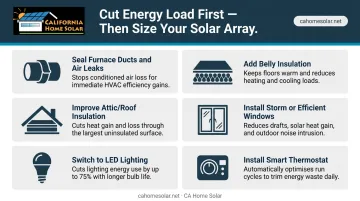
Tackling these upgrades alongside your solar installation simplifies the whole process. California Home Solar bundles window installation and HVAC upgrades with solar projects, so everything moves through a single permit process and financing arrangement — including PACE programs like HERO, which can cover the full project cost with no money down.
Frequently Asked Questions
How much does it cost to install solar panels on a manufactured home?
In California, a manufactured home solar system typically runs $10,500–$18,800 for rooftop installations and $15,000–$25,000+ for ground-mounted systems before incentives, based on 2024 median price data. Ground-mount adds cost due to structural work and trenching. Get a free on-site quote from CA Home Solar to size your system accurately.
Can solar panels be installed on a manufactured home, and what might prevent installation?
Yes, though some barriers apply. Insufficient roof load capacity, lack of a permanent foundation, and local building code restrictions are the most common obstacles. Ground-mounted systems and alternative-structure mounts (garage, carport) work around most of these limitations and are often the recommended path.
Why is my electric bill still high even with solar panels on a manufactured home?
Several factors can offset your savings: an undersized system, air leaks or poor insulation increasing your load, shading cutting panel output, or lower-than-expected NEM 3.0 export credits. An energy audit is usually the first diagnostic step.
Does having solar panels on a manufactured home make it harder to sell?
Solar generally adds value, particularly in California where energy costs are high. Owned systems — not leased — are the most attractive to buyers and don't complicate the title transfer. Leased systems require lease assignment, which can slow a sale.
What type of solar panels work best on a manufactured home?
Monocrystalline panels are best for space-constrained ground mounts (highest efficiency per square foot). Thin-film or flexible panels are ideal for weight-sensitive rooftop applications. For most manufactured home owners using ground mounts, standard monocrystalline panels offer the best long-term value.
Do manufactured home owners qualify for the federal solar tax credit?
Manufactured home owners who own their home and have taxable income liability can claim the 30% residential clean energy credit. The home does not need a permanent foundation to qualify. For 2026 installations, confirm the credit's post-2025 status with a tax advisor, as updated IRS guidance is needed.