This isn't a project for general contractors or residential installers. In California, commercial HVAC work requires a licensed contractor holding a valid CSLB C-20 license (Warm-Air Heating, Ventilating and Air-Conditioning) and full compliance with Title 24 Building Energy Efficiency Standards. The consequences of cutting corners are concrete: chronic system underperformance, uneven temperatures, code violations that delay occupancy, and equipment warranties voided before the first summer.
This guide walks commercial property owners through the entire process — from site readiness and system selection to step-by-step installation, commissioning, and the most common problems to avoid.
Key Takeaways
- Commercial HVAC installation always requires a licensed C-20 contractor — this is never a DIY project in California
- System selection depends on building size, occupancy type, zoning needs, and efficiency targets. No single system fits every property.
- California requires Title 24 compliance and building department permits before any work begins
- Installation follows a defined sequence: load calculation → permitting → site prep → mechanical work → commissioning
- Skipping commissioning causes early failures — PNNL found 40% of buildings had HVAC problems commissioning would have prevented
Prerequisites and Site Readiness
Before ordering equipment or scheduling crews, several conditions must be verified. Gaps discovered after work begins typically mean delays, change orders, and costs that could have been avoided.
What Needs Assessment First
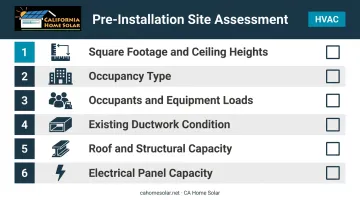
Every commercial HVAC project starts with a full site evaluation covering:
- Total conditioned square footage and ceiling heights
- Occupancy type: office, restaurant, retail, and warehouse all carry different load profiles
- Number of occupants and heat-generating equipment — commercial kitchens, for example, can dramatically increase cooling loads
- Existing ductwork condition, sizing, and leak status
- Roof or mechanical room structural capacity — rooftop units (RTUs) require verified load ratings before placement
- Electrical panel capacity — commercial HVAC systems draw high amperage and often require dedicated circuits or subpanel upgrades
Once the physical site is assessed, the regulatory side needs equal attention.
California Compliance Requirements
Commercial HVAC installations in California are regulated through Title 24 Building Energy Efficiency Standards. The 2025 Energy Code applies to projects with permit applications on or after January 1, 2026.
Key compliance checkpoints:
- Equipment must meet CEC minimum efficiency thresholds from Table 110.2-A. For instance, air-cooled AC units in the 65,000–135,000 Btu/h range require at least 11.2 EER
- Submit NRCC documents at plan check, NRCI forms during construction, and NRCA at final inspection
- For buildings with 10,000 sq ft or more of conditioned space, Title 24 Section 120.8 mandates formal commissioning
Permits must be obtained through the relevant local authority — the City of Los Angeles uses LADBS, while unincorporated LA County projects go through LA County Public Works Building and Safety. No work can legally begin until permits are approved.
Choosing the Right Commercial HVAC System
Southern California's climate makes cooling capacity the primary selection driver. NOAA data shows Los Angeles averages 1,296 cooling degree days annually versus 1,005 heating degree days, with August highs reaching 84°F and roughly 25 days per year at or above 90°F. A system optimized for peak cooling load will spend most of its life under real pressure.
System Types and Best-Fit Applications
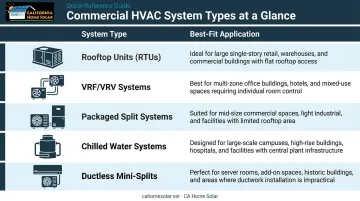
| System Type | Best For |
|---|---|
| Rooftop Units (RTUs) | Low-rise retail and office buildings; frees interior floor space; single-package convenience |
| VRF/VRV Systems | Multi-zone buildings needing independent zone control; strong efficiency at part load |
| Packaged Split Systems | Small-to-mid-size commercial spaces where rooftop access is limited |
| Chilled Water Systems | Large multi-story buildings; regulated by CEC Table 110.2-D (0.610 kW/ton for chillers under 150 tons) |
| Ductless Mini-Splits | Buildings without ductwork or targeted supplemental zone control |
Efficiency Ratings to Evaluate
For commercial systems, the relevant metrics differ from residential:
- EER and IEER are the primary California Title 24 metrics for commercial AC units
- kW/ton and IPLV apply to chilled water systems
- ENERGY STAR certification confirms performance above federal minimums
Selecting equipment that exceeds CEC minimums reduces long-term operating costs and may qualify for utility rebates. Southern California Edison's GoGreen Business Energy Financing program has issued more than $99 million in loans since 2008 for qualifying commercial efficiency upgrades, including HVAC.
Those rebate opportunities make equipment selection a financial decision as much as a technical one. CA Home Solar has worked with Southern California commercial property owners on HVAC system design, permitting coordination, and full installation across Los Angeles County for 36 years.
How Commercial HVAC Installation Works: Step by Step
Commercial installation follows a defined sequence. Deviating from this order — especially pulling permits after the work is done — is a direct path to inspection failures and performance problems.
Step 1 — Load Calculation and System Design
A licensed contractor performs a commercial load calculation per ACCA Manual N to determine required tonnage for each zone. This accounts for solar heat gain, occupancy density, equipment loads, and building envelope performance.
Undersizing causes the system to run continuously without hitting setpoint. Oversizing causes short cycling, humidity issues, and accelerated wear. Neither outcome is acceptable, and neither is fixable without replacing equipment.
This step cannot be approximated or skipped.
Step 2 — Permitting and Plan Approval
The contractor submits mechanical drawings, equipment specs, and Title 24 compliance documentation to the local building department. For LA County and Orange County commercial projects, simple jobs may qualify for expedited review while complex mechanical plan checks take longer. Confirm timelines with the relevant agency before scheduling crews.
Work cannot legally begin until permits are issued.
Step 3 — Site Preparation
- Structural supports for RTUs are installed or reinforced
- Electrical subpanels or dedicated circuits are added as needed
- Existing ductwork is cleaned, sealed, or removed
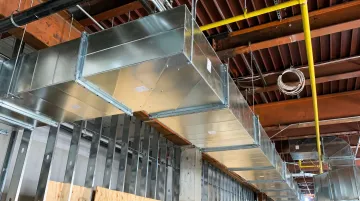
- Rough-in for new ductwork runs is completed
Any shortcuts made during ductwork rough-in — excessive bends, undersized runs, poor sealing — create permanent airflow problems. There's no fixing bad duct geometry without tearing it out.
Step 4 — Equipment Placement and Mechanical Installation
RTUs are craned or lifted into rooftop position and secured per manufacturer specifications. Indoor air handlers, evaporator coils, and fan units are installed in mechanical rooms or ceiling plenum locations.
Refrigerant lines are run and pressure-tested before charging. Skipping the pressure test is one of the leading causes of post-installation refrigerant leaks — a problem that's expensive and disruptive to fix after the fact.
Step 5 — Electrical, Controls, and BAS Integration
The system is wired to the building's electrical supply. Thermostats, occupancy sensors, and programmable controls are installed. For buildings using a Building Automation System (BAS), HVAC controls are integrated for centralized scheduling and monitoring.
Proper BAS integration enables scheduled setbacks, remote fault detection, and zone-level reporting — capabilities that directly affect operating costs over the system's lifespan.
Post-Installation Checks and Commissioning
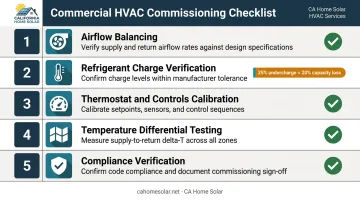
Commissioning is a formal verification process that confirms the system operates at design specifications under real load conditions. Title 24 Section 120.8 mandates commissioning for nonresidential buildings with 10,000 sq ft or more of conditioned space.
What Commissioning Covers
- Airflow balancing across all supply and return registers to eliminate hot and cold spots
- Refrigerant charge verification — NREL data shows a 25% undercharge causes a 20% reduction in cooling capacity and 15% reduction in energy efficiency
- Thermostat and controls calibration
- Temperature differential testing across zones
- Compliance verification against the permitted design
Once the system passes these checks, your contractor should hand over a complete documentation package before you accept the installation.
Documentation You Should Receive
Before accepting system handover, property owners should have:
- As-built drawings
- Equipment warranty documentation and manufacturer manuals
- Inspection sign-off records
- A preventive maintenance schedule
Store these records somewhere accessible. Missing paperwork can void manufacturer warranties and create delays when servicing the system or re-leasing the space.
Common Commercial HVAC Installation Problems and How to Fix Them
Improper System Sizing
Problem: The system runs constantly without reaching target temperatures in summer, or short-cycles in cooler conditions.
Likely cause: Load calculation was skipped or performed without accounting for building-specific factors like solar heat gain, occupancy density, or commercial kitchen equipment.
Fix: Commission a proper Manual N load calculation from a licensed engineer. If equipment is already installed, consult the contractor about corrective capacity adjustments or supplemental zone equipment.
Airflow Imbalance and Hot/Cold Zones
Problem: Certain areas receive too little conditioned air while others are overcooled. Thermostats in some zones never reach setpoint.
Likely cause: Ductwork was sized or routed incorrectly, excessive bends were used, or static pressure was never balanced after installation.
Fix: A technician performs duct pressure and airflow testing to identify problem branches. A technician then adjusts dampers and, where needed, redesigns duct sections to restore proper balance.
Refrigerant Leaks or Electrical Faults Post-Installation
These issues typically surface within the first weeks of operation: the system fails to reach target temperatures, the compressor cycles off on error codes, or breakers trip under normal load.
Refrigerant lines that weren't pressure-tested before charging leave micro-leaks that worsen over time. Incorrect electrical connections — most common with unlicensed installers — create fault conditions that may not trigger immediately.
Correcting either issue requires:
- Leak detection and system recharge by a licensed HVAC technician
- Electrical inspection and connection correction by a licensed electrician
- Pressure-testing documentation to confirm the repair before returning the system to full operation
Pro Tips for a Successful Commercial HVAC Installation
Schedule during off-hours or a planned closure. Crane lifts, ductwork rough-in, and electrical work are noisy, dusty, and hazardous to occupants. Coordinate access well in advance.
Verify contractor credentials before signing. California HVAC contractors must hold a valid CSLB C-20 license. Unlicensed contracting is a misdemeanor punishable by up to 6 months in jail and a $5,000 fine, with administrative fines up to $15,000. The liability falls on the property owner when an unlicensed installer's worker is injured on-site.
Budget for the full project scope. Total installed cost includes:
- Load calculations and engineering
- Permitting fees and plan check costs
- Structural reinforcement (if required)
- Ductwork fabrication and installation
- Electrical upgrades
- Formal commissioning
- First-year preventive maintenance
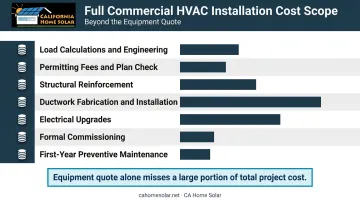
Getting only an equipment quote misses a large portion of the actual project cost.
Pair HVAC with solar if you're already upgrading. Since commercial HVAC is one of the largest electricity draws in Southern California's cooling-dominant climate, pairing it with a solar upgrade is one of the more practical ways to offset that cost. CA Home Solar is a licensed and bonded contractor with 36 years of experience coordinating HVAC and solar projects together across Los Angeles County. Integrated projects can cut overall operating costs compared to handling each upgrade separately.
Conclusion
The quality of a commercial HVAC installation determines system performance, occupant comfort, energy costs, and equipment lifespan for 15–20 years. Every phase matters — from the load calculation that sets system capacity to the commissioning that confirms it actually works.
Prioritize contractor credentials, insist on proper permitting and Title 24 compliance, and treat post-installation commissioning and documentation as non-negotiable before accepting system handover. Skipping steps at any phase compounds into expensive fixes down the road — and in Southern California's climate, an undersized or improperly commissioned system will show those problems fast.
If your commercial property is due for an HVAC upgrade, California Home Solar provides energy-efficient HVAC installations across Los Angeles and Southern California — backed by 36 years of experience and HERO financing options. Contact us to schedule an assessment.
Frequently Asked Questions
Frequently Asked Questions
How much does it cost to install a commercial HVAC system?
Commercial HVAC installation costs vary based on building size, system type, equipment capacity, permitting fees, and commissioning scope. Southern California labor and permitting costs typically run higher than national averages. Get itemized bids from multiple licensed C-20 contractors to establish realistic costs for your specific building.
Which HVAC system is best for commercial properties?
There's no universal answer. RTUs suit low-rise retail and office buildings; VRF systems handle multi-zone offices well; chilled water systems are best for large multi-story complexes. The right choice depends on building size, occupancy type, zoning requirements, and budget.
Do I need permits for commercial HVAC installation in California?
Yes. Permits are required for all commercial HVAC installations in California, and the project must comply with Title 24 Building Energy Efficiency Standards. Work performed without permits can result in fines and forced removal of non-compliant equipment.
How long does commercial HVAC installation take?
A rooftop unit replacement may take 1–3 days. A full system installation in a large commercial building — including permitting, custom ductwork, and commissioning — can take several weeks, with LADBS or LA County permit review adding time that can't be compressed.
How often should a commercial HVAC system be serviced?
At minimum, schedule quarterly inspections and filter replacements, plus a full preventive maintenance service before each cooling and heating season. ASHRAE Standard 180-2018 establishes the standard practice for commercial HVAC inspection and maintenance.
What is the lifespan of a commercial HVAC system?
A properly installed and maintained commercial HVAC system typically lasts 15–20 years. Poor initial installation or deferred maintenance shortens that lifespan considerably, increasing the frequency of emergency repairs and reducing system efficiency well before end-of-life.