But there's a legitimate version of this offer that genuinely makes financial sense for Orange County homeowners, and a predatory version that will cost you far more than you realize. The difference comes down to how the roof cost is structured, who's doing the work, and whether you actually need a new roof in the first place.
This article breaks down how bundled solar and roof financing actually works, what Orange County-specific incentives apply, how to read your SCE bill against projected savings, and — critically — how to spot a bad deal before you sign anything.
Key Takeaways
- "Free roof" means no upfront cost, not zero cost: the roof is financed into your monthly solar payment
- Bundling makes financial sense when your roof has limited life remaining and you need solar anyway
- SCE's average residential rate is 34.5 cents/kWh — high enough that solar ROI in OC is real
- The federal ITC covers 30% of solar costs through 2032, but excludes standard roof replacement costs
- Always get itemized pricing: solar cost, roof cost, and financing fees listed separately
What "Free Roof Replacement with Solar" Actually Means
The word "free" is doing a lot of work in that pitch. The CSLB stated directly in April 2023 that no California programs offer solar installation for free — and the CPUC's Solar Consumer Protection Guide echoes that rooftop solar is almost never free.
What the offer actually means: the roof replacement cost gets folded into your solar financing. You pay nothing upfront, but you're paying for that roof every month through your solar loan, lease, or power purchase agreement.
The Legitimate Version
When a contractor structures this honestly, it looks like this:
- Roof cost and solar cost are both itemized in writing
- Combined monthly payment is often less than your current electricity bill plus what a standalone roof loan would cost
- Both projects complete under one contractor, with one point of responsibility for roof penetrations
- You avoid the alternative: solar on an aging roof that fails mid-system
Removing and reinstalling solar panels for a later roof replacement typically costs $1,500–$6,000 in Southern California — money you avoid entirely by replacing the roof first.
The Deceptive Version
Some contractors inflate the solar system price to absorb roof costs, making it appear the roof is "free" while actually overcharging for the panels. California regulators have scrutinized this practice. Red flags:
- Only a single "package price" with no breakdown
- Solar system price looks unusually high compared to independent quotes
- Salesperson claims the full roof cost qualifies for the federal tax credit (it doesn't)
When Bundling Makes Genuine Financial Sense
Three conditions need to be true simultaneously:
- Your roof has limited useful life remaining (within the next several years)
- You were planning to go solar anyway
- The combined monthly payment is offset by your electricity bill savings
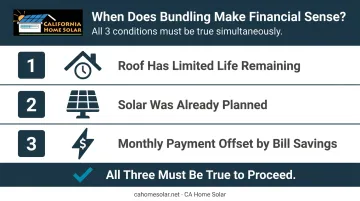
If all three apply, bundling eliminates duplicate project costs and removes the risk of a mid-system reroof. If your roof was replaced two years ago, there's no reason to bundle. Install solar directly.
How Bundled Solar and Roof Financing Works in Orange County
Orange County homeowners typically access bundled projects through one of three financing approaches.
Option 1: Solar Loan with Roof Rolled In
The installer finances both projects as a single loan. You own the system, claim the federal tax credit, and make one monthly payment. For creditworthy homeowners, this is usually the best long-term value.
PACE financing (Property Assessed Clean Energy) is another avenue: repayment runs through your property tax bill rather than a traditional loan. California Home Solar works with PACE-affiliated financing programs. Approval is based primarily on home equity and payment history, not credit score alone. If you're considering PACE, confirm current program availability directly with your contractor, as program status changes over time.
Option 2: PPA or Solar Lease
The installer covers all upfront costs — roof and solar — and owns the system. You pay a fixed monthly rate for the electricity produced. Zero out-of-pocket to start, but:
- You don't own the system
- Monthly payments are higher because the roof cost is embedded
- You can't claim the federal tax credit; the system owner does
Note: California Home Solar's preference is for homeowners to own their systems rather than lease, which aligns with maximizing long-term value.
Option 3: Cash or Home Equity
For homeowners with savings or available equity, paying outright eliminates financing costs and maximizes lifetime savings. It also keeps the federal ITC calculation clean, with no financing fees to account for.
The SCE Rate Context
Understanding your current utility costs puts the financing math in perspective. Orange County is served by Southern California Edison, which as of January 1, 2026 charges an average residential rate of 34.5 cents/kWh. A typical customer using 500 kWh/month pays roughly $187.56/month just for electricity. Over a 25-year solar system lifespan, that bill savings potential is substantial, and it's what makes the OC market particularly favorable for solar ROI.
Does Your Orange County Roof Qualify for a Bundled Project?
Not every roof should be replaced before solar installation. Here's how to assess yours honestly.
Age and Condition Warning Signs
Most reputable solar installers won't mount panels on a roof approaching the end of its service life. Signs your roof may need replacement before solar:
- Missing, cracked, or curling shingles
- Significant granule loss (check your gutters)
- Visible sagging or soft spots
- Roof older than 20–25 years with no prior replacement
The practical rule: if your roof will likely need replacement before your solar loan is paid off, replace it first or bundle it now. Waiting creates the costly remove-reinstall scenario mentioned earlier.
Tile Roofs: An Orange County-Specific Issue
Spanish-style clay and concrete tile roofs are common throughout Orange County neighborhoods. They require specialized mounting hardware and a different installation approach than standard asphalt shingles — often involving removing and replacing individual tiles to access the roof deck properly.
Not all solar contractors have the tile-roofing expertise this requires. Before signing with any installer:
- Confirm documented experience with clay or concrete tile roofs
- Ask to see completed tile-roof solar installation examples
- Verify the installer follows current tile installation standards
Structural Assessment
Solar panels add weight to your roof structure. Older OC homes may require a structural load evaluation before installation — the California Solar Permitting Guidebook identifies triggers that require additional structural review, including excessive roof load or nonstandard framing.
Structural work specifically required to support the solar array can qualify for the federal ITC, making it more affordable when bundled into the project.
Get an Independent Roof Inspection
Before agreeing to any bundled project, hire a licensed roofing contractor with no affiliation to the solar installer to assess your roof's remaining useful life. This protects you from being sold a roof replacement you don't need, which is a real concern in the Orange County market.
If an inspector confirms your roof has many years of life remaining, install solar directly. If the remaining life is short, bundling the replacement now is the smarter financial move.
Incentives That Make the Numbers Work for Orange County Homeowners
Federal Investment Tax Credit (ITC)
The ITC currently covers 30% of qualified solar costs for systems placed in service through 2032, dropping to 26% in 2033 and 22% in 2034. Eligible costs include:
- Solar panels and inverters
- Labor for installation, wiring, and mounting
- Permitting and inspection fees
- Structural work required to support the solar array
What doesn't qualify: a standard asphalt or tile roof replacement itself. The roof is only ITC-eligible when it functions as part of the solar system (such as integrated solar shingles) or when the structural improvement is directly necessary to mount the panels.
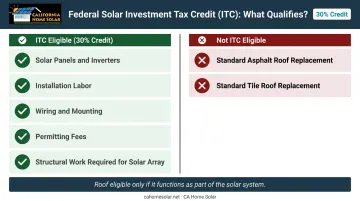
This distinction matters significantly for bundled projects — so require your contractor to separate solar-eligible costs from roof-only costs in writing before signing anything.
California SGIP Battery Rebate
The Self-Generation Incentive Program (SGIP) offers rebates for battery storage systems paired with solar. As of June 2026, the Small Residential Storage budget through SCE is currently closed — but program funding opens and closes periodically, so check selfgenca.com at the time you're ready to proceed.
Battery storage is worth serious consideration for OC homeowners, given how SCE's current net billing structure compensates exported energy.
SCE Net Billing Tariff (NEM 3)
Under NEM 3, excess solar energy exported to the grid is compensated at avoided-cost rates — generally lower than what you pay to import electricity. This makes exporting less valuable than it used to be under NEM 2. The practical implication: pairing storage with solar lets you use more of what you generate rather than exporting it at a discount.
California Property Tax Exclusion
California excludes active solar installations from property tax reassessment under its solar property tax exclusion, currently extended through the 2026–27 fiscal year. Your home's value increases with solar, but your property tax bill doesn't.
Red Flags to Watch for When Getting Quotes in Orange County
No Itemized Pricing
A legitimate quote shows separate line items for:
- Solar equipment and installation
- Roofing work
- Structural work (if applicable)
- Permit costs
- Financing or dealer fees
- The cash price of solar alone vs. the bundled price
If a contractor will only give you a single package number and won't break it down, walk away. You can't evaluate a deal you can't see.
High-Pressure Sales Tactics
Pricing transparency is just one layer of due diligence. The CSLB has specifically flagged door-to-door salespeople, misleading mailers, and high-pressure tactics as widespread in California's solar market. Watch for:
- Same-day signing pressure
- Claims that the full roof qualifies for the 30% tax credit
- No physical business address or verifiable local references
- Refusal to provide written itemization
License Verification
Once you're satisfied with the quote structure and sales approach, verify licenses before signing anything. Check your contractor's CSLB credentials:
- C-46 license for solar contractor work
- C-39 license for roofing work
Check both at CSLB's license verification page. A contractor doing bundled work should hold both, or clearly disclose which subcontractors hold the applicable licenses.
One shortcut: look for contractors enrolled in vetted programs like HERO. HERO Registered Contractors have already cleared licensing, bonding, and insurance screening, so you're not starting the verification process from scratch. California Home Solar holds HERO Registered Contractor status and carries both C-46 and C-39 licenses for bundled solar-roofing work.
When a Bundled Project Makes Sense — and When It Doesn't
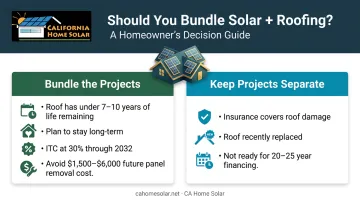
Bundle When:
- Your roof has fewer than 7–10 years of useful life remaining
- You plan to stay in the home long enough to realize energy savings
- Solar incentives are at current levels (ITC at 30% through 2032)
- You want to avoid the $1,500–$6,000 future cost of panel removal and reinstallation
Keep Projects Separate When:
- Insurance covers your roof damage. Homeowners insurance typically covers wind, hail, or fallen tree damage — but not ordinary aging. If you have a covered loss, use that payout to replace the roof first, then add solar afterward.
- Your roof was recently replaced. If there's substantial life remaining, install solar directly with no need to bundle.
- You're not ready for long-term financing. Solar loans typically run 20–25 years, which isn't the right fit for every homeowner's situation.
If You Already Have Solar and Need a New Roof
Older Orange County installations face this regularly. The process is straightforward:
- A qualified technician removes the panels
- Roof replacement is completed
- Panels are reinstalled and the system is recommissioned
Panel removal and reinstallation alone typically runs $1,500–$6,000, which is exactly why addressing the roof before installation saves money. For this process, work with your original installer or a contractor experienced in both roofing and solar — splitting the job between separate companies creates warranty and liability headaches.
Frequently Asked Questions
Can you get a free roof replacement with solar in Orange County, CA?
No upfront cost is possible through bundled financing, but the roof cost is always repaid over time through your monthly solar payment. When a roof genuinely needs replacement, the bundled approach is often the most cost-effective option for OC homeowners compared to handling each project separately.
How do I get a new roof if I have solar panels?
Panels must be removed by a qualified technician, the roof replacement is completed, then panels are reinstalled and reconnected and tested. This process typically costs $1,500–$6,000 for the panel work alone, which is why proactive bundling makes sense when a roof replacement is approaching.
Does the federal solar tax credit cover roof replacement costs?
A standard asphalt or tile roof replacement does not qualify for the 30% ITC. However, structural work specifically required to support the solar array can qualify, and integrated solar roofing products like solar shingles are an exception where the full product cost may be eligible.
What qualifications do Orange County homeowners need for a bundled project?
The roof must genuinely need replacement within a few years, and the homeowner must qualify for the chosen financing structure. PACE programs assess primarily on home equity and payment history; traditional solar loans use credit score and income. The home's roof structure must also be able to support panels.
How do I know if my roof actually needs replacement before going solar?
Get an independent inspection from a licensed roofing contractor not affiliated with your solar installer. A roof with more than 10 years of remaining life generally doesn't need replacement before solar installation, and no reputable contractor should pressure you into an unnecessary replacement.
What should I look for when choosing a bundled contractor in Orange County?
Verify active CSLB licenses for both solar (C-46) and roofing (C-39), confirm bonding and insurance, ask for verifiable local references, require itemized written quotes, and look for recognized credentials — such as HERO registration — that involve contractor vetting.